Problem-Solving Articles
Edlund No.1 can opener wear: cleaning, inspection and knife limits
Address Edlund No.1 can opener wear with its actual care areas, reversible-knife limits and parts reference, preserving the offer’s conflicting base descriptions.
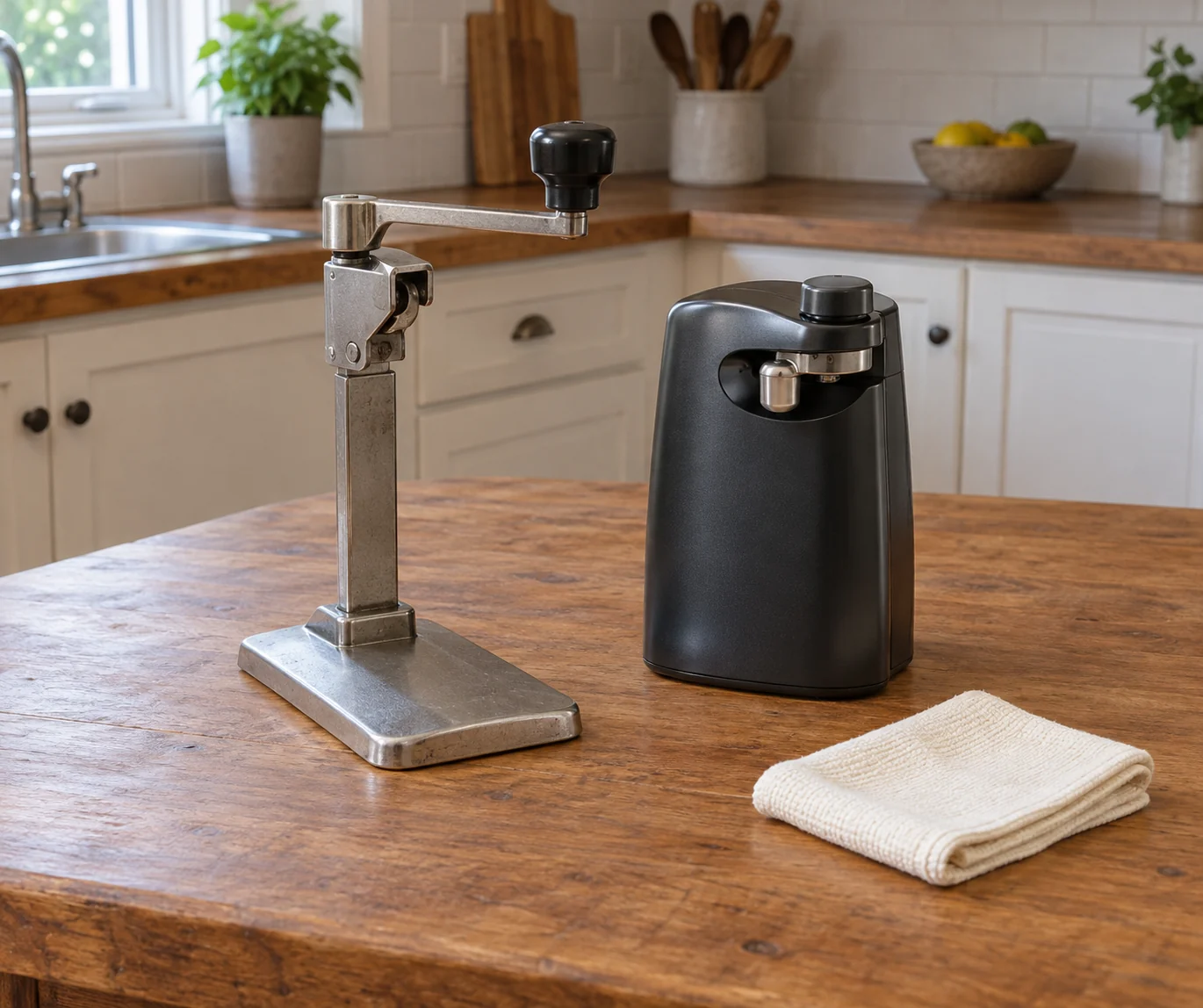
Edlund No.1 can opener wear needs to be considered separately from routine cleaning. The manufacturer's No.1 instructions call for removing food and can-opening residue, inspecting for wear and replacing worn parts. They also identify a particular knife limit: a worn knife can cause metal slivers, and the knife must never be resharpened.
If cutting quality has changed, this guide helps organize the next maintenance decision around those documented distinctions. It does not diagnose every cutting fault from its visible result. Match the actual opener to the applicable No.1 instructions before using a part number or deciding that a cleaning task resolves the problem.
Start with the actual Old Reliable No.1 offer
The Edlund manual can opener offer describes an Old Reliable No.1 table-style opener for cans up to eleven inches tall. It names a Delrin plastic spool, rust-resistant arbor, plastic bushing and replaceable base insert. These are the selected offer's component and capacity disclosures, not a diagnosis of which component has caused a particular cutting problem.
Its title calls the base stainless steel, while its native description says a plated base is included. Preserve that discrepancy when identifying the supplied equipment. The manufacturer's No.1 parts sheet distinguishes plated and stainless-steel base assemblies. Do not silently choose one of those base identities from whichever retail sentence you read first.
The eleven-inch statement concerns the listed can-height capacity. It supplies no knife condition, opening count or guarantee that every container of that height suits the opener. Retain eleven inches as the can-height statement. It cannot answer whether the knife or another part needs maintenance.
The manufacturer's actual No.1 and No.2 product page links a No.1 manual identified I021 revision C. This guide uses that No.1 document, including its cleaning instructions, wear notice and parts table. It does not transfer the different Edvantage opener's features or procedures simply because that product also uses No.1 wording.
Cleaning a manual can opener addresses named residue
For cleaning a manual can opener, the No.1 document names specific areas: the drive gear, drive-gear cavity, knife and area around the can stop. Its routine calls for removing food and can-opening residues from those areas. That is a defined cleaning task, with named components, rather than a general instruction to keep turning until the result improves.
The stated cleaning interval is daily or after each extended use. The manufacturer names its ST-93 stainless-steel cleaning brush for removing residue. It then specifies warm soapy water for the knife, gear and splash areas, says not to allow soaking, and requires thorough drying. It also gives a light non-sticking vegetable-oil coating instruction for the knife and gear when the opener is not in use.
Keep that care account with the complete applicable manual. The document has separate take-apart and assembly sections as well as the cleaning procedure. This article supplies no screw-removal or reassembly sequence. Read the complete handling and assembly instructions with the cleaning procedure.
Cleaning removes the named residues. A completed cleaning task does not, by itself, establish that all parts are unworn or that an unchanged cutting problem has been resolved. The manual separately requires inspection for wear before assembly. Keep that inspection requirement visible when deciding what work remains.
Recognizing the No.1 knife replacement limit
For recognizing the No.1 knife replacement limit, retain the manufacturer's actual wording and model scope. The No.1 notice says a worn knife can cause metal slivers, says never to resharpen it, and identifies the blade as reversible. It states that the blade should be replaced every 2,500 cans.
The replacement statement is a manufacturer maintenance instruction, not a promise that any knife will remain suitable until precisely the 2,500th opening. Nor does it establish that a knife with an unknown history is new. The same document's instruction to inspect wear and replace worn parts remains relevant to the actual condition.
Reversing a blade and resharpening a blade are different actions in this document. The take-apart account describes turning the knife to its unused cutting edge or replacing it, while the important notice expressly rejects resharpening. Do not reinterpret the reversible feature as permission to grind or hone the knife.
If the concern involves possible metal slivers, another trial opening is not evidence that the earlier concern has disappeared. This guide supplies no food-salvage procedure or way to declare affected contents suitable. Keep that concern and the equipment's condition with the responsible food-service or support process rather than treating a better-looking later cut as a complete assessment.
Record the condition without inventing its cause
Describe what was actually observed and when it occurred. A change in cutting quality, visible residue and an unknown maintenance history are different entries. Do not replace those observations with an unverified statement that the gear has failed or that the blade is definitely the only cause.
For a fictional example, an operator reports that an older No.1 no longer gives the result they previously expected. The opening count and last knife replacement are unknown. Check that opener's actual condition against its applicable maintenance guidance. It does not establish an exact remaining life or make the next opening an approved test.
A second fictional record might show that the routine cleaning task has been completed but inspection identifies a worn component. Keep both facts. The cleaning work can be complete while the replacement decision remains open. Writing only “cleaned” would conceal the separate condition that the maintenance process still needs to address.
Keep any maintenance record tied to this opener. A spare unit's known replacement history does not establish the condition of the one on the bench. Likewise, the fact that the model has replaceable parts does not identify which part the actual inspection requires. Use the documented model and observed condition together.
Use the No.1 parts table without turning it into a diagnosis
The No.1 table identifies K004SP as a packaged No.1 knife, G003SP as a packaged No.1 gear, and KT1100 as a No.1 replacement-parts kit. Keep those three part entries separate. A kit name and a single knife entry should not be treated as identical package descriptions.
The same manual uses component labels such as K004 in its take-apart account and diagram. Preserve the difference between the component label and the packaged part number in a purchase or support question. Do not drop the SP suffix from the parts-table entry and assume every seller uses the remaining characters for the same supplied package.
The table also distinguishes A930SP, the plated base assembly, from A931SP, the stainless-steel base assembly. Resolve the selected offer's conflicting base wording before identifying a base assembly. Have the supplied base established before treating a base-specific part request as settled.
These identifiers help ask a precise question about the actual No.1. They are not a complete compatibility approval for an unexamined variant or a directive to replace every listed component. This guide gives no substitution list, torque value, tool instruction or replacement sequence. Use the applicable manual and support confirmation for the actual service work.
Low-friction feature claims do not establish current knife condition
The selected Edlund description attributes reduced handle friction to its Delrin spool. It separately attributes lower turning force and easier opening to the plastic bushing, and smoother action with reduced shaft wear to the replaceable base insert. Keep those claimed functions with their named parts. They are not a report that the knife in the actual used opener is unworn, nor a substitute for the manual's condition inspection.
The rust-resistant arbor claim also belongs to that component. It does not remove the manual's washing, drying or care instructions for the opener. Preserve both accounts when planning upkeep: the supplied product describes particular materials and design features, while the applicable manual describes the recurring work and inspection. A claimed design advantage does not document that someone has completed that work on this unit.
The manual's parts table separately lists the ST-93 cleaning brush under part number 38500. That is the named cleaning tool, rather than the No.1 replacement knife or gear. If ordering supplies for a maintenance task, keep the brush, the individual wear component and any replacement kit as separate line items. The table supplies their identities; the actual condition assessment determines which service decision needs attention.
Keep the Hamilton Beach electric offer separate
The Hamilton Beach Smooth Touch countertop electric offer has a sparse native description that repeats its title, including the scissor wording. It does not identify a model number, can-height limit, knife part number or cleaning sequence. The title's Smooth Touch language is not a documented replacement for those details.
No Edlund part number, manual-cleaning method or reversible-knife instruction is transferred to that electric product. If it is the appliance with the actual cutting problem, obtain its exact identity and applicable care and troubleshooting instructions. The shared can-opener name does not establish a shared blade arrangement or service procedure.
The electric offer also cannot settle the Edlund base discrepancy. These are different supplied products with different disclosures. Keep a support request for one attached to that product, even if both were considered for the same kitchen task. A more familiar brand name does not fill the missing model information in the sparse offer.
Related kitchen-care claims need their own component scope
The actual self-cleaning appliance upkeep guide examines KFFKFF ice-maker and LG range cleaning features by the parts and owner tasks they cover. It also separates ordinary upkeep from fault diagnosis. That distinction is relevant here: a named cleaning task and a wear-replacement requirement remain separate, even when one has already been completed.
That guide's ice-maker cycle and LG EasyClean or Self-Clean accounts are not procedures for the Edlund opener. They establish no sanitizing result or cleaning-product permission here. The No.1 document remains the source for this manual opener's named care areas and wear notice.
The actual Ninja pitcher and single-serve cup guide treats its pitcher, cups, lids and blade assemblies as separate care questions. Its descriptions do not establish dishwasher compatibility or a cleaning cycle. That unresolved blender account supplies no dishwasher permission for the Edlund knife, gear or base, and the opener's care method is not transferred to those blender components.
Close the maintenance question with the actual outcome
Record whether the required cleaning and condition assessment have been completed, which model-specific replacement or support decision remains, and who will handle it. An order for a part is different from completed service. A cleaned surface is different from a resolved wear finding. Record the completed work and the remaining service separately.
For Edlund No.1 can opener wear, the source establishes distinct responsibilities: follow the applicable care instructions, inspect wear, respect the knife's replacement guidance and never resharpen it. Preserve the actual supplied base and part identity when arranging the next step. Those facts support a concrete maintenance decision without guessing a fault from a symptom or borrowing an electric opener's procedure.
Edlund No.1 can opener wear calls for model-specific care and inspection; the conceptual cover depicts generic inactive kitchen tools without an opening, repair or food-safety result.