Cooking & Food Prep
French press grounds lifters and care: Zwilling and OXO
Compare French press grounds lifters and care on OXO 11294500 and Zwilling 39500-300, with removable components and documented dishwasher permissions.
A French press can have a part that gathers spent grounds, a filter that separates from its assembly, or a dishwasher permission covering named components. Those are different disclosures. For French press grounds lifters and care, the useful purchase question is which parts you will handle after serving coffee and which instructions apply to them. OXO names a grounds lifter and a removable glass carafe. Zwilling supplies a linked manual with an inventory and explicit care guidance for its Sorrento Plus press.
The Zwilling 39500-300 Sorrento Plus offer identifies a Clear 27-oz French press with a double-wall borosilicate glass carafe. The OXO 11294500 French press offer identifies a Silver 8 CUP item with a stainless steel housing and glass carafe. Both are actual Kitchen Appliances offers. Keep those identities with any request about parts, care or the delivered package; a similar press from either brand may have different instructions.
French press removable parts begin with an inventory
For French press removable parts, OXO identifies a stainless steel and silicone grounds lifter. It describes that component as allowing one-step cleaning. This is a claim about a named part, without a timed cleanup comparison or a complete removal procedure in the description. A buyer can investigate the lifter's actual shape and instructions before choosing the press. The phrase does not document how every other piece is washed, dried or returned to the assembly.
OXO separately says the glass carafe lifts out of its stainless steel housing and the filter comes apart for cleaning. The carafe and filter have their own access descriptions. List both alongside the lifter when checking the parts you will receive. A removable carafe is not the same object as the grounds lifter, and a filter that comes apart does not establish how many loose pieces will be handled. Request the supplied inventory and exact instructions for model 11294500.
Zwilling's linked Sorrento Plus manual identifies a unit comprising the lid, filter rod, filter unit and handle, alongside a glass carafe. Its unpacking section directs the reader to check completeness and condition. Missing or defective parts require contacting the vendor, and the manual says not to use the press in that state. That inventory gives a concrete way to identify what belongs to the delivered press before interpreting a care claim.
The native Zwilling description names an 18/10 stainless steel knob, lid and filter. Its material list and the manual's assembly inventory answer different questions. One identifies materials on specified parts; the other identifies the components supplied together. Neither gives an interchangeable replacement specification for an OXO part. A familiar-looking filter or knob needs the correct compatible identity before it can be treated as a spare for the selected press.
French press dishwasher permissions need their own evidence
For French press dishwasher permissions, Zwilling's product description says dishwasher safe. The linked manual's cleaning section is more specific: it permits careful washing by hand or in the dishwasher and states that all parts are dishwasher safe. This is evidence for the press addressed by that manual. Preserve the product-page link to the document and the model identity when keeping the care record, especially if someone else will wash the press.
OXO's current description explains access to the grounds lifter, carafe and filter without providing a dishwasher-permission statement. Do not fill that gap with Zwilling's permission or a rule remembered from another OXO appliance. Ask for the actual instructions covering the supplied components. The stainless steel, silicone and glass material names identify construction; they do not independently authorize one washing method for the complete assembly.
The actual Buyfun French press component guide separates removable-filter inventory from dishwasher permission for the vessel, lid, plunger and filter. That is directly useful here because OXO gives access details while Zwilling has explicit manual guidance. Buyfun's glass and steel presses remain their own products. Use the new models' own instructions for removal and care; Buyfun's capacities and mesh descriptions belong to those older presses.
Someone choosing a press for a shared kitchen should keep the actual care instructions accessible to the people who clean it. The person who removes the components may hand them to someone else for washing. The supplied document should make the part identities and permitted method clear enough for that handoff. Before buying, identify which parts the selected package contains and obtain its care record; do not assume that every removable piece can be handled identically.
Read Zwilling's cleaning access with its restrictions
The Zwilling manual identifies the lid as a removable part of the filter-rod assembly for easier cleaning. Its complete instructions document the lid, rod and handle relationship. This establishes an assembly relationship in Zwilling's documented press. It does not show that OXO's plunger has the same attachment or that the grounds lifter replaces any of these parts. Keep this explanation with the correct press and its complete instructions.
The same cleaning section requires cleaning immediately after use and excludes hard cleaning utensils and strong cleaning agents. Read the complete manual for its component-specific cleaning method. Its safety section specifies wooden or plastic spoons for filling and stirring because metal spoons can scratch or damage the glass. Read these restrictions together with the cleaning account. A dishwasher permission does not cancel the document's warnings about unsuitable tools or handling.
The manual also excludes corrosive cleaners, wire brushes, scouring pads, metallic objects and sharp objects when cleaning the press. These are specific restrictions from the applicable document, rather than a general recipe for every glass coffee vessel. A buyer who intends to use an existing cleaning tool should compare it with this guidance before including it in the routine. OXO needs its own equivalent answer; copying Zwilling's document would leave OXO's actual permission unverified.
There is no matched cleanup test between these selected presses. OXO's one-step claim and Zwilling's documented access describe different pieces of information. Neither proves a shorter total cleanup time, fewer lost parts or greater durability under repeated washing. Choose which component arrangements to investigate according to who will care for the press and what instructions can be obtained. Ask for the actual component instructions so everyone using the press can follow the same documented care.
Keep the volume labels separate from the care decision
Zwilling's offer names 27 oz, while the linked manual identifies a 750 ml glass carafe. Keep both statements with their sources. They are not silently reconciled here into one verified equivalent capacity or a promised brewing fill quantity. The manufacturer product page also identifies the same 39500-300 item, but a document's vessel size still does not establish how many of a reader's mugs will be filled after grounds and the filter assembly are involved.
OXO gives an 8 CUP label without defining that cup unit in the product description. Do not convert it to a household mug count or claim that this press supplies more finished coffee than Zwilling. If batch quantity matters, obtain the selected press's permitted working quantity and compare it with the vessels you actually use. The grounds lifter and removable carafe answer access questions, while the capacity label requires its own interpretation.
Care access can affect the parts you keep track of without resolving volume. A removable carafe might be a purchase requirement for someone who wants a separately handled vessel, but its removability supplies no additional capacity figure. Likewise, Zwilling's lid and filter-rod relationship does not identify an operating fill line. Record the parts and nominal volumes alongside the manufacturer's working limits. Each answers a different question about the selected press.
Material and warmth claims stay with the named vessel
Zwilling describes handmade, mouth-blown double-wall borosilicate glass. Its description claims that the glass keeps coffee hot while remaining cool to the touch and that the press retains coffee's essential oils. These are product-description claims. They do not supply a common temperature curve, a surface-temperature test or a matched flavor comparison with OXO. The double-wall construction can be investigated as a feature without declaring a heat-retention or coffee-quality winner.
OXO describes heat-resistant tempered borosilicate glass and says its stainless steel housing and glass carafe keep coffee warm during brewing and serving. It also names soft, nonslip grips on the handle and plunger. Those statements belong to this model's description. They do not establish a safe contact temperature for every use or a pouring method. A soft grip and a warmth claim are features to read alongside the actual operating guidance.
Neither description provides a complete impact-resistance comparison or a prediction of service life. Zwilling's manual instructs the reader to check for damage before each use and never use a damaged press. That requirement is useful when deciding whether the document fits the people who will handle the vessel. A material's name cannot replace an inspection instruction or prove that the press will survive a particular fall, packing arrangement or accidental knock.
Use the documented press within its intended scope
Zwilling's manual defines the intended use as preparing coffee in normal household quantities with coffee powder and hot water. Its product description mentions hot or cold press coffee, but the checked manual does not provide a separate cold-preparation method. Keep that difference visible rather than extending the hot-water instructions into a new cold-brewing recipe. A reader considering another use needs the manufacturer's applicable answer for the exact product.
The manual specifies a dry, level, nonslip surface and says never to put the press on hot surfaces. It also instructs readers to keep children away from the press and hot water. These requirements explain why the press needs an appropriate preparation place even though it is manual. They do not certify an OXO placement arrangement or make the press suitable for every surface where a mug normally sits.
Zwilling's document says to clean after each use and after a prolonged period without use, then keep the press in a dry, childproof place. The cleaning section connects maintenance with the condition of the supplied components. Before selecting the press, consider whether its documented storage and care requirements can be followed where it will be kept. The statement gives no permission for storing the assembled press while wet or leaving it in another unapproved condition.
Grinder-method support does not supply a filter setting
The Zwilling manual calls for coarsely ground coffee and warns that coffee ground too finely can clog the filter. It gives a grind-texture requirement for this press without specifying a numeric position on a household's grinder. The actual KitchenAid and Eureka brew-method guide explicitly identifies French press support within KitchenAid's described brew range. It helps investigate whether another part of the coffee equipment supports the intended method.
That grinder guide provides no tested setting for Zwilling 39500-300 or OXO 11294500. Its KitchenAid setting count and Eureka's stepless adjustment cannot be translated into a shared filter specification. Keep the press's requirement with the actual grinder and its own instructions. OXO's short access description likewise gives no complete grind recommendation. Obtain that model's guidance before treating the new grounds lifter as permission for any grind texture.
Keep care and order evidence through crypto checkout
Before choosing crypto for this French press, settle which carafe and removable components the order supplies. Check whether USDT is offered for that purchase at republeq.com and use the checkout's stated asset, network and receiving details. A payment option remembered from another order does not identify this transaction. Save its confirmation together with the press model and the seller's answers about care. The site's policy makes cryptocurrency purchases final for refund purposes. Those orders cannot be returned for a refund, so an unresolved dishwasher permission should be investigated before payment. An exchange is governed by different conditions and is subject to the available product. The request has to be made within thirty days from the original purchase date. Eligibility requires an unused, unwashed item in its original condition, with the original packaging and supplied accessories, manuals and tags included. Retain the proof of payment; the policy names a transaction hash, receipt or order confirmation as examples. Contact support with the order details and await authorization and instructions before shipping an exchange. Cleaning a delivered press to try its advertised access can conflict with the unused and unwashed exchange condition. Keep that condition in mind while inspecting the package. A defective item, damage during shipping or an incorrectly shipped item has a separate reporting deadline: notify support within seven days of delivery. For those circumstances, the company may choose to offer replacement or exchange, including on cryptocurrency orders. That remedy is discretionary. A transfer record cannot establish compatibility for a replacement filter or prove which care instructions cover an unexpected component. Keep photographs of the received parts, the order identity and correspondence with the transaction evidence. Crypto checkout changes the payment record and applicable refund restriction; it does not supply a manufacturer permission to wash, dismantle or use the press.
Choose the care arrangement you can verify
For French press grounds lifters and care, investigate OXO's named lifter, removable carafe and filter access when those parts answer your household's cleanup requirement. Keep Zwilling under consideration when its assembly inventory and documented care permissions fit the intended routine. Confirm the exact delivered components and any unresolved model-specific instruction before ordering. Retain the separate volume statements and the complete care record with the selected press.
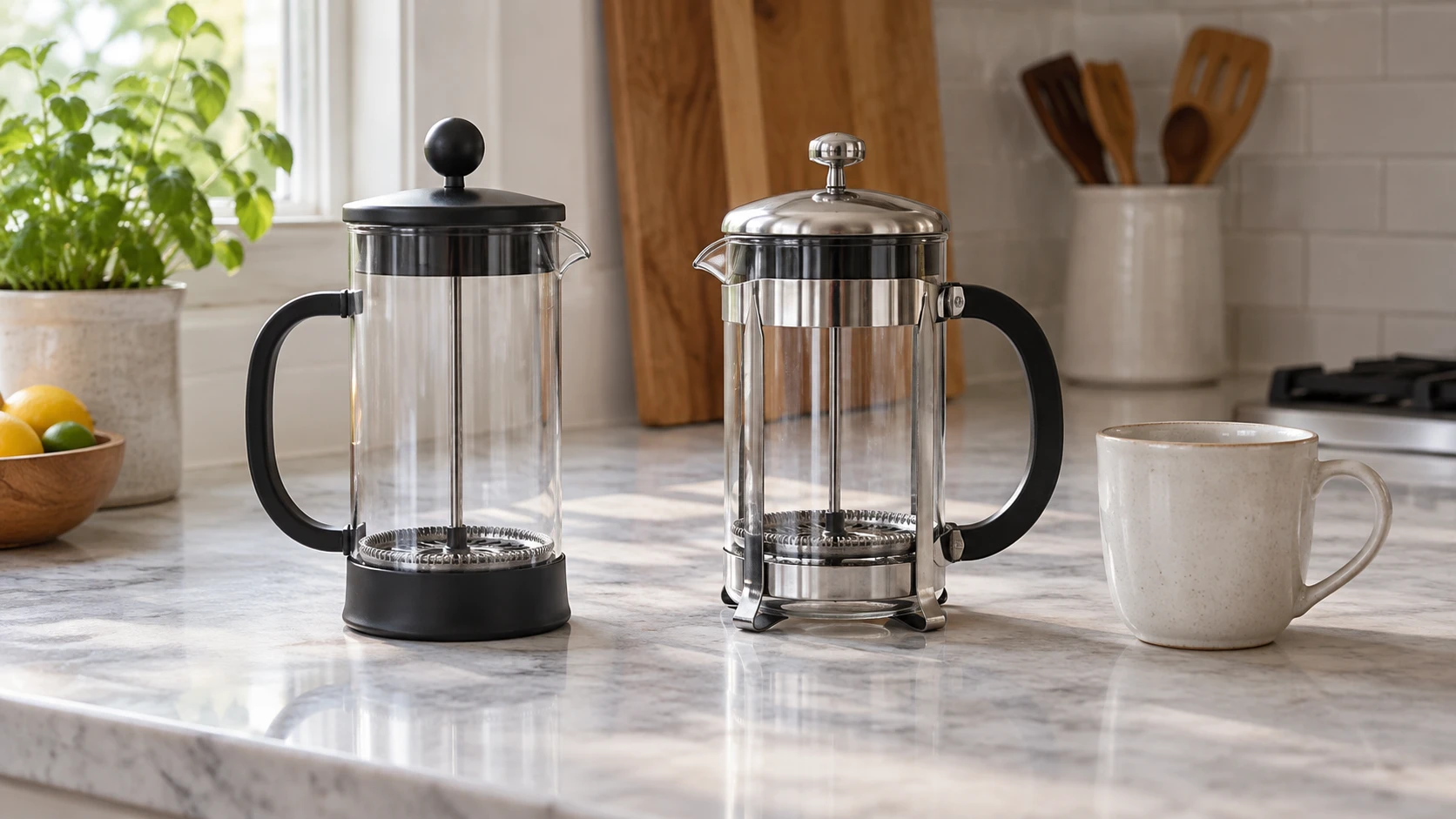
Conceptual editorial cover for French press grounds lifters and care: two complete generic empty glass coffee presses beside an empty cup on a kitchen counter, not exact retail models, supplied components or an approved cleaning arrangement.