Lighting
Window candle remote stops responding: first checks
Separate a dark candle, an unresponsive remote and timer behavior with safe external checks.
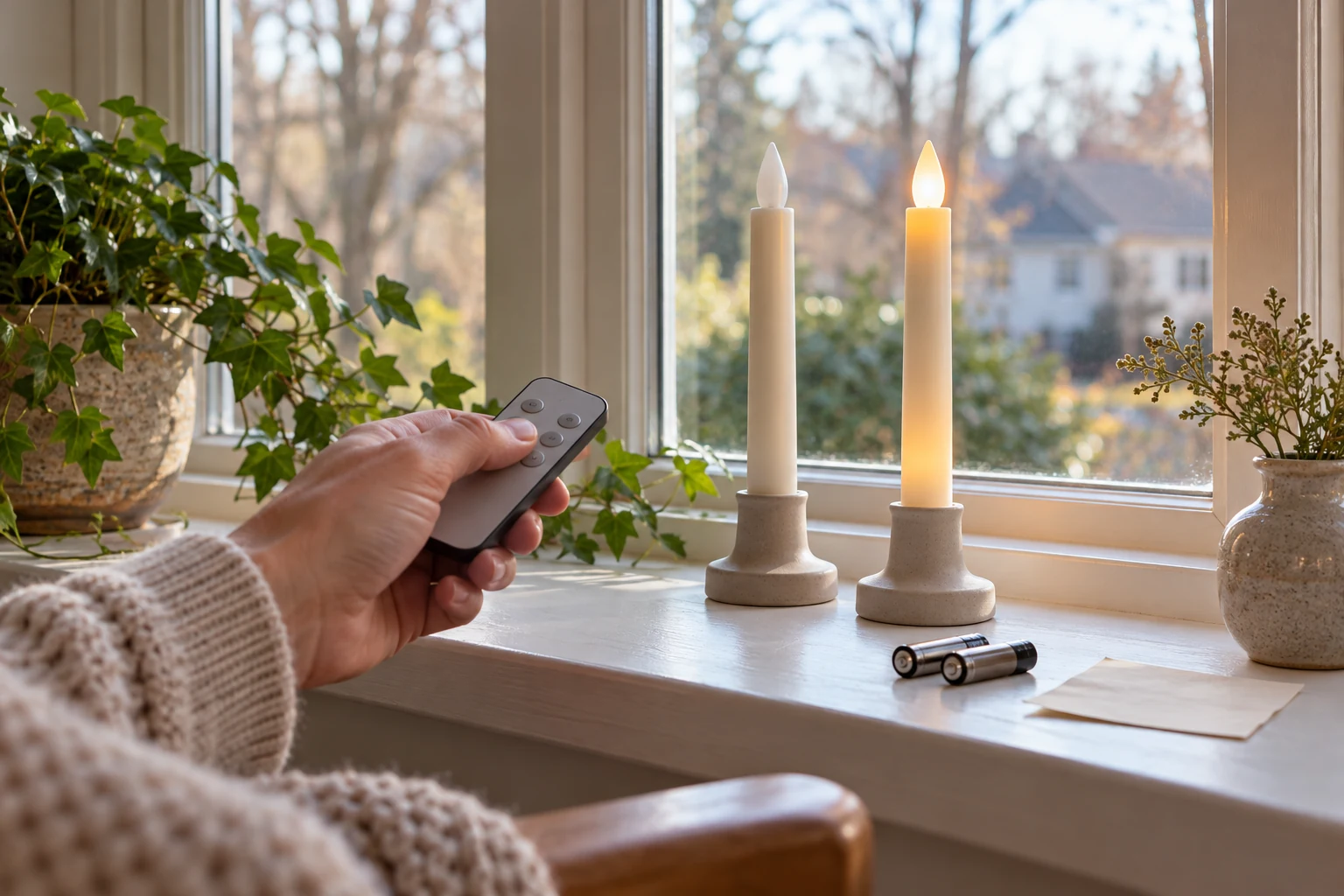
When a window candle remote stops responding, the first question is whether the candle itself can still turn on. A remote, a timer setting and a battery compartment can all produce a dark window, but they call for different next steps. Work from the visible controls and the exact product instructions. Do not open a sealed candle or improvise an electrical repair. This sequence helps you describe the symptom accurately before deciding whether to replace batteries, reset a setting, contact the seller or stop using a damaged item.
Identify what has actually stopped
Start with one candle in a well-lit room. Note whether it is completely dark, stays on but ignores remote commands, turns off at a repeatable time, or responds only when the remote is close. Those are different observations. Check whether the other candles in the same set behave the same way. If one candle fails while the others answer the same remote, focus on that candle's accessible controls and batteries. If every candle ignores one remote, the remote or its operating conditions deserve attention.
Some flameless window candles have a switch or button on the candle as well as remote control. One current Republeq ten-pack window candle listing specifically says to insert batteries and press a switch on the bottom before using the remote. That is a product-specific instruction, not a rule for every candle. Find the actual switch on your model and check its manual rather than assuming a remote can turn a candle on from every physical switch position.
Record the model, the number of candles affected and the last working behavior. Keep the box or manual if it is available. A shared household can also use the remote-control storage guide to keep several similar remotes from being mixed up. The present article deals with the candle's response, not a whole-home storage system.
Check the candle's accessible power path
Turn the candle off as its instructions direct before inspecting its battery compartment. Look for the stated battery type and polarity marks inside the accessible holder. Do not infer battery size from a neighboring decoration. A second current ten-piece remote window candle listing says its candles use two AAA batteries each. The other listing describes battery operation but should be checked at its own exact option and manual. These listings illustrate why the model's stated requirements matter more than a generic tip.
Check that each cell is seated in the direction shown by the marks and that the compartment closes normally. If a battery is leaking, swollen, unusually hot or stuck, stop handling the candle as a routine reset. Follow the battery and product maker's safety directions for that condition. Do not scrape contacts with a tool or force a damaged compartment shut. An undamaged, accessible compartment with incorrectly seated cells is a different situation from visible damage.
If the model allows user replacement, use the specified type and follow its instructions for replacing the full set of cells in one candle. Mixing old and new cells can make the result hard to interpret and may conflict with battery-maker guidance. Keep spent cells out of reach of children and pets and use your local collection route. The goal is a clean, model-compliant power check, not a series of random batteries tried in a suspect holder.
After the compartment is closed, use the candle's own control once. If it lights, you have established that at least its basic power and light path can operate. If it still does not light, the remote may not be the immediate cause. The public desk-lamp external-check guide covers a different lamp and power arrangement; its useful shared principle is to identify the accessible power path before blaming the light source. Do not transfer its electrical steps to a battery candle.
Check the remote as a separate control
Confirm that the remote belongs to this candle set. Similar little remotes can have matching-looking buttons while using different control schemes. If the manual names a removable battery tab for a new remote, check whether it has been removed. If the remote has a user-accessible battery compartment, inspect the specified cell and polarity under its instructions. A remote battery and the batteries in ten candles are separate supplies; replacing one does not prove anything about the other.
Use one known responsive candle for the remote check when possible. Stand within the range stated by the product, point the remote as directed and press a simple on/off command once. Move obvious objects out of the line between remote and candle if the design uses a direct signal path. Do not assume every remote uses the same technology or needs a visible line of sight. If the manual names a pairing, channel or group procedure, follow that exact procedure once. An unrelated remote's pairing steps do not apply.
The ten-pack listing that describes the bottom switch also says it includes two remotes. If your exact delivered option includes two, compare their behavior on the same candle without changing several other variables at once. If one remote works and the other does not, that is useful evidence for the seller. It is not proof of which internal component failed. If neither works but the candle's own switch does, record that narrower symptom before asking for support.
Do not use a phone-camera test as a universal remote verdict. A camera may show emissions from some infrared remotes, but camera filters, control technology and the way the remote is aimed can all change what you see. The product manual and a response from a known compatible candle are more meaningful than a generic online trick. Keep any test noninvasive and within the operating directions.
Rule out a timer or mode misunderstanding
A candle that turns off after a set interval may be following a timer, not losing power. Both current product pages describe remote timer choices of two, four, six and eight hours. One also lists brightness settings and static or flickering modes. These are seller descriptions for those specific products. Check the actual button labels and manual on the delivered set; a different model may use a different sequence or may repeat a timer cycle at the same time on following days.
Try the simplest documented steady-on mode during a short observation period, then note whether the candle stays on and answers an on/off command. If a candle only goes dark at a predictable time, write down the time and prior timer selection. If it changes from bright to dim, distinguish brightness or flicker behavior from a complete failure. Do not repeatedly press every button in quick succession and then infer a defect from an unknown state.
For a multi-candle window display, test one candle and one remote in a controlled spot before restoring the whole arrangement. A row of ten candles makes it easy to miss which candle answered or which one has a different setting. A simple note such as “left candle lights from bottom switch, does not answer either remote” is much more useful than “the set is broken.” Return the other candles only after the first result is clear.
Where several people use the display, ask whether someone selected a timer or turned individual candles off at their bases. That is not an accusation; it is a way to recover the last known operating state. Write down one clear starting condition before testing: which candles are physically switched on, which remote is in hand, and which mode was last selected. If the product manual says a timer resumes at a daily interval, compare the observed off time with that description. Do not leave an uncertain candle running overnight just to collect a longer test. A short, attended check is enough to determine whether the basic controls answer; the documented timer behavior can be checked against the manual.
Separate placement trouble from device trouble
A candle mounted in a deep window recess, behind a curtain or next to reflective objects may be harder to observe or reach. Move it only as the holder instructions allow, and keep it on a stable surface while testing. Do not pull a suction cup or stand loose just to aim the remote. One current listing includes holders and suction cups, but their included parts do not establish safe placement for every window. The surface, temperature and household traffic still matter.
If the candle responds on a table but not in its usual spot, record the position, distance and obstruction. The pattern may help you use the device within its stated range or ask the manufacturer about its control method. It does not justify modifying the candle or moving it into a place where it can fall. If it fails in both locations with the same controls, placement is less likely to explain the observation.
Keep candles and loose batteries away from children and pets while testing. A small battery or removable compartment cover is a separate household hazard from a nonresponsive decoration. Follow the maker's placement and care instructions, especially for a window that gets direct sun or moisture. Flameless means there is no burning wick; it does not mean every location or damaged battery is safe.
Know when to stop and report the symptom
Stop using a candle with heat, leakage, corrosion, cracked housing, exposed wires or a damaged battery holder. Do not bridge contacts, tape loose cells in place or open a sealed light unit. If a new, correctly installed set of specified batteries and the documented physical switch cannot make one candle light, contact the seller or manufacturer with the exact model and symptom. Their manual may include a model-specific reset or warranty path. Do not assume a repair step found for another decorative light fits this one.
For support, send a short sequence of facts: the product and selected option, whether the candle lights from its own switch, whether other candles answer the remote, what battery type the manual names, whether a timer was selected, and whether the problem follows one candle or one remote. Include photographs of the undamaged external controls if useful, but do not publish private order information. This lets support distinguish a power, control or mode issue without guessing.
The practical endpoint is a narrower diagnosis, not a promise that every candle can be restored at home. A candle that lights locally but ignores one remote has a different path from a candle that will not light at all. A candle that switches off after a chosen timer has a different path again. Work through those observations once, preserve the result and let the exact product instructions determine the next safe action.