Crypto Commerce
Whynter BSR-046DW dual-zone wine refrigerator vs Yeego YEG-WF24: bottles or bottles and cans?
Compare Whynter BSR-046DW dual-zone wine refrigerator by shelf layout, temperature controls, door access, and under-counter fit.
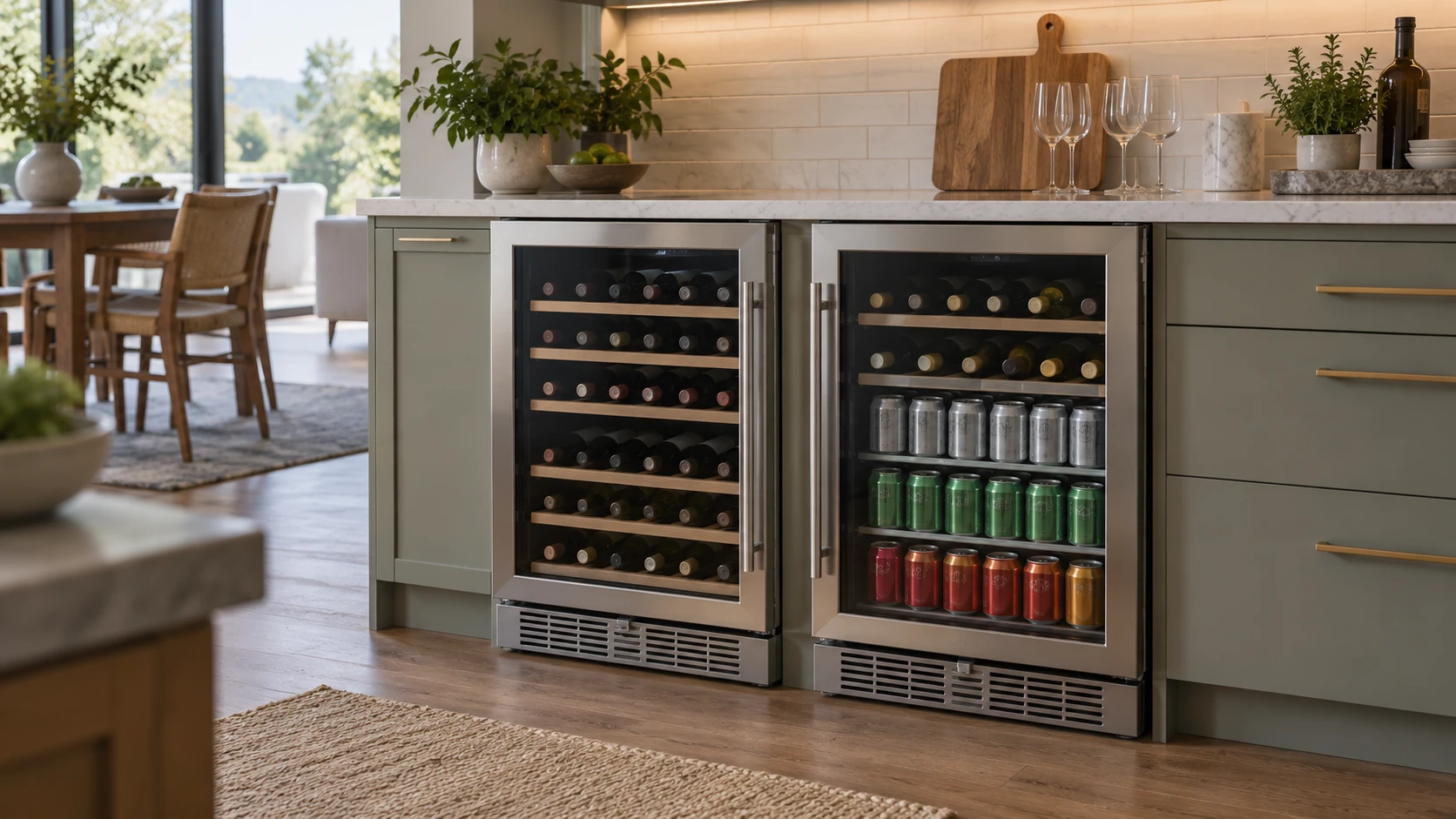
The Whynter BSR-046DW dual-zone wine refrigerator is described as holding up to 46 standard wine bottles, divided between two wine zones. Yeego's YEG-WF24 divides its cabinet between 20 Bordeaux bottles and 60 standard cans. Both are called 24-inch units and can be considered for under-counter placement, but the choice is more basic than a temperature button: is the available space mainly for wine, or should it free refrigerator shelves for other drinks too?
The saved product rows are Republeq's product descriptions, not independent capacity or temperature tests. Whynter gives a bottle count and zone split but no complete exterior dimensions in the saved text. Yeego gives labeled dimensions and separate bottle and can shelves. Check the current manuals and installation drawings before changing cabinetry. Nominal width and marketing bottle counts cannot establish that the real collection or the actual counter opening will fit.
Count the containers in the house — Yeego YEG-WF24 wine and beverage refrigerator
Whynter lists capacity for 46 standard 750-milliliter bottles in 5.65 cubic feet, with 16 in an upper zone and 30 in a lower zone. The row mentions Bordeaux bottles and taller Champagne formats. That does not promise the full 46-bottle count when every bottle has a wider shoulder or different length. Lay out a sample of the bottles actually kept and check Republeq's product page for shelf dimensions and a loading diagram. A theoretical maximum matters less than the number that fits without forcing a shelf closed.
Yeego describes a wine side for 20 Bordeaux bottles and a beverage side for 60 standard 12-ounce cans. It lists six removable wooden shelves on the wine side and three removable metal-wire shelves for beverages. If the household buys tall cans or bottled drinks, the stated 60-can count may change. A removable shelf offers flexibility, but taking one out also reduces the number of levels available. Estimate a normal week's stock of bottles, cans, and unusual containers before deciding how much each side is worth.
The published guide on bottle-and-can cooler layouts compares other products. Its method of counting the shapes you own is useful here, while its model-specific capacities are not. Map the Whynter's two wine zones and the Yeego's separate beverage compartment against what you expect to store. A cabinet that dedicates half its front to cans can be a poor fit for an all-wine collection even if its exterior looks similar.
Think about changes over time. A wine collection may grow, while a household that hosts often may need extra cold cans on weekends. Whynter's larger wine allocation leaves little evidence of dedicated can storage in its saved row. Yeego's split layout fixes a different balance. If the balance changes seasonally, ask how far shelves can be rearranged before assuming either unit can become a completely different type of cooler.
The shape of a bottle matters even within a single wine style. A broad Burgundy bottle, a sparkling-wine bottle, and a standard Bordeaux bottle can occupy different shelf space. Make a quick count of the most common shapes in the collection and ask the retailer to show how they load. If the household keeps several bottles upright after opening, check whether either cabinet permits that position without sacrificing multiple shelves. The saved rows give advertised counts, not a diagram for every mix of shapes.
Use the zones for the drinks they serve — Yeego YEG-WF24 wine and beverage refrigerator
Whynter describes a temperature range of 40 to 65 degrees Fahrenheit, with the upper zone preset cooler than the lower one. That can be useful for two groups of wine kept at different serving temperatures. Its row says fans circulate air and dual probes monitor cooling. Those are design claims, not a measured temperature map with a full cabinet of bottles. Ask whether each zone has an independently adjustable range and how the control displays actual versus set temperature.
The Yeego YEG-WF24 wine and beverage refrigerator row says each side has independent controls across 36 to 72 degrees Fahrenheit, with Fahrenheit or Celsius display. That broader stated range may make sense when one side holds cans and the other holds wine. It also makes the exact settings important: wine kept for serving and cans intended to be cold may call for different targets. Check the manual's allowed ranges for each side rather than assuming every number applies identically to both compartments.
Both descriptions mention memory after a power interruption. Whynter says its settings are restored, and Yeego describes power-off memory. That is convenient, but neither row tells us how long the interior stays at its target temperature during an outage. If the cabinet holds valuable bottles, a separate thermometer or monitoring plan may be useful. Do not treat saved settings as proof the drinks remained at the intended temperature while the power was out.
Yeego claims control within one degree and describes dual-circulation fans. Whynter claims close temperature uniformity within its cabinet. The saved rows do not show a common test method, load, or door-opening schedule. Compare the controls and ask for current specifications, but avoid ranking the machines from unlike marketing statements. A thermometer placed in a loaded cabinet after installation can tell the owner more about the actual location and settings.
Measure the under-counter space — Yeego YEG-WF24 wine and beverage refrigerator
Yeego gives exterior dimensions of 23.4 inches wide, 22.4 inches deep, and 34 inches high. Its row describes a front grille and says the unit can be built in, placed under a counter, or used freestanding. Confirm the required side, rear, and top clearances in the current installation guide. A front grille does not by itself prove that every tight enclosure is permitted. Check the door-open depth and whether a neighboring cabinet handle blocks a shelf from sliding out.
Whynter says its 24-inch cabinet can be installed under a counter or freestanding, but the saved description does not give a full width-depth-height set. Obtain its drawing before treating 24 inches as the exact cutout width. Measure the height under the counter at the lowest point, including flooring, trim, and any lip at the opening. A few millimeters can determine whether the appliance slides in or requires cabinet work.
Both units have glass doors, according to the rows. Whynter lists a dual-pane, UV-blocking tempered-glass door with a reversible stainless-steel frame, while Yeego describes double-layer glass with a UV-blocking black insulation layer and a stainless frame. Confirm whether the Yeego door is reversible; its saved row does not say so. Door swing matters especially near an island or when the cooler sits at the end of a run of cabinets. The shelves must clear the open door to be usable.
The floor and outlet deserve attention too. A filled wine cooler is not a small object to slide around casually. Verify the permitted electrical connection and leveling method in each manual. Yeego's row instructs the buyer to let the unit stand upright for 24 to 36 hours before first use. Ask the delivery team to preserve that requirement and document when the appliance was positioned. Whynter's saved row gives no corresponding wait time, so follow its own manual rather than borrowing Yeego's instruction.
Think about who will service the unit once it is surrounded by cabinetry. Keep access to the plug and any required ventilation openings, and ask how it can be pulled forward without damaging the floor. The saved Republeq catalog records do not state service-clearance dimensions. A beautiful tight fit may make a simple cleaning or repair difficult. Include removable shelves, door glass, and the space needed to swing the door fully in the installation plan, rather than measuring only the appliance body.
Compare daily access and upkeep — bottle-and-can cooler layouts
Whynter describes five adjustable, spill-resistant beechwood shelves, a safety lock, three-color LED lighting, vibration dampening, and a fingerprint-resistant door. Those features may matter to someone storing wine as a collection. The lock could be useful in a shared space, while adjustable shelves help with unusual bottles. Ask whether shelves must be removed to fit the taller Champagne formats the row mentions; the saved description does not explain how the maximum bottle count changes.
Yeego describes wooden shelves on the wine side, wire shelves on the can side, blue LED lighting, anti-vibration design, and activated-carbon purification. It claims a 41-to-43-decibel operating range. Whynter's saved row has no matching noise number, so that single figure cannot settle which unit would be quieter in a living area. Check the actual installation and room acoustics if compressor sound could be noticeable near seating.
The glass and finish should be cleaned according to each manual. Fingerprint resistance is a finish claim, not a guarantee that the door never needs wiping. Check how to remove shelves and whether spilled wine or a leaking can can be reached at the bottom of the cabinet. A cooler that is easy to arrange at first but awkward to clean after a spill may not suit a busy beverage area.
Whynter is the stronger candidate to investigate when the goal is a larger wine-only collection with two serving zones and a lock. Yeego suits a household that wants a documented split between wine and cans in one under-counter cabinet. Verify the real bottle shapes, door and shelf clearance, approved installation, and current temperature-control behavior before choosing from nominal capacities alone.