Crypto Commerce
TABU wine cooler vs Towallmark: bottle and can layout
The TABU wine cooler description gives a clearer starting point for a mixed wine-and-can arrangement: it assigns 21 bottles of 750 ml wine to the left zone and 88 cans of 330 ml drinks to the right. Towallmark advertises 33 bottles and 96 cans, but its description leaves the simultaneous loading arrangement less clear. For a buyer choosing between them, the immediate decision is whether TABU's stated split suits the drinks being stored or whether Towallmark's larger advertised counts warrant investigating its shelf layout.
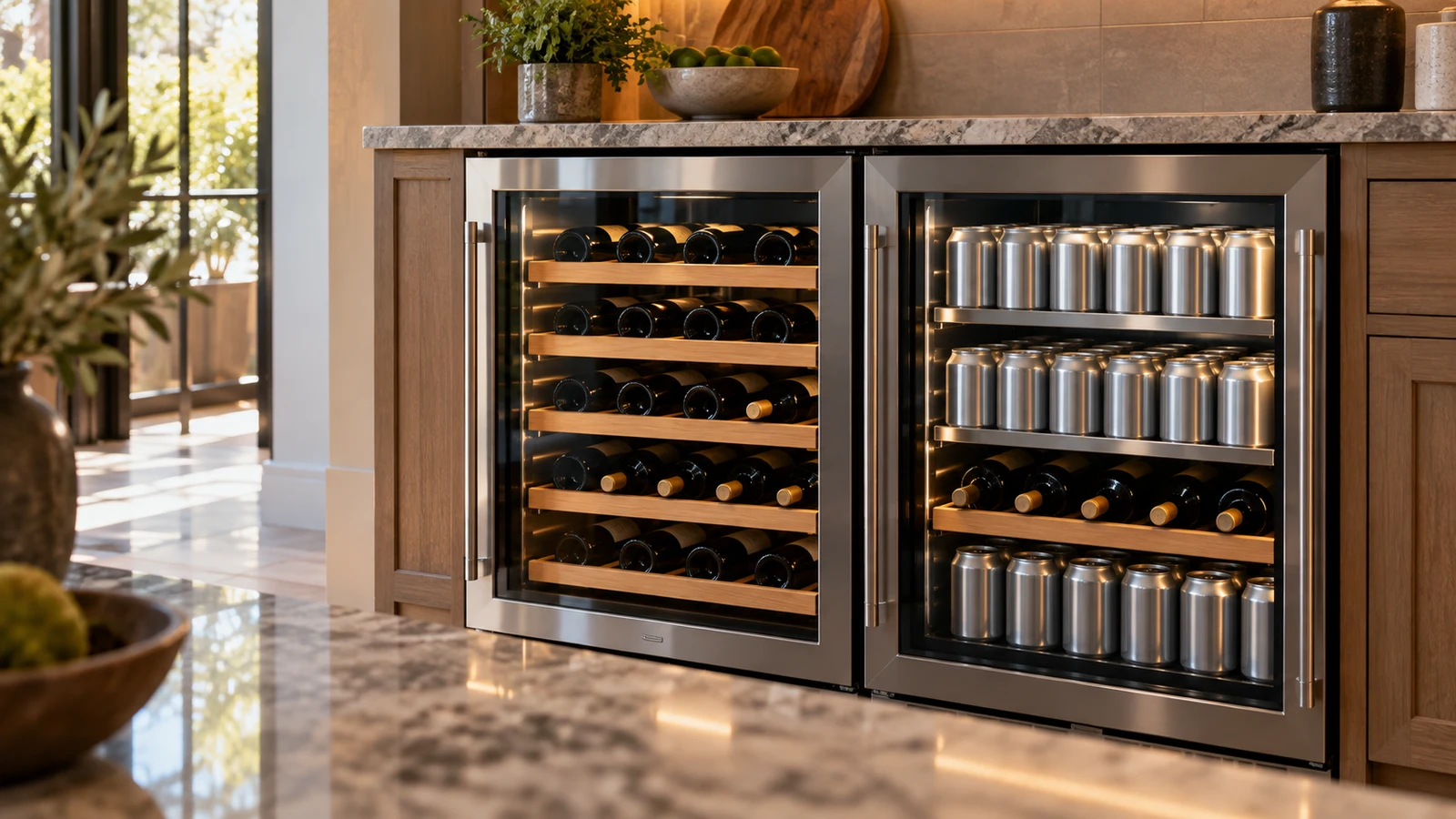
The TABU wine cooler description gives a clearer starting point for a mixed wine-and-can arrangement: it assigns 21 bottles of 750 ml wine to the left zone and 88 cans of 330 ml drinks to the right. Towallmark advertises 33 bottles and 96 cans, but its description leaves the simultaneous loading arrangement less clear. For a buyer choosing between them, the immediate decision is whether TABU's stated split suits the drinks being stored or whether Towallmark's larger advertised counts warrant investigating its shelf layout.
Cabinet width also separates these products. TABU lists a width of 23.4 inches, while Towallmark lists 30.5 inches. Those are exterior dimensions, not installation opening requirements or measurements of usable shelf space. Neither description establishes how your particular assortment will fit. Use the listed counts to shortlist a cabinet, then connect each count to the container size, shelf arrangement and zone where it belongs.
Compare Refrigerator Compartment Capacity Beyond The Total: Read The Two Layouts
The TABU wine cooler product description explicitly separates wine bottles from drink cans by side. That makes it possible to compare your intended wine stock against the left-zone claim and your intended canned drinks against the right-zone claim. Keep those comparisons separate. A bottle position and a can position describe different containers, and adding them together would obscure the allocation that makes this listing useful.
TABU also specifies the container volumes behind its counts: 750 ml for wine bottles and 330 ml for cans. Those details give you a starting reference, although volume alone does not establish a container's outside shape. If your usual drinks come in different formats, ask about those formats directly. The description does not provide bottle diameter limits, can height limits or a shelf-by-shelf loading diagram from which to confirm a different assortment.
Towallmark's capacity heading advertises 33 bottles and 96 cans. Its following sentence uses slash-separated wording and describes storage “at one time,” without explaining where each type goes. That wording needs clarification before you assume the cabinet accommodates both advertised quantities simultaneously. It does not supply the same explicit left-side wine and right-side can assignment found in TABU's description. Preserve that distinction when comparing the products instead of turning the Towallmark figures into a confirmed mixed-load plan.
The Towallmark description separately identifies an upper temperature zone and a lower temperature zone. It does not clearly connect the advertised bottle and can quantities to those zones. A useful seller question would be: “Can this exact model hold the advertised wine bottles and cans together, and which shelves and zones hold each?” Ask for an answer tied to the product you intend to order, since a general brand answer would leave the arrangement unresolved.
For broader reading, Compare refrigerator compartment capacity beyond the total addresses the related capacity question. In this comparison, the immediate issue is narrower: TABU supplies a named side for each container type, while Towallmark requires clarification of how its advertised counts share the cabinet. That difference affects how confidently you can plan a mixed load from the descriptions alone. It does not establish that either appliance has better cooling performance or more usable storage for your drinks.
Compare Refrigerator Compartment Capacity Beyond The Total: Assign Your Actual Drinks
Write down the drinks you want chilled at the same time, including their package sizes. Keep a separate entry for anything that differs from the container references in the description. For example, a household buying both regular wine bottles and unusually broad bottles should identify those groups separately. This gives the seller a concrete fit question and prevents an advertised bottle count from becoming an assumption about every bottle in the collection.
For a can-heavy selection, begin with TABU's right-zone reference of 88 cans of 330 ml drinks. Compare that reference with the packaging you actually buy. If your stock includes taller cans or bottled soft drinks, ask whether those containers fit in the intended arrangement and what capacity applies to them. Do not assume unused wine space can accept the overflow; the supplied description does not explain alternative loading configurations or whether the two sides can exchange roles.
For a wine-heavy selection, Towallmark's advertised 33-bottle count is a reason to examine it further. The description lists removable wooden shelves, which gives you a specific feature to ask about when discussing bottle shape. It does not say how many bottles remain accommodated after a shelf is removed or repositioned. Ask which arrangement supports the advertised count and whether your wider or taller bottles require a different arrangement. A seller's loading diagram could answer that more clearly than a capacity number.
A mixed assortment needs a joint answer. If you want wine and cans available together, describe that combined load in one request instead of asking separate questions about maximum bottle capacity and maximum can capacity. Separate answers might each describe a different setup. Request confirmation that the proposed arrangement accommodates both groups at once, with any shelf changes identified. This is especially useful for Towallmark because its supplied description does not resolve the allocation between the advertised container types.
Also decide how much of your stock needs to remain accessible without rearrangement. If you want to select an individual bottle while leaving neighboring drinks in place, ask for a view of the proposed loaded shelves and an explanation of how they are accessed. Neither supplied description proves that a full advertised load allows the access pattern you prefer. Treat access as a question about the suggested arrangement, without assuming either product requires stacking or obstructs particular positions.
Towallmark Refrigerator Alternative: Match The Layout To The Cabinet Width
The Towallmark refrigerator alternative lists exterior dimensions of 30.5 inches wide, 33.9 inches high and 22.4 inches deep. TABU lists 23.4 inches wide, 34.3 inches high and 22.5 inches deep. Use these dimensions in their labeled directions when comparing the intended location. Width is the conspicuous difference here, but height and depth still need their own checks; one cabinet's suitability does not establish the other's.
The wider Towallmark cabinet accompanies higher advertised bottle and can figures, but exterior width cannot tell you how much storage any particular shelf provides. Avoid treating the extra cabinet width as a guaranteed benefit for your assortment. First resolve whether Towallmark's figures describe simultaneous storage and which container sizes they assume. Then consider whether that confirmed arrangement would give you useful room for the drinks you intend to keep, given the space the cabinet occupies.
TABU's description names built-in, under-counter and freestanding installation methods. Towallmark's description identifies front vents and describes installation under countertops or as a standalone unit. Those statements identify intended installation options; they do not provide a complete installation specification. Obtain the exact model's instructions before committing to an opening. Do not infer clearance requirements, door movement space or the dimensions of a finished recess from the exterior cabinet measurements alone.
Keep the layout decision and installation decision connected without merging them. A cabinet can have an appealing advertised drink arrangement while still needing an unsuitable amount of space at your chosen location. Conversely, a cabinet that appears promising by exterior dimensions may not accommodate the mix you want. Record the proposed drink arrangement beside the model's dimensions so that a favorable answer to one question does not quietly become an assumed answer to the other.
Temperature information adds another qualification to the proposed arrangement. TABU supplies a range of 36°F to 61°F, but the description does not assign a separate range to each side. Towallmark gives 40°F to 50°F for its upper zone and 50°F to 66°F for its lower zone. These are description-based specifications, not measured performance results. They should not be presented as equivalent evidence about how independently each part of the cabinet can be set.
If your arrangement depends on keeping particular drinks at a chosen temperature, ask which zone can accommodate them and whether that zone supports your intended setting. For TABU, resolve how the stated overall range applies to the left and right sides. For Towallmark, connect the upper and lower temperature specifications to the confirmed loading plan. This keeps the temperature question attached to actual bottle and can placement, without inventing controls or settings absent from the descriptions.
Compare Refrigerator Compartment Capacity Beyond The Total: Choose An Arrangement You Can Confirm
The TABU wine cooler is the more straightforward candidate to investigate when your intended mix resembles its specified 750 ml wine bottles and 330 ml cans and you prefer its listed cabinet width. Its description provides a direct left/right allocation against which to frame questions. That is a documentation advantage for this particular comparison, not a finding that your full assortment will fit or that the appliance will outperform Towallmark. Confirm the remaining fit details for the exact model.
Towallmark deserves further consideration when the larger advertised quantities are relevant to your intended stock and its cabinet dimensions suit the location under consideration. The decisive missing detail is a clear mixed-load arrangement. If the seller confirms both quantities together, ask for the container sizes and shelf configuration behind that answer. If the figures instead describe alternative arrangements, compare the arrangement you would actually use with TABU's stated split. Either answer makes the choice more concrete.
Before choosing, match the product page and selected variant to the description you used. Keep the listing's zone labels and dimensions with your notes so you can recognize a different configuration. Product names alone should not settle this check. If an updated page changes the capacity wording or dimensions, revisit the affected part of the comparison. The useful purchase record is the description of the exact item being offered, together with any clarification about your intended load.
Check current availability and the final price when you are ready to purchase, along with the applicable delivery and return terms. If choosing a crypto payment option, review the payment instructions and displayed terms for that order before proceeding. This layout comparison does not establish checkout availability, payment costs or refund conditions. Keep those transaction checks brief and separate from the appliance decision; a payment preference supplies no evidence about bottle fit, zone allocation or installation suitability.
Open the product that best matches your intended assortment and send a concise loading question before committing. Include the drinks' package sizes, which types you want stored together and the dimensions of the intended location. For TABU, focus on departures from its stated bottle and can references. For Towallmark, first resolve whether the advertised quantities share one arrangement. Choose once the proposed load and the exact cabinet's installation requirements both match your needs.