Writing & Documents
Check who supplies the door stop before buying another
A sample enquiry separates an inspection visit, a service-supplied replacement and a customer purchase before a household commits to another order.
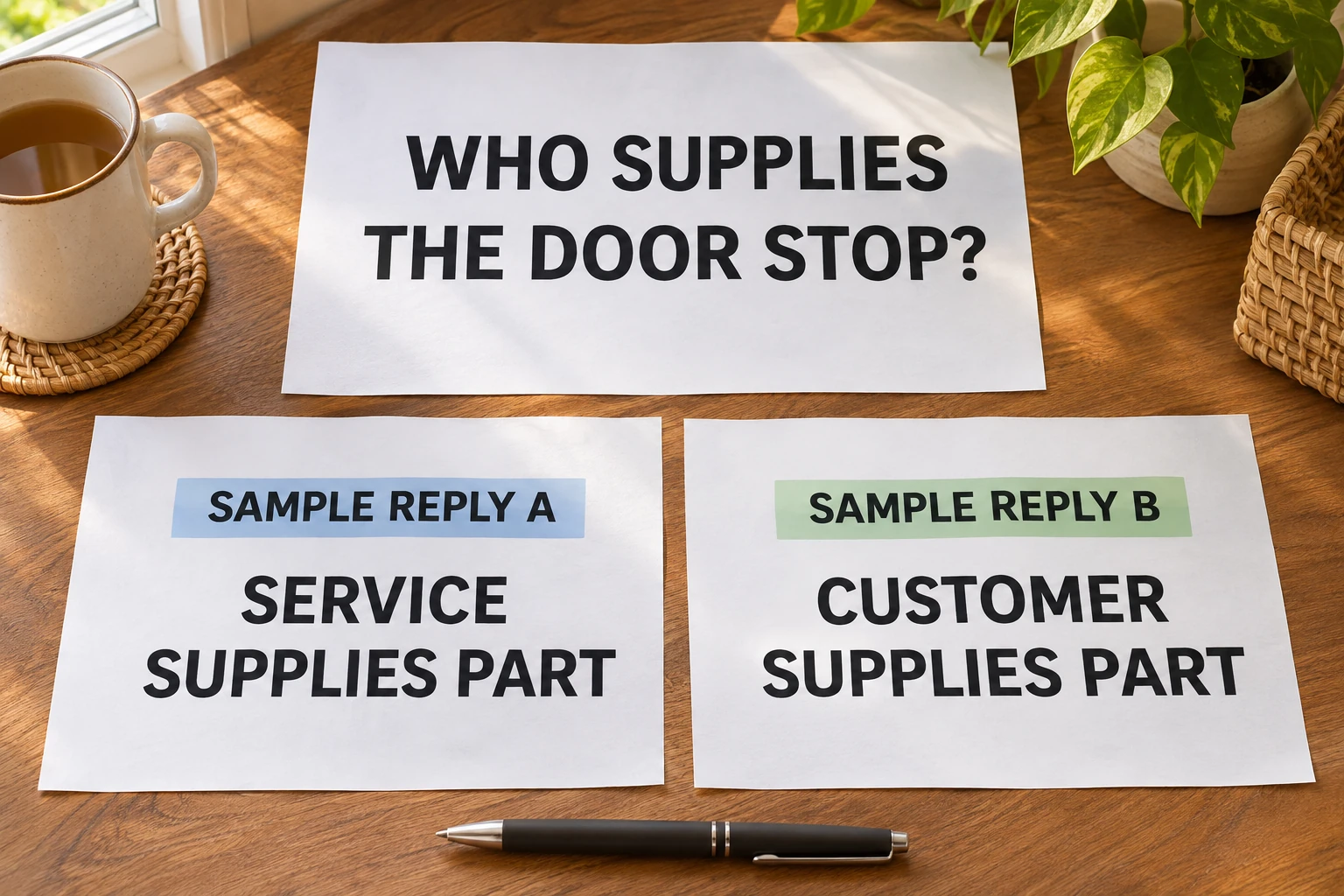
Ask who supplies the door stop before buying another one for work someone else is arranging. A message confirming a visit may leave that question unanswered. The original correspondence below gives a household requester three different replies to read: an inspection appointment, a replacement supplied with the work, or a part the customer must obtain after its specification is agreed.
Iona and the caretaker in this example are invented. Their messages create a small purchasing decision on the page. They establish no actual service agreement, landlord obligation, quotation, order or replacement result. The useful comparison is between the complete replies and the purchasing responsibility each fictional reply actually states.
Give the enquiry one identified job
Iona has reported the stop in an invented reading room. Her report is already with the caretaker, and she is waiting to hear what work is proposed. She has a product page open, but she has not placed an order. The room and its existing hardware have no retail identity in this example. Neither actual product discussed later is assigned to that room.
Her first draft says, “Are you coming on Thursday?” It asks about a visit. An answer confirming Thursday could be perfectly responsive while saying nothing about a replacement part. Iona wants to settle the supply question as well, so she adds it to the message. She keeps the room reference because the caretaker also handles other requests.
The revised enquiry reads: “For the reading-room request, please confirm who will obtain the replacement stop. Is the stop included in the work you are proposing, or should I buy an item after you have confirmed its exact specification? I have not ordered one. Please keep the supply answer with this request when you confirm the visit.”
A visit confirmation leaves a question open
The first sample reply reads: “I can visit the reading room on Thursday to inspect the reported item. I will tell you what work I propose after that visit.” This reply identifies an inspection. It gives Iona a reason to retain the appointment message, but it contains no sentence assigning the purchase of a replacement.
Iona can acknowledge the appointment without treating the supply question as answered. Her follow-up reads: “Thank you. I will leave the separate purchase open until you have inspected the item and confirmed the proposed work. Please tell me whether your later proposal includes supplying the stop.” That is the chosen next message in this version of the example.
Nothing in the exchange has yet selected an item. Iona has not asked the caretaker to fit something she found online, and the caretaker has not approved that offer. The open browser page remains an option she was considering. The conversation can pause here with an inspection planned and a purchasing decision still to make.
Read the version that includes the part
Now consider a complete alternative reply: “For the reading-room request, our team will supply the replacement stop described in our proposed work. Please do not order a stop for this visit. I will send the exact item reference with the work confirmation.” In this authored version, the team expressly takes responsibility for supplying the part.
Iona calls this the service-supplied part version in her notes. That label refers to the sentence the example actually gives her. She can retain the promised item-reference question while leaving her own proposed purchase unplaced. The reply has settled who is to obtain the item, with its exact reference still due in the later confirmation.
Her response reads: “I understand that your team will supply the replacement for this request. I will not order a separate stop for the visit. Please include the item reference when you send the work confirmation.” This response records her understanding and leaves a clear opportunity for the caretaker to correct it before someone acts on a different assumption.
The example stops short of a completed repair. A sentence promising supply is available to read; there is no delivery, installation or observed working result on the page. Iona has made one narrower decision: she will not place the separate order she had been considering while this arrangement stands.
Read the version that leaves sourcing with the customer
The other complete alternative reads: “Our proposed work covers fitting a replacement stop supplied by you. The stop itself is not included. Please send the exact item reference before buying so that I can confirm whether it is the part specified for this job.” This reply assigns a different task to Iona and includes a condition before she buys.
She labels this the customer-supplied part version. Her next message reads: “Please send the specification for the replacement you are proposing. I have a possible offer reference, but I will wait for your confirmation before ordering. I also need your answer about any separate supplied pieces required for the proposed work.” She has a sourcing task, with information still outstanding.
Keep the condition in the reply when deciding what happens next. Iona has not been told that any object sold as a door stop will do. Nor has the example identified either linked retail account as the right item. The caretaker's requested confirmation belongs to the particular fictional job and its eventual specification.
These two replies are alternatives. They are not consecutive instructions in which the team first supplies the part and then quietly transfers the task to Iona. Save the selected reply with the request it concerns. If the actual arrangement later changes, the changed answer needs to be made explicit in that same conversation.
Ask about a changed proposal before adding an order
Suppose the selected arrangement is the team-supplied version, and Iona later receives a message asking her to choose a finish. She can answer the finish question while asking whether the existing supply arrangement still stands. A choice of appearance does not, in this invented exchange, contain an instruction for her to buy the item privately.
Her response can say, “I prefer the finish shown in your proposed item reference. Please confirm that your team is still supplying the stop under the reading-room request.” The wording connects the new preference with the earlier responsibility instead of leaving the recipient to infer what she intends to do.
A different change would need a different answer. If the caretaker now proposes that Iona obtain the item, she can request the revised specification and supply terms before deciding whether to accept that task. The article invents no price, deadline or right to insist on the earlier arrangement. It simply keeps the proposed change visible before her separate purchase.
Return an answer attached to the wrong request
A further version gives Iona a different problem. The returned confirmation names the laundry room, while her message concerns the reading room. It says the team will supply a stop, but the document reference belongs to the other room. Iona keeps that mismatch visible. She has an answer about supply, with its connection to her own request still unconfirmed.
Her reply reads: “The attached confirmation names the laundry room. My question concerns the reading-room request. Please confirm which request this supply arrangement covers and send the matching item reference.” She can ask that without editing the received attachment herself or treating the two rooms as interchangeable. The example gives her no reason to decide that the wrong heading is merely a harmless typing error.
The later answer can identify the intended room and correct the record. Until that answer is written in this version of the exchange, Iona leaves her proposed order open. The useful result is a precise question about the actual returned text. It does not need an invented explanation for how the mismatch occurred.
Read the actual hardware accounts separately
The QQUVFGWF floor-stop account shows curved-cover hardware above a low rounded base and connecting strap. Its description mentions screws and glue, which the sole image does not inventory. Material, adhesion, durability and mounting claims remain unverified here.
The Hoffman ALGDSTOP2 account shows an enclosure-door linkage and brackets in an installed demonstration. That enclosure is not established as supplied. The description's material, washer and compatibility statements remain unverified. Neither account identifies Iona's replacement.
Keep operating instructions and package contents with their own questions
The doorstop release enquiry asks for the applicable release instructions while retaining an unknown operating result. This example asks which party supplies a proposed replacement; it offers no release action.
The floor-stop kit inventory separates complete bodies from loose mounting pieces. A service reply assigning supply does not establish an order's package contents. Keep the eventual exact item and any required pieces with the job specification.
Keep a separate transaction with its actual checkout
A separate purchase on republeq.com begins with the actual offer and the order being considered. If a checkout presents cryptocurrency as an available payment choice, read that transaction's current information before choosing USDT or another displayed asset. The fictional correspondence above supplies no payment instructions and establishes no transaction. An expression of interest in a product can remain open while its actual details are being checked. Keep the selected offer reference and any questions with the order information so that a later answer can be understood in context. If someone else is helping with the purchase, tell them which decisions have actually been made before they act on your behalf. A remembered preference for one payment method cannot confirm that it appears in the checkout you are using. Read any presented conditions carefully and obtain clarification through the responsible service when an essential detail is unclear. This article provides no receiving address, transfer network, wallet procedure or promise about processing time. It attaches no discount, faster delivery or special refund arrangement to the mention of USDT. Preserve the actual records of any action you do take, including the order reference and the communications relevant to it. An acknowledgement needs to be read for what it actually confirms. A payment record, an order acceptance and a delivered item concern separate events. If the status of a transaction is uncertain, retain that uncertainty while seeking an account of the event before considering another payment. You can leave the purchase undecided while a necessary answer remains outstanding. A current checkout and its actual terms govern any eventual transaction, while Iona's enquiry remains an invented example.
Finish with the supply question answered in writing
Iona can keep a short record: the reading-room request, the selected reply, the item reference when provided and her own next decision. The inspection-only version leaves supply open. The team-supplied version keeps her proposed private order unplaced. The customer-supplied version gives her a sourcing task subject to the stated confirmation.
Asking who supplies the door stop has a concrete purpose in this example. Iona wants the response to say which party obtains the part before she commits to another purchase. The selected exchange can finish with that answer and its remaining condition intact, without inventing an actual saving or a completed repair.