Home Decor & Table Settings
A wallpaper mood board can leave out a favorite pattern
A wallpaper mood board follows Rowan through four fictional proposals before she chooses abstract background interest and keeps her favorite bird idea separately.
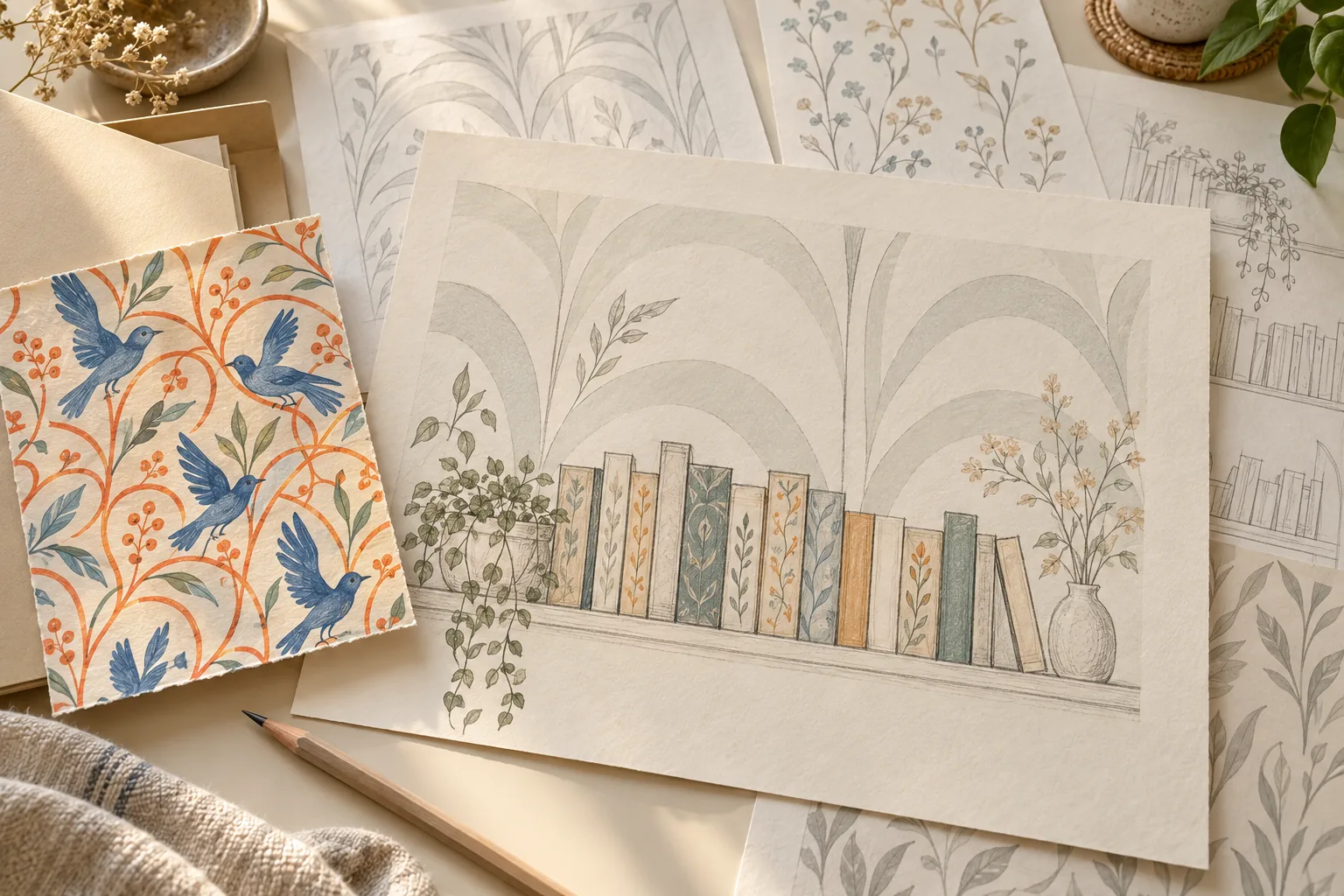
A wallpaper mood board can help you discover that your favorite image belongs in a different project. You can enjoy a pattern, keep it in your collection of ideas and still leave it out of the room concept you are choosing now. That decision becomes easier to explain when the board has a particular purpose beyond gathering attractive things.
The original fictional example below follows an adult named Rowan making paper proposals for an imagined reading nook. The drawings, preferences and room are invented. No wallpaper is bought, painted, hung or tested. The exercise provides no measurements, installation method or claim that a color changes attention or wellbeing. Its result is a chosen visual proposal, with any real room and product decisions still separate.
Give the reading nook brief a specific purpose
Rowan begins with a sentence: “I want the drawn nook to make the books the part I notice first.” That is her preference for this imagined project. She enjoys illustrated patterns, but she wants to see whether she can give the books a clear place in the concept. The sentence gives her something particular to compare with each proposal.
Her reading nook brief also names what she is not deciding yet. She has made no choice about an actual wall, chair, shelf, lamp or covering. A rectangle on her page stands for a group of books. Another outline suggests a seat. Their paper positions supply no assurance about real furniture clearances, supports or suitability.
Keeping those practical questions outside this first comparison lets Rowan change the drawing freely. She does not have to defend an order already placed or explain why a room must accept a pattern she has bought. The present task is smaller: choose a visual direction she wants to investigate further.
She writes her sentence at the top of a separate note rather than across every drawing. The note belongs beside the proposals, where she can refer to it. If she later changes the brief, she wants to know that she changed the purpose as well as the picture. A preferred result needs its own stated question.
The favorite pattern takes over the first proposal
Rowan's favorite pattern is an invented group of blue birds among orange loops. It is separate from both retail designs discussed later. She enjoys the little gaps between the birds and the sense that one might be looking back at another. Her interest is personal and specific, without a claim about what every viewer would notice.
In the first paper proposal, she fills the large background rectangle with her bird drawing. She places a small group of book shapes in front. When she looks at the page, she notices the birds first and keeps returning to them. She likes the page, but the books have become a supporting detail in the scene she has drawn.
That result answers a useful question. The bird design works as the main interest for this version of Rowan's picture. It does not answer her current wish to make the books the first part she notices. She could change the brief and choose a bird-centered room concept. For now, she decides she still wants to explore the book-centered idea.
She labels this page “birds lead” and keeps it. Calling it wrong would conceal why she likes it. Calling it the final choice would conceal the difference between enjoying the image and choosing it for this particular purpose. The page can remain a successful different idea without becoming the chosen reading-nook proposal.
Shrinking the image changes more than its area
For the second proposal, Rowan redraws the bird pattern inside a narrow rectangle beside the book shapes. This is a paper composition, without a plan to cut or install a strip of real wallcovering. She wants to see what happens to the illustrated subject when it occupies less of her drawing.
The smaller area does not give her the result she expected. On this page, she has made the birds tiny enough that the gaps she enjoyed are hard for her to pick out. She notices a busy colored patch rather than the small imagined exchanges between birds. Reducing the pattern's area has changed the part she liked about it.
She could draw larger birds inside the same narrow rectangle. That would be another fictional design variation. It would not establish that a real retail pattern can be resized or supplied in a different scale. Rowan makes a quick separate sketch of the larger birds, keeping the variation visibly distinct from any actual product reference.
She likes the larger individual bird, yet the new drawing feels like a different illustration to her. She decides not to keep revising the motif just to make it fit the first brief. The original bird idea can remain intact elsewhere. A project does not have to consume every image that interested its maker.
A nearly blank version is worth comparing honestly
For the third proposal, Rowan leaves the background pale and adds a few faint curved marks. The book rectangles remain the most detailed part of her drawing. This time she notices them first. She has met the brief more closely, but she finds the whole page too plain for the concept she wants to keep working on.
She does not need to pretend that meeting one sentence makes every other preference irrelevant. The sentence was a starting purpose, rather than a complete account of her taste. She adds a second line to her note: “Keep a small amount of pattern interest without turning it into the main subject.”
That addition changes what the next proposal must attempt. Rowan keeps the earlier note as well, so she can see why the almost-blank page led to another question. She is not claiming that the first brief secretly contained every later preference. Her understanding of the project has become more specific through comparing the drawings.
She labels this third page “books lead, too little pattern for me.” The words make the reaction usable without treating plainness as a universal flaw. Another person could prefer this version. Rowan's task is to choose the concept she wants to pursue, while explaining her own reasons in ordinary language.
Choose a different pattern role for the fourth page
On the fourth page, Rowan draws broad pale arcs behind the books. They are an original abstract motif for the exercise, without a claim that a selected wallpaper supplies those exact marks. She leaves parts of the background blank. The book group still carries the sharpest detail in her drawing.
Rowan likes how the arcs reappear around the books without becoming a set of characters she wants to follow. She notices the books first, then the background shapes. That is her response to this invented page. It supplies no measured viewing sequence, lighting result or guaranteed effect in an actual room.
She compares the fourth page directly with the nearly blank third version. The new one gives her a small visual interest to return to without the bird-centered story of the first page. This comparison helps her name what she wants: a background relationship in the current concept, rather than her favorite illustration occupying less space.
The chosen direction is therefore the fourth page. The original bird drawing stays in a separate folder called “other ideas.” Rowan does not promise that it will become another room project. Keeping it can simply mean she still likes looking at it. There is no need to invent a future use to justify leaving it out today.
A mood board does not have to become a shopping list
Rowan now has a visual proposal she wants to investigate. It does not identify a real covering, room surface or supply quantity. The drawn pale arcs are a preference statement. Finding out whether she wants an actual product, and whether it suits a particular application, would require different information.
She keeps a small note beside the chosen page: “Abstract background interest; books remain the main subject; practical choices open.” Those words preserve the concept without turning a sketch into an order. A supplier could answer a question about an exact product later, but the drawing alone cannot supply that product's properties.
She also leaves the bird reference outside the chosen page. If she brings every attractive image back into the final board, the decision becomes unclear again. Someone looking at it might reasonably think the birds remain part of the proposed room. The separate folder lets Rowan preserve an interest without presenting it as a current requirement.
A friend asks whether leaving the birds out feels disappointing. Rowan says she is glad to have found out why she liked the first drawing. She had enjoyed the little illustrated scene, while the current project wanted a quieter background role. The conversation ends with two preferences understood, rather than one preference declared less worthy.
Keep the actual wallpaper accounts separate
The Brewster Home Fashions Jan wallpaper offer identifies model 4000-95135-1 from its PaintWorks collection. It describes White paintable damask wallpaper and says glue is not included. Its photograph shows a pale raised-looking scroll design on a roll. These attributed listing and appearance details do not supply a painting method or reproduce Rowan's invented abstract arcs.
The Chesapeake Parliament Cream Owl Wallpaper offer identifies 3115-12413 in its title. Its account describes coated heavyweight paper and uses packaged-double-roll wording. Its image shows pale owls among leafy forms. Preserve that identity and packaging wording without turning the photograph into a confirmed order quantity or a scale drawing for a room.
Neither selected account establishes Rowan's fictional reactions or the proportions of her proposed nook. The invented blue birds and orange loops are not the photographed owl design. The generic arcs are not a rendering of the Jan pattern. No real paint, hanging, care or coverage decision follows from the creative comparison.
Related creative exercises ask different questions
The Crayola Air-Dry Clay gift guide revises a new project's intended role around material limits and the recipient's preference. Rowan is choosing a visual concept for herself, without making a gift or applying those clay instructions to wallcoverings. The two projects keep their practical information separate.
The wordless comic drawing session guide follows an event across pictures and considers what a reader sees. Rowan's four pages are alternative room concepts rather than consecutive story panels. Their order records her choices, without claiming that another viewer has read a narrative or preferred the same arrangement.
Keep the chosen page and the reason for choosing it
Before putting the drawings away, Rowan places the selected fourth page beside both versions of her note. She keeps the first bird-centered page separately because it still interests her. She does not need all four proposals visible whenever she returns to the current project. The selected page should identify the choice, while the earlier pages can explain how she reached it.
Her next conversation about a real room can begin with the visual direction and the unanswered practical questions. If the actual space changes what she wants, she can revise the brief openly. If she discovers a covering she likes, she can compare that exact offer with her intention instead of treating a familiar motif as a completed match.
A wallpaper mood board has helped Rowan leave out her favorite pattern for a definite reason. She wanted background interest around the books, while the bird drawing gave her a subject of its own. Keeping that distinction lets her choose the current concept without giving up the pleasure of a different image.