Troubleshooting & Repairs
Utility knife will not retract: stop before carrying it
Identify the actual knife and obtain applicable model instructions or service guidance when its blade remains exposed.
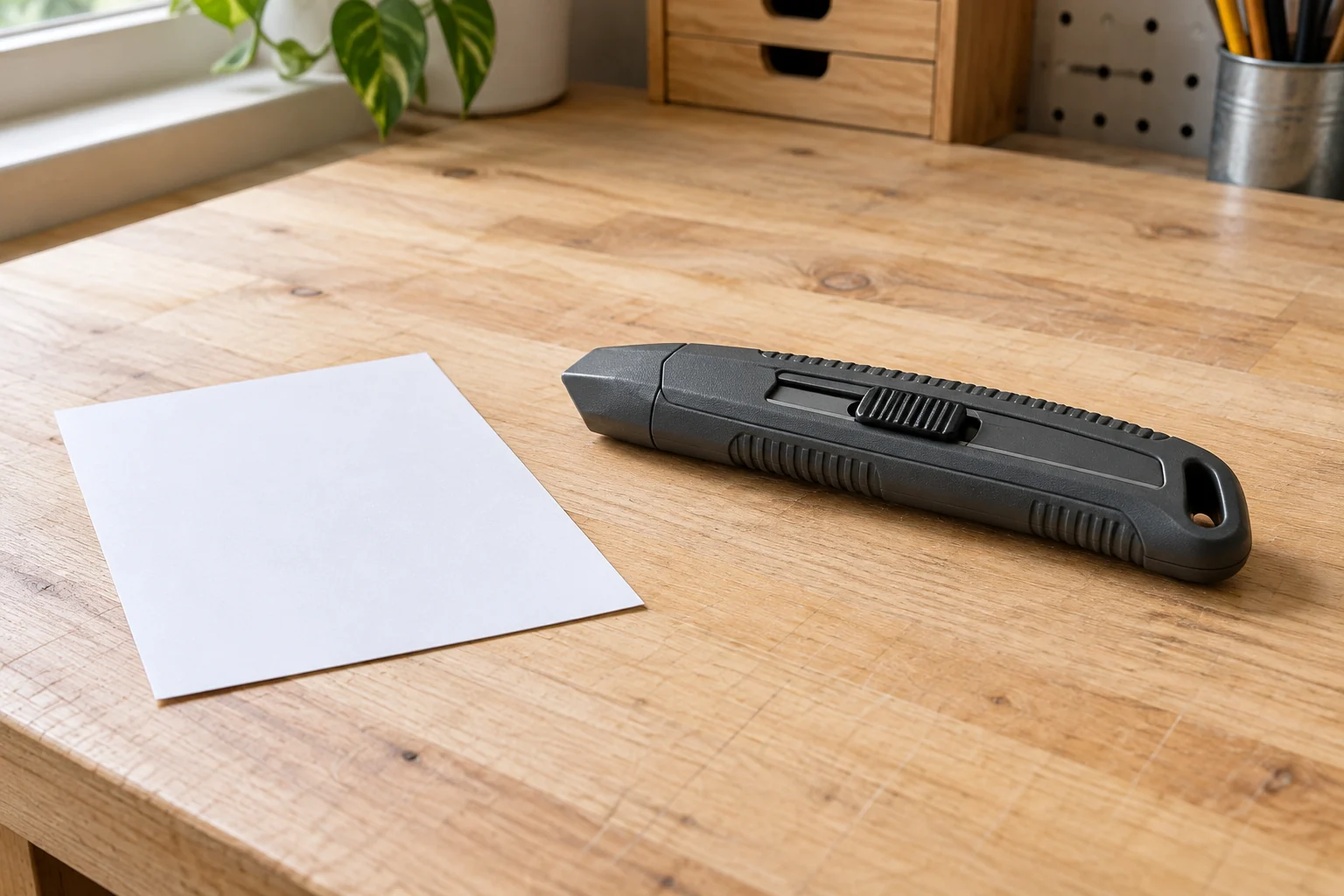
When a utility knife will not retract after a normal movement you already understand, stop cutting. CCOHS says retractable blades should be fully retracted after use. An exposed blade has not reached that condition. Do not pocket, conceal or pass the open tool while seeking the applicable instructions.
Keep three questions separate: what you observed, which tool produced that observation, and what action its instructions actually permit. A short description can preserve all three without naming a broken component. The expression “will not retract” describes the result you need help with. It does not establish whether the cause is an unfamiliar control, an incorrect operating assumption or an internal fault.
Keep an exposed utility knife blade visible
CCOHS describes brief placement at the back of the counter with the sharp edge away. It also says not to carry sharp tools alongside other objects or try catching one that falls. Keep an exposed utility knife blade visible. This is not a method for wrapping, capping, transporting or storing a knife with an unhoused blade.
The temporary location and the unresolved condition belong together. Someone returning to the area should not mistake an interrupted task for a tool ready to use. If obtaining assistance requires moving the knife, establish an appropriate arrangement first. An improvised container or a familiar place in a drawer is not an answer supplied by this guide.
Manual blade retraction depends on the actual knife
The OLFA 1072198 LA-X offer identifies an eighteen-millimetre utility knife and a pack of five. Its actual category is Tools → Hand Tools. OLFA's matching LA-X product page describes an auto-lock slider that allows blade adjustment. The word “lock” concerns retaining a position; that account does not establish automatic return of the blade when you release your hand. Keep manual blade retraction separate from a self-retracting mechanism. Neither the pack count nor the phrase “auto-lock” supplies a troubleshooting sequence. This guide does not prescribe blade replacement, snapping a segment, using the built-in pick or releasing a control inferred from the photograph. Obtain the instructions applicable to the actual unit before doing anything beyond a normal movement you already understand. Eighteen millimetres identifies the listed blade size; it is not a direction to expose that much blade. Likewise, five units in an offer do not supply five different operating methods.
The STANLEY 2-10-122 Titan RB offer names a silver knife with a retractable blade. Its actual category is Tools → Featured Brands. That brief offer description establishes the listed identity, without providing an operating procedure. It gives no basis here for telling you to turn a wheel, loosen a component or press harder. Keep the full offer reference with your question so that “Titan” or “Stanley knife” does not become the only identification available. The absence of a verified procedure in this article is an unresolved information boundary, not evidence that your unit has a particular fault. Do not substitute the OLFA slider account for instructions about this knife.
Keep the workplace response within its own scope
HSE's hand-knife guidance concerns textile workplaces, including packing and warehousing tasks. It begins by considering whether hand-knife use can be eliminated or reduced. Where knives remain necessary, it calls for suitable tools, access to spares, designated storage near the work and training in the applicable working practices. It warns against knives lying loose on work surfaces and against carrying them between places in pockets or hands. Those are workplace arrangements, rather than a household repair recipe. They explain why brief visible placement should not become indefinite loose storage. In a workplace, use the established reporting and storage arrangements and ask the responsible person about an assessed alternative. A user trial does not replace assessment of suitability. This article adopts no industrial cutting procedure, protective-equipment standard, blade-disposal method or first-aid instruction from that guidance. Its training account includes the correct tool and protective equipment for each task, company rules and supervision. It rejects exemptions for jobs lasting only a few minutes. Those management decisions precede resuming work.
A replacement decision is separate from a repair decision. The fact that another tool is available does not answer what is wrong with the stopped knife. Conversely, leaving the stopped knife unresolved does not require completing the original task with it. Keep any decision about continuing the work attached to the appropriate task and operating information.
Give the service enquiry an observable starting point
Begin an enquiry with the exact identification available from the tool and its retained paperwork. Distinguish a name on an offer from a marking you have actually read on the supplied unit. If they disagree, state both. There is no need to resolve that discrepancy by opening the handle or moving the blade for a better view.
Describe the last movement already attempted, using ordinary language. “The control moved back, but part of the blade remained visible” and “the control did not move” are different descriptions. Use whichever matches your existing observation; these examples are not requests to repeat the movement. Avoid converting either description into a diagnosis such as a broken spring.
Ask which normal retraction instruction applies to that exact unit and whether the remaining condition requires service or replacement. An answer about another model leaves that question open. If a reply names an unfamiliar part, request identification in the applicable instructions before interpreting it as permission to manipulate the part.
Keep the reply with the question it answers. A general statement that a product is retractable does not explain why your blade remained exposed. A response identifying the correct manual may resolve the information question while leaving the physical condition unresolved. Those outcomes deserve different descriptions when you decide what can happen next. Keep both versions available for the person answering the enquiry.
Do not turn an incomplete answer into a fresh cutting test. The purpose of the enquiry is to establish an applicable next action. Until that action is known, another cut adds an event without settling the existing uncertainty. The enquiry can remain useful even when the right answer is that the tool must stay out of use.
Separate a service answer from a return decision
The Leatherman warranty-cost guide distinguishes postage from an unconfirmed warranty decision. Its actual subject is Leatherman equipment, including Curl and Rebar offers. It does not establish warranty coverage or shipping permission for either utility knife here. Use that distinction when asking about a possible service route: confirmation that someone can inspect an item is different from confirmation of a covered remedy. A manufacturer and a merchant may also answer different questions. Keep their responses identified rather than combining them into a single promise. Before arranging any return, obtain the applicable destination, authorization and handling instructions for the actual item and condition. This article supplies no mailing or packaging procedure for an exposed blade. A postage estimate, an available label or a remembered policy cannot resolve the tool's retraction problem or establish that it should be shipped in its current condition. Keep any existing purchase expenditure separate from a prospective service payment. An amount already spent is not evidence that a future charge is covered, and a quotation is not a completed transaction.
A clear handoff can state the current position without claiming a repair: identification confirmed, applicable instructions obtained, further action still awaiting an answer. If the answer changes, retain the earlier description rather than rewriting it as though the new information had always been available. That preserves which decision the response actually supports.
Keep the unfinished project separate from the knife
The pumpkin design guide keeps face planning on paper before cutting and discusses adult carving roles alongside two carving-kit listings. That is a useful boundary for a seasonal project interrupted by a tool problem: a design decision can remain a design decision. The guide does not approve a utility knife as a substitute for a kit tool, establish a shared closing mechanism or resolve an exposed blade. Its paper plan can be retained while the equipment question remains open. Do not turn a finished drawing or an assigned adult role into evidence that the stopped knife is ready. A planned project still needs suitable, working equipment. Its kit descriptions are inventories to read, not demonstrations that every named implement suits every stage. A paper plan can identify an intended appearance without making an equipment choice or showing a completed carving.
Close the enquiry with its actual outcome. If the applicable normal procedure has not been established, say that. If it has been identified but the condition remains unresolved, keep that distinction. A helpful explanation, a product reference and a service contact are progress in obtaining information; none is a completed physical repair.
Confirm the actual order before a USDT purchase
If you are considering USDT for a utility-knife order at republeq.com, first establish what the actual checkout offers for that transaction. Leave the purchase uncommitted if USDT acceptance or the applicable terms cannot be confirmed. A cryptocurrency reference elsewhere is not confirmation of a payment option for your order. Check the product identity and supplied quantity before making a payment decision. The OLFA offer identifies a five-pack; the Stanley offer names the Titan RB knife without an equivalent multiple-unit statement. Ask the merchant about any unresolved contents question and keep the answer with the relevant product reference. Do not assume that paying with crypto changes what is supplied or provides operating instructions. Read the actual checkout and purchase terms for the destination and goods concerned. Establish what those terms say about cancellation, returns, exchanges and reporting discrepancies rather than adopting an assumed policy from this article. No current refund, exchange or warranty outcome is confirmed here. If the terms or payment option remain unclear, retain the product reference and question without completing the purchase. An enquiry can remain open while you decide whether the proposed goods meet your need. Keep any eventual order confirmation with the goods identification and the record supplied for the payment. Compare the shipment with that retained order before putting a unit into use, and obtain the instructions for the supplied model. Follow the applicable reporting process if the identification or quantity differs. Keep that purchasing decision separate from the condition of the knife that prompted the enquiry. Another purchase does not establish a repair of the earlier tool, authorize carrying an exposed blade or resolve an uncertain control. The order answers which goods were requested; the applicable tool instructions and any service response answer the remaining equipment question. Neither answer should be silently substituted for the other.