Writing & Documents
An unfinished household list can become a short story
An unfinished household list gives Inez a fictional scene to finish without completing every task; compare two original endings and choose the action the prose actually shows.
An unfinished household list can supply the shape of a fictional story without turning the story into instructions for completing the jobs. A list points toward things that have not happened. A scene can show someone deciding what those missing actions mean to them. The two forms can share a few words while doing different work on the page.
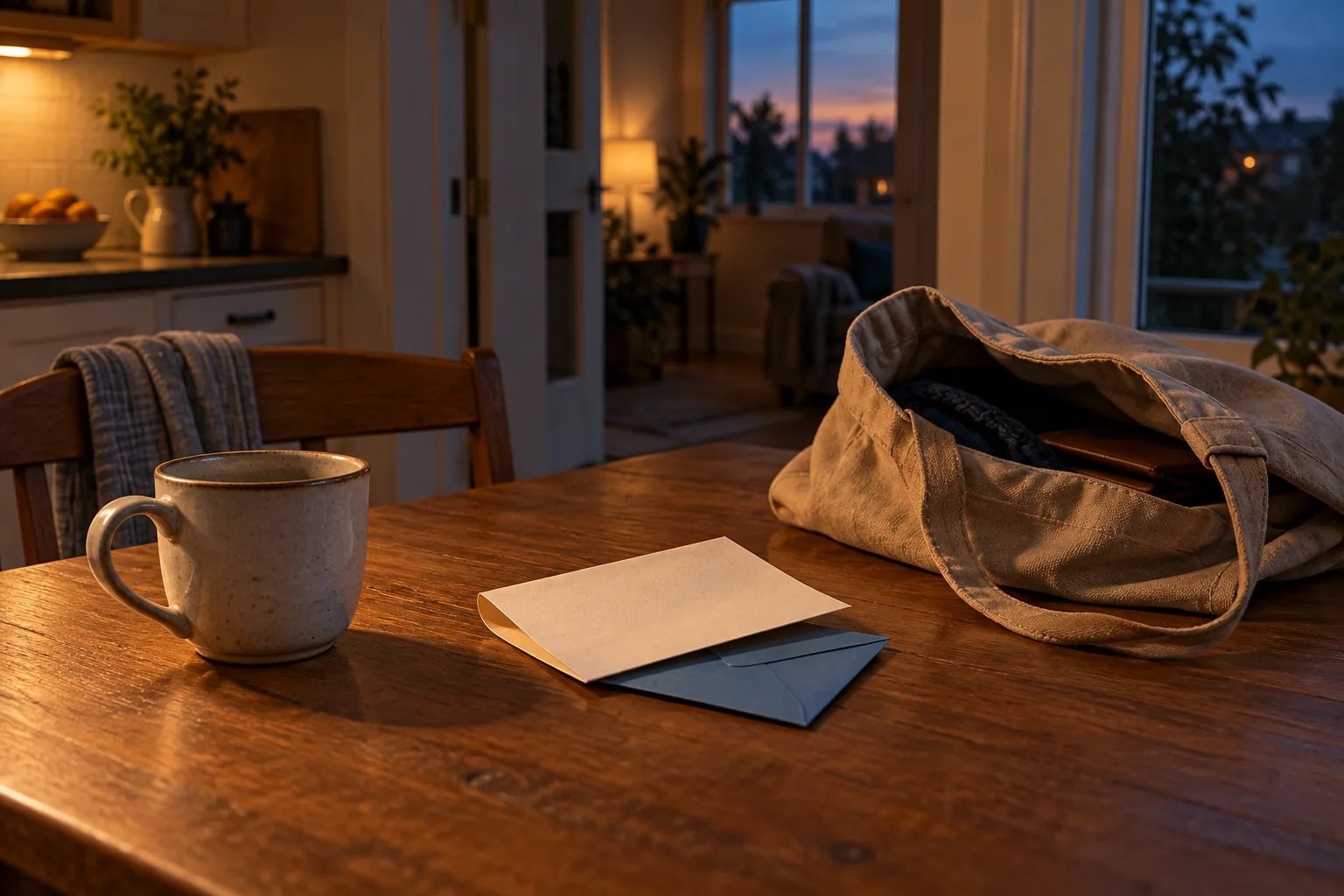
Consider an invented evening with a character named Inez. She is clearing a table in an apartment she is about to leave. Under an empty mug she finds a sheet headed Saturday. Its three entries are bathroom part, blue envelope and call Dev. Nothing is crossed out. The example below develops that scrap into prose, then chooses where the story should end. These are original fictional passages, not a report about anyone's home or a record of an actual repair.
Start with a list that leaves room for a person
The first version of Inez's sheet is intentionally sparse. Bathroom part does not identify a fault or a suitable replacement. Blue envelope does not say what is inside. Call Dev does not explain the relationship. Those omissions create possible questions for the writer. They do not establish answers about a real household. Keep the invented situation separate from practical advice someone might need for a real task.
Here is an initial passage: Inez flattened the paper with the mug. Saturday had passed, though she could not remember which Saturday she had meant. At the bottom, below the three entries, someone had drawn a small square. She held the sheet toward the window, as if another line might become visible in the fading light. Then she put it down exactly where it had been.
That paragraph adds a person, a location and an action. It still leaves the list untouched. Its interest lies in Inez's hesitation rather than in whether a particular job will be completed. The empty square becomes a detail she notices, but the passage does not need to reveal who drew it. You can keep that uncertainty if it belongs to the version you want to write.
For this exercise, choose one question to carry forward: will Inez treat the sheet as an obligation she must finish before leaving? That question gives the next passage a direction. The contents of the envelope and the identity of the person who drew the square can remain outside the story. Adding every possible explanation would create several other stories inside this small one.
Keep household objects outside a repair manual
The Korky 528 offer names a Quiet Fill toilet fill valve in a three-pack, with UPC 378482524759. Its gallery shows three valve bodies. The selected Korky account provides a bounded example of the kind of ordinary supply a vague list entry might concern. Its promotional statements about quietness, testing and ease do not become facts about Inez's apartment.
The Lasco 04-4104 offer describes a low-profile toilet fill valve in a quantity of six, under Toilets and Bidets. Its single picture shows one assembly with associated tube and small mounting or sealing pieces. The selected Lasco account does not independently demonstrate the stated package quantity through that picture. Neither quantity is a requirement for writing the scene.
Neither selected account establishes what needs attention in the fictional apartment, whether either part belongs there or how any work should be done. The story supplies no plumbing procedure, compatibility judgment or completed repair. A writer can leave the entry at bathroom part. If you are dealing with an actual household problem, this invented scene cannot answer its technical questions.
Inez does not need a purchase scene merely because a supply appears on her list. In the next version, the words matter because she wrote them and then left them unfinished. The object remains ordinary. She does not have to discover a rare keepsake, uncover a secret message or repair something as a symbol of repairing her life. Those would be additional choices with different consequences for the ending.
Turn task order into a scene sequence
A list can put bathroom part first simply because it came to mind first. Prose needs its own chosen order. In Inez's scene, the envelope is the one object she can immediately see. Starting there lets the paragraph contain an action without pretending to solve the entry above it. The change is a decision about the fictional page, not a method for managing household work.
Try this continuation: The blue envelope stood between two cookbooks. Inez took it out and found the spare photographs she had promised to return to Dev. The top one showed a chair on a balcony, no people in it. She could remember the afternoon but not why anyone had photographed the chair. She slid the pictures back inside and placed the envelope on top of the list.
Here, the scene has advanced through a physical action. Inez has found the envelope and learned what it contains. The empty balcony chair adds a particular image, but it does not demand an account of an entire friendship. Keep the image if its quietness suits this scene. Remove it if you want the exchange of photographs, rather than the remembered afternoon, to remain central.
Notice that the first list entry has not been completed. That does not make the continuation incomplete as prose. Its movement is from an uncertain task sheet to a specific item Inez can return. The order is now table, shelf, envelope and table again. Those places give the scene a small route, while the writing still leaves the practical household job unresolved.
Choose what the unanswered call does
For turning a task list into fiction, a new action should belong to the question you selected. Inez can pick up her phone, but a call would introduce another voice and another stretch of conversation. You can write that conversation if it is the scene you want. You can also stop before it, provided the stopping point gives the current action a consequence.
One possible passage is direct: Inez opened Dev's number and held the phone above the paper. She had been planning to explain every unfinished entry. Now the envelope covered the first two lines, leaving only the instruction to call. She lowered the phone. On the back of the envelope she wrote, Found these. Can I leave them with you tomorrow? She sent that sentence instead of the explanation.
In this version, the message changes the size of her immediate intention. She is arranging to return photographs, not presenting a full account of why the Saturday list remains unfinished. That is a particular choice by this fictional person in this scene. It is not a recommendation that readers replace calls with messages, avoid difficult conversations or leave actual obligations unexplained.
Another version could have her make the call. You would then decide what Dev says and whether the conversation changes the meaning of the list. That would require writing the exchange rather than treating the ringing phone as a completed conversation. For the version developed here, keep the short message. It preserves the scene's attention to the small sheet and the envelope.
Turning a task list into fiction
The wordless comic drawing session guide develops visible action across panels and considers what a first reader understands. This prose example instead works with an unfinished written list, Inez's chosen action and a sentence she sends. It does not require a panel sequence or a test of whether another person can identify an uncaptioned plot.
The Crayola Air-Dry Clay gift guide changes an imagined object's intended use after considering material limits and the recipient's preference. Inez's scene concerns neither a proposed gift nor selecting a making material. The relevant distinction is that an unfinished task sheet need not dictate the action that ends a piece of fiction.
Return to the original three entries before adding a new event. Bathroom part remains unfulfilled. Blue envelope has become a concrete object with a next destination. Call Dev has become a short message about that object. The story has not completed the list; it has changed Inez's relationship to one immediate action. Keep that account precise instead of announcing that everything is finally settled.
Compare two endings beside the same page
For choosing a short story ending, write the actual alternatives rather than labeling one hopeful and the other sad. A first ending might read: Inez crossed out blue envelope. The line ran through blue but stopped before envelope, where the pen had dried. She left it that way and set the sheet beside the keys. When she turned out the kitchen light, the paper was still there.
A second ending might read: Inez folded the list around the envelope. The corners of the photographs kept it from closing neatly. She put the uneven packet in her bag and carried the mug to the sink. Saturday stayed on the outside of the fold, a small heading for something she would take with her instead of something she had finished.
The first leaves the sheet in the apartment and gives the incomplete line visible emphasis. The second makes the sheet travel with the envelope. Neither says that the bathroom work happened, the photographs reached Dev or the apartment was fully cleared. Choose the second for this particular story because it carries forward the object Inez has just found and the message she has actually sent.
There is another small revision available inside the chosen ending. If Inez puts the packet beside her bag instead of inside it, her next action remains undecided. That wording would leave the scene at preparation. Putting it inside the bag commits this version to carrying the paper away, though it still proves nothing about tomorrow. Keep inside for the present draft. The difference is only a few words, but it changes which action the final sentence can honestly describe as having happened. Read that action against the opening before deciding whether to add anything else.
Choosing a short story ending
You can keep the unused ending as a separate draft. It has its own effect, and another opening might lead toward it. For this version, read the scene from the mug holding down the sheet to the folded packet in the bag. The paper changes position and use. The uncompleted entries stay visible without requiring a final paragraph that explains a lesson for every reader.
An unfinished household list gives this story a beginning because Inez has to decide what to do with it. The chosen ending answers that narrow question: she takes it with the envelope. The ordinary household task remains outside the completed fictional action. A small piece of writing can finish with that distinction intact, leaving the character's next morning for another page.