Skills & Planning
Underdetermined counts: ask for a different total
Nine pairs satisfy one eight-item total. A scaled copy retains every pair, while an independent weighted total identifies five and three; a changed odd total has no integer answer.
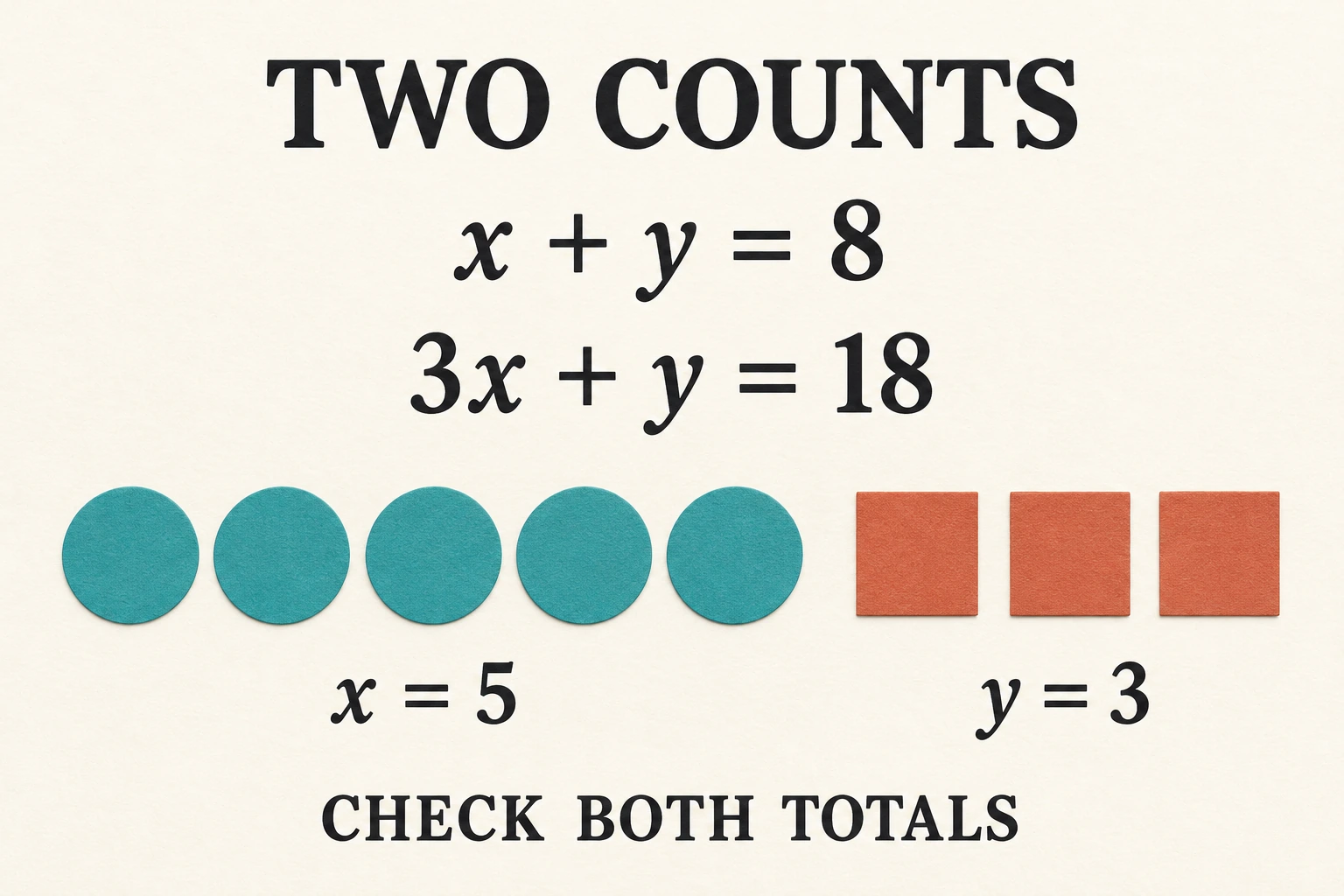
Write the count question before solving it
Underdetermined counts can survive a worksheet with two neatly written equations. Suppose a fictional box contains eight paper tokens, each classified as either a circle or a square, with no other category. Let x be the number of circles and y the number of squares. Both counts must be nonnegative integers, and a category is allowed to contain zero tokens. The only observation initially supplied is x + y = 8. Our question asks for both individual counts, rather than merely the combined number already given.
Keep the domain beside that equation. A nonnegative integer is a whole number starting at zero. Values such as minus one or five and a half cannot be category counts in this exercise. We are not weighing actual contents, estimating a proportion or reading a product package. The token box is invented so that every mathematical input can be stated explicitly. Drawing a few example tokens does not add an observation to the problem unless the drawing is declared to show the complete box.
Retain every pair the first total permits
The possible ordered pairs x, y are 0,8; 1,7; 2,6; 3,5; 4,4; 5,3; 6,2; 7,1; and 8,0. Each pair sums to eight and respects the count domain. There are nine possibilities, because x may take any of the nine integers from zero through eight, with y then determined by subtracting x from eight. Nothing in the initial observation favors the pair 4,4 over the pair 5,3 or any other member of this list.
Two different valid pairs are already enough to refute a proposed unique answer. For example, 2,6 and 5,3 both satisfy the stated total. Listing all nine gives a stronger record of exactly what remains open. If someone proposes one of them, ask which additional observation excludes the other eight. A preference for symmetry or a tidy-looking drawing supplies no such observation. Keep an unanswered count unanswered until a stated condition actually narrows the retained possibilities.
Recognize a scaled repeat
Now add a second written equation: 2x + 2y = 16. It may look like another measurement because it occupies another line. Divide both sides by the known nonzero number two. The result is x + y = 8, exactly the original restriction. Conversely, multiplying the original equation by two produces this new line for every original pair. Thus the second equation leaves all nine possibilities in place. There are two written equations but only the original restriction on the individual counts.
Check this without algebra if preferred. For the pair 2,6, doubling each count gives 4 + 12 = 16. For 5,3, the doubled amounts give 10 + 6 = 16. Both remain possible, and the same calculation works for the other seven pairs. The repeated total is consistent with the first one, so there is no contradiction to repair. Its limitation is that it does not distinguish any of the possibilities the first observation left unresolved.
An inconsistent repeat would be a different case. If the second line were 2x + 2y = 17 while the first still required x + y = 8, doubling the first would require the same left side to equal sixteen. No pair could satisfy both exact statements, even if fractions were permitted. Preserve that as a separate changed input. A redundant consistent total leaves many solutions; a contradictory scaled total leaves none. Calling both situations insufficient information would hide a useful difference.
Supply a total that distinguishes the categories
For the next version, retain x + y = 8 and replace the scaled repeat with 3x + y = 18. This second condition assigns three units to every circle and one unit to every square, with eighteen units in all. Those units are fictional weights in a counting rule, not masses or prices. The coefficients belong to the new stated observation. They cannot be chosen after seeing an answer simply because they make that answer convenient.
Subtract the first equation from the second. The difference between 3x + y and x + y is 2x, while the difference between eighteen and eight is ten. Therefore 2x = 10. Divide by two to obtain x = 5. Substituting into x + y = 8 gives y = 3. Each operation uses exact values and a nonzero divisor. The subtraction removes the shared y term because its coefficient is one in both equations.
Check the candidate in both original equations. Five plus three equals eight, and three times five plus three equals eighteen. Both counts are nonnegative integers. The derivation also establishes uniqueness: any pair satisfying the two original equations must satisfy 2x = 10, so its x must be five; the original sum then forces y to be three. Substitution establishes that this forced candidate actually works. Keeping both the derivation and the check prevents an accidental arithmetic step from passing as a complete solution.
See the new restriction in the nine-pair list
The weighted total 3x + y takes the values 8, 10, 12, 14, 16, 18, 20, 22 and 24 across the nine pairs already listed, in increasing order of x. Exactly one of those values is eighteen. This finite check explains how the new observation separates the candidates. Moving one token from the square category to the circle category preserves the ordinary total of eight but increases the weighted total by two. The scaled repeat never made any such distinction.
The list also lets another reader audit the result without accepting a shortcut. Attach the weighted total to each retained pair, then cross out the eight rows that do not give eighteen. The remaining pair is 5,3. This method and equation subtraction settle the same defined problem in two ways. The row check is practical because the count range is short; it is not a claim that every count problem must be solved by writing down all possible pairs.
Check a total that misses the integer domain
Change the weighted total to nineteen while keeping x + y = 8 and the same coefficients three and one. Subtracting gives 2x = 11, so the real-number candidate is x = 5.5 and y = 2.5. Those values satisfy both equations as equations over real numbers. They fail the declared category-count domain. Under the original nonnegative integer rules, this version has no solution. Rounding either value would alter at least one exact total and would not repair the specified problem.
The nine-pair list shows the same obstruction: all its weighted totals are even, and nineteen is odd. This gives a short incompatibility check tied to the exact total of eight. It does not establish a universal rule that a weighted count must be even. Changing the coefficients or the base total would require checking what values then become possible. Here the domain and the two totals together rule out every permitted pair, even though relaxing the domain to real numbers would admit one.
Do not silently change the question
If the exercise instead required at least one token of each category, the endpoint pairs 0,8 and 8,0 would disappear. Seven pairs would remain under the first equation, and the scaled repeat would still retain all seven. The independently determined pair 5,3 would remain valid. This is an explicitly revised domain, not a reason to remove the zero-count cases from the original list. Record any added restriction before using it to discard a possible answer.
A report that asks only for x + y already has its answer eight in the first observation. A report that asks for x and y individually needs more. Distinguish the requested output from everything one might infer about the box. Even when the individual counts are unresolved, the combined count can be fixed. Conversely, knowing a combined total does not authorize filling in its categories equally. The worksheet should identify which quantity is established and which question is still open.
Keep the optional coaster accounts bounded
The Make Market white coaster account shows a packaged square with MAKE MARKET and MAKES 2 print, plus a matching unprinted square and pale backing pad in its second image. Bulk quantities and material properties are not independently verified.
The mixed square and round coaster account shows two square stacks and two round stacks of dark pieces. The photograph does not independently establish its stated 48-piece quantity, exact size or material. No engraving or protection-performance claim is adopted.
Neither coaster account supplies the fictional token counts or their equations. The photographed shapes are optional tabletop context, and the paper problem requires no purchase.
Compare different mathematical diagnoses
The zero-factor cancellation guide starts with known equal values and locates an undefined division in a displayed trace. Here division by two is defined; the initial obstacle is that a scaled repeat leaves the unknown counts unresolved.
The five mark stop game guide derives endpoint probabilities and mean durations from a fully stated random-movement rule. These equations instead constrain two integer category counts. There is no random path, stopping time or probability assignment in this worksheet.
Ask transaction questions using the actual order
If you separately consider a coaster order on republeq.com, assess the current offer and transaction before choosing how to pay. The counts and weighted units in this paper exercise are invented inputs, not product quantities, prices or cryptocurrency amounts. Before using USDT, inspect the actual checkout and determine what the particular order presents. Check the requested amount and denomination, the receiving destination displayed, any network instruction, and the order status before sending funds. These are questions to resolve, rather than statements that an option exists for either offer. Confirm that the item and intended quantity match your proposed order. Resolve product and supplied-content questions separately from payment instructions. A photograph does not authenticate transaction terms. Keep a record of the current instructions and the result of any action you actually take, distinguishing a pending step from a completed payment. If the selection changes while you are checking, review the resulting transaction instead of carrying an earlier conclusion across automatically. Determine what the merchant currently supplies about delivery, cancellation and any refund process before relying on it. Do not assume a transfer can be reversed or a particular network will be supported. This conditional checklist makes no claim about token acceptance, transfer success or available remedies. You can complete the paper worksheet without buying either offer. A solved pair of equations cannot authenticate a payment destination or show that an order has been accepted. The actual purchase needs its own current evidence, and its records belong separately from the invented count exercise. Keep unresolved transaction details visible throughout.
Label the result that the constraints support
For x + y = 8 together with its doubled copy, retain all nine nonnegative integer pairs and record the individual counts as unresolved. For x + y = 8 and 3x + y = 18, retain the unique pair 5,3 with substitution into both equations. For the changed weighted total nineteen, record no solution in the declared integer domain. These three results answer three precisely stated inputs. Keeping each input beside its result makes the diagnosis reproducible without inventing an observation, rounding away a conflict or counting redundant equation lines as new evidence.