Learning & Creative
Find a zero-factor cancellation in a false algebra trace
An original paper trace moves from true identities to an impossible equality. Track the factor forced to zero and retain the last valid line.
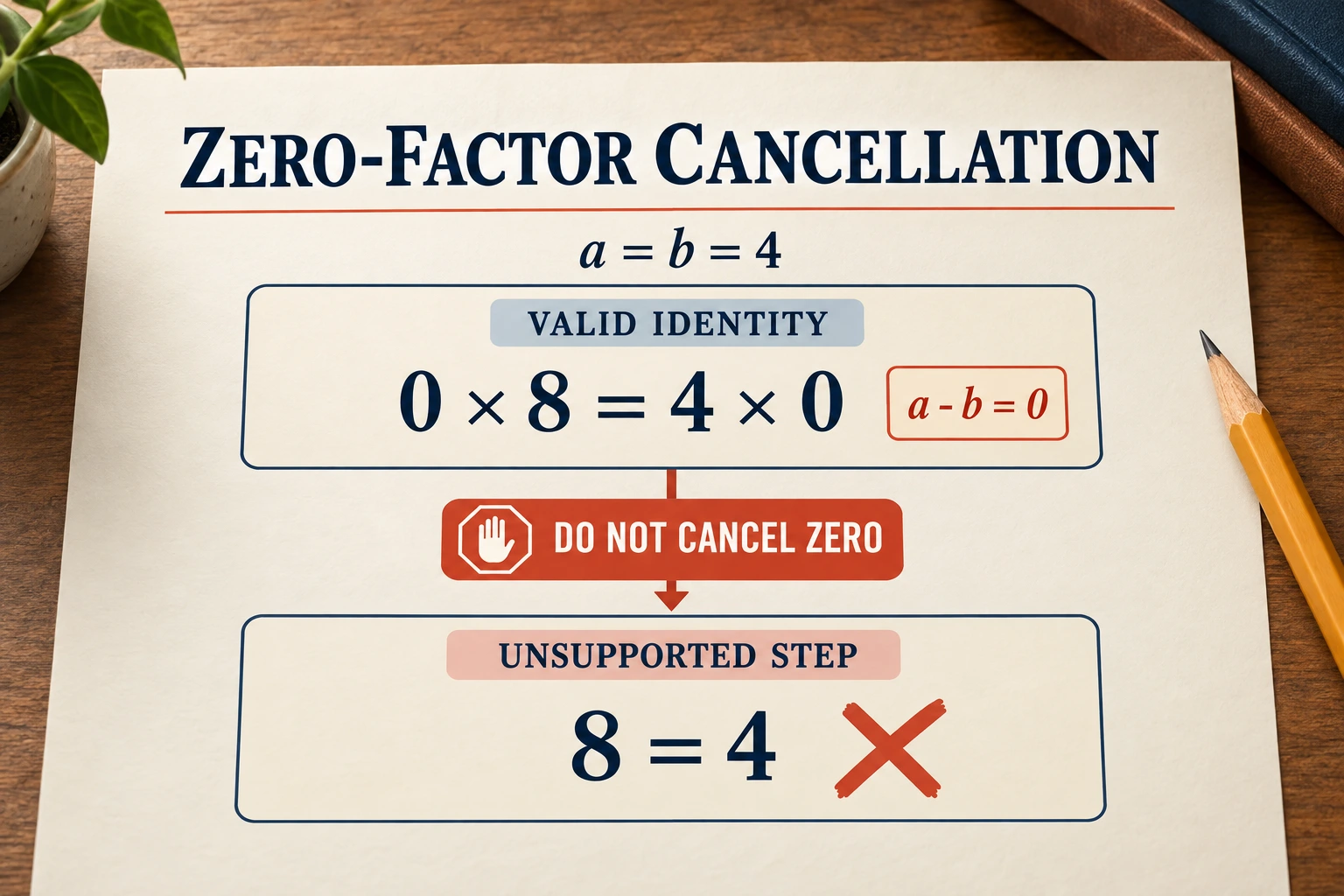
A zero-factor cancellation can make a short algebra trace appear to prove an impossible equality. In the original paper record below, the first three lines are true under the given premise. The next line removes a common factor that equals zero. That operation is undefined, so the claimed conclusion does not follow.
The task is to find the step that needs to stop, while preserving the valid work before it. All numbers are exact values in ordinary real-number arithmetic. They are not measurements, prices, instrument readings or observations of a device performing a calculation.
Keep the starting values beside the trace
Let a and b both equal four. Write a = b = 4 above the working. These are fixed starting values for this exercise, not unknown quantities whose values we hope to discover. In particular, a minus b equals zero throughout the record.
A letter can conceal that last fact if you look only at its shape. The expression a minus b is a written difference, and its value follows from the premise. It does not become nonzero because it occupies the position where a factor might later be crossed out.
Keep the letters and the numerical check together. One column can contain each symbolic equation; another can substitute four for both letters. The substitution is available at every line because the starting values have already been supplied. There is no need to infer them from the final result.
Reconstruct the true equations first
Begin with a squared equals ab. Under the premise, the left side is four squared, or sixteen. The right side is four times four, also sixteen. This line is true. Its validity depends on the chosen equal values, so retain the premise above it.
Subtract b squared from both sides. The equation becomes a squared minus b squared equals ab minus b squared. Numerically, that is sixteen minus sixteen on the left and sixteen minus sixteen on the right. Both sides are zero.
Nothing has required division so far. Subtracting the same defined value from equal quantities preserves their equality. If someone marks this subtraction as the source of the impossible conclusion, the numerical row supplies a direct check: zero still equals zero.
Do not reject every preceding line merely because you know the last line is false. A diagnosis is more precise when it identifies which transformation loses its justification. Here, retaining the true subtraction row makes the later unsupported operation easier to locate.
Expand the factored row to check it
Factor the left side as (a - b)(a + b). Expanding those brackets gives a squared plus ab minus ab minus b squared. The two middle terms cancel by addition, leaving a squared minus b squared. This verifies the factorization without dividing by a minus b.
Factor the right side as b(a - b). Expanding it gives ba minus b squared, the same as ab minus b squared in our ordinary arithmetic. The full factored equation is therefore (a - b)(a + b) = b(a - b).
Substitute the supplied values again. The factored row reads zero times eight equals four times zero. Both products are zero, so the equation is still true. The factor a minus b appears on both sides, and its value is visibly zero on both sides.
The cancellation of ab with minus ab during expansion was subtraction of equal terms. Removing a common multiplicative factor by division is a different operation. The shared word cancel should not make those steps look interchangeable when you explain the trace.
Evaluate the factor before removing it
The next proposed line is a + b = b. It would come from dividing both sides of the factored equation by a minus b. But a minus b is four minus four, or zero. This is exactly the divisor the premise rules out.
Crossing out matching symbols does not supply permission for that division. The usual removal of a common factor requires the factor to be nonzero. Here, that requirement cannot hold alongside the stated starting values. Stop before writing the proposed line as a consequence.
If you nevertheless substitute into it, a + b = b reads eight equals four. This is the first false equality in the displayed trace. The check exposes the false result; evaluating the removed factor explains why the transition to it was unsupported.
Explain why the zero products do not determine the factors
Consider a separate exact comparison: zero times nine equals zero times three. Both products equal zero, although nine and three are different. Thus two equal zero products cannot, by themselves, establish that the other two factors are equal.
This comparison is enough to test the proposed cancellation rule. If crossing out a common zero were legitimate, it would also turn that true equation into nine equals three. The counterexample shows why a rule permitting that step would fail even before considering the letters a and b.
Do not describe zero divided by zero as an answer that can take any value. In ordinary arithmetic it is undefined. The equation zero times q equals zero is satisfied by many values of q, which is precisely why it does not recover one uniquely determined quotient.
Likewise, assigning the quotient zero would not repair the proof. Zero times eight and four times zero agree because both products are zero, not because the cancelled factors secretly acquired a common replacement value. Keep the product equality in the form that is actually justified.
Compare a cancellation with a nonzero divisor
Use another equation with its own declared input: 3(x + 1) = 15. The factor three is nonzero. Dividing both sides by three gives x + 1 = 5, and subtracting one gives x = 4. Substitution into the original equation gives three times five equals fifteen.
This control identifies the condition missing from the false trace. A known nonzero divisor permits the division; a factor forced to zero does not. We have not changed the original a and b to make that control work. It is a separate equation illustrating a permitted operation.
There is no need to avoid all factorization or all division after finding the error. Check the actual divisor at the step being considered. In the false trace it is a minus b, not a plus b, the number b or a symbol chosen from some earlier line.
Repair the record without inventing a new premise
Retain the row (a - b)(a + b) = b(a - b). Add a note beside it: a - b = 0, so division by this factor is undefined. Mark a + b = b as an unsupported proposed step rather than presenting it as the next established equality.
The repaired result is the diagnosis of the stopped trace. It does not need another value for a, a new solution or a replacement conclusion about the numbers. The given a = b = 4 remains consistent with every retained equation.
If the record later subtracts b from the false line and reports a = 0, preserve that downstream work as dependent on the unsupported line. Subtracting four from eight equals four would produce four equals zero, which is still false. A defined later operation cannot supply the missing justification for the earlier division.
Changing a to five while keeping b at four would create a different problem. The proposed first line would then read twenty-five equals twenty and would already be false. Making a minus b nonzero that way does not repair the original chain; it breaks its starting equality.
Keep the numerical check and the symbolic reason together
A note saying only that eight does not equal four leaves the reader to find the cause again. A note saying only never divide by zero may leave them to identify where zero appeared. Combine the two: the shared factor is a minus b, its value is zero under the premise, and removing it would require undefined division.
You can explain the same limit with a and b both equal five on a separately labelled copy. The factored row then becomes zero times ten equals five times zero. Removing the zero factor would claim ten equals five. The same kind of failure follows from the same equal-value premise.
This second copy is a check on the explanation, not evidence that the original values changed. Keep its premise attached to its own rows. The useful conclusion is about the attempted division in these records, rather than a claim that every algebra trace with brackets or repeated letters contains the same mistake.
Read the two ruler accounts
The Mitutoyo Series 182 ruler account names a 12-inch rigid ruler. Its sole image shows a flat graduated rule with Mitutoyo print. The short description lists material, color, finish and type; these are offer entries, not independently verified measurements or material findings.
The BAZIC clear ruler account names a 288-pack. Its sole image shows four packaged rulers and a 288 PACK callout. That promotional view does not establish delivered quantity, accuracy or the stated graduation size. The paper values here are not readings from either offer.
Keep the nearby mathematical questions distinct
The calculator error-message guide uses applicable model manuals to distinguish input and calculation errors, including an explicit zero denominator. This paper trace instead conceals the zero inside a symbolic difference. It supplies no calculator control sequence or hardware repair.
The exact-fraction proof for an invented display number uses a reduced fraction and a parity contradiction. Its division by two has a nonzero divisor. Here, the error is attempting to remove a factor whose value the premise already fixes at zero.
Leave a possible purchase with its actual evidence
If you separately consider an order on republeq.com and want to ask about USDT, identify the exact offer and intended quantity before discussing payment. The letters and numbers in this algebra trace are invented mathematical inputs, not product prices, token amounts or instructions to transfer funds. Finding an unsupported equation establishes no available payment method or commitment by a seller. Read the choices and conditions actually presented for the intended transaction, and ask the responsible support contact to clarify essential information before deciding whether to proceed. If a cryptocurrency option is offered, establish the specified asset and network, the requested amount, any stated validity period and the reference associating payment with that order. Do not infer a destination from an illustration, a previous transaction or a message about another proposed purchase. Resolve any necessary item or supplied-contents question separately from the payment discussion. Ask about applicable delivery, cancellation, return and refund conditions, including the denomination of an approved refund and relevant deductions. Keep each answer attached to the offer and quantity it concerns. A changed basket may require reviewing the resulting transaction information again. If an instruction has expired, obtain current information before making a transaction decision. This article promises no present USDT availability, conversion result, fee level, processing time, refund amount or delivery outcome. You can examine every equation without placing an order. Preserve any eventual acknowledgement and payment record separately from the paper proof. A valid algebraic identity cannot confirm that a transaction was authorized, completed or reconciled. If the transaction status is uncertain, resolve it through the responsible merchant before considering another payment.
Retain the last valid line and the reason for stopping
For a = b = 4, the trace correctly reaches zero times eight equals four times zero. The proposed next line, eight equals four, requires cancelling a factor equal to zero. Leave that step rejected, with the divisor and its value written beside the retained identity.
The repair preserves what the record established and identifies the operation it cannot justify. Someone reviewing it can check both the true products and the failed cancellation condition without guessing which premise or line was changed.