Outdoors & Mobility
Read umbrella size labels before comparing canopy and carry form
An explanation of umbrella dimension wording and pictured states, without turning a curved canopy illustration or ruler photograph into a verified fit claim.
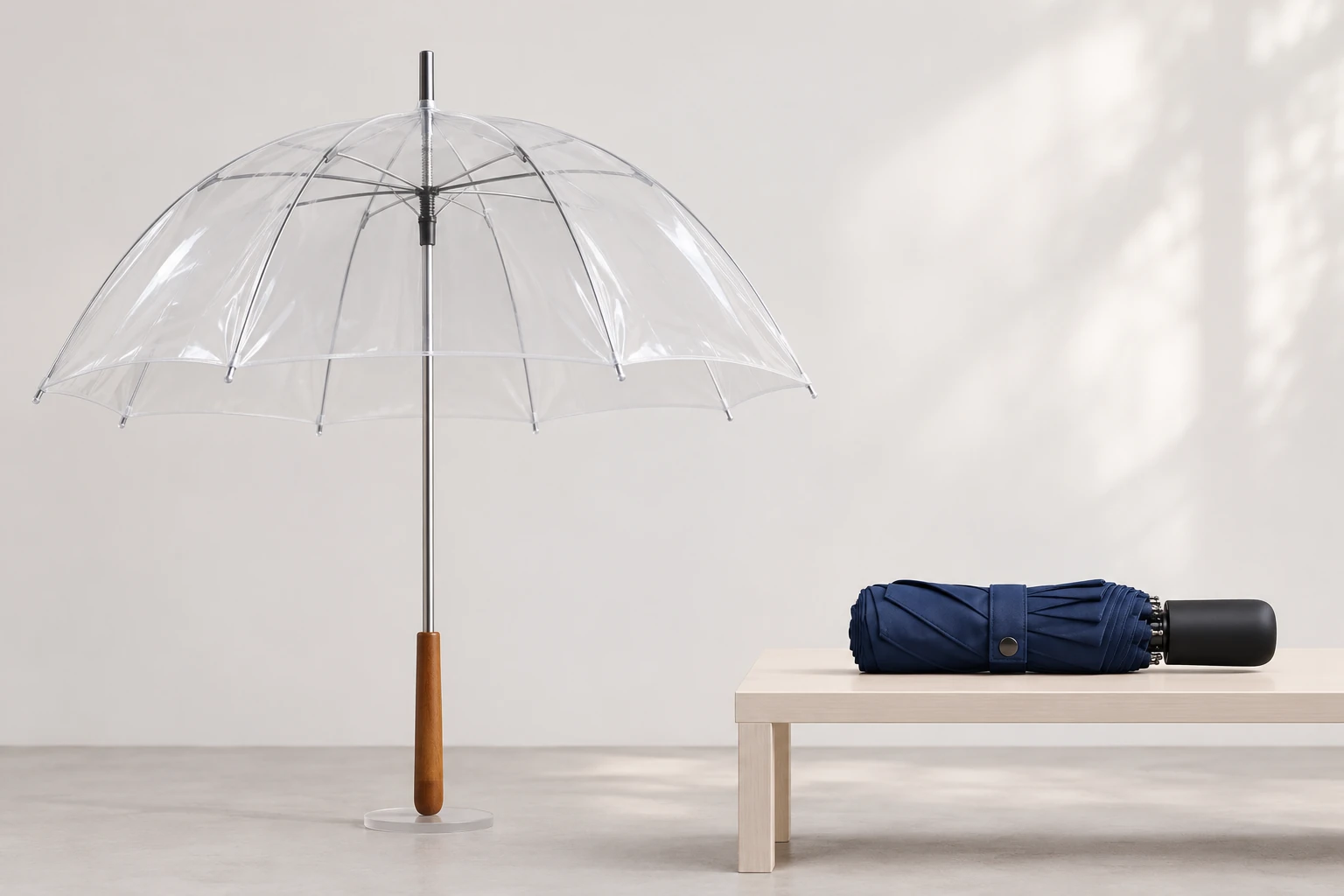
Umbrella size labels become more useful when the product state stays attached to them. An opened canopy, a closed stick umbrella and a folded compact umbrella present different questions. A number printed beside one view should not quietly become the answer for another. Begin with the question you need answered, then read the wording and illustration together before comparing offers.
Someone considering an umbrella for a daily trip might want information about its open form and its carrying form. Those interests can coexist without collapsing into one size field. A clear purchase note leaves room for both. It also keeps an undefined size description visible as a question, rather than making it look precise by supplying a meaning the listing has not stated.
Keep the pictured state with the label
Start by identifying the view that accompanies the size wording. Is the canopy open? Is the umbrella closed but still a stick form? Is it folded into a shorter carrying form? These are descriptions of the information being presented, not instructions for operating an unfamiliar umbrella. Keep the relevant product’s instructions separate from the job of reading its catalog entry.
The clear auto-open umbrella six-pack offer repeats a forty-eight-inch label in its title and description. One gallery graphic draws that label over the opened canopy with a curved arrow. The whole account identifies a six-pack, and another image depicts six umbrellas. Preserve the illustrated cue as shown. It is not an independently checked straight-span measurement or a statement of closed carrying length. The native brand field is Unbranded; Barton Outdoors graphics do not authenticate a maker here.
Canopy size wording therefore needs its own place in the record. Retain the exact wording and the view or diagram that accompanies it. If the description does not define the measurement you require, ask for that definition. Do not replace a missing straight-span answer with a curved graphic simply because the same unit appears beside both ideas.
Keep closed carrying length as a separate question
Closed carrying length concerns the item in the carrying state relevant to the buyer. Record which state the information describes, including whether an applicable description concerns the umbrella itself or an identified carrying accessory. A short-handle phrase alone does not provide every outside dimension. Nor does a general compact label establish that the item will fit a particular space.
The second example is the Unbranded short-handle umbrella offer, identified by SKU 18679163439. Its native description names automatic opening and a short handle. Gallery images show the same striped folding umbrella, including a closed view beside a ruler. Other images show a fitted sleeve, whose supplied inclusion is not established by the native prose. This article does not read a calibrated length from the photograph, claim that the sleeve is supplied, or authenticate the Martini Racing Porsche graphics as a maker.
For a carrying-space enquiry, retain the actual requirements of the space alongside the product question. An answer about the open canopy would leave the carrying-state dimension unresolved. A photograph showing a closed item can help identify which form is under discussion, but it does not automatically supply the exact information needed to establish a pairing with another object.
Try two description cards without inventing measurements
Imagine preparing two fictional description cards for an umbrella enquiry. One card has an open-canopy illustration and a size phrase. The other has a closed-form illustration and no dimension wording. These are invented reading examples, not additional retail offers. The task is to identify what each card actually says and what question remains unanswered, without inserting an imagined measurement.
If the buyer’s question concerns the carrying form, the open-canopy card should retain its own description. Add the carrying question beside it rather than moving the canopy wording into the blank field on the closed-form card. This keeps the enquiry honest. It also lets another person see why the available information has not yet answered the intended purchase question.
Now suppose a reply supplies a defined dimension for the relevant closed form. Keep that answer with the exact product and stated condition it addresses. It fills a particular information gap. It does not retroactively change the meaning of the open-canopy card, identify the contents of a different offer or establish every other requirement involved in carrying the item.
Read the illustration as part of the account
A diagram can make a description clearer when its arrows, endpoints and wording identify the intended feature. Read those cues before extracting a number into a comparison note. If you retain only the number, the next reader may lose the distinction the illustration was providing. Keep a reference to the whole diagram so that its context remains available when someone reviews the enquiry.
Do not treat a product photograph as an independently calibrated drawing. Camera angle, framing and the relationship between objects need information of their own. This explanation supplies no method for measuring from a photograph and no correction for perspective. If the required product dimension is missing, obtain an applicable stated answer rather than creating one from the apparent scale of an image.
The same care applies when a search result crops the original view. A shortened caption may omit the word that identifies the product state. Return to the actual offer and preserve the fuller account before using the detail. A crop can be useful for finding a candidate; the eventual note should still identify the item and the information on which the comparison depends.
Keep other product relationships with their own evidence
The hanging file folder fit guide distinguishes document format, stated capacity and the support arrangement. Those relationships belong to the folder problem it examines. They do not supply an umbrella dimension. The useful connection here is the need to retain what a descriptive field actually concerns, while leaving a different product question with the evidence that addresses it.
The paint roller cover compatibility guide separates working dimensions from the cover and frame interface. Its actual roller specifications remain with those offers. They provide no umbrella measurement or carrying-space approval. A precise-looking field can still leave another relationship unresolved; keep that missing question visible instead of borrowing an answer from a different component.
In an umbrella enquiry, name the actual carrying arrangement if that is what prompted the question. Give the responsible seller or maker the exact product reference and ask for the applicable dimension or clarification. Retain the answer and the information it refers to. This explanation does not provide a fit test, a modification method or permission to force an item into an unsuitable space.
Leave coverage and opening controls outside the size field
A size label does not independently establish the weather experience a person will have. This article has not tested coverage, rain protection, wind behaviour or carrying comfort for either offer. Keep any applicable product claims attributed to their actual source and conditions. Do not convert the act of understanding a dimension label into a broader performance assurance.
Opening and closing instructions also need their own account. A label attached to an open view does not explain a complete operating sequence, and the appearance of a handle button does not define every movement. Consult the applicable instructions for the actual item. The reading exercise here concerns product-state and size information; it supplies no shaft-reset, maintenance or repair procedure.
If several people contribute to the comparison, ask them to retain the same distinctions in their notes. One person may be looking at an open illustration while another is considering storage between trips. Name those questions in the shared record before discussing a preference. This makes it easier to exchange the missing information without describing the other person’s question as an error.
Keep payment context separate from the size enquiry
If you consider buying through Republeq.com and its current checkout actually offers a USDT cryptocurrency payment option, keep payment checks separate from umbrella size labels. An available payment method does not establish the meaning of a product size label or resolve a missing answer about the route. Before authorizing a purchase, confirm the exact item, selected option, quantity and delivery information shown in the current order. Read the applicable delivery and return terms rather than treating a product description as a promise about every eventual outcome. If a token payment requires a network choice, use the exact supported network and recipient instructions provided by the current checkout. A familiar token name alone does not establish those details, and this article supplies no address or payment route. Do not send funds using information copied from an unrelated message, product photograph or old purchase note. Keep the order and payment records available so that the person responsible for the purchase can identify what was actually requested. If the size requirement remains unresolved, pause the purchase decision long enough to obtain the applicable answer or select a different supported plan. A checkout button cannot supply missing dimension evidence. This article has not tested a checkout, verified token settlement, calculated charges or established that any particular payment option is available to every buyer. USDT is conditional purchasing context here. The same practical separation applies with any payment method: establish what the task requires, identify the exact offer and its limits, and complete the checks that matter before relying on the item for the intended journey.
Finish the comparison with its limits intact
The two native examples provide different information: a curved canopy-label graphic in the clear six-pack offer, and closed-form photographs in the short-handle offer. Neither is converted here into a verified carrying-space fit. Keep those source limits attached when deciding what further product information the intended purchase needs.
A useful final note names the exact offer, preserves the relevant wording and pictured state, and identifies the unanswered requirement. It should let another reader return to the same source without reconstructing the question from an isolated number. If a later clarification changes the record, retain what it actually resolved and keep the earlier wording identifiable.
When an offer changes during the discussion, check which answers still belong to it. A reply concerning one product should remain attached to that reference even if a replacement looks similar in a small photograph. Tell the person making the purchase what changed and which requirement needs a new answer. Preserve the earlier enquiry so that a familiar label does not conceal the switch. This is a record of the proposed order, not a declaration that either item has passed a physical carrying test.
Read umbrella size labels with that discipline: retain canopy size wording in its open-view context, obtain the applicable closed carrying length separately, and leave undefined wording as a question. The result is a clearer product enquiry, with no invented measurement and no promise that an unrelated carrying or weather requirement has already been met.
A canopy label does not give every carrying dimension.