Outdoors & Mobility
travel pillow shape comparison for packing and use
Compare rectangular and curved travel pillow forms, then test their placement and retrieval in your actual bag.
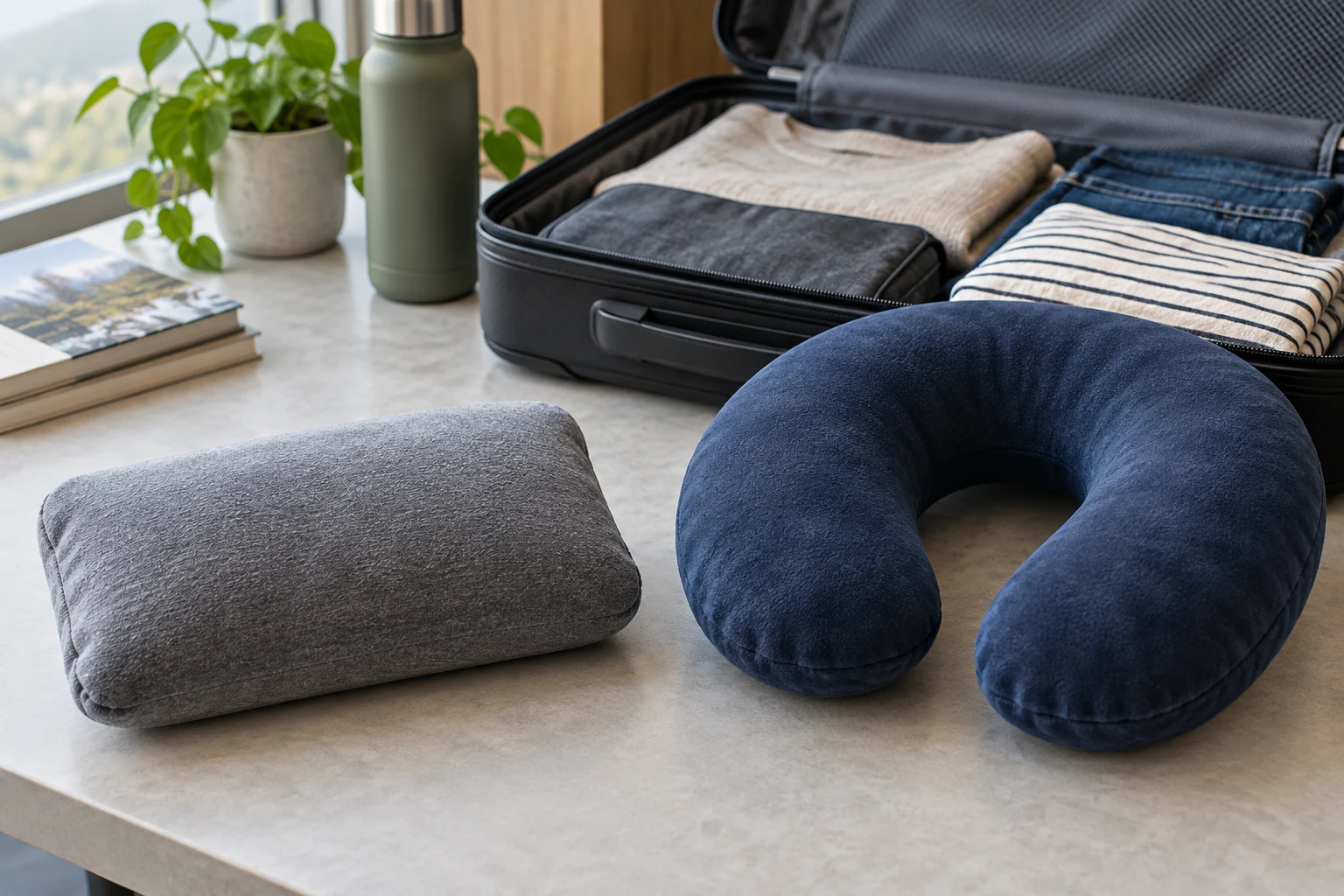
Travel pillows do not all take the same shape. A small rectangular pillow presents a broad, flat face; a curved neck pillow wraps around a different part of the body. Those visible forms affect how each sits in a bag and where you might place it during a journey. The shape alone does not prove better sleep, medical support, or a fit for every traveler. A useful travel pillow shape comparison begins with the actual product and the actual space you expect it to occupy.
The two product records considered here show different physical examples: a rectangular travel pillow supplied with a case, and a curved neck-pillow set associated with an eye mask. They are useful for explaining form, not for declaring a universal winner. A catalog image cannot tell you how your head will rest in a particular seat or how a pillow will behave when squeezed among other belongings. Use the documented shape as a starting point, then check the real object and bag before your trip.
Identify the two shapes
A rectangular travel pillow is easy to recognize because its long and short sides form a familiar cushion outline. It can be turned so its broad face or narrower edge meets a surface. That flexibility may be useful when a traveler expects a flat place to lean, but it also means the pillow has to be positioned rather than merely worn. Where the traveler puts it will depend on the seat, headrest, and personal preference. Do not assume its familiar outline means it will stay put in motion.
A curved neck pillow presents an opening between its ends and a rounded arc. It is designed to sit around the neck area, yet the real fit depends on the person and setting. A curved outline can leave an open central space while still projecting at the sides. When packing, that irregular shape may interact with the corners of a bag differently from a flat rectangle. These are observations about geometry. They are not a promise that the product supports a particular posture or prevents discomfort.
Look at the actual item from above and from the side. Is it a rectangle, a broad curve, or a more complex form? Notice where its thickest parts are. If you already own it, place it on a table instead of judging only the compressed image on a screen. A pillow’s outline tells you how to orient it in a bag; its thickness and material tell you whether that orientation actually leaves room for the rest of your things. A title may name a style without documenting every dimension.
See what each form occupies
The rectangular travel pillow with a case is the flat-sided example in this comparison. Its product title identifies a rectangular pillow and included case. That does not establish that every similarly named pillow has the same size, that its case works with another pillow, or that it can be compressed safely. When you plan bag space, set the actual pillow against a wall of the bag and see whether its broad face takes over the area needed by clothing or other essentials.
The curved neck travel pillow set is the contrasting form. Its listing describes a neck-pillow shape and an associated eye mask. The eye mask is a separate component; it does not change the pillow’s curved footprint. A curved pillow may nest around a small object in some bags, but forcing unrelated items through the opening can distort the kit or make it hard to retrieve. Check the actual package pieces and keep the mask where it will not be lost.
The practical difference is not simply that one is flat and the other is round. A rectangle has corners you can align with a bag wall, while a curved piece may leave gaps yet project farther at its sides. Those gaps are not automatically usable storage. If you fill them with loose objects, you may make the pillow difficult to remove quickly. Try both orientations in your own bag and observe what remains accessible; the same pillow can pack differently in a narrow tote and a broad carry-on.
Do not use a catalog photograph to infer a compression ratio. Some materials can be squeezed and rebound, while others may lose their form or need a specific storage method. The two product records do not establish a common compression or vacuum-bag rule. If you have the pillow, test a gentle placement rather than a forced squeeze. If you do not have it yet, leave a margin in your packing plan. A bag that closes only under strain is already telling you the layout needs revision.
Test the real bag
Start with the items that must travel, not with an empty bag that makes every pillow look easy to pack. Put clothing, documents, and other essentials in their usual places. Then add the pillow in the location where you expect to retrieve it. Close the bag normally and reopen it. Can you take the pillow out without pulling everything else apart? Can you return it after use? These two movements matter more than whether the pillow fits once for a photograph.
Try a second orientation if the first blocks a zipper or pocket. The rectangular pillow might sit along a broad side or on top of softer belongings. The curved one might occupy an outer section if the bag allows it. Neither placement is universally best. Keep heavy or sharp objects from pressing into a soft pillow, and follow any care directions provided with the actual product. The point of the test is to find a layout that works with your bag’s real opening and your own retrieval routine.
If the pillow will be carried outside the bag, examine any strap or attachment on the exact item before relying on it. Do not assume a loop in a product photograph is suitable for hanging a loaded pillow from luggage. An external item can brush surfaces, catch in a tight aisle, or separate from the bag. You may prefer to keep the pillow inside, especially when you cannot verify the attachment. This is a practical handling choice, not an airline policy statement; baggage rules come from the carrier and trip.
For a trip where the main question is how to keep a rest item reachable at the right moment, the travel rest kit packing routine handles that sequence. This explainer asks the earlier shape question: what physical form are you adding to the bag? Once that is clear, you can decide when it should be accessible. A pillow hidden under the last layer of clothing may be technically packed but unhelpful during a short stop.
Consider where the pillow will be used
The rest setting changes the meaning of the shape. A rectangular pillow needs a surface or position that makes its broad face useful. A curved neck pillow places its arc around part of the neck area. Neither form can be evaluated from shape alone because seat geometry, clothing, head position, and personal preference differ. If you can try the item at home, sit in a reasonably similar posture and notice where it moves or presses. Do not treat a few minutes of trial as a medical assessment.
Think about how you will put the pillow away after use. A rectangular piece with a case may be simple to slide back into its own cover if the supplied pieces are present. A curved set may include a separate mask that needs its own pocket. Do not assume the mask fits in the pillow opening or that the rectangular case fits the curved pillow. Keep each kit’s components together and check labels or care instructions for the exact product before washing or storing it.
The travel pillow accessory compatibility guide covers the separate decision about which case and eye mask belong to which product. It is especially useful if multiple pillow kits are mixed at home. This article is about understanding the forms before packing and placing them. Shape explains why a generic one-size packing instruction fails, but it does not authorize swapping accessories between the two examples.
If another person will use the pillow, let them test their own fit and handling. A child’s neck-pillow listing, for example, should not be generalized to an adult or to another child simply because the curved silhouette looks familiar. Follow the actual product’s age and use information where available. In a shared travel bag, separate each person’s kit so the pieces do not get mixed. A neat packing plan is only useful if the right traveler can recognize and retrieve the right item.
Keep claims within the product record
A product title can identify a pillow’s type and perhaps an included component, but it cannot substitute for measurements or comfort testing that the listing does not provide. Do not infer that either example meets a medical need, offers a particular degree of neck support, is machine washable, or complies with every carrier’s baggage allowance. Those claims require their own exact source. This restraint makes the comparison more useful: it tells you what to inspect instead of pretending a photograph answers every question.
Keep the comparison personal and physical. Lay the pillow next to your bag, observe the outline and thickness, try a normal close-and-reopen cycle, and practice retrieving it from its intended position. If it blocks access to more important items, move it or leave it out. If the pillow has an included case or mask, verify the pieces and follow their own care information. A smaller packing challenge can often be solved by changing orientation, but no arrangement can create space that is not there.
Before departure, repeat the test with the bag at its real packed level. A travel pillow shape comparison is complete when you know which physical form you are carrying, where it can be placed without forcing the bag, and how you will retrieve and return it. The rectangular and curved examples offer different outlines, not guaranteed outcomes. Let the actual item, actual bag, and traveler’s own trial decide whether either belongs in the kit.
After the trip, note whether the chosen position worked. Was the pillow easy to reach, or did you have to unpack other things? Did a separate mask disappear into the bottom of the bag? Did the pillow’s shape make a pocket difficult to close? These observations can improve the next trip without turning one experience into a rule for everyone. Store each kit’s pieces together and keep the bag layout simple enough that you will use it again.