Outdoors & Mobility
travel pillow accessories: match a case or eye mask to the right pillow
See which case or eye mask belongs to your pillow shape and confirm the actual included pieces before packing.
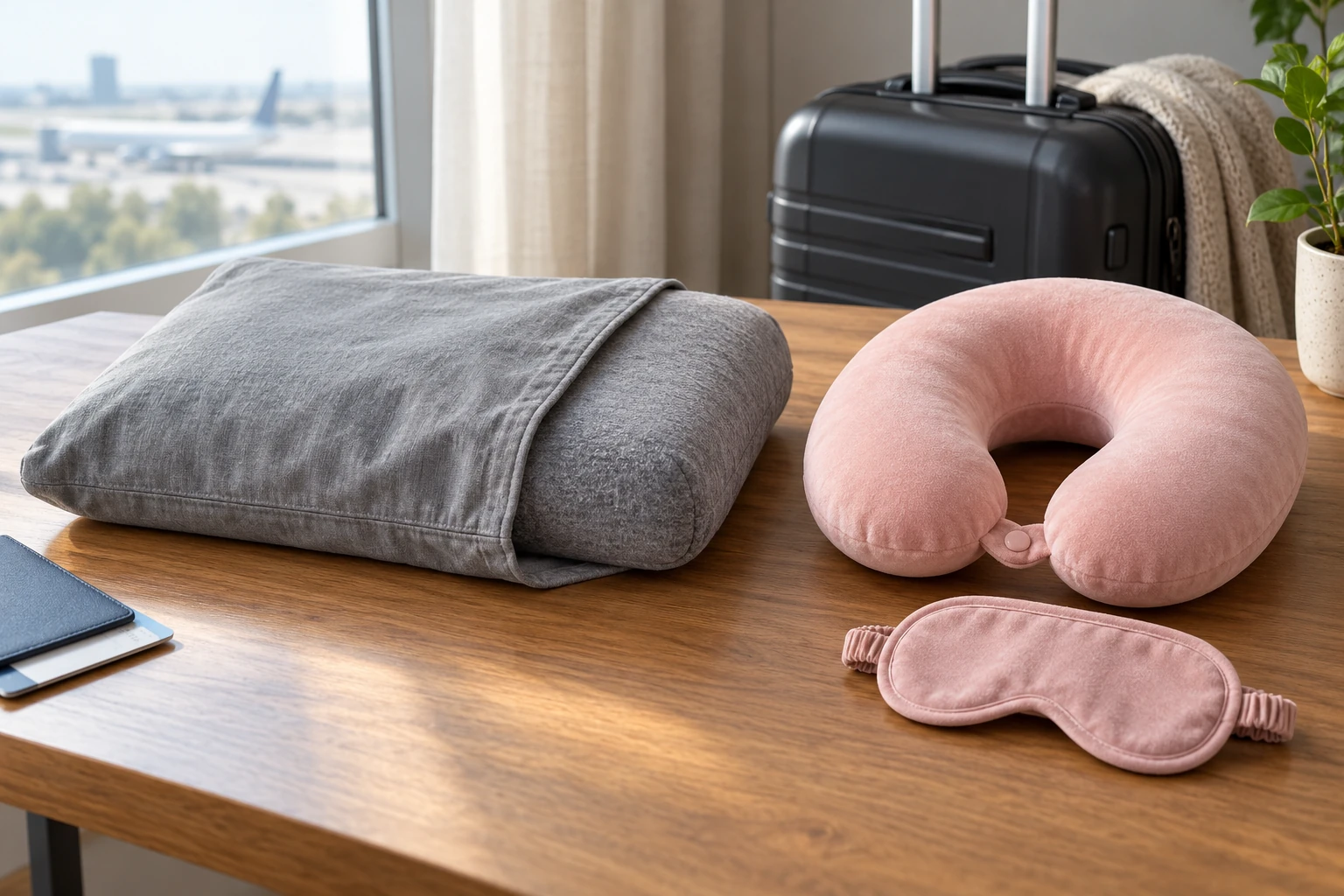
Travel pillow accessories can look like one interchangeable group when they are packed together: a loose case, a curved neck pillow, an eye mask, and sometimes a carry pouch. They serve different pieces of a rest setup. A case must fit a particular pillow shape. An eye mask sits separately over the eyes and does not make a neck pillow fit better. A pouch may hold the set for transport without changing how either item supports the traveler. The useful purchase and packing question is which accessory belongs to the exact pillow you will carry.
Place the pillow and every claimed accessory on a table before the trip. Identify the pillow’s shape, the opening in any case, and whether an eye mask or pouch is part of the same listing. Read the included-items line for the actual product rather than treating a styled photograph as a complete inventory. Then check the real dimensions and closure details that matter for your use. “Travel pillow” can describe a rectangular pillow or a U-shaped neck pillow, so the words alone do not establish accessory compatibility.
Start with the pillow shape
A rectangular travel pillow has a broad face and two longer sides. A fitted-looking case for that shape may have an opening along one edge and enough fabric to wrap around the corners. A curved neck pillow has an opening at the front and a different profile. A case shown on a rectangular pillow should not be presumed to fit the curved one. Hold the real case against the real pillow without stretching or forcing it. If the shape is wrong, a matching color will not fix the mismatch.
Notice where the pillow will be used, but keep that separate from the accessory decision. A pillow for a guest bed or a quiet seat can need a different shape from one carried around the neck. The travel pillow rest-moment guide helps choose when a pillow should be reachable during a trip. Once that decision is made, check the case or mask against the chosen pillow. Do not buy an accessory first and then ask the pillow to suit it.
For a case, inspect its actual opening and the way the pillow enters it. Does the fabric reach around the pillow without compressing it into a shape it was not made to hold? Does a zipper or fold close without catching the pillow edge? These are physical checks, not claims that every case should fit every pillow in a named size class. If the case is sold separately, use the maker’s compatibility or measurements for that exact item. If it is included, confirm which pillow the included case accompanies.
Read what the package actually includes
The gray travel pillow with pillow case is an example of a listing that names the pillow and its case together. The listed rectangular 14-by-20-inch format gives a specific object to compare with a case, rather than a generic promise about all travel pillows. Check the current product page for the exact included pieces and dimensions. Do not infer that the case also covers a U-shaped neck pillow or that another brand’s case uses the same opening.
The children’s neck travel pillow and eye-mask set names a different arrangement: a curved pillow paired with an eye mask. The mask is an accessory to the rest setup, not a pillow cover. A two-piece or two-set phrase should be read against the exact listing, because the number can describe sets, included components, or a package quantity. Confirm the actual contents before deciding that a second person has a complete set. The photograph alone may not resolve that count.
Make a small inventory from the listing: pillow, removable case if named, eye mask if named, and any carrying piece if named. Keep items not mentioned in the listing out of that list. An accessory shown in lifestyle photography may be staging. This habit prevents the common surprise of expecting a case with a neck pillow simply because another travel pillow page included one. It also protects against buying a duplicate eye mask when the chosen set already includes one. Use the actual product record, not a category label, to settle the inventory.
Look at the physical relationship between the items. The case goes around or over a pillow only if it is designed for that pillow. The eye mask is separate and should be evaluated for the wearer’s own comfort and fit. A carry pouch would need to hold the chosen components without forcing them, but its presence cannot be assumed. If you are assembling pieces from different listings, check each connection independently. “Travel accessory” is a broad merchandising phrase, not a compatibility specification.
Check the case before packing
If a case is removable, put it on the pillow at home. Do not wait until a crowded departure area to discover that the opening is too narrow or the closure catches. If the case comes off for cleaning, follow the care instructions for both case and pillow; the two pieces may have different requirements. Do not assume a pillow can be washed because its case can. Record which case belongs to the pillow if several family members own similar-looking items. A small label on a separate storage bag can help keep matched pieces together without changing the pillow itself.
A case that goes on only with strong pulling is worth reconsidering. It may be the wrong size, the wrong shape, or simply oriented incorrectly. Turn it to locate the intended opening and compare it with the pillow’s longer and shorter dimensions. If it still does not seat naturally, stop rather than stressing a seam. A product’s measured outside dimensions are more useful than a broad “standard travel” description, but even a matching number needs a check of thickness and opening design. A case is compatible when it fits the actual pillow without distortion.
If the pillow has a fixed outer cover, a separate case may not be part of its intended setup. Check the product’s own description before adding one. A loose sleeve can shift during use and might change how the pillow sits. No universal rule says every travel pillow needs an extra cover. If the reason for adding one is cleaning, use the maker’s care guidance to decide whether a removable case is appropriate. Keep the decision tied to the particular pillow rather than an assumption drawn from another product page.
Treat the eye mask as its own item
An eye mask does not need to attach to a neck pillow to be part of the same travel kit. Check whether it is included, then assess it on its own terms. Can the wearer adjust it comfortably? Does it stay in place without an awkward strap position? A children’s set should be evaluated for the actual child rather than by a decorative design alone. A picture can show the intended combination, but cannot prove comfort for a particular person. Keep the mask clean and stored where it can be found when the pillow is used.
Do not confuse a matching theme with a tested fit. A pink mask and pink pillow may be sold together, but the mask still has its own shape and strap. If it is being replaced, compare the replacement’s size and construction with the wearer’s needs rather than hunting only for the same color. A mask may also be used without the pillow, while the pillow can be used without the mask. Their shared package does not make either component mechanically dependent on the other.
For travel, think about where the mask will be when it is wanted. If it sits at the bottom of a suitcase, the accessory may be present but inconvenient. A small pocket or pouch can keep the mask with the pillow, provided it does not crush or soil either piece. This is a packing choice, not a claim about a particular product’s included storage. The suitcase space-planning guide handles the broader bag-size decision. Here, decide whether the exact pillow and its own accessories can be reached together.
Test the combined kit
Put all the pieces you plan to take into the bag you will actually carry. A rectangular pillow can take a different shape of space than a U-shaped neck pillow. Do not infer packing volume from a product title or a photograph beside an empty suitcase. Check whether the case stays on, whether the mask has a protected place, and whether the pillow can be removed without scattering the other items. The kit should work as packed, not only as a neat arrangement on the table.
If two travelers share a bag, keep their pillow accessories identifiable. A removable case can be confused with another similar case; an eye mask can disappear into a side pocket. Set out one group per person and confirm each group’s pieces against its product listing. If a package supplies two sets, verify that the actual components are present for both. Do not assume a “two-set” label means two of every pictured object unless the included-items record supports it. A brief inventory before departure is easier than sorting near a gate or hotel bed.
After the trip, separate pieces that need cleaning according to their own care labels and return each accessory to its pillow. If the case is laundered while the pillow stays in storage, leave a note or a designated place so the pair can be reunited. Do the same for an eye mask kept with a neck pillow. This return habit preserves the compatibility decision you already made. It prevents the next trip from starting with a search for a case of uncertain size or a missing mask.
If you are replacing one component, bring the exact pillow or its measured details to the comparison. The brand, shape, and stated dimensions narrow the search, while the opening and closure still need to suit the actual object. Ask the seller or maker about compatibility when the listing is unclear. Do not infer an exact fit from “travel pillow” alone. A case, mask, or pouch is useful only when its role and fit are clear for the traveler who will use it.
Travel pillow accessories become simpler once their roles are kept separate. The rectangular pillow’s case covers that pillow; the eye mask in a neck-pillow set serves the wearer; and any carrying piece must be confirmed from the actual package. Check included items, compare real shapes, and pack the chosen pieces together once. The result is a kit you can identify and retrieve without treating visually similar accessories as interchangeable.