Problem-Solving Articles
Suitcase size label confusion: build a packing and space plan
Resolve suitcase size label confusion by separating overall, case and expansion figures from packing questions and missing interior measurements.
Suitcase size label confusion often begins with a short number in a product title. A case called 27 inches may also have a longer overall measurement, a shorter case measurement and a separate expansion figure. If you copy only the title's number into a packing or storage plan, you may be asking it to answer a question that belongs to a different measurement.
Resolve the confusion by naming the question first. Are you trying to understand the exterior, the case measurements or the amount of room available for particular belongings? Keep the listing's terms beside its numbers and leave an unanswered field open. You can then identify which measurement answers the question and which detail still needs checking.
Identify the exact offer before checking the number
The Travelpro Maxlite 5 25-inch Expandable Checked Spinner Luggage in Slate Green is described as a softside expandable spinner and a checked-medium 25-inch model. The brand is Travelpro. The short description supplies that product identity, format and color; it does not provide a table of exterior or interior measurements.
The it luggage VIPRB-16-263208-UWL25-S015 27-inch offer gives a different level of detail. It describes gray unisex checked luggage with a hardside case and spinner wheels. The model reference is VIPRB-16-263208-UWL25-S015, with SKU 763167181. Preserve that reference when seeking clarification rather than treating the shorter name in the URL as a substitute for the actual listing identity.
Both offers sit in the catalog's Checked Luggage category. The category tells you how the site groups them. Travel rules, a vehicle's storage space or a cupboard's opening still need their own information. A category name is not a measurement and cannot establish that a particular packed case meets a separate requirement.
Checked suitcase dimensions and packing space are separate questions
To separate checked suitcase dimensions and packing space, write the practical problem as a sentence: “I need the outside measurements for this offer,” or “I need to understand whether these particular belongings fit inside it.” The first question needs exterior information. The second needs information about usable space and the actual belongings. A nominal size label alone does not settle either question.
Use these examples to organize your own questions before deciding what information you need. The descriptions provide no demonstrated packing list, fitted set of clothing or measured interior volume. Keeping your intended contents separate from the product facts prevents an imagined packing scene from becoming a claim about the offer.
For the Travelpro model, the available description leaves the detailed measurement question open. That is a specific gap to resolve for the exact 25-inch offer. It gives no reason to borrow a dimension from another Maxlite size, another color listing or a case photographed beside it. A matching family name does not establish that an unstated measurement belongs to this item.
Put overall and case measurements on separate lines
The it luggage description lists overall dimensions of 27.8 x 19.5 x 11.8 inches, followed by “+ 3 inches expansion.” It separately lists case dimensions of 25 x 17.7 x 11.8 inches, again followed by “+ 3 inches expansion.” Those are two distinct sets of numbers under two distinct labels. Keep each label with its own complete set.
The shorter 27-inch title does not replace either set. When your question concerns the stated overall dimensions, use the line that the description calls overall. When it concerns the stated case dimensions, preserve the line called case. Changing the labels to make the measurements look more uniform would remove information the source actually provides.
The description does not explain exactly which protrusions are counted in each measurement or provide a dimensioned drawing. It therefore supports quoting the two stated sets, while leaving those mechanical details unresolved. You can ask a precise question about what a measurement includes without inventing an answer about the handle or wheels.
Keep expanded luggage measurements in their stated context
When reading expanded luggage measurements, keep each source term attached to its own figure. The it luggage copy says the case expands from the middle for up to 25 percent more space while maintaining stability. It also attaches the separate expansion notation to both dimension lines. The percentage is a qualified capacity claim in the description. The dimension notation is presented alongside the measurements. Preserve both without treating them as interchangeable units.
Do not add 25 percent to every exterior dimension and call the result the expanded size. The description does not supply that calculation. Similarly, the separate three-inch notation is not a basis for enlarging every number in the listed dimensions. If the exact expanded outline matters to the problem you are solving, seek clarification tied to the model and the stated measurement convention.
The Travelpro description calls its suitcase expandable but supplies no expansion measurement or percentage. That difference should remain visible in your notes. It leaves a model-specific question for Travelpro, rather than an empty space to fill with the other offer's figure. An expansion feature and a quantified expanded size are different amounts of information.
Separate a packing list from the luggage specification
If the immediate problem is a packing plan that keeps growing, put the intended contents on a separate page. Name the items you actually plan to take and identify the ones whose size needs checking. This is a planning exercise you can adapt to your trip; the product descriptions do not prescribe a packing list or tell you what your own priorities should be.
Keeping the list separate lets you change the plan without rewriting the product facts. You might decide an optional item can stay home, or you may find that an essential item raises a dimension question. Either outcome belongs to the particular trip. It does not prove that a larger headline size is the answer or that a different suitcase will accept the same contents.
Neither source gives interior pocket measurements or a tested arrangement for your belongings. Leave those points open if they matter. A softside description or a hardside description identifies the case format; it does not establish a particular usable interior shape. A clear packing question is more useful than assigning an invented capacity to that format.
Work through a disagreement before changing the purchase plan
Suppose one person has copied “27-inch” and another has copied the it luggage overall line. They may be looking at the same offer while recording different fields. Identify the label attached to each number first. Keep the title's nominal size and the source's overall measurement in the notes, each with its original role.
If two statements really describe the same field and still disagree, preserve both statements and ask about the exact model. Choose a specific question such as which overall dimensions apply to the offer identified by its model and SKU. A number from a similar product would leave the original model-specific question unanswered.
This approach also helps when a description is short. For Travelpro, you have enough information to identify the 25-inch softside expandable checked spinner in Slate Green. You have not been given the detailed dimensions here. Ask for the measurements required by your original question.
Treat the listed weight as one part of a different problem
The it luggage offer lists a weight of 8.95 pounds. That is a source-stated product weight. It does not report the weight of a packed case containing your belongings. If weight is part of the travel question, keep the stated product figure separate from any result for the actual packed item.
The description calls the trolley tubes strong and lightweight and says they help reduce weight. That is an attributed design claim. It does not identify how much weight the tubes remove, what another model weighs or how much more a traveler may pack. A comparative packing allowance would need evidence beyond that sentence.
No weight is supplied in the short Travelpro description. The model family name supplies no numerical weight here. Keep the absence attached to the exact offer while gathering the facts required for your own question. A weight problem and a dimension problem can both matter, but they need separate answers.
Keep travel acceptance outside the product label
A reader may ultimately need to compare a suitcase with an actual travel requirement. That comparison needs the current rule that applies to the particular booking and a measurement that matches the rule's definition. Neither product description gives that booking information or establishes acceptance for every journey.
Keep an external requirement in its own note, with its actual wording and source. Then identify which product or actual-case measurement would answer it. This article does not supply airline limits or claim that either offer meets them. Its purpose is to help you avoid comparing a nominal label with an unrelated requirement and calling the question resolved.
If the necessary product detail is missing, that is the next question to answer. A retailer's Checked Luggage category, an expandable feature or a spinner-wheel description cannot supply a missing travel condition. The case can be described accurately while the separate acceptance question remains open.
A feature description can help focus the next question
The it luggage copy says its spinner wheels are designed and tested for control and describes tan PVC detailing on the front panel. It also names a ten-year warranty. Those statements help identify the offer and describe claims made for it. They do not change the dimension labels or provide a packing result.
If the warranty matters to a decision about a problem with a case, obtain the applicable terms for the exact offer. The description supplies no detailed remedy or claim procedure here. A named warranty period is not a set of repair instructions, and it should not become a promise that every packing or handling problem will receive the same response.
Return to the question that prompted the research. A visual detail may confirm that you are reading the intended listing. A warranty name may introduce a separate support question. Neither needs to distract from resolving whether you have the correct overall measurement, the correct case measurement or enough information about the interior.
The Seahorse and KRYTJACZ carrying-case guide gives a concrete example of a bag becoming part of a larger packing plan. It distinguishes a carrier’s outside measurements from its usable interior and addresses a lighting case packed inside another suitcase. If that is your intended arrangement, record the complete equipment case as one of the contents. Its size and the suitcase’s usable space need their own confirmation; the 25-inch or 27-inch luggage label cannot establish the fit.
The Benro and Neewer tripod transport-size guide shows the other side of the same problem: the object you plan to pack also needs a complete measurement record. A stated folded length leaves its width, depth, protrusions and measured configuration unresolved. Before putting a tripod on your suitcase packing list, identify the exact carried configuration and the opening it must pass through. Neither a shorter tripod label nor a longer suitcase label proves that the complete arrangement fits.
Finish with an answer tied to the original problem
A useful set of notes can end with an answer and an open question. For the it luggage offer, you can preserve both stated dimension lines and the separate expansion wording. For the Travelpro offer, you can preserve the model identity and request the detailed measurement that the short description omits. Keep the offer identity beside each note.
Then return to the planned contents or intended space. If the information now answers that question, record the answer in those terms. If it does not, name the missing field rather than treating a size label as a substitute. The packing plan and the product record can stay separate until you have the facts needed to connect them.
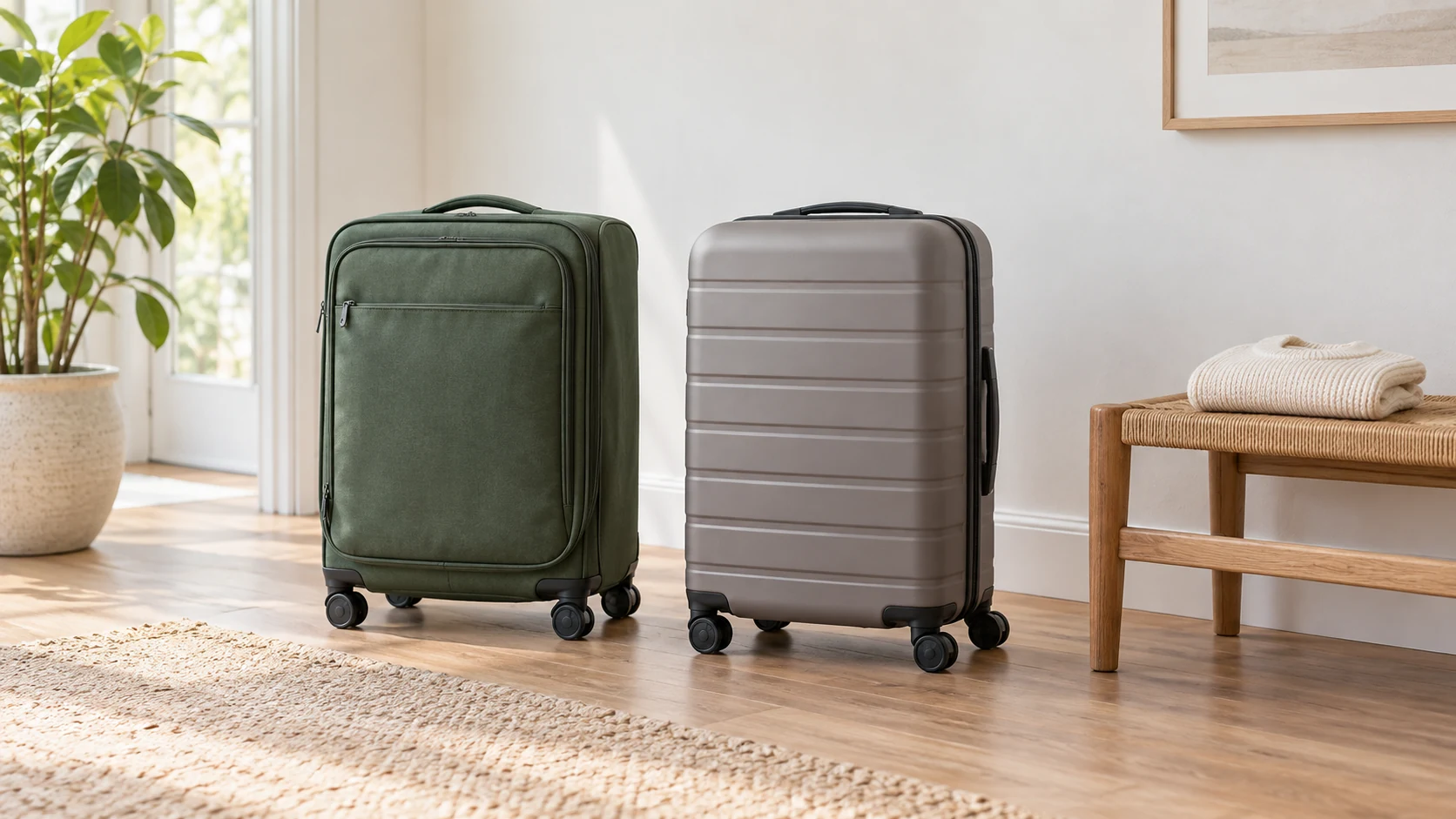
Conceptual editorial cover for suitcase size label confusion: whole generic fabric and hard-shell suitcases beside folded clothing, without depicting exact models, measured size or a tested packing fit.