Cameras & Video Gear
Camera tripod transport size: Benro TMA37C and Neewer TP77
Compare camera tripod transport size on Benro TMA37C and Neewer TP77: folded lengths, head and plate inventory, bags and carrier dimensions.
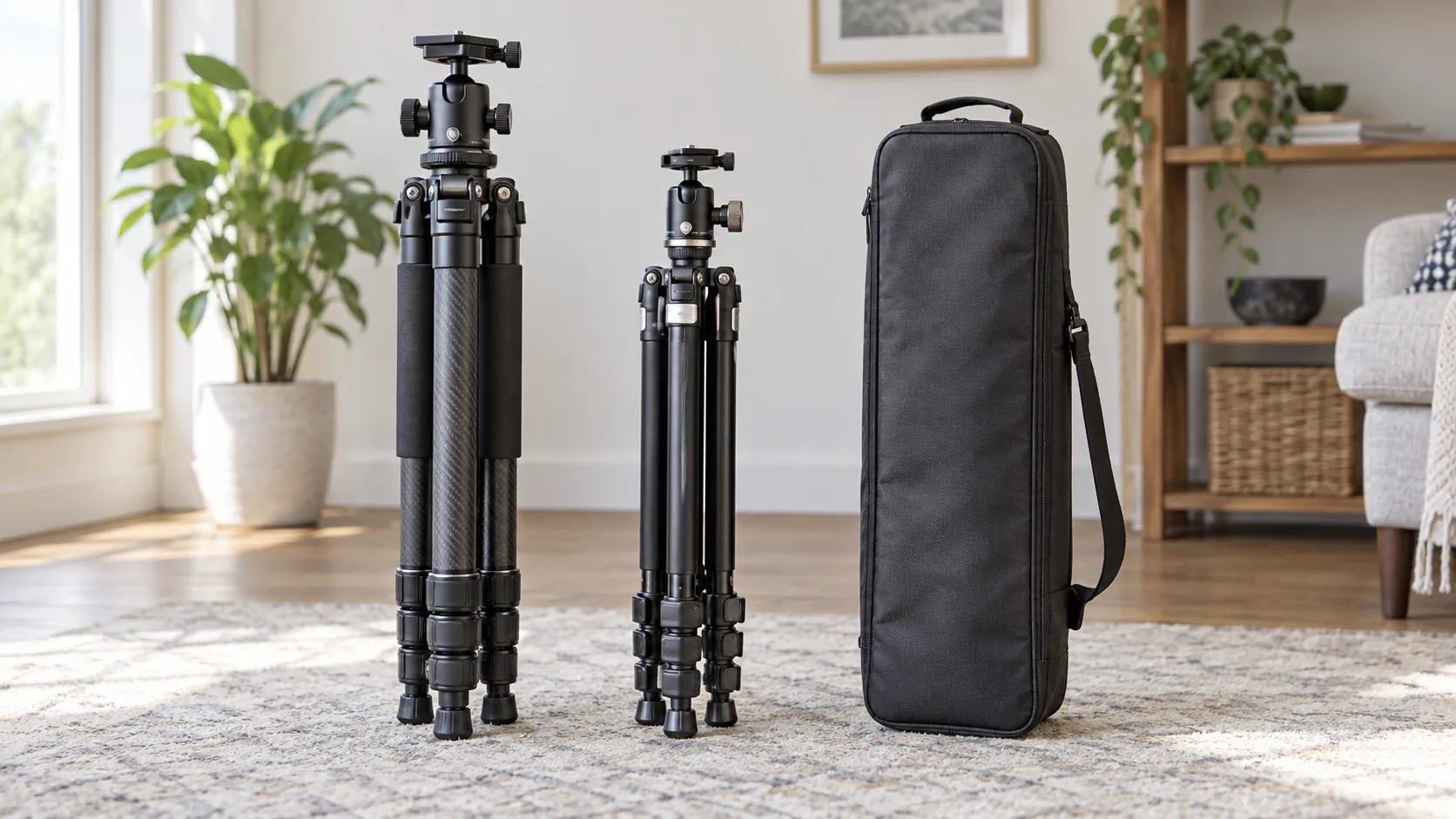
Benro states a 24.6-inch folded length for the TMA37C; Neewer states 19 inches for the TP77. For camera tripod transport size, the useful starting point is the folded item and the parts that must arrive with it. Benro's TMA37C and Neewer's TP77 provide actual folded-length labels, unlike a listing that supplies only maximum height. Keep those labels alongside the package inventory. The complete kit also needs a contents record and a carrier with confirmed usable space.
The Benro Mach3 TMA37C Series 3 tripod lists a 24.6-inch folded length, with 62.5 cm also given, and a 4.1-pound weight. Its description identifies a three-section, 9X carbon-fiber support with twist locks, independent leg spread and a rapid removable center column. Those details make it worth investigating when the carried support's length and configuration decide the purchase. The description does not enumerate a supplied head or camera plate; that leaves their package status unresolved rather than proving they are excluded.
The Neewer TP77 tripod and monopod offer lists 19 inches folded and a 3.53-pound net weight. Its title names an Arca quick-release plate and a bag, while the description identifies a 36 mm ball head with two independent knobs. Four leg sections, flip locks and a two-section center column are also described. Investigate that package when its documented head, plate and carrying inventory suit the support being planned. The Arca label alone does not certify a particular camera attachment or interchangeability with another plate.
Illustrative camera tripod transport size scene showing two fully folded generic supports beside a closed carrier. The pictured dimensions, packages and attachment hardware are invented for the illustration.
Folded tripod length belongs to a documented configuration
The listed folded-length labels differ by 5.6 inches: Benro states 24.6 inches and Neewer states 19 inches. Both numbers are retail descriptions; their measurement configurations are unspecified. The accounts do not establish the same measurement endpoints or enumerate every part present during measurement. Keep folded tripod length attached to that uncertainty. A head, plate, feet or another component can matter to the actual outer envelope, so ask which delivered configuration each stated number describes.
Benro's accompanying 62.5 cm figure is another expression of its folded length, not a second available size. Neewer's 19-inch statement belongs to its folding description. Avoid treating either number as a complete three-dimensional package specification. Neither provides enough information here to establish every folded width, depth or protrusion. Those additional dimensions matter when the carrier opening or a shaped interior is the limiting space, even if its longest usable dimension exceeds the listed length.
Consider a carrier with a confirmed 22-inch usable internal length. Neewer's listed 19-inch folded number is a reason to investigate that carrier further. Benro's listed 24.6-inch number already exceeds the stated interior length. That numerical check establishes a length conflict for the Benro label; it does not approve the Neewer fit. The actual configuration, other dimensions, opening and usable shape still need to match. No alternate diagonal fit or component-removal workaround is established by this comparison.
Use carrier interiors rather than exterior dimensions
The actual Seahorse 920 and KRYTJACZ L carrying-case guide distinguishes a camera hard case from a lighting-support case. Its KRYTJACZ account specifically names straps for tripods, stands and softboxes. The guide asks for the longest folded support and usable interior dimensions because a shell, divider or seam occupies part of a carrier's exterior envelope. That is a direct transport question for these two tripod offers, without proving that either named case accepts either support.
An exterior length advertised for a case should stay in the case's exterior record. Compare the tripod with a separately confirmed usable interior record for the actual carrier variant. A divider layout or shaped end can reduce usable space even when the exterior looks ample. That case guide leaves complete interior dimensions unresolved for its two offers. Obtain the current selected carrier's record; its protection claims do not establish tripod fit.
A planned carrier also has a particular opening. Interior length alone leaves unanswered whether the complete support can pass through that opening in its documented carried state. Obtain the applicable carrier dimensions and configuration information before selecting around a single number. Keep the fit inquiry tied to the documented carried state; an improvised alteration is outside the evidence for this purchase.
Tripod head and plate inventory changes the package question
Neewer's head, quick-release plate and bag are named in the offer, giving tripod head and plate inventory a more explicit starting point. Keep the title's Arca plate wording separate from the description's 36 mm ball-head account. A head size describes the identified component; it is not a camera mounting-thread specification. Two independent knobs describe controls, not a fitting sequence. Request the exact supplied items and their applicable interfaces before treating the package as ready for the intended camera.
Benro's description concentrates on the support's frame, legs and column. It does not enumerate a head or plate. Ask for the contents of the actual TMA37C offer. A photograph, a different Mach3 package or a general brand accessory catalog would not settle this particular offer's inventory. The practical inquiry is whether the delivered TMA37C includes the parts needed for the planned attachment and whether those parts belong in the folded-size record being compared.
Imagine two purchasers with different inventories. One already owns an identified head and plate and needs to establish whether the support and transport arrangement suit those parts. Another needs a complete support package and has no existing attachment hardware. Their orders differ because one brings identified attachment parts and the other needs them supplied. The folded-length label leaves that distinction open. Keep the intended parts, delivered parts and unresolved interfaces in separate entries rather than assuming a common package.
A named bag does not describe every carried item
The TP77 title's bag is useful inventory evidence. It does not provide the bag's usable internal dimensions, padding, pocket layout or permitted contents. Do not treat it as a confirmed carrier for an attached camera, spare head or other accessory. Ask what configuration the supplied bag is designed to contain. That answer should identify the TP77 package itself, rather than borrowing details from another Neewer bag whose photograph or dimensions happen to be available.
Benro's checked description does not enumerate a bag. As with its head and plate, silence is not proof of exclusion. If a carrier is essential to the order, confirm its exact inclusion or separately identify the carrier being considered. Record the support's folded length, the identified carrier's interior and the delivered pieces together. This keeps an unlisted bag from quietly becoming part of the order.
Keep weight labels separate from kit weight
Benro states 4.1 pounds and Neewer states a 3.53-pound net weight. Subtracting the published numbers gives 0.57 pound, but the accounts do not establish equivalent included components or measurement conditions. That arithmetic should not become a complete-kit carrying-weight winner. Confirm whether each applicable weight includes its described head, plate, feet or other supplied items. A carrier and independently required attachment parts also belong in the weight of the package that will actually travel.
The carbon-fiber and aluminum descriptions identify construction materials. They do not supply the missing weight configuration or establish that one complete order is easier to carry. Benro's lightweight wording is an attributed description, while Neewer supplies a numerical net figure. Keep both types of evidence visible. A buyer budgeting for a longer walk needs a confirmed carried-package weight, with the configuration recorded, rather than a conclusion inferred from the material name or a subtraction between unlike labels.
Working height answers a different question
Benro's listed working range is 15.2 to 63.6 inches. Neewer lists 19 to 77 inches and separately describes a two-section center column. These figures concern working positions, not the support's transport envelope. Neewer's 19-inch folded statement and 19-inch lower working figure happen to share a number; their meanings remain separate. The descriptions do not establish that the folded support is a permitted shooting arrangement, or that every working position has the same packed dimensions or supported camera configuration.
A purchase may require both a carried-size limit and a particular working-height account. Record each requirement against the corresponding evidence instead of choosing by the tallest number. For a transport decision, the useful column question is which carried configuration the stated folded length describes. The source supplies no altered-configuration packing dimensions. Obtain applicable configuration information if a working position is also decisive.
Leg sections and locks identify the support being compared
Benro describes three leg sections with twist locks. Neewer describes four sections with flip locks. Those are useful distinctions when asking the seller to identify the delivered support and the state behind its folded measurement. Section count alone cannot calculate folded length: the actual segment lengths, overlaps and other parts are not all supplied. Likewise, the lock names do not establish a timed packing advantage or tell how either complete tripod behaves after repeated transport.
Benro also describes independent leg spread and spiked or retractable feet. Neewer describes three leg-opening angles. Keep those feature accounts with the exact product identity, especially if a seller's package photograph differs from the written listing. The accounts supply no comparison of feet protrusion in a measured transport envelope. Applicable instructions must address any change to those parts; an imagined feet arrangement cannot resolve the stated carrier-size question.
Accessory claims need their own inventory boundaries
Neewer describes a hook for a sandbag and expressly says the sandbag is not included. That is a concrete package distinction: the hook's presence does not mean the order contains the accessory. It also does not establish a permitted loading method or tested performance improvement. If an accessory is part of the planned carried kit, identify it separately and obtain its applicable requirements. Do not add an imagined supplied sandbag to the TP77 contents or use its hook to rank the two tripods.
The Neewer description also claims an inverted-column macro option and conversion to a monopod with a 35-to-70-inch range. Those accounts concern other advertised configurations. They do not replace the stated tripod folded length with a verified monopod transport size. Benro's rapid removable-column account similarly lacks a separate carried-dimension record for an altered setup. Keep optional configurations out of the transport comparison unless exact applicable documentation establishes the configuration and dimensions needed for that separate inquiry.
Included support is distinct from camera suitability
The actual Nikon Z30 and Sony ZV-E10 II solo-shooting kit guide names a 50-inch tripod within Sony's described bundle. Its whole-kit discussion separates included equipment from the suitability of that equipment for a camera and lens job. That distinction applies directly to the Neewer head-and-plate inventory and the unresolved Benro attachment inventory. The older bundle's tripod supplies no compatibility, load or packed-size evidence for either support here.
The TP77 title's DSLR and phone wording describes intended equipment categories. It does not enumerate every phone holder or approve every camera, plate or adapter. Benro's frame description also does not identify a complete compatible-camera list. Retain the exact camera and attachment requirement in the purchase inquiry. A confirmed supplied plate is useful evidence of an included part; a confirmed interface and applicable configuration are separate evidence needed before treating the assembled support as suitable.
Price the confirmed transport package
The captured offers list Benro at $481.19 and Neewer at $86.24 in USD, a $394.95 difference between those recorded amounts. These are the checked offer prices, subject to the actual order's current charges. Neewer's named bag, head and plate give its contents inquiry specific parts to confirm. Benro's higher recorded amount accompanies its carbon-fiber frame and specified support features; it does not settle the unenumerated attachment or carrier inventory. No stiffness, longevity, carrying comfort or camera suitability advantage follows from the price difference.
For someone who already owns an identified head and carrier, the remaining purchase may center on confirming the Benro support's interfaces and carried envelope against that equipment. Someone starting with no support accessories has a reason to investigate the Neewer package's named pieces. These are different order requirements, so compare the confirmed complete orders before judging their cost. Do not invent an extra-head price for Benro or assign a monetary value to Neewer's bag without the corresponding actual offer. A contents confirmation can change which additional purchase is necessary.
Close the transport record around the actual order
For Benro, the meaningful starting record is TMA37C Series 3, 24.6 inches folded, the stated 4.1-pound weight and an unenumerated head, plate and carrier inventory. For Neewer, it is TP77, 19 inches folded, the stated 3.53-pound net weight, a described 36 mm ball head, an Arca plate in the title and a named bag. The product pages list these categories: Camera Accessories for Benro and Cell Phone Photography Accessories for Neewer. These are two real photographic-support offers, not identical catalog packages.
Choose a transport package only when its documented carried configuration, actual contents and carrier requirements meet the intended trip. The shorter Neewer folded label and named bag provide specific facts to investigate; Benro provides its own folded-length and frame account. Neither establishes a complete-kit weight advantage, a camera connection or a tested case fit. Resolve those exact questions while comparing camera tripod transport size, so the order refers to the support and parts that need to arrive together.