Crypto Commerce
Toshiba ML-EC42P(BS) countertop microwave vs ML-EM62P: choose cavity space or cooking modes
Compare Toshiba ML-EC42P(BS) countertop microwave by usable cavity, counter clearance, cooking modes, and controls.
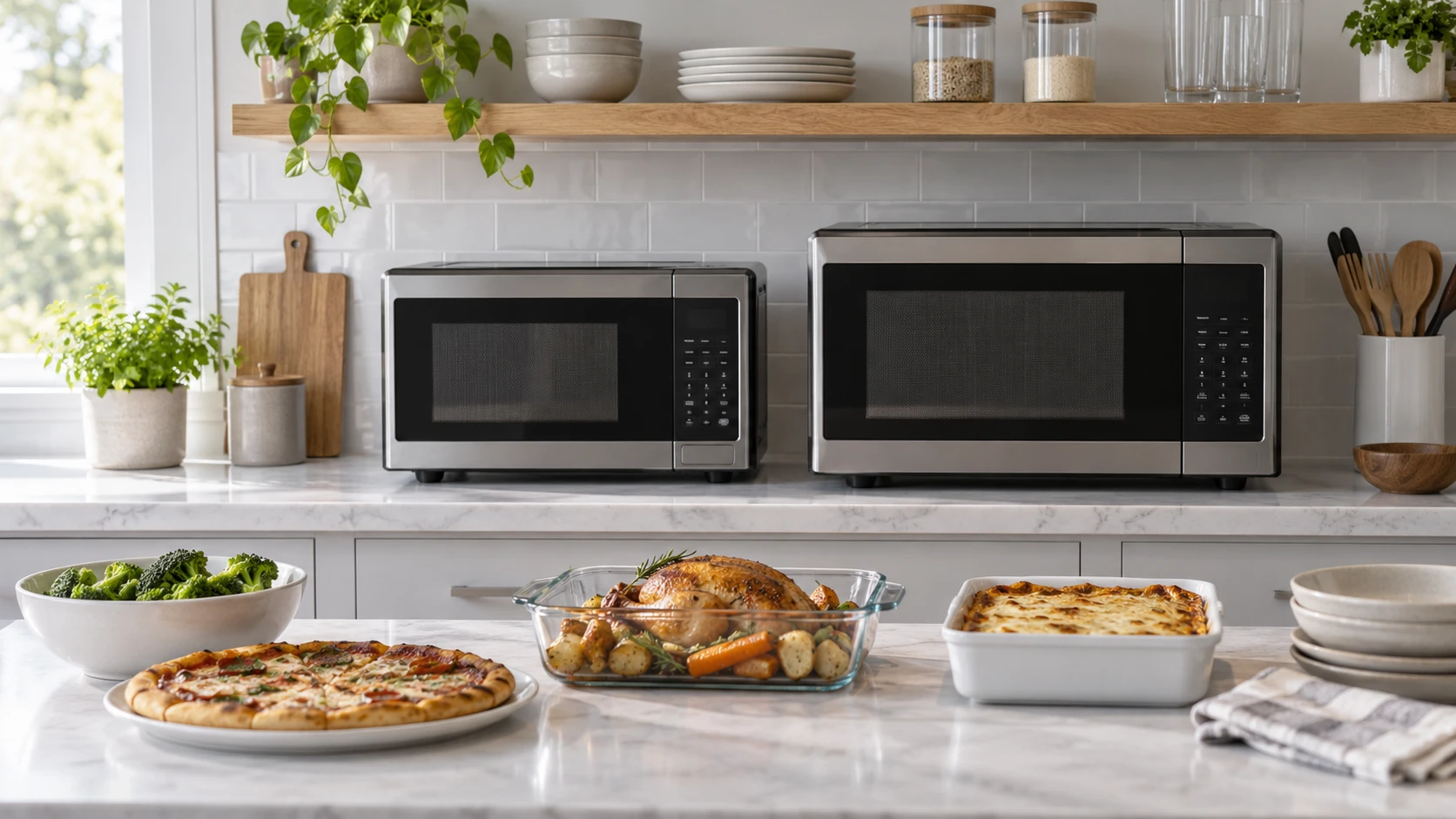
The Toshiba ML-EC42P(BS) countertop microwave is listed at 1.5 cubic feet with microwave, air-fry, convection, and combined microwave-convection modes. Toshiba's ML-EM62P(SS) is listed at 2.2 cubic feet and focuses on roomy microwave cooking with sensor and preset controls. One promises more ways to cook in a smaller cavity; the other offers a larger stated cavity for ordinary reheating and defrosting. The counter and the dishes used most often should decide which difference matters.
These are saved Republeq's product descriptions rather than a matched cooking test. The first row includes exterior and interior measurements. The second gives a capacity and examples of large food it can hold, but no full dimensions in the saved text. Check current manufacturer specifications for the exact model codes before ordering. A cavity volume does not tell you whether a tall container, a rectangular dish, or a handled mug can rotate freely.
Start with the dish that barely fits today — a large microwave with a compact model
The ML-EC42P row gives a 13.6-inch removable turntable and says the cavity can take a 12-inch pizza or a whole roasted chicken. Its stated interior dimensions are 15.5 by 15.35 by 10.2 inches. Those figures are more useful than volume alone when you have a particular plate or baking dish in mind. Measure the dish including handles and lid. Leave space for it to rotate without touching the side wall, and consult the manual if the chosen cooking mode changes which cookware is allowed.
The ML-EM62P row describes space for a 16-inch pizza or a whole chicken. That is a Republeq's catalog fit example, not a precise interior drawing. Check the turntable diameter and the cabinet's usable height in the current manual. A wide pizza example does not establish that a tall covered bowl or a casserole with projecting handles will clear the walls. The larger 2.2-cubic-foot rating suggests more room in total, but the shape of that room still needs inspection.
The published guide comparing a large microwave with a compact model uses different products. Its practical method of checking dish fit transfers to this decision, while its model-specific dimensions do not. Take the largest dish used each week to the store if a display model is available. At home, mark its footprint on the planned counter so you can see whether the microwave door can open while someone stands at the sink.
The ML-EC42P's exterior dimensions are listed as 21.8 by 21.5 by 13 inches. Verify the orientation of those measurements in the official drawing and add the manufacturer's ventilation clearances. The saved ML-EM62P row does not give a corresponding exterior size, so do not assume that its larger cavity will occupy a proportionally larger rectangle. Check the complete width, depth, height, door swing, and required space above both units before making a counter plan.
Stand where someone would normally load the microwave and open the door in that position. A cabinet edge, refrigerator handle, or wall can interrupt the swing even when the body fits. Check whether a hot dish can be set down beside the oven without crossing a sink full of water or a busy cooktop. The outlet should be in the location required by the manual, with the cord routed away from heat and splashes. If the only available space is an enclosed shelf, verify that the manual permits that installation and lists enough ventilation room; a countertop label alone does not approve a built-in enclosure.
Decide whether the extra modes would be used — Toshiba ML-EM62P(SS) countertop microwave
The ML-EC42P combines microwave, air-fry, convection, and microwave-convection cooking in one cabinet. Its row lists a grill rack and grill tray in the box alongside the turntable and manual. That may be attractive in a kitchen short on storage for separate countertop appliances. It also means the owner must learn which accessories and cookware belong in each mode. A metal rack that is appropriate for one program should never be assumed safe in a different program without the manual's instruction.
Air-fry and convection names describe cooking functions, not the results on a particular recipe. The saved row says air frying avoids deep frying, but it supplies no matched texture or cooking-time comparison with a dedicated air fryer. Ask how much food the tray holds and how it is cleaned. If the household cooks only an occasional frozen snack, the added mode may be less useful than larger reheating space. If it regularly bakes or crisps small portions, one multifunction unit may reduce the need for another appliance.
The Toshiba ML-EM62P(SS) countertop microwave row describes microwave presets, defrost programs, and a humidity sensor. It does not claim air frying or convection in the saved description. Someone who already owns an oven or air fryer may prefer the larger microwave cavity and familiar controls. The absence of an extra mode from this row should still be confirmed against the current product manual, especially if a retailer has bundled several similar Toshiba model names together.
The number of functions can be misleading when the daily task is reheating one plate. Think through a normal week: how many meals need microwave reheating, how many need convection browning, and which containers you already use. A unit that can do four things is valuable when those functions replace tools you otherwise need. It is less valuable when learning mode rules slows down a simple breakfast routine.
Compare sensor and preset controls — Toshiba ML-EM62P(SS) countertop microwave
The ML-EC42P row describes a humidity sensor with preprogrammed settings for foods such as potatoes and frozen vegetables. It also lists a digital display, speedy cooking, multistage cooking, ten power settings, a mute function, and a child safety lock. Those controls could help a household that reheats varied food, but the saved row does not establish how accurately the sensor handles every portion size. Read the manual's sensor-cooking instructions and use appropriate covered or vented containers.
The ML-EM62P row also describes a built-in humidity sensor. Its six automatic menus include items such as bacon, beverages, chicken pieces, oatmeal, and reheating a frozen roll or muffin. Separate defrost programs address meat, poultry, and fish. One-pound and automatic defrost, speedy cooking, memory, multistage cooking, sound on/off, an interior light, a clock, and a child lock are also listed. Match those buttons to the food actually made at home rather than counting the number of menu labels.
Sensor controls use the conditions inside the oven to guide a program, but the saved rows do not give a matched test of heating evenness. Stirring and standing time may still be necessary for many foods. Check the instructions for the exact dish, especially when reheating a dense portion that can be hot at the edge and cool at the center. A preset is a convenient starting point, not a substitute for checking whether food is heated through.
Both rows describe a way to quiet the control sounds: the ML-EC42P lists mute, while the ML-EM62P lists sound on/off. That might matter in an apartment with a sleeping room near the kitchen. Verify which tones can be silenced and whether the setting persists after a power interruption. A disabled beep can also make it easier to forget food inside, so consider the household's habits before treating silence as an automatic benefit.
Put wattage in context — Toshiba ML-EM62P(SS) countertop microwave
The ML-EC42P is listed at 1,000 watts of microwave power. The ML-EM62P row lists 1,200 watts. Those figures are useful specifications, but they do not guarantee that the larger model finishes every dish exactly one-fifth faster. Cooking time depends on food amount, shape, starting temperature, container, and the selected power level. Sensor programs may follow their own timing. If a favorite recipe specifies a microwave power, consult each model's conversion guidance rather than guessing from the headline wattage.
The ML-EC42P includes an ECO mode, and the ML-EM62P row also lists eco mode. The saved descriptions do not quantify their standby savings. If energy use is a priority, request current manufacturer figures for standby and cooking rather than ranking the units by a shared button name. Replacing a separate convection or air-fry appliance could change the household's overall counter use, but the rows do not support a bill-savings claim from that possibility.
Cleaning requirements differ with use. The ML-EC42P lists an easy-to-clean stainless steel interior, but air-fry or convection cooking can leave a tray and rack to wash. The ML-EM62P row does not describe its interior finish or supplied accessories. Check how the turntable, tray, and any rack come out, and whether replacement parts are available. A spacious oven can still be inconvenient if a large turntable is hard to wash in the household's sink.
The ML-EC42P is worth considering when the smaller measured cavity fits your dishes and its added cooking modes would replace work done by another appliance. The ML-EM62P is the clearer candidate for large microwave dishes and a straightforward set of sensor, preset, and defrost controls. Confirm the official exterior and interior drawings, ventilation gaps, accessory rules, and current box contents for both models before choosing a place on the counter.