Cooking & Food Prep
A toaster batch capacity needs a completion time beside it
A fictional token model compares batch size, cycle duration, partial cycles and demand. Its stipulated numbers are not measured toast times or an appliance operating schedule.
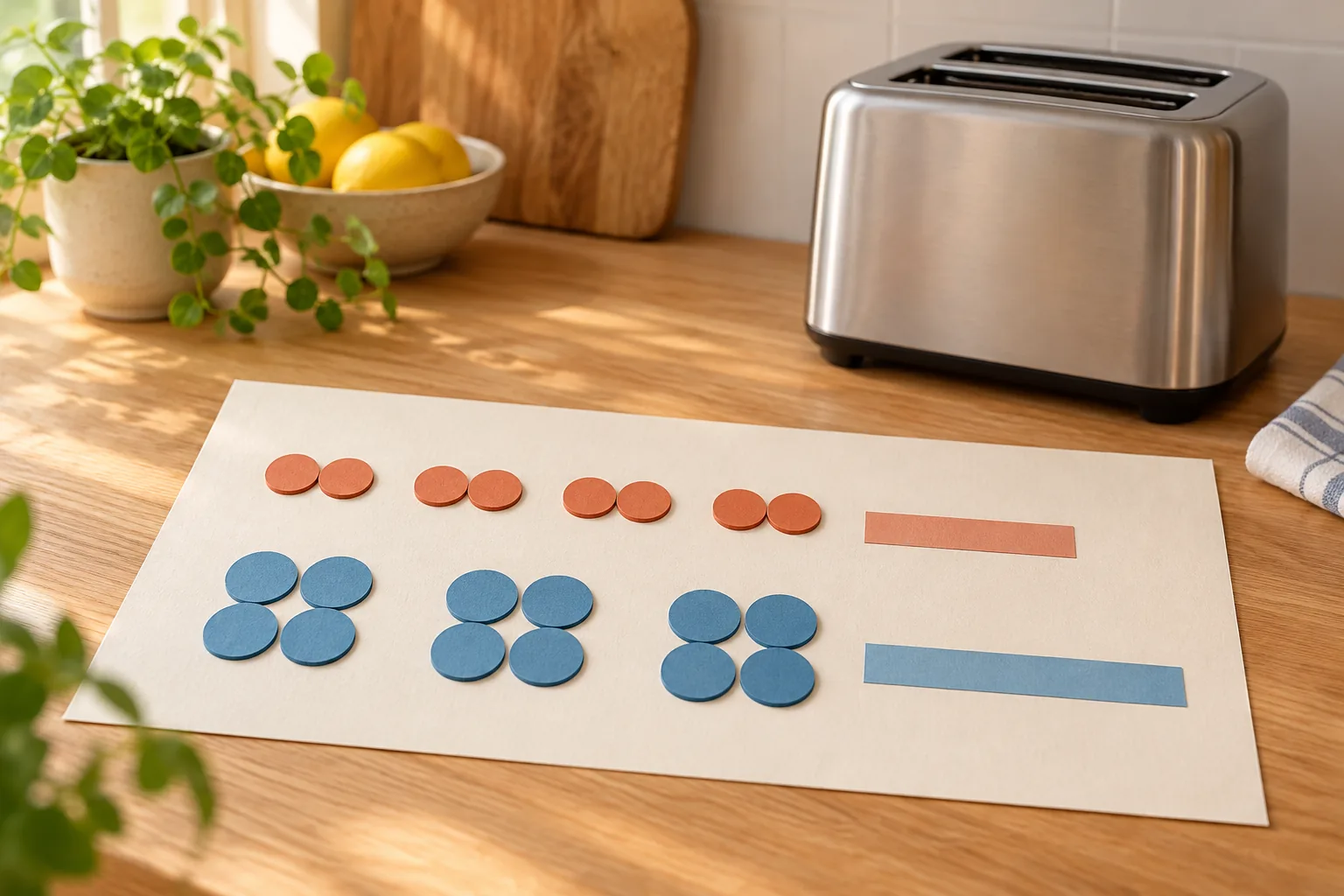
A toaster batch capacity describes a quantity per batch, while a completion question also needs time. This original fictional token worksheet explains the difference. It predicts no actual toast time, doneness, food fit or safe operating schedule. The numbers below are invented inputs for paper arithmetic, not settings or measured performance for either retail appliance.
Define two fictional batch models
Imagine Tomas drawing two boxes on paper, labelled A and B. Box A has two token positions and completes a batch in three invented time units. Box B has four positions and completes a batch in eight units. A token is an abstract counter. It represents no particular food, size, moisture level or cooking result.
Tomas stipulates that each batch begins with all its assigned tokens and all finish together at its end. There is no intermediate completion. The boxes can begin a new batch immediately after the previous one. These are deliberately simplified mathematical assumptions. They establish no permission to operate or reload an actual appliance without its own applicable requirements.
Keep slots per cycle and completed items separate
For slots per cycle and completed items, begin at the first completion. A’s two tokens finish at time three. B’s four finish at time eight. B has more positions per batch, but its first completed tokens arrive later under the stipulated durations. Neither position count by itself states how many tokens have finished by an earlier deadline.
At time zero, no batch has finished in either model. At time two, both still have zero completed tokens. A has two assigned positions and B four, but assigned tokens are not yet completed tokens. Tomas keeps the in-progress state distinct from the completed total instead of counting a started batch as an ended one.
Count the completed batches at a deadline
At time six, A has finished two batches, ending at three and six. Its completed total is four tokens. B’s first batch is still in progress, so its completed total remains zero. The deadline changes the answer: four available positions in B do not provide four completed tokens at this particular time.
At time eight, A still has four completed tokens because its next batch ends at nine. B now completes its first four. Both have four completed tokens at this deadline, despite having different batch sizes and durations. The equal result at time eight does not erase the different results at time six.
Extend the timeline without changing the rules
At time nine, A’s third batch has finished, giving six completed tokens. B still has four because its second batch does not finish until sixteen. At time sixteen, A has completed five batches, ending at three, six, nine, twelve and fifteen. That gives ten tokens, while B has completed eight in two batches.
At time twenty-four, A has completed eight batches and sixteen tokens. B has completed three batches and twelve tokens. These totals follow the particular invented cycle lengths and the assumption of immediate restarts. They are not a comparison of the KitchenAid and All-Clad offers, whose actual cycle durations are not assigned anywhere in this exercise.
A rate describes the stipulated long-run relationship
Under this unchanged paper model, A’s two tokens in three units give a rate of two-thirds of a token per unit. B’s four in eight give one-half per unit. A has the smaller batch and the larger stipulated rate. Multiplying batch size without retaining its duration would miss that relationship.
A fractional rate does not mean a fraction of one token has completed at every instant. Tomas’s rule still permits completion only at batch endpoints. The rate summarizes repeated cycles while a deadline count must respect those endpoints. At time one, neither box has completed a token even though each has a positive calculated rate.
A partly elapsed cycle is not a partly completed batch
At time seven, B has used seven of its eight stipulated units in the first cycle. That is seven-eighths of the cycle duration. Under the stated all-at-once completion rule, its completed token count is still zero. Multiplying four by seven-eighths would calculate three and one-half, but that number is not a completed count under this problem’s rules.
The example does not claim real cooking behaves as an all-or-nothing token task. It defines a paper counting convention and follows it consistently. No elapsed fraction here establishes food readiness, internal temperature, browning or suitability for eating. An actual appliance display would need its own applicable meaning rather than an interpretation borrowed from this model.
Change the duration and recompute the comparison
Create a separate version in which B still has four positions but finishes a batch in four time units. Its rate becomes one token per unit. By time eight it completes two batches and eight tokens, compared with A’s four. By time twenty-four it completes six batches and twenty-four tokens, compared with A’s sixteen.
The new B version has the same position count as the original B but a different duration. Its results therefore change. Keep the versions separate: four positions with eight-unit cycles is not the same specification as four positions with four-unit cycles. Neither duration was measured from a retail toaster or inferred from a photograph of its controls.
A requested quantity can leave unused positions
Now give A a finite demand of five tokens, using the original three-unit batch duration. Two full batches complete four tokens by time six. A third batch containing the remaining one finishes at time nine under Tomas’s unchanged rule. The second position in that final batch remains unassigned. It does not create a sixth requested token.
For the original B with four positions and eight-unit duration, five tokens require two batches. Four finish at eight, and the remaining one at sixteen. Three positions are unused in the last batch. In this stipulated comparison, a larger batch size reduces the number of batches from three to two but does not reduce the final completion time.
The demand amount belongs beside the final time
For a different demand of four tokens, A finishes at time six and original B at time eight. For a demand of two, A finishes at three while B still takes eight under the fixed-duration assumption. These are different requests. Keeping the requested amount visible prevents a result for five tokens from silently becoming an answer for every possible demand.
For zero requested tokens, no batch is needed and the completion time is zero in this mathematical account. That boundary case follows the absence of work, not an instant real cooking cycle. The model makes no claim about an appliance’s readiness, warm-up, rest interval or energy use when a household request changes.
A delay between batches changes the model
Return to A’s five-token demand and stipulate a one-unit gap between successive batches. Its first batch ends at three. The second begins at four and ends at seven. The third begins at eight and ends at eleven. The completion time is now eleven rather than nine, because there are two inter-batch gaps.
Tomas adds no gap after the final batch because this version asks when the five tokens finish, not when another future batch could begin. Adding three gaps would answer a different timeline. These invented gaps do not prescribe a reload or rest interval for actual equipment. Any real requirements remain outside the paper assumptions.
A missing duration blocks a time prediction
Suppose a third paper box C has four positions but no assigned batch duration. Its position count is known. Its completed total at time eight is not determined, because the problem leaves the duration missing. Tomas cannot borrow B’s eight units merely because both boxes have four positions.
Likewise, a photograph containing four tokens supplies no elapsed duration in this model. It might illustrate one batch, a demand or a completed group, depending on its stated role. Keep that role with the picture. The paper calculation requires defined inputs rather than a convenient assumption from a visually similar arrangement.
Read the KitchenAid offer as its own appliance
The selected KitchenAid KMT2115CU toaster offer describes two extra-wide slots, a manual high-lift lever, bagel and cancel buttons, a metal body and removable crumb tray. Its four-image gallery shows the complete two-slot appliance and controls. It supplies none of Tomas’s invented batch durations or token results. A photographed shade dial does not establish a three-unit cycle or an output rate here.
Keep the All-Clad countdown with its actual context
The selected All-Clad TJ822D51 toaster offer describes two slots and an LED time-remaining display. Its seven-image gallery includes the whole appliance, display and marketing panels. A pictured countdown state supplies no measured complete cycle duration, and the marketing claims are not tested results here. Both retail offers are complete two-slot toasters; neither is Tomas’s fictional four-position B.
Leave care and continuous-length decisions with their guides
The bread stuck in a toaster guide concerns model-bound cooled bread-piece care, separate controls and unresolved faults. It does not provide the invented scheduling inputs above. This article supplies no extraction, cleaning, loading or operating procedure and cannot establish that a toaster is ready for another cycle.
The tape length and continuous piece guide distinguishes a total length from an uninterrupted individual piece. Tomas’s question is different: completed batches by a stipulated time, including partially filled final batches and gaps. A continuous-length condition does not set a batch duration or turn in-progress tokens into completed ones.
Keep the Republeq order with the exact appliance enquiry
If a reader considers a toaster through republeq.com, retain the exact offer identity and the practical questions concerning that purchase. This paper exercise requires no order and establishes no actual toast time, food fit, browning result or permitted operating schedule. Confirm the proposed appliance, supplied contents and applicable instructions before deciding whether to buy. If the actual checkout offers cryptocurrency, including USDT, consider the methods and conditions shown for that basket. This article establishes no current token availability, network, address or payment amount and gives no transfer procedure. A preferred payment method cannot turn a slot count or a photographed countdown into a measured household output rate. Read the delivery and return terms applying to the real order. If a transaction is made, keep its actual order identity and payment response. An uncertain result needs reconciliation through the merchant before another payment is considered. Several notes about one proposed appliance do not create several orders or justify another payment. Likewise, completing a purchase supplies none of the fictional cycle durations and does not establish that a real appliance has arrived, been inspected or produced a particular breakfast result.
Finish with the quantity and time together
Tomas’s toaster batch capacity worksheet keeps positions, cycle duration, deadline and requested quantity distinct. A larger batch can finish later under the stated numbers, while a partial final batch and an added gap change specific results. Keep each answer with its inputs. None of this fictional arithmetic predicts actual cooking time or authorizes a real appliance procedure.
Grouped paper tokens and time strips represent a fictional batch calculation.