Office Supplies & Stationery
Three-pair savings budget: test the promised minimums
A fictional savings worksheet tests all three overlapping pair promises before choosing individual shares.
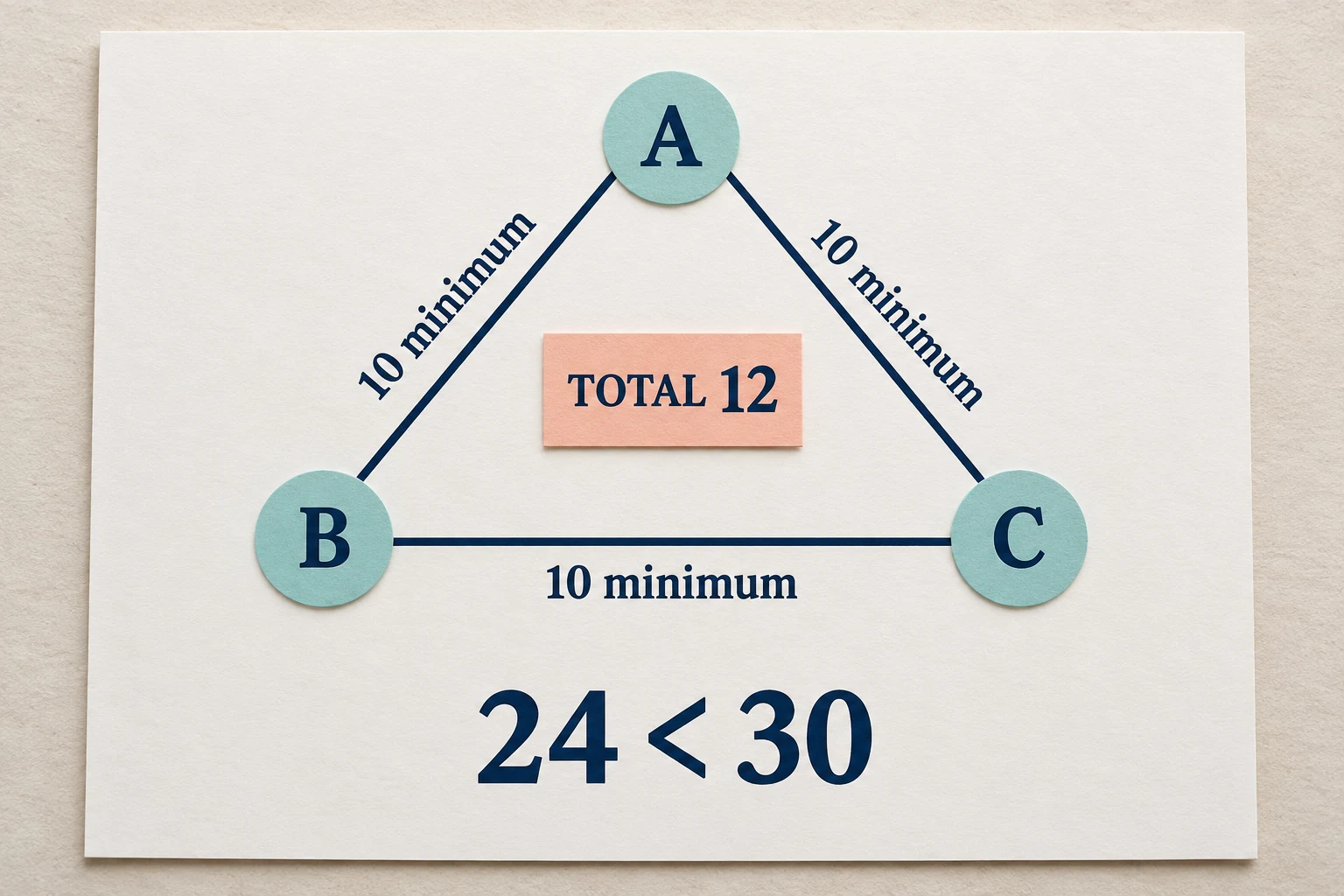
A shared saving of twelve tokens cannot meet three promises that each pair of groups will receive at least ten. That remains impossible even if the individual shares can be fractional and everyone agrees to try a different splitting rule. The three-pair savings budget in this original fictional worksheet fails before a particular allocation is chosen. Adding the promises exposes the shortfall and identifies two precise ways to change the model: increase the total or reduce the common pair minimum.
Call the three fictional groups A, B and C. Each has a separate task that would cost ten tokens alone. Assume any two tasks together would cost ten tokens, while completing all three together would cost eighteen. These are expressly invented, comparable cost inputs. Separate completion of all three costs thirty, so the grand arrangement saves twelve. A pair compares its separate twenty with its joint ten and has a ten-token saving in that separate case. No real product price or shared-order quotation supplies these figures.
State the allocation and the promises
We will divide the grand saving among A, B and C. Let a, b and c be their nonnegative shares, with a plus b plus c equal to twelve. These shares are amounts of the saving, not the groups' remaining bills. They are freely divisible for this model. A group allocated four would have a saving of four against its fictional standalone ten, but the argument below concerns the shares themselves. Keeping the baseline and the allocation units visible prevents a cost from being mistaken for a saving.
Now add the proposed promises. A and B together must receive at least ten, A and C together must receive at least ten, and B and C together must receive at least ten. Each promise compares that pair's combined grand-arrangement shares with its stipulated separate pair saving. This is a condition chosen for the worksheet. It does not establish anyone's legal entitlement, a standard of fairness, an actual agreement, or a prediction that real groups would leave an arrangement.
Write all four conditions on the same page. The total is a plus b plus c equals twelve. The minimums are a plus b at least ten, a plus c at least ten, and b plus c at least ten. Every occurrence of a names the same share, and likewise for b and c. The promises therefore overlap. Allocating ten to each pair as though the pairs had separate pools would replace this one-budget problem with a different calculation.
A failed split is only a starting check
An equal allocation gives four to each group. Its three pair sums are eight, eight and eight. It uses the entire twelve-token saving and meets the nonnegative-share rule, but it misses every ten-token pair minimum by two. This calculation shows that the equal split fails. It does not, by itself, show that every possible split fails. An unequal assignment remains a candidate until we check it or find a reason covering the entire permitted set.
For example, allocate ten to A, one to B and one to C. The total is still twelve. A with B now receives eleven, and A with C also receives eleven, so two promises are satisfied. B with C receives only two. Moving shares toward one group has changed which constraints fail while leaving the total unchanged. We should not accept the record after checking only the two pairs containing A. The condition requires all three named pairs simultaneously.
Trying more individual splits could continue indefinitely because fractions are permitted. We need a calculation that applies to an arbitrary a, b and c satisfying the total. The overlapping pair structure supplies it. We can add the three lower-bound statements without choosing any individual share. If an allocation met every statement, it would have to meet their sum as well. A contradiction at that level rules out every allocation within the stated model.
Add the three overlapping minimums
The three left sides add to a plus b plus a plus c plus b plus c. A's share occurs twice, B's occurs twice and C's occurs twice. Their sum is therefore two times a plus b plus c, or twice the grand saving. With a total of twelve, the three pair sums must add to twenty-four, regardless of how that twelve is divided.
The three right sides add to ten plus ten plus ten, or thirty. Meeting all three minimums would require the sum of the pair sums to be at least thirty. But that same sum is fixed at twenty-four. Twenty-four is less than thirty, so the conditions contradict one another. This proves that no permitted allocation satisfies every promise. The proof uses the total and all three minimums together; it does not depend on the equal split or the ten-one-one example.
The six-token gap between thirty and twenty-four is a gap in the sum of overlapping pair requirements. It is not six additional tokens that must be put into the grand pool. Each added token in that pool contributes twice when the three pair sums are added. The exact threshold therefore needs a separate calculation. Confusing the summed-constraint gap with the budget increase would overstate the required change.
Fractions cannot remove this contradiction. Three decimal shares summing to twelve still contribute twenty-four across the three pair sums. Neither can an alternative allocation rule cure it while preserving all four conditions. A rule can select a point from the permitted shares; it cannot make twenty-four at least thirty. The failed model needs a stated change in an input or condition before a successful allocation can be recorded.
Raise the total to the exact threshold
Hold all three pair minimums at ten and call the grand saving T. Their sum requires two times T to be at least thirty. Thus T must be at least fifteen. In the fictional cost setup, this could be a separate version in which completing all three tasks costs fifteen instead of eighteen, while their separate total remains thirty. That would make the grand saving fifteen. It is a changed input, not a repair that silently rewrites the original twelve-token case.
At fifteen, allocate five to each group. Every pair receives ten, all shares are nonnegative, and the total is fifteen. This explicit witness proves that the threshold can be met. The earlier inequality established necessity; the witness establishes feasibility at the boundary. The lower bound alone would leave open whether another requirement prevented an allocation at that total; five each checks every condition.
The boundary allocation is unique under these conditions. Since B and C must receive at least ten together from a fifteen-token total, A can receive at most five. The other two pair promises similarly put B and C at most five each. Three shares each at most five can sum to fifteen only when all three equal five. This uniqueness conclusion belongs to the exact boundary version, with the same minimum applying to each pair.
Keep twelve and reduce the common guarantee
Another separate version retains a grand saving of twelve but asks for the largest common pair minimum it can support. Call that minimum p. The three pair sums always add to twenty-four. If each were at least p, their total would be at least three times p. Consequently p cannot exceed eight. This is a bound on the same minimum promised to every pair, not a claim that no individual pair can receive more than eight.
The equal allocation four, four and four gives every pair eight, so it attains that bound. In this changed version, eight is the largest feasible common pair guarantee. The original promise of ten fails by two per pair at this allocation. Reducing the requirement to eight makes the worksheet feasible without changing the total, but it also changes what the worksheet promises. Preserve the original failure alongside the new version rather than reporting that ten was met.
The same argument works for any nonnegative total T and nonnegative common minimum p in this divisible three-share model. Adding the minimums requires three times p to be at most two times T. If that inequality holds, assigning T divided by three to each group gives every pair two times T divided by three, meeting the minimum. Thus the maximum common pair guarantee is two thirds of T. This sufficiency uses the symmetric common minimum; it is not a general solution for arbitrary different pair conditions.
Check a version above the boundary
With a total of sixteen and every pair minimum still ten, the shares six, five and five work: their pair sums are eleven, eleven and ten. The shares five, six and five also work, with pair sums eleven, ten and eleven. These are distinct allocations satisfying the same conditions. Feasibility above the threshold therefore does not supply a unique splitting rule. Choosing between permitted allocations would require a further stated objective or agreement.
Keep each version's total, pair minimum and witness together. Twelve with minimum ten has no witness because it is impossible. Fifteen with minimum ten has the unique five-each witness. Twelve with minimum eight has a four-each witness, and sixteen with minimum ten has multiple witnesses. Those records answer different questions. A witness from the fifteen-token version cannot prove the original twelve-token promise was achievable.
Keep source accounts and nearby methods separate
The shared cost allocation guide, shared cost allocation across two entry orders, averages two parties' marginal costs under a chosen rule. This worksheet tests three overlapping pair minimums before selecting shares. No entry-order average is calculated here.
The pairwise count guide, pairwise count totals for three bags, reconstructs exact individual counts and checks nonnegative integer conditions. Here the pair statements are lower bounds, the total is separately supplied, and fractional shares are allowed. We are checking promised minimums, not recovering bag contents.
The BOSTITCH Inpower account, Inpower desktop stapler bundle, declares five each. Its sole image shows one complete BOSTITCH-marked stapler, without verifying five delivered. The description's integrated remover and storage are device features, not independent supplied tools. No force reduction, capacity, material or operating performance is tested here.
The Charles Leonard account, Charles Leonard full-strip stapler six-count, retains the native CHL82210-6 identity. Its sole image shows six boxes marked 82210. Closed packaging does not authenticate contents, delivered quantity or performance. Neither stapler account supplies the fictional cost inputs or a shared-order saving.
Keep checkout questions with an actual order
If you separately decide to purchase an office item, review its actual supplied contents and current checkout terms before authorizing payment. The worksheet's tokens are invented arithmetic units, not quoted prices or cryptocurrency amounts. A feasible allocation of fictional savings does not establish an available discount, a joint-order offer or an agreement by anyone to contribute. For an order on republeq.com, check the methods presented for your specific transaction. If cryptocurrency is offered and you consider USDT, confirm the exact asset, network, amount, receiving details, fees and any time limit through that checkout. A token name by itself does not settle the network or the amount that would arrive after applicable charges. Do not infer availability for a particular basket from an article, a product image or an earlier order. Review the intended quantity, shipping destination, delivery estimate and final total. Ask how cancellation, returns and any approved refund would be handled, including the refund asset or currency, network where relevant, calculation basis and possible deductions. Keep these questions separate from an internal plan to divide a bill or a saving. Another person's proposed share does not confirm that a merchant has received payment, and a correct sum does not reconcile an uncertain transaction. Retain the product account, order confirmation and any transaction reference together, so that a later query can identify the actual purchase. If an essential instruction or condition remains unclear, pause and obtain clarification before committing funds. This is conditional purchasing guidance, not a report of a completed transaction, a guarantee of any current payment option, or a recommendation to choose a particular asset. The budget test can be completed without placing an order, and its fictional figures should remain separate from any eventual payment record.
Before choosing individual shares, add the three pair promises and compare their required sum with twice the one grand total. For the original twelve-token saving and ten-token minimum per pair, that comparison is twenty-four against thirty, which proves failure for every split. Save that contradiction with the assumptions. A changed total or common minimum can produce a feasible worksheet, and its successful witness belongs to that explicitly changed version.