Learning & Creative
Check shared cost allocation across both entry orders
An original joint-cost example assigns fictional costs of six, ten and twelve tokens. Averaging each party’s increments across two entry orders gives shares of four and eight.
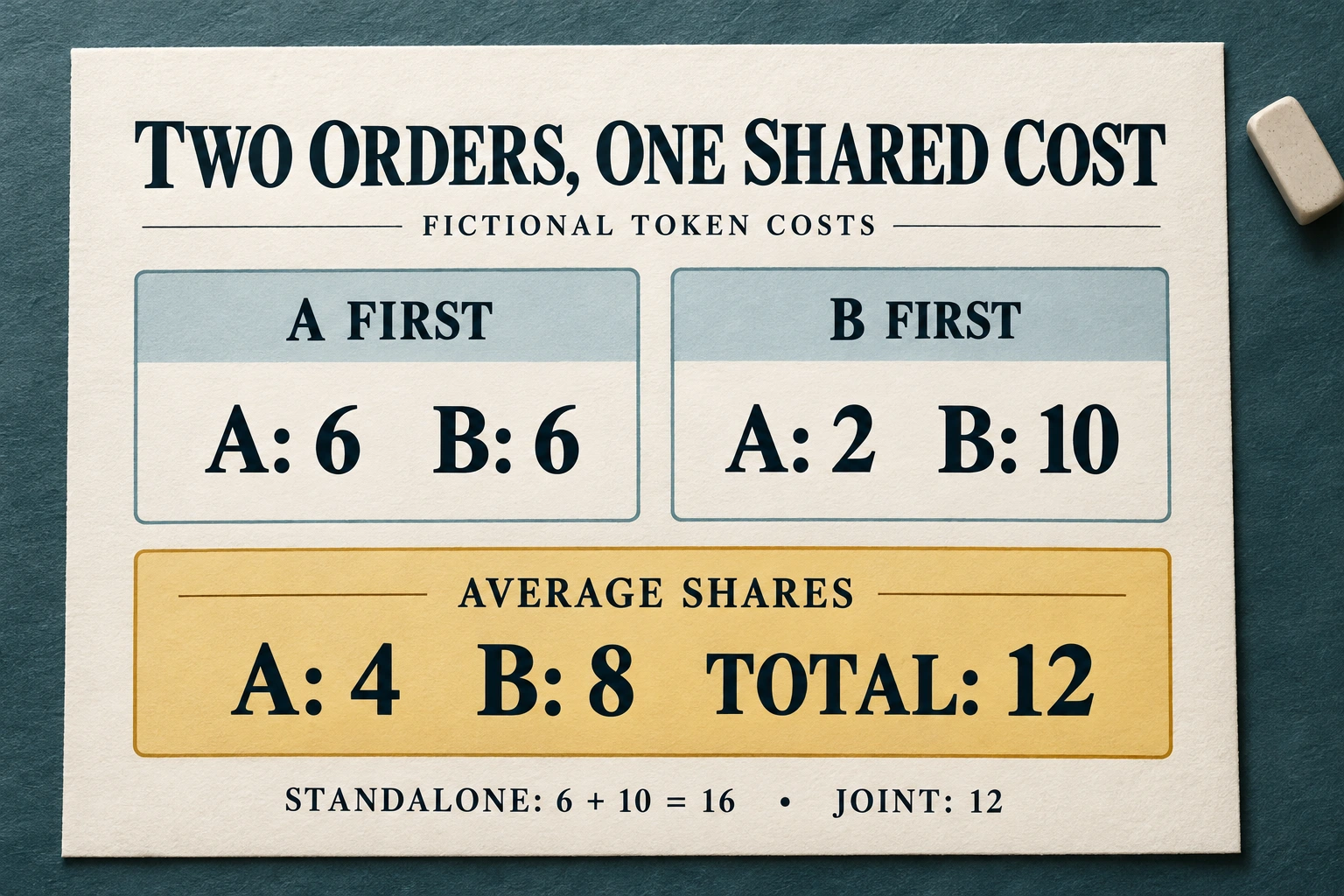
Write the separate and joint costs before dividing anything
A shared cost allocation can depend on a declared rule even when the joint total is already known. In this original paper example, serving A alone costs six tokens, serving B alone costs ten, and serving both together costs twelve. Serving neither costs zero. The figures are stipulated fictional inputs, not prices for either eraser offer linked later.
We will compare two hypothetical entry orders. In one, A enters the calculation first and B joins afterward. In the other, B enters first and A joins afterward. These are ways to attribute the same joint cost. They do not describe the timing of real purchases or require anyone to place separate orders.
Our chosen rule is explicit: calculate each party's added cost in each of the two orders, then average that party's two figures with equal weight. The result will allocate twelve tokens between A and B. We have chosen the rule for this exercise; the arithmetic does not establish that it is universally fair or suitable for a real agreement.
Trace the order with A first
Begin with neither party and a cost of zero. Adding A brings the cost to six, so the increment attributed to A is six minus zero, or six. Retain the starting and ending costs beside that increment. They identify the change being calculated.
Now add B while A is already included. The cost changes from six to twelve, so B's increment in this order is six. The two attributed amounts are therefore A six and B six. Their sum is twelve, matching the joint cost.
B's standalone cost of ten is not the second increment in this order. That ten describes serving B without A. The second step instead compares the joint twelve with the existing A-only six. Using ten as the second increment would combine two separate-case figures and produce sixteen rather than the declared joint cost.
Keep this order's result as one column. An equal-looking six-and-six split has appeared, but we obtained it from these particular cost differences. We have not yet applied the rule that averages both orders. A different set of standalone figures could make this first column unequal.
Trace the order with B first
Restart the hypothetical calculation from neither party and zero cost. Adding B alone brings the cost to ten, so B's first increment is ten. This is a separate trace, not a continuation after the first order's twelve-token endpoint.
Add A to the B-only case. The cost rises from ten to twelve, making A's second increment two. Written in the same A-then-B column order used above, the allocation is A two and B ten. Those amounts also sum to twelve.
A's attributed increment has changed from six to two, while B's has changed from six to ten. The joint cost has not changed. The difference comes from which standalone case is already present when the other party is added to the calculation.
Do not compare A's first-order six with B's second-order ten and call sixteen the joint allocation. That would take both parties' first-position increments while omitting both second-position increments. Each complete order needs to remain intact before the averaging step.
Average each party's two increments
A has increments six and two across the orders. Their equal-weight average is four. B has increments six and ten, whose average is eight. The chosen allocation is therefore A four and B eight, and four plus eight returns the joint twelve.
Average by party name rather than by entry position. Averaging the two first-position amounts, six and ten, would give eight; averaging the second-position amounts, six and two, would give four. Those position averages do not identify who owes which amount. Keep A's figures together and B's figures together.
Equal weight here means that each of the two hypothetical orders contributes one half to the calculation. It is part of the authored allocation rule. We have supplied no probabilities about who would actually arrive first, and no prediction is needed to calculate the two averages.
Once both orders have been included, choosing which trace to write first on the page does not change either party's average. A still has six and two; B still has six and ten. That is the limited sense in which this rule removes the initial choice between the two entry orders.
Separate the total saving from the way it is assigned
The two standalone costs add to sixteen: six plus ten. The stipulated joint cost is twelve, giving a total difference of four. This comparison describes the fictional cost function. It does not demonstrate that combining any actual eraser orders would reduce their checkout total.
Under our mean allocation, A contributes four instead of its standalone six, a difference of two. B contributes eight instead of its standalone ten, also a difference of two. The allocated differences add to the same total four.
The first order's six-and-six attribution would instead leave A no difference from standalone and B four below standalone. The other order's two-and-ten attribution would give A the full four-token difference and B none. Averaging the orders divides that particular total difference equally between the two parties.
These comparisons do not make an attributed saving into a payment already received. The page contains no transaction or actual reimbursement. Retain the standalone figures, joint figure and chosen allocation together so the word saving has a stated baseline.
A correct total does not identify the chosen allocation rule
An equal split of the joint twelve would assign six to each party. A split in proportion to the standalone six and ten would assign twelve times six divided by sixteen to A, or four and a half. B would receive seven and a half. Both alternatives add to twelve.
Those are different rules from the equal-weight mean of the two entry orders. A person choosing either alternative deliberately has not made an addition error merely because their shares differ from four and eight. A record claiming to use our averaging rule, however, needs to show the two increments for each party and their averages.
Even requiring that neither party pay more than its standalone cost leaves several possible splits. If the shares sum to twelve, A could have any amount from two through six while B takes twelve minus A's amount. Our four-and-eight result sits within that range; the no-higher-than-standalone condition alone does not select it.
This range concerns exact fictional token amounts and permits fractions. It does not address indivisible physical goods, rounding to cents or a method for reconciling remainder units. Those would require additional rules and should not be inserted silently into this example.
Check what happens when the joint cost changes
Keep the standalone costs six and ten, but make a separate case with joint cost sixteen. With A first, the increments are A six and B ten. With B first, they are B ten and A six. Averaging therefore gives A six and B ten.
The joint cost now equals the sum of the standalone costs, so neither party receives a saving under this rule. A shared arrangement has not become cheaper merely because two parties appear in one calculation. The declared joint figure supplies the outcome.
For another separate case, set the joint cost to eighteen. A first gives A six and B twelve. B first gives B ten and A eight. Their averages are A seven and B eleven, summing to eighteen. Each exceeds its own standalone cost by one.
No split summing to eighteen could keep both shares at or below six and ten. Those two ceilings together allow at most sixteen. This is a direct inconsistency between the proposed total and those ceilings, rather than a special failure that averaging alone could repair. Do not describe the eighteen-token case as a saving.
Keep the cost function with the averaging formula
For the same two-party setup, call the standalone costs a and b and the joint cost j, while keeping the cost of neither at zero. A's two increments are a and j minus b. Its mean is their sum divided by two. B's increments are b and j minus a, averaged in the same way.
Adding the two means cancels the standalone terms and leaves j. Subtracting A's mean from a gives half of a plus b minus j. B has the same difference from its own standalone cost. These identities explain the original two-token differences and the changed-cost controls without supplying any real tariff or guarantee.
Before using the method elsewhere, establish that the separate and joint figures describe the intended cases on a comparable basis. This exercise gives them outright. It does not infer a joint quote from two product listings or establish what any actual participant has agreed to contribute.
Keep nearby allocation questions separate
The basket discount allocation guide assigns a reduction proportionally between lines and uses saved net amounts for a stipulated return. Here separate-case and joint costs supply counterfactual increments. There is no returned line or refund entitlement to calculate.
The gap-rule grouping FAQ changes which numerical pair is calculated first. Our two traces attribute a fixed joint total to named parties, then average by party. They perform no nested larger-minus-smaller gap operation.
Retain the actual eraser identities and image limits
The native BAZIC neon eraser-top account names 5,760 total and a 120-count box. Its single image shows caps, packaging and printed pencil illustrations. It authenticates no delivered quantity, fit, material, safety or erasing performance.
The native OfficeSpace OF3470454 account names a case of 288. Its single image shows a Snuggle Wuggles eraser display labeled 24. Retain both unit labels without inventing the case configuration. Neither account supplies our token costs.
Attach a USDT enquiry to the actual order
If you separately consider an eraser order on republeq.com and want to ask about USDT, identify the actual offer and intended quantity before discussing payment. The six, ten and twelve tokens in this exercise are fictional cost inputs, not checkout prices, cryptocurrency amounts or confirmed joint-order quotations. This article does not establish that a payment option is currently available for an account, location or basket. Read the choices and conditions actually presented for the intended transaction, and ask the responsible support contact to clarify essential information that remains missing. If a cryptocurrency option is offered, establish the specified asset and network, the requested amount, any stated validity period and the reference associating payment with that order. Do not infer a transfer destination from an eraser photograph, a display count, an earlier transaction or either hypothetical entry order. Keep the BAZIC account separate from the OfficeSpace account when asking about supplied contents. An answer about one does not automatically describe the other, and a changed quantity may require reviewing the resulting order information again. Ask separately about applicable delivery, cancellation, return and refund conditions, including how an approved amount would be determined, its denomination and any deductions. No present USDT eligibility, discount, conversion result, fee level, refund amount, processing time or delivery outcome is promised here. You can check every allocation using an available sheet without ordering either item. Preserve any eventual order acknowledgement and payment record separately from the fictional cost table. A chosen internal split cannot establish a merchant's payment instructions, confirm another person's contribution or turn an uncertain transaction into a completed one.
Save both complete orders beside the result
For the original six, ten and twelve costs, keep the A-first allocation six and six and the B-first allocation two and ten. Averaging each party's two entries gives four and eight. The shares sum to twelve and assign two of the stipulated total four-token difference to each party. Retain the chosen rule with those results.