Musical Instruments & Listening
Compare swapping versus regrouping a gap rule
An original larger-minus-smaller rule permits swapping a pair but can change its result when three inputs are regrouped. Follow both traces and an agreeing control.
Does swapping a pair mean I can change the grouping?
No. In the original paper example below, swapping two inputs within one calculation preserves its answer, while changing which pair is calculated first can change the final answer. Swapping versus regrouping a gap rule concerns two different permissions. We will define the rule completely, trace both groupings of the same three inputs and check an example where the groupings happen to agree. No actual instrument needs to be played or measured.
Use only nonnegative whole numbers. For any pair, take the larger number and subtract the smaller. Call the result their gap. The gap of 2 and 5 is 3; the gap of 5 and 2 is also 3. If both inputs are equal, their gap is zero. This definition supplies the entire operation for the exercise. It is not ordinary subtraction in the order the numbers were written.
Write G(a, b) to mean “apply the larger-minus-smaller rule to inputs a and b.” The letters are placeholders, not measured bell frequencies or product specifications. We will use 2, 5 and 9 as three fictional inputs. Their order stays fixed when we compare the two groupings. Only the location of the first calculation changes.
Why is swapping the two inputs safe for one gap?
Switching the written positions does not change which number is larger and which is smaller. In G(2, 5), the larger input is 5 and the smaller is 2. In G(5, 2), those identities remain the same. Both calculations therefore subtract 2 from 5 and return 3. The reasoning applies to every allowed pair because the definition selects the larger and smaller by value, rather than by their left and right positions.
For equal inputs, switching positions still changes nothing: the two values are equal and their difference is zero. This includes G(0, 0). The zero case belongs to the rule because zero is an allowed input. We do not need a separate exception for which copy of an equal value is called the larger one; either subtraction produces the same zero.
This permission concerns the two inputs presented to one application of G. It does not say that every expression containing several G symbols may be rearranged however you like. In a two-stage calculation, one input to the final gap may itself be the result of an earlier gap. Keep that completed intermediate result together when considering a swap at the final stage.
What happens when I calculate the first pair first?
Start with G(G(2, 5), 9). The inner parentheses tell you to find the gap of 2 and 5 before using that result with 9. The inner gap is 3. Replace the whole inner expression with its result, leaving G(3, 9). The larger of those inputs is 9 and the smaller is 3, so the final result is 6.
Save a two-line trace: first inputs 2 and 5, output 3; second inputs 3 and 9, output 6. This record identifies both inputs at each stage. The second calculation does not receive all three original values. It receives the intermediate 3 and the unused original 9. Treating it as a three-number subtraction would silently replace the operation we defined.
You can check the first-stage swap without changing this grouping. G(G(5, 2), 9) also begins with a gap of 3 and ends with a gap of 6. You can also swap the two inputs of the outer application, writing G(9, G(2, 5)). The completed inner result is still 3, so the final pair is 9 and 3 and its gap remains 6.
Neither safe swap has moved the original 5 into a new first-stage pair with 9. The first stage still combines 2 and 5. This is the useful boundary of the permission: a swap exchanges the two inputs of an existing gap calculation. It preserves the grouping that determined those inputs.
What changes when I calculate the last pair first?
Now write G(2, G(5, 9)). The inner calculation takes 5 and 9, whose gap is 4. Replace that entire inner expression with 4. The outer calculation is G(2, 4), which returns 2. The final answer is therefore 2, while calculating the first pair first returned 6.
The two expressions contain the same original numbers in the same left-to-right order: 2, 5, 9. The difference is the grouping. In the first expression, the initial pair produces 3 and leaves 9 for the next stage. In the second, the initial pair produces 4 and leaves 2 for the next stage. Those are different final input pairs, so the pair-swapping argument does not make their answers equal.
Compare the complete traces rather than only the final answers. First-pair-first uses 2 and 5 to make 3, then 3 and 9 to make 6. Last-pair-first uses 5 and 9 to make 4, then 2 and 4 to make 2. Every individual gap follows the same definition. The disagreement does not require a calculation mistake or an instruction to reverse ordinary subtraction.
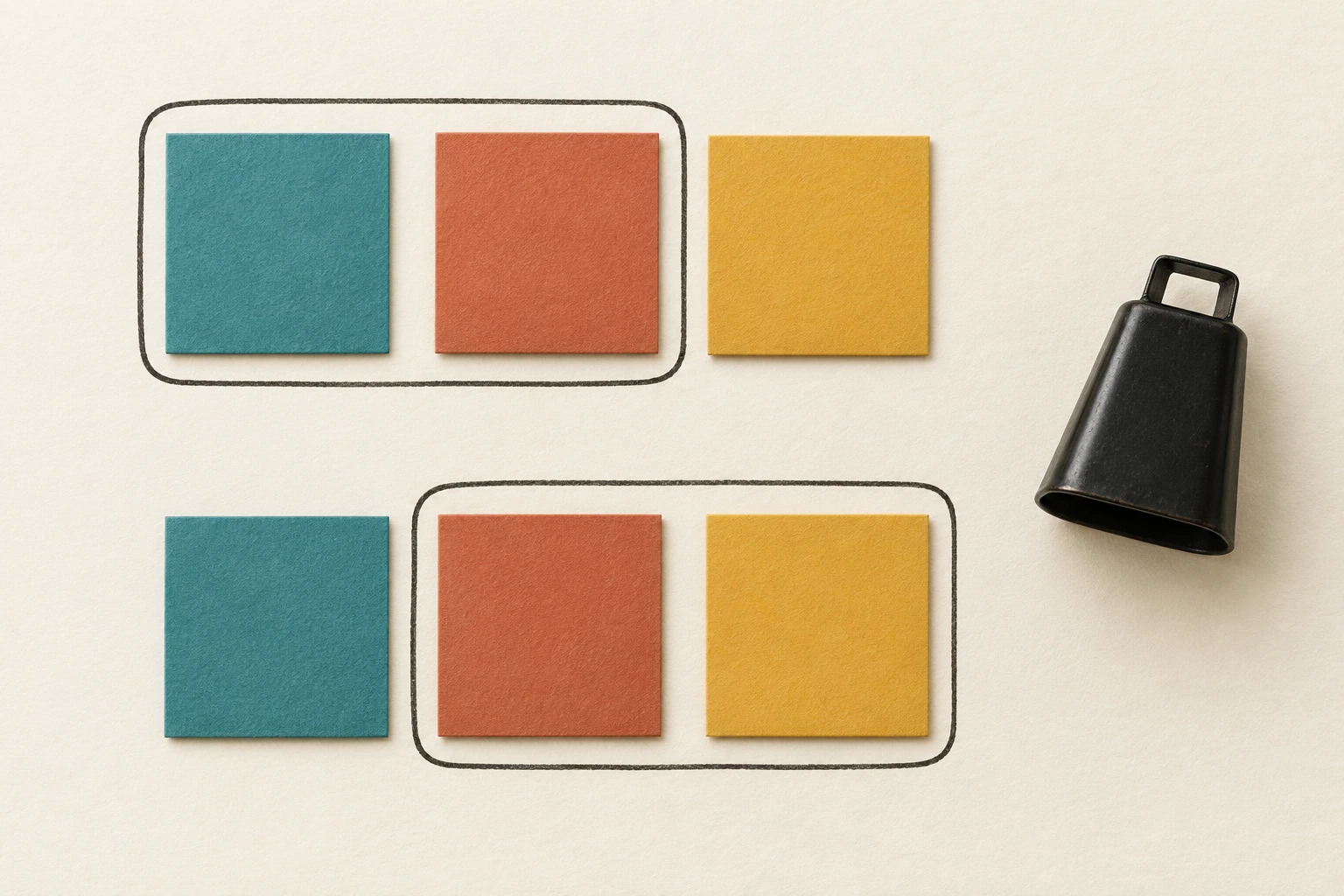
For a paper check, put the original values on three separate cards. Place an outline around the two being combined first, record their gap on another card, and then use that result with the remaining original card. Keep the original cards available beside the trace. This is an invented recording method, not an accessory inventory or an operating procedure for either linked bell.
What would go wrong if I ignored the parentheses?
The notation would leave the two-stage instruction incomplete. A row such as 2 G 5 G 9 does not, by itself, state which application should happen first in this exercise. You could agree on an additional reading convention, but you must state it. Do not assume the pair-swap permission supplies a grouping convention. It answers a different question about an already specified pair.
A friend who says “I got 6” may have calculated correctly under the first grouping. A friend who says “I got 2” may have calculated correctly under the second. Ask for the first pair and intermediate result before diagnosing an arithmetic error. Once the intended grouping is explicit, each trace can be checked against that particular instruction.
Likewise, an intermediate card marked 3 needs its origin recorded. In this example, it represents G(2, 5), rather than an extra original input that was present from the beginning. If you move that card to another worksheet, bring its defining pair with it. Otherwise the final pair can look straightforward while the earlier instruction that produced it has been lost.
Can the two groupings ever agree?
Yes. Try a separate example with inputs 0, 5 and 9. Calculating the first pair first gives G(0, 5) = 5, followed by G(5, 9) = 4. Calculating the last pair first gives G(5, 9) = 4, followed by G(0, 4) = 4. Both groupings return 4 for this triple.
Keep this agreeing example separate from the earlier counterexample. It does not change the results for 2, 5 and 9. The question “did these two traces agree?” concerns the stated inputs. The broader claim “regrouping always preserves the result” concerns every allowed triple. The explicit 6-versus-2 result is enough to reject that broader claim, even though some triples give equal answers.
This also explains why trying one convenient example cannot establish a universal permission. The zero-first example gives an agreement, but it leaves other triples unexamined. Here we already have a complete contrary trace. We are not offering a classification of every triple that agrees; the narrower task is to distinguish pair swapping from an unrestricted regrouping rule.
How is this different from moving cards or combining averages?
The castanet card-order puzzle counts neighboring exchanges needed to rearrange a row and uses inversion changes to check exact move counts. Our safe swap concerns the two inputs to one gap calculation. There is no target card order, move budget or parity requirement in this example.
The explanation of combining group averages reconstructs page totals and book counts before calculating a combined mean. This gap rule computes no mean and assigns no observation weights. Moving a parenthesis here changes an intermediate gap; it does not correct an omitted group size or combine two collections.
What role do the two bell listings play?
The native Tycoon Low-Pitched Hand Bell offer has one gallery image showing a single metal cowbell-shaped instrument with Tycoon markings. Its title supplies the low-pitched label, rather than a sound heard for this article. The photograph does not establish a supplied separate beater, and the paper numbers do not represent its pitch, dimensions or measured performance.
The native Gon Bops B085H hand-bell offer has two gallery images showing the same black cowbell-shaped instrument with B085H markings. Repeated views are not evidence of two supplied bells. No audible result, projection, overtone pattern, warranty outcome or separate accessory is established here. Both listings provide a musical context for a paper activity, not a physical demonstration of the gap rule.
You can complete every trace without either instrument. In particular, the numbers 2, 5 and 9 are not instructions for strikes, a rhythm or a combination of actual sounds. An instrument theme does not supply new mathematical permissions. Leave any question about choosing or using a real bell with its own applicable product information.
Does a correct trace answer a cryptocurrency purchase question?
No. A correct paper trace establishes only the result of the gap calculation under its written inputs and grouping. If you separately investigate a bell purchase on republeq.com and want to ask about USDT, begin with the actual offer and order you are considering. This FAQ does not establish that a particular checkout, seller, location or account currently supports that payment choice. Inspect the methods and conditions actually presented for the intended transaction, and resolve missing information with the responsible support contact before taking an action. If a cryptocurrency option is offered, check the specified asset and network, the amount requested, any stated time limit and the way the payment would be associated with your order. Do not reconstruct a destination or transfer instruction from a product photograph, an earlier purchase or a mathematical example. Keep the actual order terms available while asking those questions. Establish the cancellation and refund conditions that would apply, including which currency would be returned and what requirements would govern any return. A product's musical description does not answer those transaction questions, and a payment option does not authenticate the product's sound or supplied contents. If the selected offer or quantity changes, check the resulting order information again rather than assuming an earlier answer covers it. The article promises no present USDT eligibility, discount, fee level, conversion result, refund amount or successful delivery. Both native products remain optional context for an exercise that can be done on paper. Keep the purchasing decision and any eventual transaction record separate from the record of which two numbers were combined first.
What should I retain with the answer?
Save the rule, the three original inputs, the chosen grouping and both intermediate and final results. For 2, 5 and 9, first-pair-first returns 6 while last-pair-first returns 2. Swapping the two inputs of an existing gap remains safe because its larger and smaller values stay the same. Regrouping can instead change the pair presented to each stage. Those explicit traces are the evidence for the distinction.