Cleaning & Vacuums
Tennis court shoe cleaner parts explain brush and basin roles
Understand the documented bristle and sole-contact panel arrangements in a practical court-cleaner enquiry, with the two retail offers and their limits kept identifiable.
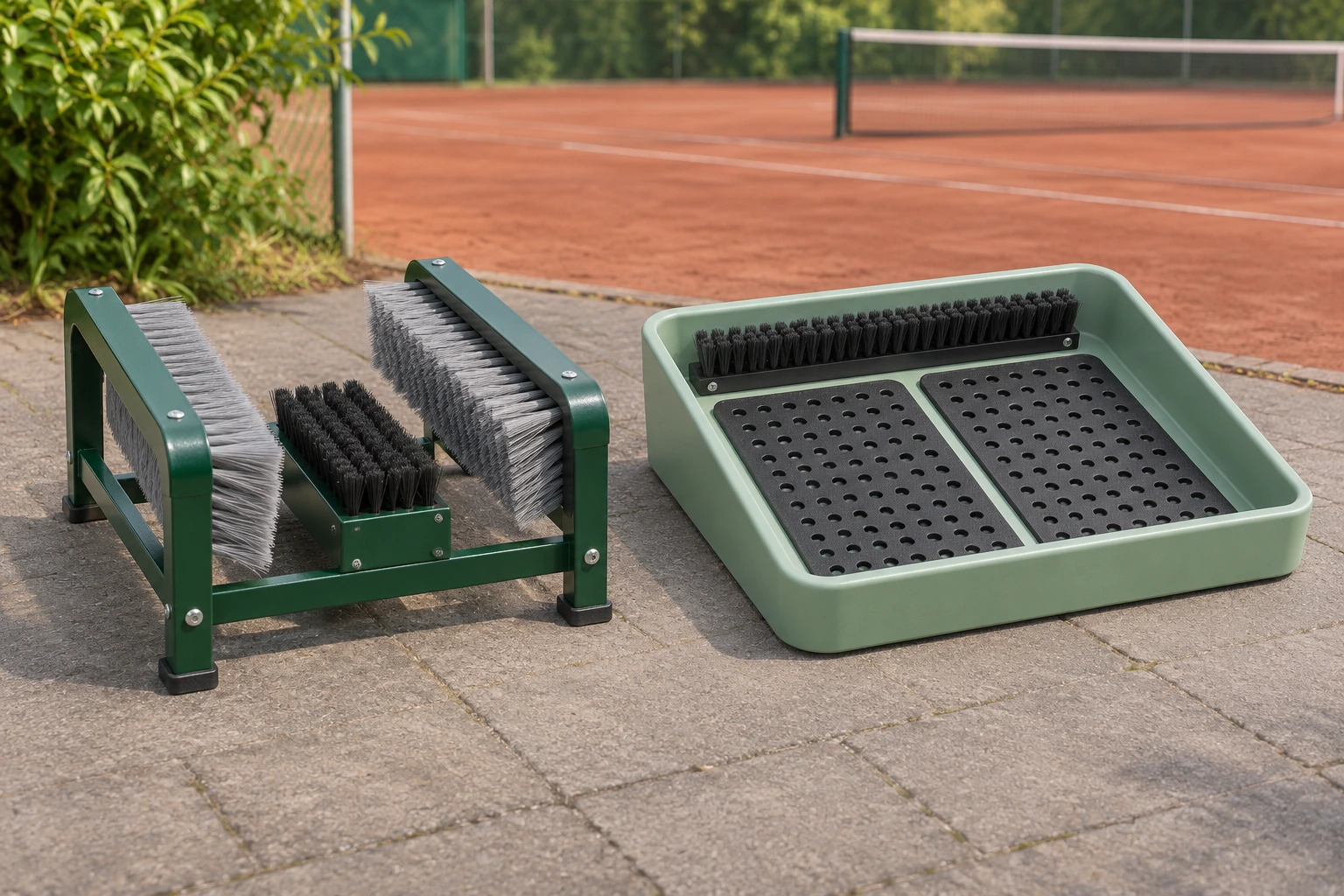
Tennis court shoe cleaner descriptions become easier to compare when you can name the part you are asking about. Someone pointing at a photograph may mean the bristles, the surface beneath a shoe or the whole assembly. Begin with that distinction before choosing equipment for a club. A clear parts question gives the person answering it something specific to identify, especially when the product name supplies very little explanation.
This explainer follows two documented working arrangements and two retail offers. It then uses an invented adult club-volunteer enquiry to show how a reader can keep a question attached to the right component. The enquiry ends with a defined request for information. Nobody operates a cleaner in the example, and the story reports no observed cleaning result.
Read the maker's two bristle roles
Har-Tru describes its Shoe Brush with softer upper bristles for the tops of shoes and stiffer lower bristles for clay and debris on soles. These shoe brush bristles have different stated contact roles within its named design. The maker also describes a carbon-steel base and says the unit can be mounted or used freestanding. Its cleaning account mentions a hose or soap and water. Keep those statements with that maker's brush when seeking the applicable instructions. A retail photograph with a similar arrangement still needs its own supplied identity established before those material, mounting or care statements can be applied to it. The description explains the named parts without supplying a trial on your shoes or at your club.
Understand the basin and panel mechanism
Har-Tru's Tennie Two-Step account describes a basin holding water and two perforated rubber panels. It says the panels channel water into tennis-shoe soles as the user rocks back and forth. A water-filled shoe cleaner in this account therefore involves the panels' documented working action, beyond the basin's visible outline. The maker offers versions with and without a brush and identifies the brush and rubber mats as replaceable. Keep the selected version available when obtaining its instructions. This is an explanation of the maker's stated mechanism. Filling, placement and actual operation need the directions for the equipment being used, along with the club's applicable arrangements. The presence of a rear brush in a photograph does not establish that every offered version includes it.
Keep each retail offer identifiable
The BuyBocceBalls shoe-brush offer identifies SKU 630564047 and UPC 704660846762. Its sole gallery shows a green chassis, two inward-facing side brushes and a central upward-facing brush. No readable maker or model label appears. The short native account identifies a court shoe brush but supplies no complete instructions. Its catalog identity is retained without claiming that it is the manufacturer's brush described above.
The Har-Tru Tennie Two-Step offer shows a shallow tray, two dark panels and a rear brush. The pictured label reads TENNIE TWO-STEP. Its own metadata names model BBB-access_147-3012, while the description says only “tennis net court.” The tiny label in its other package photograph is unreadable. The visible family name supplies no independent numeric-model confirmation or complete operating instructions.
When discussing either offer, make the question easy to locate in its picture. You can describe a component in ordinary words and ask the seller to confirm its proper name. An uncertain name can remain a question. There is little benefit in choosing a technical term merely to sound knowledgeable if it directs the answer toward a different piece of equipment.
Keep the full offer available during that conversation. A close crop may be helpful for pointing, but retain the whole picture and the written reference beside it. That gives the other person a chance to correct your interpretation. If they identify a different part from the one you meant, return to the photograph together before discussing what to order.
Follow one parts enquiry through an ordinary conversation
Imagine Nina, an adult volunteer helping a tennis club organize an equipment enquiry. Another volunteer, Owen, has asked her to investigate a cleaner. His message contains a small photograph and the words “something like this.” Nina does not know which feature prompted the request. She starts by asking what Owen wants her to find out, while leaving the proposed purchase undecided.
Owen says his question concerns the piece he is pointing at in the picture. Nina asks him to describe its position, then repeats the description in her own words. He corrects her once. That short exchange gives them a shared reference without requiring either person to guess an unfamiliar component name. They now know which visible part belongs in the enquiry.
Nina also asks who will answer the equipment question for the club. Owen gives her the name of the person responsible for the existing arrangement. She can ask that person about what the club has and what information is missing. Volunteering to collect details has given Nina a defined task. It has not supplied her with knowledge about equipment she has yet to identify.
She prepares a brief message describing the part and asking which instructions concern it. She keeps the photograph that prompted the question available for the recipient. She avoids claiming that the club owns the item in a retail offer merely because Owen found a similar picture. The message asks for an identification that can be checked against the actual equipment.
Suppose the reply discusses a whole unit when Nina meant one component. She can point out the difference and ask the narrower question again. She need not begin a second shopping search immediately. The useful next step is to establish whether the reply answered the original enquiry, or whether she and the recipient have been discussing different objects.
In this invented exchange, the club's equipment lead agrees to identify the existing item before Nina pursues a purchase. Nina gives Owen that answer and closes her shopping task for the moment. The outcome is a clearer responsibility and a question attached to a particular part. The example stops there, with neither an order nor a successful cleaning demonstration added to it.
Let the answer determine the next enquiry
A parts explanation can help you recognize what further information you need. Ask for the document that applies to the named item and read the relevant directions together. If a reply supplies only a general product-family name, keep the remaining model question visible. The recipient may need another photograph or a reference from the actual equipment before giving an applicable answer.
Describe the intended enquiry accurately when handing it to another person. Someone asked to identify an existing component may otherwise assume you want a recommendation for a complete purchase. Say which question has been answered and which still needs attention. This lets the next person continue the conversation without having to reconstruct what “the cleaner” meant in an earlier message.
If the proposed item changes during that conversation, return to the revised offer. Check that the question you send now identifies the item being considered now. Retain an earlier answer with the earlier enquiry when you need it for reference. A reply can be accurate about its original subject while leaving the revised proposal open.
You can also decide that a purchase enquiry should wait. Nina's imagined club might already have the information it needs once the responsible person identifies the existing equipment. Another club could still need details from a supplier. Those are different outcomes of an enquiry. Neither requires announcing a preferred product before the people involved know which equipment question they are trying to answer.
Use the matching guide for a different equipment question
The published tennis balls and court surfaces guide keeps a ball's duty wording, the actual surface and a session's equipment requirement distinct. Its ball-selection discussion supplies no component instructions for either cleaner here.
The boot tray rim and coir insert explainer concerns wet footwear placed in household trays. Its storage-and-runoff discussion has a different purpose from the court-cleaner mechanism described here. Keep its tray and insert account with that household use.
A shared word can make two conversations appear closer than they are. When someone brings you another guide, ask which question they expect it to answer. It may help identify the next person to consult, or concern a different task altogether. You can acknowledge that contribution while keeping your current equipment enquiry clear.
For Nina and Owen, the useful handoff is the short description they agreed on and the name of the person following it up. They can return to their other club tasks while that enquiry is handled. Their decision does not need a ranking of every cleaner sold, an imagined maintenance problem or a demonstration staged for the photograph.
Keep an optional order attached to the selected goods
If a later equipment enquiry leads to an order at republeq.com, identify the selected goods before choosing a payment method. A customer who prefers crypto should inspect the options presented for that particular transaction. Where USDT is offered, read the asset and network instructions shown for the current order before authorizing payment. Keep the merchant's order reference with the transaction information so a later question can identify the same purchase. Review the item again if the basket changes while a supplier answers an enquiry. A response about the earlier item may leave the revised goods unclear. Obtain any essential clarification through the seller's published support route while the order can still remain undecided. Read the delivery and return terms for that transaction and retain the conditions you accept. If another person will receive the goods, agree on the selected item and the delivery details before treating payment as approval of a shared purchase. Preserve a written product clarification with the order confirmation when one has been supplied. Someone helping identify equipment needs the relevant product reference, while wallet recovery phrases and private keys belong outside that correspondence. If a payment result is uncertain, use the existing order and payment references to reconcile it before considering another payment for the same purchase. A completed transaction records an equipment purchase. The actual item still needs its applicable instructions and the club's arrangements before use. Choosing USDT leaves those equipment questions to be answered on their own evidence. No token amount, exchange rate, processing period or transaction deadline is inferred here from an earlier order, another merchant or someone else's payment experience.
Before ending the enquiry, state the answer you actually have. You may have identified a component, obtained the matching document or established who needs to investigate further. Keep that answer available to the people who will act on it. For a Tennis court shoe cleaner, a precise parts question helps the conversation reach that point without turning an incomplete description into a promised outcome.
Conceptual court shoe-cleaning arrangements show bristle contacts beside a shallow two-panel basin.