Product Compatibility & Accessories
Tennis balls and court surfaces: read the exact duty claim
Match court-surface recommendations, actual Penn and Wilson ball offers, programme requirements and court-pace labels without inventing universal compatibility.
Matching tennis balls and court surfaces starts with the exact ball description and the surface you intend to use. A duty label, an all-court claim and a court's pace category do not name the same thing. Read each description with its actual source before choosing a pack for your game.
The selected Penn offer calls its regular-duty balls all-court. Penn's current Championship Regular Duty Case page recommends soft clay or indoor courts. Preserve both accounts without inventing a universal prohibition.
Establish which court and which requirement you mean
Begin with the place where you expect to play. If you only know the club's name or a booking time, ask which actual surface the session uses. A reference to playing indoors identifies a location condition; it does not, by itself, give you a complete material specification for the surface beneath the players.
Keep the purpose of the session available too. You may be choosing supplies for your own practice, bringing balls to a shared session or following an organizer's named equipment requirement. Those are different purchase situations. A product can have an all-court description while a particular session still asks participants to bring a named item.
Ask the person responsible for that session about the actual requirement. This guide provides no ball-approval receipt for either selected offer and no authority to disregard a club or event's conditions. If a specific model is required, resolve that identity before substituting another product because its general description sounds suitable.
Read regular duty and extra duty labels in their source
For regular duty and extra duty labels, Penn's current Championship Regular Duty Case page recommends soft clay or indoor courts; its Extra Duty Case page names hard courts. Those manufacturer recommendations supply no performance trial here.
Keep the manufacturer's two case accounts distinct from the selected regular-duty retail offer. An Extra Duty Case is not the selected item. The current manufacturer pages establish no exact UPC or pack-identity match to this transaction.
When asking a seller about the difference, name the actual regular-duty offer and the surface you intend to use. Ask which supplied product and documentation the seller's all-court description concerns. A reply about another Championship variant would leave the original question open. Keep any eventual confirmation attached to the item it identifies.
Keep the Penn retail package intact
The Penn Championship Yellow tennis-ball offer identifies SKU 1796017345 and UPC 072489211819. It describes regular-duty felt pressurized balls, with seventy-two balls in twenty-four cans. Its actual account includes soft clay and indoor and outdoor hard courts in its all-court wording.
Its controlled-fiber, natural-rubber, even-nap, consistent-feel, reduced-shock and hundred-years-of-testing statements remain retail claims, without a measured performance or personal-suitability result here.
Keep the stated cans and total balls together when comparing the order. Seventy-two identifies the total number of balls; twenty-four identifies the can count. Neither figure identifies a court material. If you need fewer cans or expect a different sold quantity, confirm the actual transaction instead of treating a displayed total as permission to split the package.
Pressurized is also part of this selected account. It does not supply a useful-life guarantee for an opened can, a storage duration or a refilling method. This compatibility discussion supplies no can-opening, ball-repressurizing or equipment-maintenance procedure. Follow the applicable instructions for the actual product when handling questions arise.
Use the Wilson guidance without inventing a prohibition
Wilson Australia's ball-choice guide describes extra-duty felt for hard, abrasive surfaces. It also says regular- and extra-duty balls can be used on any court surface with trade-offs. Its examples associate regular-duty use on hard courts with less wear life and extra-duty use on softer courts with more fluff. This is Wilson's general explanation, not a measured result for the selected Penn balls.
Read the limits of that account before applying its recommendation. Designed for a surface does not necessarily mean unusable everywhere else. Conversely, an all-court phrase does not promise identical play or wear across every surface. Ask what a recommendation actually establishes before turning it into a universal compatibility rule.
Do not use Wilson's explanation to overwrite Penn's wording. They are separate publishers discussing their own products and categories. Retain which company supplied a statement when comparing the accounts. A shopper can understand a general trade-off while still needing confirmation about the exact product being ordered.
The actual Wilson practice offer supplies its own identity
The Wilson 1284411 practice-ball offer identifies SKU 141745788 and UPC 026388018055. Its description gives a pack of seventy-two yellow all-court practice tennis balls. The actual catalog brand is Wilson, and the item is classified as Unisex All Spring Sports.
The account says the balls are made from recycled materials. That does not identify a particular recycled-content percentage, certification or complete material composition. Keep it as the source's claim. The retail description provides no documented connection to Wilson's Triniti technology, so no Triniti core, felt or packaging claim is assigned to this model.
Its size is written as 8.3 by 3.1 by 3.1, without units. The account also leaves unclear what those dimensions describe. Do not turn them into centimetres, inches, a ball diameter or a packed-case measurement. Ask for the unit and measured object if those details affect the purchase. For that size question, a measurement of one ball would not establish the shelf space required for seventy-two.
The offer states seventy-two balls but gives no matching can count. Do not copy Penn's twenty-four-can arrangement into the Wilson order. The common total identifies a quantity shared by the descriptions; it does not establish identical packaging, pressurization or supplied accessories.
Keep all court practice ball claims with the selected model
For all court practice ball claims, the Wilson offer's all-court wording belongs to model 1284411. Its practice description does not supply an event approval, measured rebound or official match-ball designation. Keep the actual intended session with those remaining questions.
If a group simply asks you to bring the same model it already uses, obtain that model identity before choosing from another yellow-ball listing. If the group instead gives a surface requirement, ask whether it also specifies a ball. These requests can sound similar during a quick conversation while supplying different information for an order.
An existing photograph of a package may help identify what someone means, but a remembered color alone leaves the model unresolved. Compare the written identifier with the actual offer. This article supplies no claim that every yellow practice ball, every Penn Championship variant or every Wilson model has the same construction.
A programme's ball requirement is another compatibility question
The USTA National Tennis Center's actual 10 & Under Pathway illustrates a different equipment decision. Its Red Aces account uses alternative red felt or foam balls on thirty-six-foot courts. Its Orange Champs account uses an orange ball on a sixty-foot court. The programme also varies racket sizes. These are that programme's descriptions, not universal assignments made here for a particular child.
The same page describes its pathway in terms of age, physical size and ability, with changes to courts, equipment, net height and scoring. An all-court claim on either selected retail pack supplies no confirmation that the pack meets a particular class's stated ball requirement. Neither selected description identifies the supplied balls as those programme's red or orange types.
Ask the actual programme about its equipment before buying for that purpose. A suitable court location does not answer every question about a class. Keep the supplied ball identity attached to the programme's requirement, without assigning a child to a level or replacing the instructor's assessment with a retail label.
A court-pace category answers a separate question
The International Tennis Federation's Classified Surfaces page describes five Court Pace Rating categories: one, slow; two, medium-slow; three, medium; four, medium-fast; and five, fast. It explicitly says the classification concerns court pace and does not imply ITF approval or endorsement. Those numbered surface categories are not retail ball-brand or duty labels.
For example, a surface described as category three has a pace description in that scheme. The number supplies no selected Penn or Wilson product identity. Likewise, a regular-duty label does not reveal the classified pace of the actual venue. Keep the surface record and the ball offer available as separate evidence if both matter to the session.
This article identifies no classified venue, tested surface product or approval for either selected pack. It provides no way to measure court pace at home or derive a rating from a court's appearance. Obtain the actual venue information rather than assigning a category from a photograph or a familiar surface name.
Resolve the comparison before ordering supplies
A useful answer to a compatibility question should identify the product, the intended surface and the source of the recommendation. If one part remains missing, say which part. A seller's response about a regular-duty product can resolve an identity question while leaving the venue's requirement to the organizer.
Keep a change of plan visible. If the session moves to another court, check the actual requirements for that session rather than assuming the earlier answer covered it. If the offered product changes, repeat the identity comparison for the newly proposed item. An answer attached to another pack does not silently become a statement about the replacement.
Price or package quantity can matter after that comparison, but neither settles it. A larger supply of the wrong named item would leave the session's requirement unresolved. Confirm what the order supplies before comparing the convenience of a bulk package with the number of balls the group wants.
For a small purchasing example, suppose a group requests twelve balls and the available offer supplies seventy-two. Ordering that package supplies sixty more than the stated request. It does not establish that twelve can be bought separately or that the group wants the remainder. Confirm the actual sale quantity and who wants the supply before letting a bulk total decide the order. The subtraction concerns quantity only; all seventy-two still need the correct identity for the intended session. A shared total cannot settle the earlier surface or programme question.
Let other ball games keep their own equipment questions
The actual summer croquet guide keeps a chosen nine-wicket game with the selected equipment descriptions and the group's invitation. Its croquet balls and playing arrangement supply no tennis surface recommendation. The relevant habit is establishing which equipment and game the participants have agreed to use.
The actual croquet out-of-turn guide distinguishes a ball-identity and turn problem from other questions about play. Its remedy belongs to the named croquet account. It supplies no tennis-ball substitution or court-rating procedure.
Match tennis balls and court surfaces using the actual offer, the applicable recommendation and the session's requirements. Keep any unresolved model or surface detail attached to that decision.
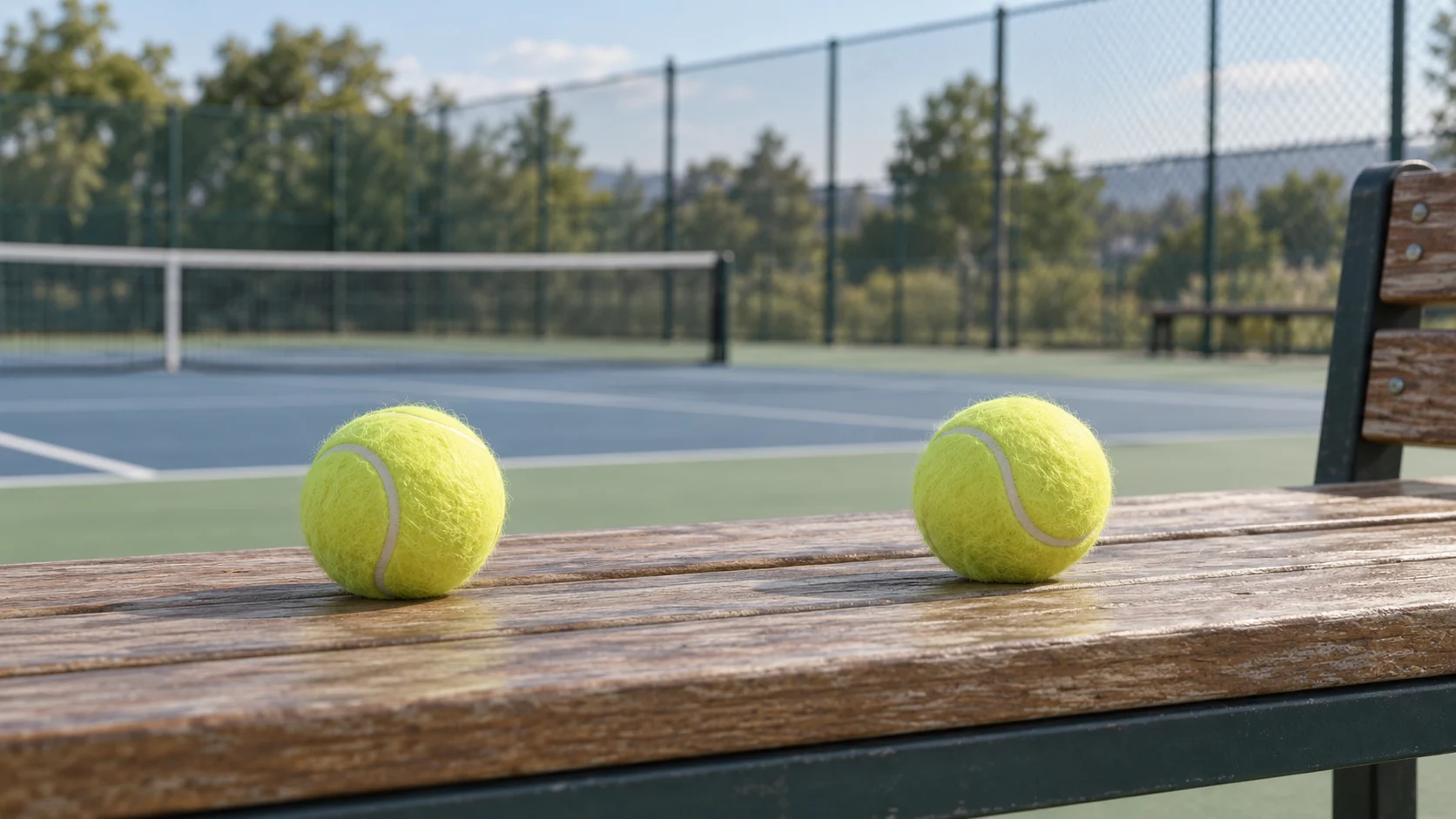
Conceptual tennis balls and court surfaces cover with generic inactive balls; no exact retail model, tested surface compatibility or measured playing result is demonstrated.