Problem-Solving Articles
Croquet played out of turn: restore the right ball
Follow the USCA basic nine-wicket distinction between an immediately noticed wrong turn and a later discovery, keeping restoration and the proper next ball clear.
Croquet played out of turn needs a correction tied to when the error was noticed. Under the United States Croquet Association's basic nine-wicket rules, an immediately identified wrong turn and a sequence of earlier unnoticed wrong turns have different restoration instructions. Establish which situation occurred before changing the game position.
This guide explains that rule distinction through ordered examples. It assumes the actual USCA basic nine-wicket game, rather than another croquet game or an adopted option changing turn order. The question is which incorrect play gets corrected and which ball properly continues. It supplies no swing, court setup or physical placement technique.
Identify the ball that should have played
The USCA basic rules give the four-ball order as blue, red, black and yellow. Its six-ball order adds green and orange after yellow. Keep the chosen game and actual ball sequence available when someone asks whose turn it was. A remembered player's name is useful only if it identifies the correct ball in that game.
First describe what was actually played. If blue was followed by red in the four-ball example, black would normally follow. A different ball being played raises an order question. Do not change another part of the game merely because someone has just noticed the colour sequence.
The source also includes challenging options that change the ordinary sequence after opening turns. An agreed option needs its own reading. The worked cases here retain the basic order and the basic out-of-turn provision, so an optional format is not silently mixed into either example.
Restoring balls after an immediate out-of-turn error
For restoring balls after an immediate out-of-turn error, the USCA basic rule says there is no penalty. Balls moved during that incorrect play are returned to their positions before the error, and play proceeds properly. The same provision still requires the relevant correction.
Consider a fictional four-ball game. Blue has played, followed correctly by red. Yellow then plays when black should be next, and the group notices the mistake before another turn begins. The relevant error is that yellow play. Identify the positions before that play and the balls it moved.
Suppose, as an explicit fact of this invented case, yellow's incorrect play also moved black. Returning only yellow would leave a second changed ball in place. The immediate-error provision covers the balls moved during the incorrect play. Both affected balls therefore belong in the stated restoration before black continues properly.
The example assumes those prior positions are known. It demonstrates the scope of the rule rather than a technique for determining an uncertain position or moving a ball accurately. Keep an actual unresolved position question with the applicable game rules instead of declaring that the hypothetical case established it.
Keep a moved ball separate from the player who made the error
Two questions matter in that immediate case: which ball was played out of turn, and which balls changed position because of it? The answers need not contain the same number of balls. Yellow identifies the wrong turn, while yellow and black identify the affected positions in the stated example.
One person may correctly name yellow as the error while another correctly recalls black moving too. Their accounts answer different parts of the restoration question. Read both against the actual event before deciding what needs to be returned.
Once the immediate correction is established, identify the proper next ball. In this example, that is black because blue and red were the preceding correct turns. The error does not supply an invented reason to skip black, repeat red's completed play or begin an entirely new game.
Correct ball after a later out-of-turn discovery
When an out-of-turn play was initially accepted without the mistake being noticed and the error is discovered later, the USCA basic account says to replace only the last ball played out of turn. The correct ball after a later out-of-turn discovery then proceeds. Preserve that stated later-discovery scope instead of automatically undoing every earlier turn someone remembers.
The USCA itself illustrates this with red, then blue, then yellow being played. When yellow's incorrect place after blue is noticed, yellow is replaced and red plays correctly. This is the source's particular sequence and outcome. It should remain intact when explaining how the later-discovery provision works.
The key difference from the earlier invented case is the intervening accepted play before the mistake is identified. Apply the source's stated later-discovery correction to that situation. Do not combine its last-ball instruction with the immediate case's different restoration scope and present the mixture as one universal procedure.
The official document's FAQ also asks what happens when someone plays out of turn. Its brief answer refers to replacing the last ball played out of turn and having the correct ball play, with a reference back to the basic-rule example. Read that short answer alongside the full provision, including the circumstances in which the mistake was noticed.
The source example gives both parts of the outcome: yellow is replaced, and red continues. Naming only the replacement leaves the next-turn question unanswered. Keep the continuation visible when explaining the correction to another player.
Record when the group noticed the mistake
For an actual discussion, describe the played sequence and the point at which someone noticed the error. Saying only that yellow played incorrectly leaves out the condition that distinguishes the two cases. A description such as noticed before another turn began supplies more useful information.
In the immediate fictional example, the group stops to resolve yellow's play before anyone else takes a turn. In the USCA's later-discovery example, the source identifies the particular accepted sequence and the final incorrect yellow play. These are separate accounts, with different facts supporting their correction.
A person who joined the conversation late can ask which turns are known, which positions changed and when the error was noticed. Keep an uncertain memory marked as uncertain. Use the sequence and detection point to identify the applicable rule case.
No penalty does not mean leaving the wrong position
The USCA out-of-turn rule expressly says there is no penalty. That statement sits beside its restoration instruction. It does not remove the requirement to correct the relevant play, and it does not supply an extra loss of turn or an invented scoring deduction.
Explain the correction using the actual sequence and the applicable clause. In the immediate fictional case, identify the affected positions and black's proper continuation. In the source's later example, identify the last incorrect yellow play and red's continuation. Keep the particular outcome attached to its own case.
If another issue is also present, find its actual rule before combining the answers. Bonus shots, boundaries and an adopted non-sequence option raise their own questions. This guide's out-of-turn explanation does not settle those separate facts by describing one error as corrected.
Read the NOBRAND set's short contents account literally
The NOBRAND croquet set with carrying case identifies SKU 1941346651 and UPC 775637831272. Its actual description places it in Outdoor Games and names outdoor gatherings such as picnics, parties and reunions. It states that six solid-wood mallets are included.
Those mallets are described as 26 inches long with a stated diameter of 1.85 inches. Preserve that actual wording. The short description does not enumerate balls, wickets or stakes, and the word complete in the address does not fill those inventory fields. Obtain the actual package information if it determines an equipment decision.
Neither that description nor its gathering examples establish a supplied rule set identical to the USCA account. The rule explanation in this article remains conditional on the game actually selected. It is not a verification of everything contained in the NOBRAND package.
Keep the ETHFRF inventory with its own offer
The ETHFRF Multicolor croquet set identifies SKU 16722867751 and describes a six-player Outdoor Games set. It names six wooden mallets, six balls, two wooden stakes, nine coated-wire wickets and a carry bag. That is a more detailed inventory than the selected NOBRAND description supplies.
The ETHFRF account attributes outdoor use to the mallets and stakes, rust and wear resistance to the wickets, and compact transport and storage to the bagged set. These are retail claims, without a physical trial here. They establish no weather threshold, storage method or operational permission for either selected offer.
Keep game choice and bonus-shot questions separate
The actual summer nine-wicket doubles guide keeps the four-person game choice and individual ball assignments explicit. Its GoSports and Franklin contents remain with those offers. Here, identifying the actual assigned ball helps establish whose turn should have followed.
The actual croquet bonus-shot counting tutorial follows valid events, replacement awards and wicket-roquet order under the basic rules. Its GSE and PerfectPitch examples provide no new out-of-turn penalty. Returning an incorrect ball and calculating a valid bonus award are different rule questions.
Keep an equipment order with its actual payment information
If you are considering croquet equipment through republeq.com and prefer crypto such as USDT, establish the exact offer before investigating payment. The NOBRAND account names six mallets but does not enumerate every game component, while the ETHFRF offer provides a separate inventory including balls, stakes and wickets. Keep those descriptions with their actual items. A preferred payment choice cannot complete the missing package information or establish which rules accompany a set. Read the checkout methods actually presented for the selected transaction and their applicable conditions. USDT appearing in this guide supplies no confirmation that it is available for that order. Leave an absent or unclear option unresolved. Players with appropriate equipment already owned can consult the agreed rules without arranging another purchase. Review the actual delivery information and applicable return terms before ordering around a planned gathering. This discussion promises no arrival date or particular remedy. If another person is helping choose the equipment, give them the complete product reference and the remaining questions. A reply about ETHFRF's named wickets does not add them to the sparse NOBRAND inventory. A third proposed set needs its own current account. Keep any eventual confirmation with the order it identifies. This paragraph provides no wallet instructions, token-transfer sequence or network selection. A remembered cryptocurrency checkout cannot settle the current payment or delivery conditions for a different transaction. Choosing USDT, another available method or no purchase leaves the game correction dependent on the actual played sequence and the applicable rules. Retain the equipment identity, transaction information and rule question separately so a useful answer to one does not silently stand in for the others.
Continue with the ball the applicable correction identifies
Croquet played out of turn is clearer when the account includes the sequence and when the error was noticed. Use the basic rule's immediate-error restoration for that case, and its last-incorrect-ball correction for the stated later case. Identify the proper continuation without adding a penalty the rule does not impose.
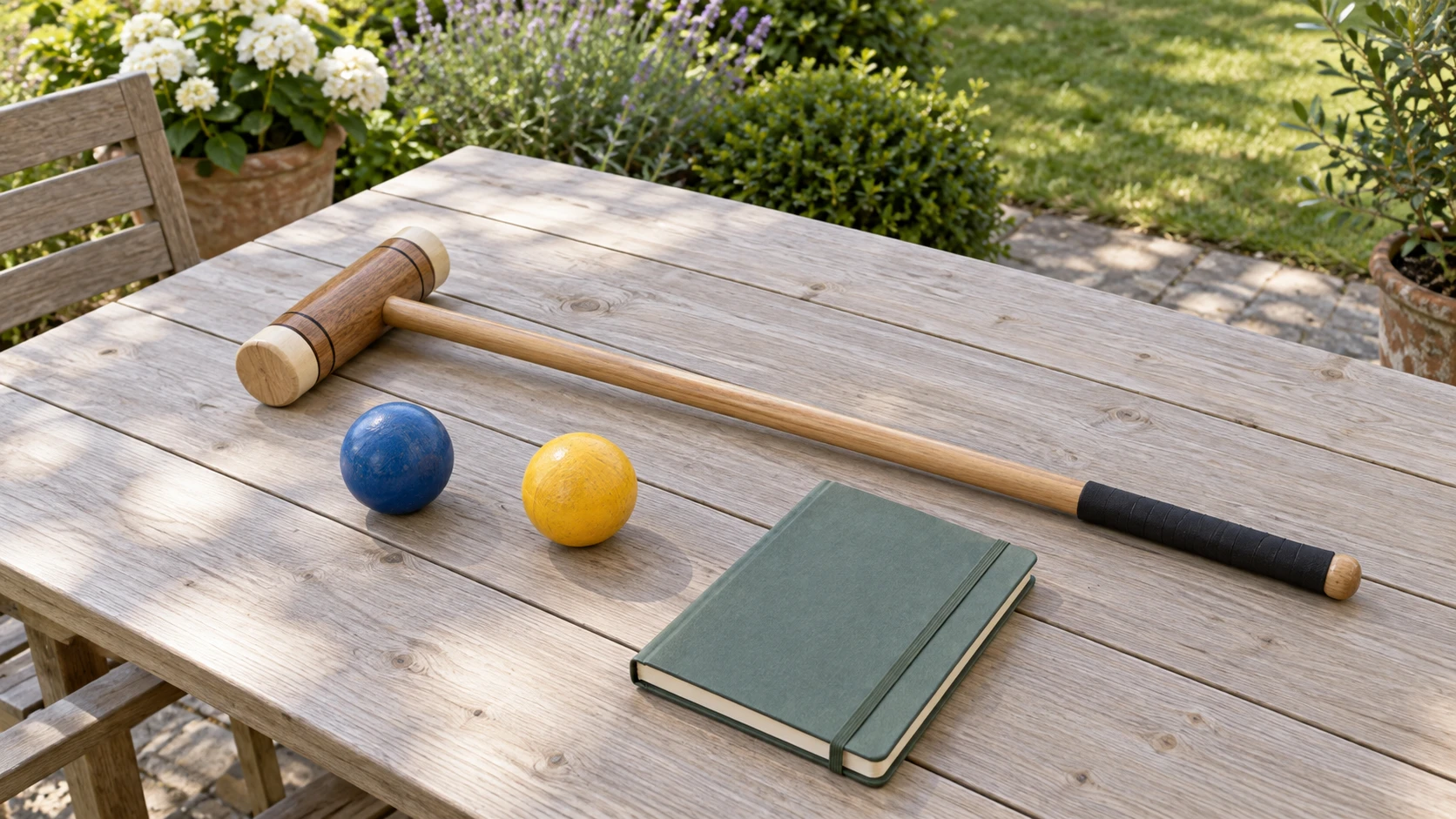
Conceptual croquet played out of turn discussion with complete generic inactive equipment and a blank notebook; no exact retail set, corrected ball position or playing technique is demonstrated.