Skills & Planning
Tautogram writing: tell a story using only S words
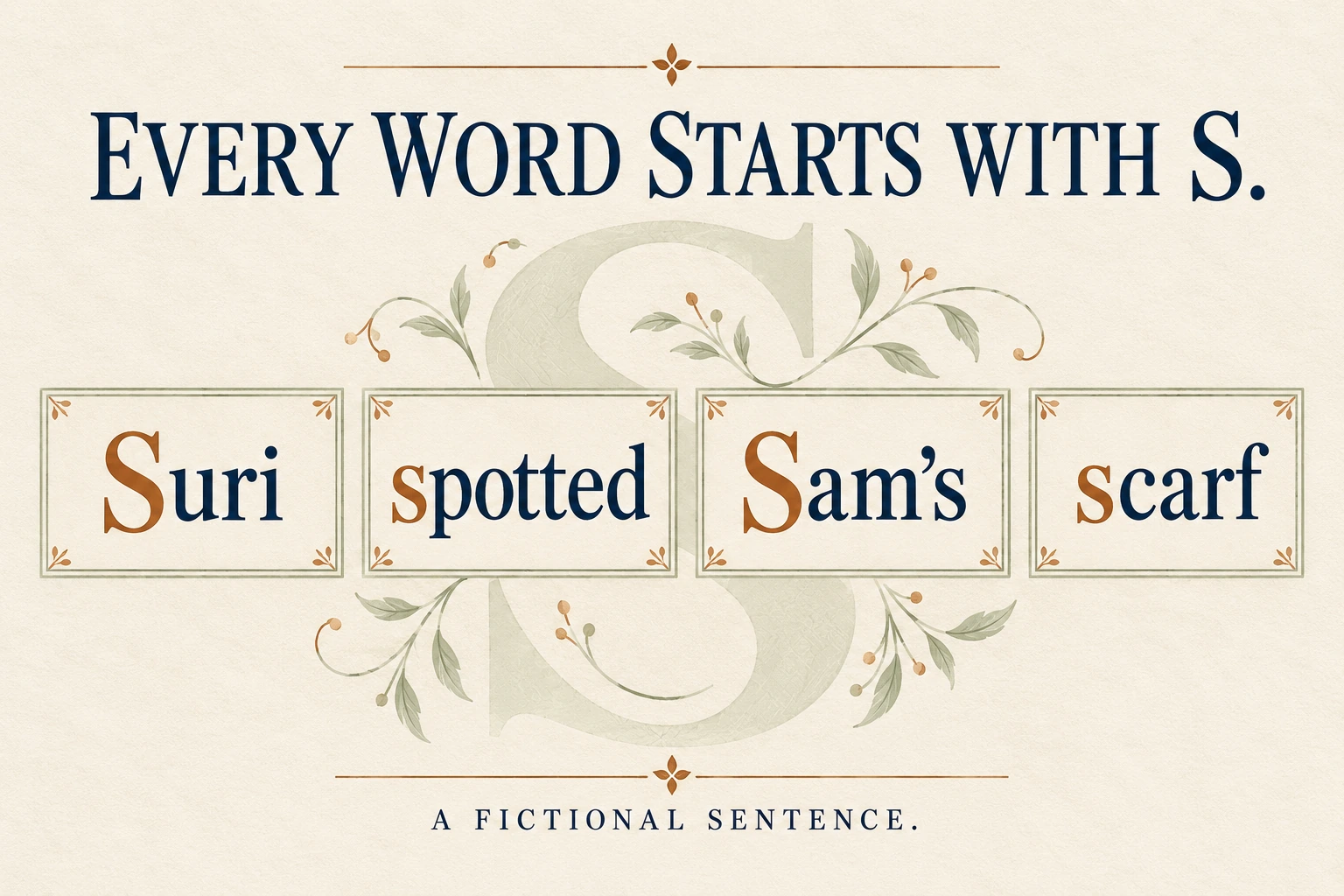
A fictional Suri and Sam scarf scene uses only words beginning with S. Check every token, repair an internal the and keep spelling compliance separate from the scene you choose.
Choose a rule small enough to inspect
Tautogram writing gives this fictional scene one visible constraint: every word in the selected story begins with the letter S. The rule covers words inside a sentence as well as its opening. It does not require a fixed number of sentences, a vertical spelling, repeated endings or rhyme. Choose this version's rule before drafting so that a pleasing sentence does not quietly change what the page is meant to test.
For the exercise below, treat an alphabetic run as a word, keeping an internal straight apostrophe with that word. Ignore capitalization and surrounding punctuation when checking its first letter. A hyphen separates words for this particular check. These are declared working rules for an English-language page, without a claim that every writer uses the same convention. The article's explanatory prose and headings remain outside the story's S-only condition.
Give the scene an event to carry
Imagine Suri noticing Sam's scarf caught in shrubs during sleet. Sam stops, Suri frees the scarf and their expressions change. This is an invented scene, without an observed weather event, journey or rescue report. Its names, objects and actions give the writer something specific to retain while choosing words. You do not need to perform any outdoor action to complete the writing exercise.
A name beginning with S makes repeated references to a character available under the rule. Here Suri and Sam serve that purpose. They remain two separate fictional people. Replacing every difficult reference with a new name could make a letter check easier while making the scene harder to follow, so keep track of who notices, who stops and who acts on the caught scarf.
Read the whole selected story
Sleet stung Suri. Sam sprinted south. Spiky shrubs snagged Sam's striped scarf. Suri spotted snagged stripes. She stretched, slipped, steadied. Sam stopped, shivering. Suri slowly shifted stubborn stems. She saved Sam's scarf. Sam smiled. Suri's shoulders settled.
This is the complete selected copy, rather than a list of possible S words. Its first short sentence places Suri in the imagined sleet. Sam's southward movement precedes the scarf catching. Suri notices the stripes, reaches toward the obstruction and shifts stems. The explicit sentence about saving Sam's scarf resolves the immediate event. The final shoulders suggest Suri relaxing, which is an authored physical detail within this fiction.
Inspect words inside the sentences
Begin the spelling check with Sleet, stung and Suri. All three start with S when case is ignored. Continue with Sam, sprinted and south, then inspect Spiky, shrubs, snagged, Sam's, striped and scarf. Checking only the capitalized first word of each sentence would leave most of these positions unexamined. Write or point to each word once so the check follows the actual selected copy.
The sentence about shifting stems contains Suri, slowly, shifted, stubborn and stems. Each passes the same initial-letter test. Its middle words matter just as much as Suri at the opening. The rule does not award a partial pass for a sentence that begins correctly. Keep the complete story beside any checklist instead of assuming that an earlier version's result still describes a revised word.
Repair an ordinary internal word
Consider a separate trial: Suri saw the scarf. Its opening Suri begins correctly, as do saw and scarf. The internal word the begins with T and breaks our condition. A period at the end or an S at the sentence opening does not change that word's initial. This identifies one exact conflict in the trial without requiring you to reject its ordinary meaning as a sentence.
One possible repair is Suri spotted Sam's scarf. All four words begin with S under the declared convention. The possessive also specifies whose scarf Suri notices, giving the revised sentence a detail the trial lacked. This is a wording change with a meaning effect, rather than a silent spelling correction. The selected longer story uses its own spotted-stripes sentence after already establishing Sam's scarf.
Read what a valid revision changes
Compare Sam stopped with Sam stayed. Both two-word sentences pass the initial-letter rule. In the selected story, Sam has just been sprinting south, so stopped explicitly changes that movement. Stayed would put a different emphasis on remaining somewhere, without stating the same stopping action as clearly. For this particular sequence, keep stopped. The letter check alone cannot decide between the two meanings.
The surrounding shivering remains an invented action. It does not measure temperature or establish why another real person might shiver. Likewise, Sam smiled supplies the chosen response after the scarf is saved; it reports no actual reader's reaction to the writing. Keep those authored details available to assess the scene without turning them into evidence that the constraint improves stories or makes everyone feel the same way.
Use short structures when they fit the scene
She stretched, slipped, steadied keeps one subject with three consecutive actions. The omitted repeated subject is understood within that sentence. This writer chooses the compressed sequence because it moves through Suri's reaching and recovery. It is a specific fictional wording choice, without a rule that every sentence should contain three verbs. Read its place between noticing the scarf and shifting stems before deciding whether to retain it.
A list such as silver, sudden, splendid, small could pass an S-initial check while leaving the intended event unwritten. Passing the constraint does not oblige you to keep every available adjective. The selected page uses striped to help explain what Suri spots and stubborn to characterize the stems in the fictional action. An added description would need its own reason within the scene you want to tell.
Declare how apostrophes and hyphens behave
Under our working convention, Sam's remains one word with an internal apostrophe and begins with S. Suri's at the final opening works the same way. The possessive ending does not need to begin a separate word because the rule explicitly keeps that apostrophe inside the word. This is a counting choice stated for the exercise, rather than permission to attach arbitrary words together to conceal their initials.
By contrast, the trial snow-dusted splits into snow and dusted under our declared hyphen rule. Snow passes and dusted fails because D is its first letter. Removing the space or adding a hyphen would therefore provide no shortcut here. You can choose a different convention for a different project, but label it before applying it. Do not call the original word check unchanged after changing its boundaries.
Check spelling without imposing a sound test
Our rule concerns printed initial letters. She starts with S and passes. City starts with C and fails this rule, whatever sound a reader gives that opening. We have not required every opening to sound identical, so the selected words may have different spoken beginnings. Read aloud if it helps you assess your own page, keeping that authorial listening separate from the visible letter check.
Line wrapping also leaves this word condition unchanged. The same story can occupy a paragraph or several deliberately printed lines while retaining the same words and initials. A copied word still needs checking if its spelling changes. Moving a break between two intact words does not itself add an S or remove a conflicting T. Preserve the actual selected wording when comparing layouts.
Keep a revision beside the copy it changes
Save the complete selected story before trying a replacement. Then write the proposed new sentence in full. A note saying improve the ending does not yet provide words whose initials or meaning can be assessed. With two actual copies, you can inspect exactly which word changed and whether the altered action still follows from the earlier sentences. Keep the trial separate until you choose the whole version to retain.
If you deliberately relax the condition, label the resulting page as another project. Ordinary prose might express a detail more directly, and the writer may prefer that choice. For this selected exercise, keep the S-only copy and its exact word boundaries. The condition gives you a concrete editing task, while the final choice of scene and wording remains yours. Neither compliance nor a short word count establishes literary quality.
Bound the optional stapler accounts
The Swingline black stapler account shows one complete black stapler with a Swingline mark. The image does not independently establish bundle quantity, exact model, material, sheet capacity or stapling performance.
The Swingline pink stapler account shows one complete pink and silver stapler with a Swingline mark. Exact model, supplied quantity, material and mechanism performance remain unverified. No independent staple stock is pictured.
Neither account supplies the story or its word rule. Their role is optional paper-workspace context, and the writing requires no purchase.
Keep neighboring writing constraints distinct
The harmonica acrostic poem guide fixes the first letter at each line position to spell HARMONICA. Our rule checks every story word, including internal ones. It needs no vertical spelling or nine-line arrangement.
The word-chain poem guide carries a line's last word into the next opening. This scene has no required word handoff. A shared initial letter does not require two neighboring words to have the same complete spelling.
Ask actual transaction questions outside the story
If you separately consider a stapler order on republeq.com, assess the current offer and transaction before choosing how to pay. The fictional names and story words are authored inputs, not product quantities, prices or cryptocurrency instructions. Before using USDT, inspect the actual checkout and determine what that particular order presents. Check the requested amount and denomination, the receiving destination displayed, any network instruction, and the order status before sending funds. These are questions to resolve, rather than statements that an option exists for either offer. Confirm that the item and intended quantity match your proposed order. Resolve product and supplied-content questions separately from payment instructions. A photograph does not authenticate transaction terms. Keep the current instructions, their date and the result of any action you actually take, distinguishing a pending step from a completed payment. If the selection changes while you are checking, review the resulting transaction instead of carrying an earlier conclusion across automatically. Determine what the merchant currently supplies about delivery, cancellation and any refund process before relying on it. Do not assume a transfer can be reversed or a particular network will be supported. This conditional checklist makes no claim about token acceptance, transfer success or available remedies. You can complete the paper writing without buying either offer. A story sentence cannot authenticate a payment destination or show that an order has been accepted. The actual purchase needs its own clear and current order-specific evidence, and its records belong separately from this fictional exercise. Retain unanswered questions beside the proposed transaction.
Retain one complete scene and its actual check
Keep the selected story from Sleet stung Suri through Suri's shoulders settled, with its words intact. Inspect every initial once, then read the scene for the sequence you chose: scarf caught, Suri notices and acts, scarf saved, responses follow. Preserve the failed the trial and any meaning alternatives separately. Your finished page records this particular constraint and this particular fictional scene, without requiring equipment or another reader's approval.