Headphones & Earbuds
Summer swim headphones: plan music for water and dry deck
A summer pool-day packing plan that separates dry-deck listening from onboard music for a swim.
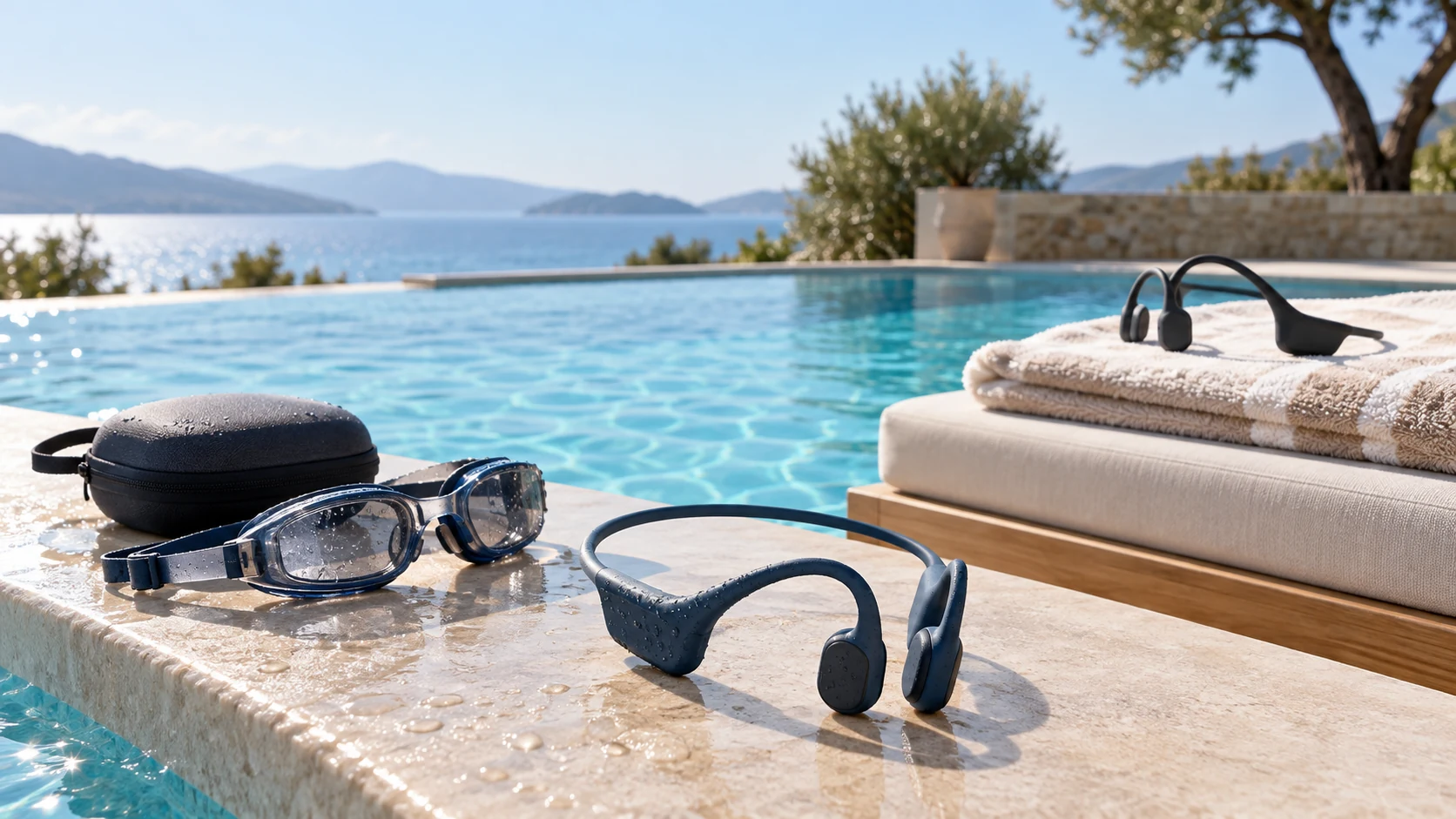
A summer pool day asks more of headphones than an ordinary walk. The person who wants music while swimming needs a different setup from the person listening while reading on a dry lounge chair. The distinction is easy to lose when two open-ear sets look similar in a shopping photo. A Summer swim headphones plan starts by marking the water line: which moments happen in the pool, which happen beside it, and where the phone will stay. Then you can choose a headset for the part of the day it is actually described to handle.
Divide the outing into water and dry-deck time
Write a short plan before packing. You might swim laps, rest on a towel, talk with friends, and then walk home. Music in those moments is not one continuous task. In the water, a phone may be stored well away from the pool, and a headset has to be suitable for that use. On the deck, you may want a light open-ear pair while keeping the phone nearby. Put a clear break between those uses instead of assuming one water-resistance label makes every activity interchangeable.
Set aside a dry pouch or case for anything that should not enter the water. Give the phone, keys, and dry-deck headset a place that does not depend on balancing them on the pool edge. Decide where you will change gear before you arrive. A bench, locker, or bag compartment can serve as the handoff point. If the outing includes a walk or ride to the pool, make that a separate listening decision; it should not silently determine what you wear in the water.
Read the two product descriptions literally
The LOBKIN X29 open-ear headphones listing describes Bluetooth pairing, a built-in microphone, an IPX6 rating, and up to ten hours of playback per charge. It presents running, cycling, gym workouts, and similar activity as uses. Crucially, that same saved description says the headset is not suitable for swimming or underwater use. The IPX6 detail cannot be lifted out of the sentence that limits the product. Treat this as a dry-deck or other listed activity option, and keep it out of the pool.
The HIFI WALKER swim headphones listing instead describes an IP68 headset with an onboard 32GB MP3 player and Bluetooth for wireless use. It names swimming among the intended activities and states up to ten hours of playback. Its title and description disagree about the Bluetooth version, so there is no sound basis here for choosing a precise version number. More important to this outing is the separation between music stored on the headset and a wireless connection to a phone. The listing supports the onboard-player feature; it does not establish dependable underwater Bluetooth streaming.
These are seller descriptions, not a controlled test of sound, waterproof endurance, battery life, or fit. They also do not provide a substitute for the instructions supplied with a particular unit. If your plan requires a specific swim depth, session length, cleaning method, or charging routine, check the current instructions before using the headset that way. Do not infer a safe use condition from an abbreviated IP label alone.
Load music before you leave
For a swim session, make the playlist an evening or predeparture job. Decide which tracks you actually want for the planned time in the water. Put them onto the onboard player using the instructions for the headset and the files you are entitled to use. Check that the player recognizes the files while you are still at home. A folder that looks complete on a computer is not proof that a headset can play every file in it. Try a short sample through the headset, then stop playback and make sure you know how to start it again.
Keep the phone in its dry place when you reach the pool. Bluetooth may be useful for a walk or a dry rest period, but the underwater plan should use music already stored on the swim headset. This avoids making a pool session depend on a wireless path the saved listing does not verify underwater. If transferring files is more work than you want for an occasional swim, acknowledge that before buying for this use. You may decide to keep music for the deck and swim without it.
Make the playlist short enough to test. Put a familiar track first so a quick playback check tells you whether the player is ready. Keep volume at a setting you can manage according to the product instructions and the place you are using it. Do not use the open-ear description as a promise that you will hear every instruction, person, or signal around you. Your attention to the pool, other swimmers, and local rules remains your own task.
Prepare a dry-deck listening station
The LOBKIN pair can have a role during the dry part of the visit, provided the unit and current instructions support the conditions where you place it. Charge it before leaving, confirm pairing while the phone is dry, and put it in the dry pouch when you change for swimming. Do not carry it into the pool merely because it handled sweat during another workout. A small handoff rule is easier to remember than a vague claim that it is “waterproof”: on the towel or in the case, never in the water.
If you choose the HIFI WALKER for the whole outing, still separate playback modes in your plan. Use onboard files for the swim segment. Treat Bluetooth as a dry-use convenience unless the exact current instructions establish more. The two modes should not be collapsed into one promise of uninterrupted music. Pause before changing modes, check what is playing, and put the phone away before returning to the pool. This is a practical packing and operation sequence, not a claim that the headset switches modes in a particular undocumented way.
Think about other people sharing the space. A pool bench may be crowded, and a loose headset can be easy to misplace during towel changes. Choose a case or bag pocket you can identify by touch, and return the dry item there every time. If you need to answer a call, step into a suitable dry place and use the device according to its instructions. The presence of a microphone on a product page does not make a headset a safe way to manage calls while swimming.
Keep adjacent shopping questions separate
A buyer comparing ordinary wireless listening styles can use the JBL and Philips wireless headphone comparison for its separate bundle decision. That guide is about a different pair and does not certify either pool-day product. Here, the first question is whether you need music in the water at all. If the answer is no, there may be no reason to choose a swim-specific player. If the answer is yes, the dry-only LOBKIN listing is not a substitute for the swim use named by the HIFI WALKER listing.
Replacement cost is another decision. The headphone replacement-cost guide offers a separate way to think about when another set is needed. It does not answer which headset may enter a pool. Before adding a second set to a summer bag, consider whether one existing dry pair already covers the deck. Then assess a swim player only for the water segment. This keeps the purchase tied to a real gap in the outing rather than the novelty of a new season.
Run a short practice session at home
Before the first pool trip, place the items on a table as you will pack them: goggles, towel, the swim headset, its case, the phone pouch, and any dry-deck pair. Rehearse the handoff. Start a stored track on the swim headset, stop it, and put it in its case. Take out the dry pair and confirm its ordinary connection without putting either device near water. This dry practice cannot prove waterproof performance, but it can reveal a missing file, confusing control, uncharged device, or case that will not fit the bag.
Read the care and charging directions for the exact unit before and after the outing. Do not assume the two headsets share a charging connector, cleaning step, or drying requirement. Pack the parts they actually need and keep any charging equipment away from wet poolside surfaces. If a unit looks damaged or its seal or controls seem wrong, stop and consult its instructions rather than using a swim label as a blanket assurance. The point of a trial is to expose a small problem while there is still time to change the plan.
Use one simple note after the first outing. Record whether music played from the onboard files, whether the case was easy to find, and whether you used the dry pair at all. A real pool-day observation is more useful than guessing from feature lists. If the dry pair never leaves the bag, pack less next time. If the stored playlist was the friction point, prepare it earlier or decide that music belongs only on the deck.
Make that note about the routine rather than a score for either product. A poor first outing may come from a forgotten charge or a file that was never transferred, while a smooth outing may simply reflect a short swim and an easy place to store the bag. Keep those observations separate from seller promises about battery duration or water resistance. If you share the gear, write down which person charged it and where the case was returned. That small handoff prevents the next swimmer from discovering an empty battery at the pool. You do not need a spreadsheet; a few specific lines are enough to improve the next packing decision.
Make the summer bag easy to reset
When you return, separate wet and dry items according to the actual care instructions. Put the phone pouch and the dry-deck headphones back in their usual places. Deal with the swim headset as its supplied directions require before charging or storage. Refill the bag with the towel, goggles, and case only when those items are ready, so the next visit does not start with a damp or missing piece. This modest reset is part of the listening plan, not an elaborate new gear system.
For the next pool day, ask three questions: will you listen in the water, do the stored files play, and where will the dry items wait? If you only want music beside the pool, keep the LOBKIN within its explicit no-swimming boundary or use another suitable dry option. If you want music during the swim, use a headset whose current instructions permit that use and prepare its onboard player in advance. That distinction lets a summer outing stay simple without turning two similar-looking open-ear products into the same promise.