Headphones & Earbuds
Headphone replacement cost planning with AKG K72 and Sennheiser HD 300 PRO
Budget AKG K72 and Sennheiser HD 300 PRO upkeep by exact replacement parts, compatible cables and actual service quotes before assigning future savings.
A headphone's first price is easier to find than the cost of keeping it useful. For headphone replacement cost planning, start with the listening job and ask what happens when a wearable part or cable needs attention. AKG K72 and Sennheiser HD 300 PRO provide two actual examples. Their documented upkeep features help you form a budget, but neither description gives a measured service life or guarantees that buying either one will save money.
The current Republeq prices captured here are $87.44 for AKG K72 and $237.40 for Sennheiser HD 300 PRO, a $149.96 initial difference. Both are wired over-ear studio headphones; their exact manufacturer pages identify closed-back construction. AKG positively lists replaceable earpads. Sennheiser positively lists a replaceable cable and headband padding. Compare those features through actual compatible parts and service quotes, rather than assigning an imaginary future saving to the higher price.
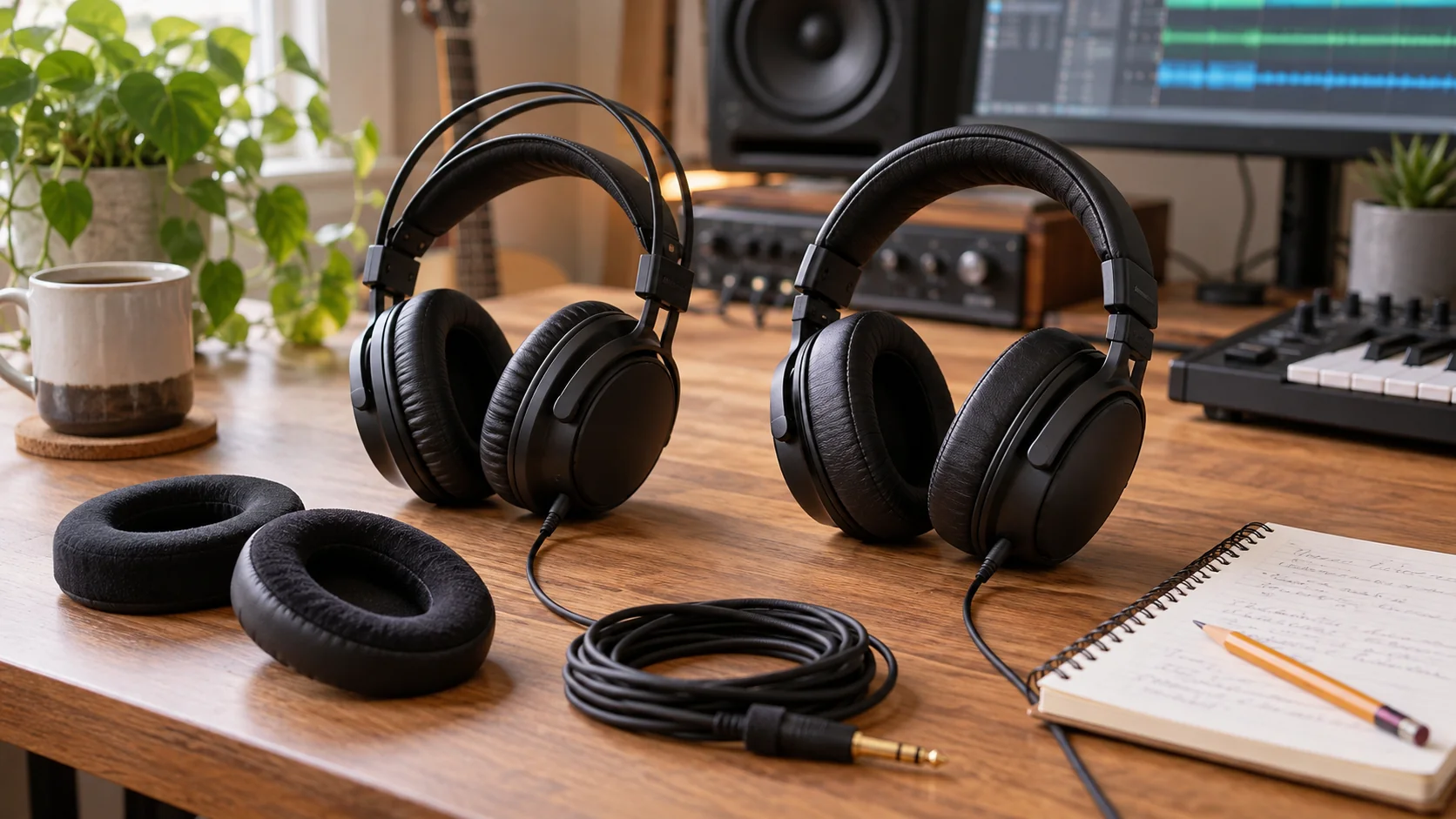
Conceptual editorial cover for headphone replacement cost planning: generic wired headphones, loose ear cushions and a handwritten upkeep list, not exact retail models, certified replacement parts or evidence of measured lifespan.
Give the studio headphone upkeep budget a specific task
Identify who uses the listening position and what they need to finish there. An occasional home listener and a person with booked recording sessions can face different consequences when equipment is unavailable. Record the source device, the normal seated position and whether the headphones travel. These details tell you which connection, handling and service questions belong in the studio headphone upkeep budget before a purchase.
Check whether the existing headphones still complete that task. A worn-looking pad, an uncomfortable fit and a missing adapter are different observations. Describe what you can actually see or hear without naming an electrical fault you have not diagnosed. Obtain appropriate support for an unresolved problem before buying an entire new set around an assumption. This article has not inspected a reader's equipment or determined that any specific repair is sufficient.
If this is a new listening position, write down the full usable arrangement. Include the headphones and any necessary connection parts confirmed for the intended source. A lower headphone price can leave money available for a required adapter, while an unsuitable connector can leave either order unusable. Neither retail description establishes compatibility with every laptop, audio interface or amplifier. Confirm the entire arrangement before turning the two prices into competing complete totals.
Read AKG K72's replaceable headphone parts separately
The AKG K72 offer identifies black wired, closed-back over-ear headphones, 40mm drivers and a self-adjusting headband. The exact AKG page lists replaceable earpads and says the model is not foldable. Use those entries to ask for replacement pads and plan where the headset will fit. They do not establish a pad replacement price, a repair interval or how long the headset will remain available in parts stock.
For replaceable headphone parts, obtain the correct K72 pad reference and ask whether it is currently available for the delivered model. Request the actual price, quantity and applicable replacement instructions. A listing for one cushion is different from a pair, and a familiar-looking pad does not prove a model match. Confirm whether the quoted part is supplied by the manufacturer or another seller and what compatibility that seller supports.
AKG's exact page gives a three-meter cable and a 3.5mm plug with a screw-on 6.3mm adapter. Check the selected order's supplied parts against the source you will use. Its replaceable-earpad entry does not establish a user-removable cable. Ask for the approved service path if the cable needs attention; do not assume that a positive statement about one replaceable part applies to every other component.
The K72 page's non-foldable entry also belongs in a practical handling plan. Check the space available where the complete headset will rest or travel, without forcing it into a packing movement its instructions do not support. Obtain a suitable carrying arrangement if one is needed. The actual retailer description does not list a protective case, so price a separately required item only after confirming what the order supplies.
Identify the HD 300 PRO parts before assigning value to them
The Sennheiser HD 300 PRO offer identifies the black studio model for tracking, mixing and monitoring. Sennheiser's exact HD 300 PRO page positively describes a wired connection, closed-back design and replaceable cable and headband padding. Keep the PRO model name with the inquiry. A part sold for a similarly numbered Sennheiser headphone needs its own explicit applicability before it enters this budget.
Ask for the compatible replacement cable reference, current availability and delivered price. Establish which parts accompany that cable and the instructions that govern attaching it. This article provides no cable replacement procedure. A replaceable component gives you a supported question to investigate, while the eventual benefit depends on obtaining the correct part and following the actual model's instructions when the need arises.
Do the same for headband padding. Obtain a model-specific part and service answer rather than assuming the manufacturer feature means any cushion will fit. Keep the quoted quantity and installation requirements in the record. If labor or shipment is involved, ask for its actual cost and expected timing. The feature entry does not set a universal repair charge or establish that every buyer can perform the work themselves.
Sennheiser's page also describes viscoelastic earpads. That material statement is different from a quote for a particular replacement pad or an account of what a selected service covers. Ask the relevant support contact about the part you actually need. Keep each component's documented answer separate; a replacement-cable entry does not determine the availability, fitting method or service terms for the rest of the headset.
Turn a parts inquiry into a complete quote
Keep the exact headphone model, part reference and quantity at the top of the inquiry. State where the order will be delivered and whether you need a part only or a service that includes fitting. Ask which taxes, shipment charges and labor are included in the answer. A low component price with an unanswered delivery or installation requirement is an incomplete upkeep total.
Ask what the supplier can confirm about present availability. An item displayed on an old parts page may require a current stock answer; an unavailable part should not be entered as a purchasable solution. Record the date and scope of the reply. Neither current headphone listing promises that its parts will remain stocked for a particular number of years, so future availability remains an uncertainty.
Keep normal wear, accidental damage and an apparent fault as separate questions for the applicable purchase or service terms. Obtain the written terms for the exact order and ask who should receive the initial inquiry. The manufacturer pages do not establish that every worn pad or damaged cable qualifies for a free replacement. This article makes no coverage determination for an individual purchase.
If the quoted work involves shipping the headphones away, ask how the equipment should be packed and what order information is required. Follow that service's actual instructions. Keep the expected return arrangement with the quote, including any unresolved timing. A studio label and a replaceable part do not guarantee a particular turnaround or establish that the listening position can continue operating while the set is away.
Use the initial $149.96 difference without inventing a lifetime total
The captured difference is a comparison of two current headphone offers. It is not a measured difference in annual upkeep or a credit against a future repair. Recheck the live delivered totals before ordering. If the K72 meets the listening task and its confirmed upkeep route is acceptable, the lower initial total is a concrete budget consideration. That does not prove it lasts as long as another model.
For HD 300 PRO, decide whether its documented cable and padding arrangements serve a specific need you can name. Obtain their actual replacement and service quotes. The additional initial spend needs that practical context; describing parts as replaceable does not prove that you will use them or that their combined future cost stays below buying another headset. Leave an unanswered component price visible in the budget.
If you want to assess a possible repair, write down the specific component and the quote you have obtained. Record the confirmed initial total, then add a current quote for a specific replacement if that is the scenario you want to assess. Label it as an example with current prices. Neither source supplies a failure probability or replacement schedule, so multiplying a guessed repair count by a part price would create a false lifetime estimate.
If an actual service quote later arrives, compare it with the current cost of a complete usable replacement at that time. Confirm what the service fixes and which other concerns remain unanswered. An inexpensive pad cannot resolve a separate unassessed channel problem merely because both affect the same headset. Keep a repair decision tied to the condition and supported remedy established for the actual equipment.
A reader moving a functioning set to another listening position faces a different budget question. Check whether the original desk still needs headphones and whether the second source accepts the confirmed connection. Moving existing equipment may avoid a new purchase, but it can also leave the first task without its required set. Record both positions before treating reuse as a saving.
Consider the consequence of equipment being unavailable separately from the component invoice. A reader with booked work may need a supported alternative already on hand; another can wait for the service answer. Identify the actual task and available equipment before adding a spare to the budget. This guide gives no monetary value for missed sessions and does not establish that every studio needs a second headphone set.
Keep a spare-parts purchase tied to a confirmed use
Before buying a spare, check whether the component is already included in the headphone order or available through the applicable service arrangement. Confirm the quantity you actually need. A duplicate adapter stored in a drawer may offer less value than resolving a missing connection part for the working desk. The appropriate choice depends on the complete usable arrangement, rather than the number of accessories in the cart.
If several people share the listening position, record which headphones and source-end parts belong together. A replacement quoted for one model should not become a general spare for every set in the room. Keep the model and compatible part reference with the supplies. This simple inventory helps avoid assigning a purchased component to the wrong headset when another person is assembling the desk.
Store the equipment according to the actual instructions and the space you have confirmed. Plan the cable route around the seated position and where the headset rests between uses. The source pages give no measured reduction in failures from a particular storage method. Treat careful handling as an ordinary equipment responsibility, while keeping any model-specific packing or disconnection requirement with its own documentation.
Use related guides for questions that belong to their own products
The Sony MDR7506 and DT 770 PRO X package guide separates a named case and protection pack from a documented detachable-cable arrangement. Its relevant habit is to obtain actual parts and service terms before valuing an addition. The Sony program, case contents and beyerdynamic connector do not transfer to either K72 or HD 300 PRO.
The wired listening and restored monitoring guide considers actual condition, accessories and a representative working session. Its restored ATH-M40X account is specific to that offer. It does not label either headphone here restored or give these models folding or swivel features. Use the condition and inspection questions with the exact selected order, preserving each product's own description.
Keep the listening result in the decision as well as the parts quote. The K72 description makes neutral-reference and isolation claims, while the HD 300 PRO material describes monitoring and passive attenuation. The sources do not report a matched acoustic comparison. Neither replaceable components nor the initial price establishes which headset lets a particular reader make better recording or mixing decisions.
Save the answers needed for the next upkeep decision
Before ordering, put the confirmed delivered price, model identity, supplied accessories and source connection in one short record. Add each compatible part reference and any current service quote obtained. Mark the unanswered questions plainly. Keep that record with the delivered headset so a later pad or cable inquiry starts with its own model and confirmed contents.
On arrival, reconcile the package with that record and follow the supplied setup instructions. Check the actual listening arrangement at a comfortable level through the intended source. Record a missing part, uncomfortable fit or observed channel problem with the order details. An ordinary check can identify a concern to raise with the seller; it is not a controlled longevity test or an electrical fault diagnosis.
For the K72 route, obtain the correct pad and any needed service answer alongside the lower initial total. For HD 300 PRO, confirm the replacement cable and padding arrangements before assigning them budget value. Choose the set whose usable configuration, fit and confirmed upkeep requirements meet the task. Retain the actual quotes and order information so later spending follows the component needed, rather than an unsupported expectation of lifetime savings.