Office Supplies & Stationery
Source note cards: keep quotations, claims and locators separate
Record a short excerpt, distinguish quotation from paraphrase and preserve its exact source version before using it to support a draft claim.
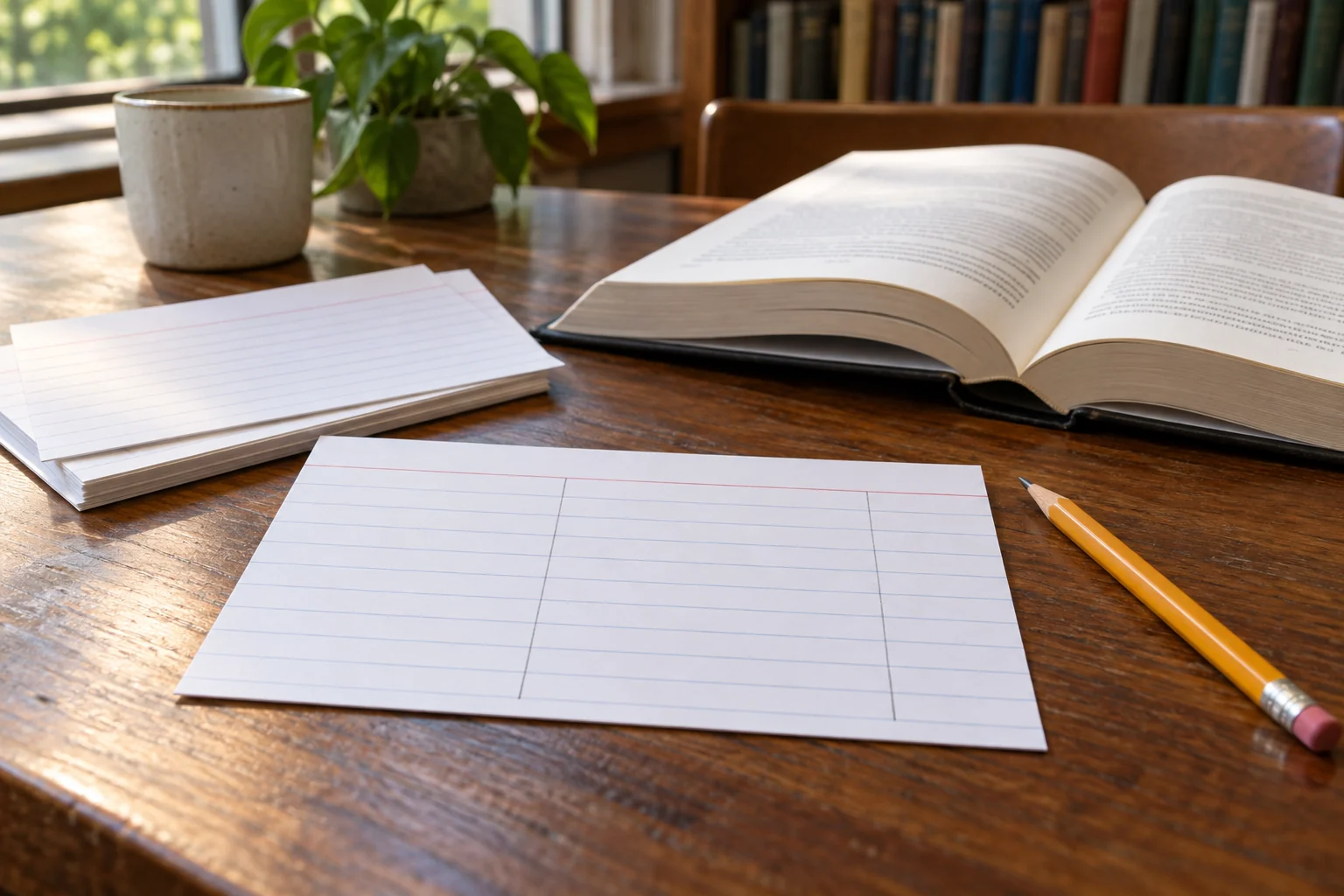
Start with the passage you may need to use
Source note cards can help keep a short quotation, your interpretation and the route back to the original passage distinct. Begin with the source open in front of you, not with a sentence recalled from memory. Record the source's words separately from the point you want to make. A neat card does not turn an interpretation into a verified fact. This tutorial uses an invented notice to show the difference between a narrow statement and an overbroad claim, then preserves that distinction when the notice changes version.
Choose one passage relevant to the question you are working on. Keep enough surrounding material available to understand its subject, conditions and exceptions. A striking sentence can be a poor note if the next sentence limits it. The card can point back to that fuller context rather than trying to contain the entire document. Decide what you need to recover later: the exact wording, the source identity, its applicable version and a location that leads to the passage. Your eventual draft may use none of the quotation, but the note should not obscure where it came from.
Give the note a short identifier that can also appear beside the draft sentence it supports. The identifier is your working reference, not a substitute for the source's title or publication details. For example, N-01 can identify one note while the source field names the actual document. If another note uses the same source for a different passage, give it a separate note identity or a clearly distinct entry. This makes it possible to revise one claim without silently changing every other note associated with the document.
Separate a verbatim quotation from your own wording
Mark an exact copied passage as a quotation when you record it. Preserve its wording rather than smoothing a phrase while still presenting it as exact. If you omit or alter material, keep that alteration visible in an appropriate way and retain access to the full passage. Do not mix copied sentences and your own shorthand in one unlabelled block. Later, it can be difficult to tell which words belong to the source and which were an interpretation made during reading. Separate areas on the card can prevent that ambiguity from being built into the note.
Keep the quotation as short as the actual purpose allows. Record the condition needed to understand it, or point explicitly to the surrounding section. A note that copies more text is not automatically better evidence for a claim. Ask which part of the passage supports the point you intend to make and whether a nearby qualification changes that support. If the excerpt alone would mislead a later reader, revise the note before using it. The original document remains available for the complete account; the card is a working aid to reading it accurately.
Read the actual card offers without adopting learning claims
The Oxford ruled cards listing identifies white 5-by-8-inch index cards. Its whole native account and gallery show packs of ruled cards with matching Oxford branding and size information. The description also promotes note-taking and learning benefits that are not adopted or tested here. The paper provides a surface for the proposed record; it does not verify a quotation, improve recall by itself or establish the accuracy of a draft. Choose a writing arrangement you can read without treating the listing's promotional claims as results of this exercise.
The Three Leaf ruled cards listing identifies white 4-by-6-inch cards. Its native gallery shows matching Three Leaf packs in a shipping carton. The carton is packaging, not a separately claimed filing system. This guide makes no durability, ink-resistance, archival or learning-performance comparison between the offers. Neither size establishes how much of your handwriting will fit legibly. Make a replaceable sample with the information you actually need before preparing a larger set, and keep the original source available when the note is too small for its necessary context.
Give the source locator its own space
Keep three roles visible: copied wording, your proposed interpretation and the source locator. The fields can be arranged to suit your handwriting, but their roles should remain distinguishable. Add the note identifier and source version where they can be recovered with the quotation. If the card becomes crowded, use another sheet or keep the longer interpretation in the draft notes. Tiny writing that obscures a qualifier is not a successful compression. The point is to preserve the relationship between a claim and a passage, not to fit an entire research process onto one card.
Consider this explicitly invented notice: “The hall closes at six on Fridays during December.” For the exercise, call its source “Hall notice, version 1,” with the passage under a fictional “December hours” heading on page one. Those identifiers and the sentence are created for this tutorial; they describe no real hall or opening schedule. N-01 records the sentence as a verbatim quotation and retains both conditions: Fridays and December. The interpretation field remains separate, so a later draft can be checked against what the invented source actually states.
Now test the proposed draft claim, “The hall closes at six every day.” The note does not support that claim. The source sentence names a day of the week and a month, while the draft has extended it to every day without evidence. Adding quotation marks around only the phrase “closes at six” would not restore the lost conditions. The repair is to narrow the claim to the supported scope or obtain appropriate evidence for the broader one. Do not treat the presence of a source title on the card as support for words the passage does not establish.
A paraphrase can preserve the same limited meaning without reproducing the sentence. For this exercise, “In December, Friday closing time is six” retains the stated day and month. Label it as your wording, and keep its reference to the invented source. A paraphrase should not become a place to add a year, a holiday exception or an explanation of why the hall closes then. Those details are absent from the example. Keep any question about them in a separate area instead of letting a plausible addition enter the supported claim unnoticed.
Test the route back to the actual passage
For a real source, record the title and identifying details that distinguish the version you used. Add a page, section heading or another stable passage locator appropriate to that document. A web address may lead to a source without leading directly to the sentence, while a page number may change across editions. Use enough information for the actual material. Where you keep a saved copy, identify that copy as well. The note should allow the relevant passage to be recovered rather than merely reminding its author that something useful was once read.
Try the locator after closing or setting aside the source. Can you reach the correct version and passage from the card alone? If another person will use the notes, ask whether the identifiers make sense without your memory of the reading session. An abbreviation that is obvious today may be ambiguous later. Revise the locator if it leads only to a general collection or an old edition. This test checks retrieval, not whether the passage truly supports the claim. Return to the wording and its conditions for that separate judgement.
The page flags return-marker guide addresses temporarily finding a place again during reading or checking. A marker can help while the source remains open on the desk. It does not replace a source title, version and passage locator on the note. Keep that distinction when the document moves or the marker is removed. The card should still identify the material you used. A temporary physical cue is useful for the current reading session, while the note needs a recoverable reference for later drafting.
The appliance manual index guide addresses identifying the applicable document and testing a route to its relevant section. That is a useful related retrieval task. This article adds a different record: the particular excerpt, your paraphrase and the claim each can support. Finding the right manual or notice does not make every sentence in a draft accurate. Use the locator to reach the source, then check the actual passage against the proposed statement rather than treating a successful lookup as the end of the evidence question.
Keep different excerpts and claims distinguishable
One source can support several different points, but that does not make its passages interchangeable. If N-01 records opening hours and N-02 records a different condition, keep each excerpt and locator clear. A later change to one passage need not affect every note from the document. Likewise, two cards with similar headings may refer to different versions or subjects. Do not merge them merely to make a smaller deck. Preserve the distinctions needed to identify which passage supports which wording in the draft.
When two sources disagree, record the difference before deciding how to describe it. Do not average incompatible statements or choose the convenient one without examining their dates, subjects and applicability. The card may carry a clear unresolved question rather than a final claim. A source note is allowed to remain incomplete. Keeping the conflict visible is more useful than writing a smooth paraphrase that suggests both accounts agreed. Any eventual conclusion needs the evidence appropriate to the real question, not merely a tidy arrangement of cards.
Preserve the source version when wording changes
Suppose the invented notice is replaced by version two, which says, “The hall closes at seven on Fridays during December.” The earlier quotation should remain identifiable as wording from version one. Do not change “six” to “seven” inside that old quoted record and leave its version label unchanged. Create a new version-bound note or a clearly recorded update that preserves the earlier identity. The new notice may affect a current claim, but it does not retroactively change what the earlier invented document said.
Next inspect the draft that actually uses N-01. If it is meant to describe the current version, check it against the new passage and revise the supported wording as needed. If it is comparing historical versions, the earlier note may still belong in the comparison. These are different purposes. Marking a source as superseded helps only when the note also says what source and passage replaced it. Keep the chain specific enough that another reader can understand which version supplied each quotation without guessing from handwriting or card order.
Leave missing evidence unresolved
If the source can no longer be retrieved, distinguish a saved excerpt from a source you can currently inspect in full. Your note may preserve useful information, but it cannot supply surrounding conditions that were never recorded. Seek an appropriate saved copy or another verifiable route when the claim requires it. Do not fill the gap with reconstructed quotation marks around remembered wording. A recollection can be recorded as a recollection while the exact passage remains unverified. Keep that status visible before the note is used in a draft.
Before using a note, check the claim, quoted wording, interpretation and locator together. Make sure the draft has not dropped a condition or borrowed a conclusion from a different passage. Keep copied words visibly attributed and your own explanation separate. This is a practical check for the record you have made; it does not promise that a particular card layout will prevent every error. If the note cannot support the intended sentence, repair the sentence or the evidence rather than treating the completed fields as an approval.
Keep purchase information outside the invented example
If you consider crypto when buying cards, inspect the current transaction separately from the note-taking exercise. Before considering USDT, confirm the selected listing, quantity, delivery details and displayed amount in the current checkout on republeq.com. If a transfer instruction appears, check its destination, denomination and any stated network requirement there. An invented source notice cannot authenticate a payment address, establish token support or prove that a card order is appropriate. Neither can a neatly labelled note supply missing facts about the transaction. Resolve unclear or conflicting instructions before acting, and keep a record of the exact purchase you intend. This paragraph provides questions for reading current information; it does not claim that either linked offer accepts USDT, that a network is supported, that transfers are reversible or that a payment will succeed. A completed transfer does not by itself show that the correct supplies have been dispatched or delivered. If the selected order changes while you check it, review that changed transaction rather than using an answer about a different quantity or product. On receipt, compare the actual supplied identity and contents with the current order. The fictional hall notice, its two versions and the example note identifiers supply no evidence about a real seller, payment route, refund or delivery promise. Keep each real purchase question attached to its own relevant current record. Keep the selected product and the payment request visible together during that check. A correct quotation demonstrates what wording was recorded from its identified source; it does not establish facts outside that source's scope or settle an unrelated checkout decision.
Finish with a note that can be checked
Source note cards should preserve the distinction between a verbatim quotation, your wording and the source locator. Keep the source version attached to the excerpt and test the proposed claim against the actual conditions stated. The invented notice supports a limited Friday-in-December statement, while its revised closing time belongs to a different version. A later reader should be able to recover those distinctions from the note and the source. If something is still missing, leave a specific question instead of an apparently finished card that implies more evidence than you have.