Problem-Solving Articles
Sorting a mixed shredding pile by supported materials
Sort a mixed shredding pile by actual Fellowes LX75 and Royal MC165 material claims, keeping permission, paper capacity and unknown items separate.
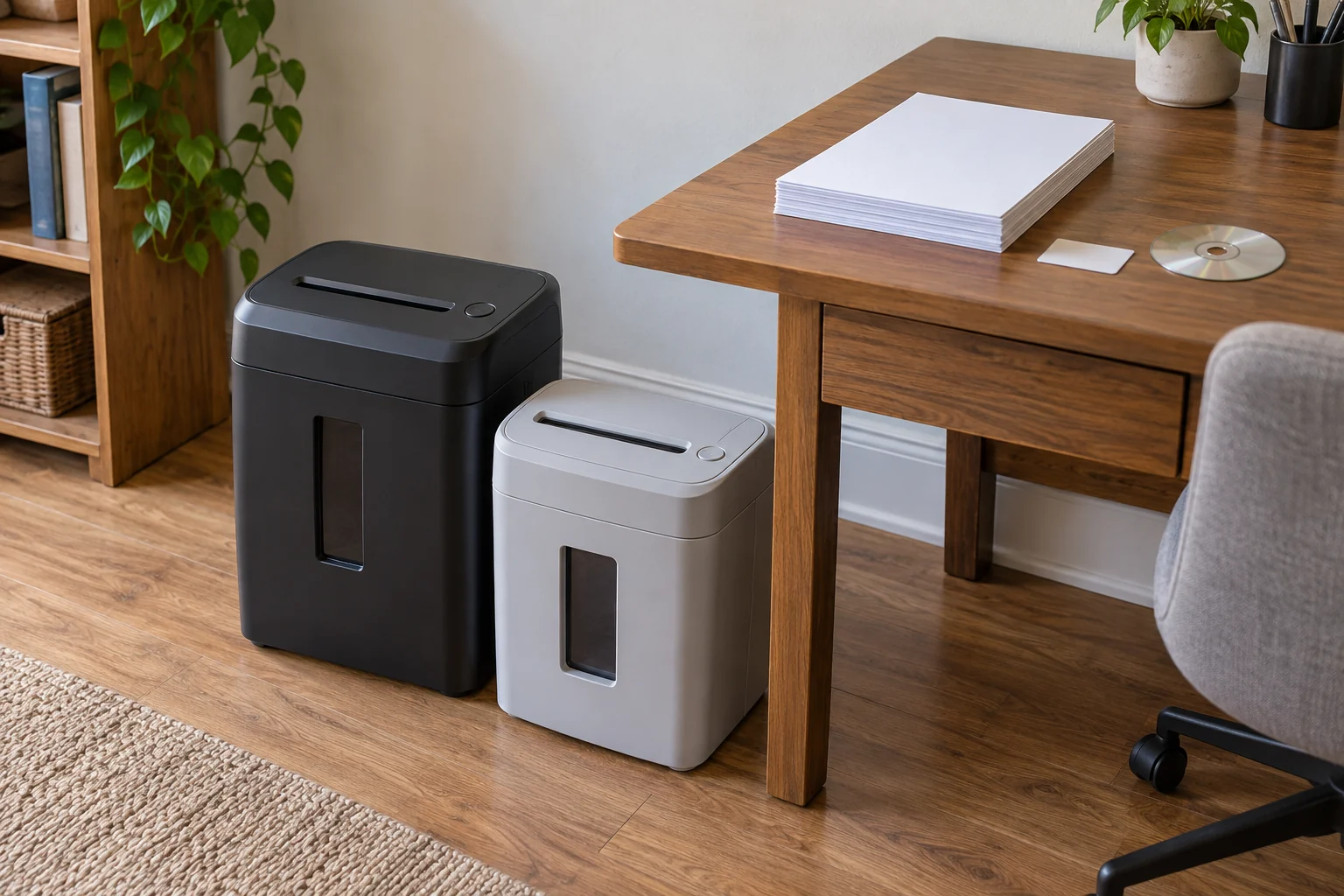
Sorting a mixed shredding pile starts with two separate questions: whether an item has been approved for destruction and whether the selected machine supports its material. A paper sheet, a plastic credit card and an optical disc need different entries in that decision. A paper-sheet limit does not establish support for the card or disc.
The Fellowes Powershred LX75 and the Royal MC165 offer different stated material lists. This guide uses those actual descriptions to organize an already approved pile before an equipment choice. It supplies no feeding, jam-clearing, dismantling or destruction procedure. Keep the applicable instructions with the actual machine before operating it.
Separate the destruction decision from the machine question
Begin with items whose owner has already approved their destruction under the requirements that actually apply. The record owner and applicable requirements determine whether a record may be destroyed. Something that still needs a retention decision belongs outside the approved pile, even if its material appears on a machine's accepted list.
Record why each unresolved item remains undecided. A document may need a copy checked, a record owner may need to answer a retention question, or the material may be unclear. Those are different obstacles. Buying a machine with a higher sheet count would leave each question unresolved.
The Brother ADS-1350W and DS-740D scanning guide explicitly discusses checking the saved image before shredding or returning an original. Its account includes page order, legibility and the possibility that image cleanup removes a faint mark. That is a useful separate check when a copy is required. A successful scan does not itself authorize destruction.
If a required copy remains incomplete, record that issue before considering machine capacity. A missing back page cannot be repaired by choosing a different shredder. Equally, a complete file does not establish that the original can be discarded. Keep the actual owner's decision and any applicable requirement attached to that document.
Matching shredder materials to the machine
For matching shredder materials to the machine, keep a list of the materials actually present rather than one total for everything in the pile. Ordinary paper sheets, stapled paper, paper-clipped material, plastic credit cards and optical discs pose distinct questions. An unidentified object inside an envelope is still unidentified.
The Fellowes 4405001CC LX75 White shredder identifies SKU 1801648128 and UPC 043859790395. Its account also names 4405001. The description states 11 sheets per pass and expressly lists staples, paper clips, plastic credit cards and junk mail.
Those statements belong to this Fellowes offer. The description does not list CDs or DVDs. That omission does not establish a universal ban across every Fellowes machine, but it leaves optical-disc support unconfirmed for this selected description. Do not fill the gap from another product bearing the same general shredder label.
The Royal HP 91044Q Gray shredder offer identifies SKU 1867325524 and UPC 022447910445 and also lists MC165. Its material account names paper, credit cards, envelopes, CDs and DVDs, along with staples. Keep that actual identity with the answer rather than interpreting HP as a different manufacturer's identity.
The Royal description does not expressly name paper clips. Fellowes' paper-clip statement cannot supply the missing Royal answer. If paper clips are part of your actual pile, keep that specific compatibility question open until the applicable information for the confirmed Royal model resolves it.
Give mixed envelopes their own unresolved-material entry
A description naming envelopes or junk mail does not identify everything inside a particular envelope. The outside label alone cannot establish that hidden contents fit the selected machine's material list. Record the uncertainty instead of treating the entire object as ordinary paper.
For example, suppose an already approved set contains several known paper letters and a separate unopened object whose contents are unknown. The known letters can have a paper-material entry. The unknown object needs its own material question. Its position beside letters does not turn it into the same material.
This is a sorting decision, not an instruction to process an envelope or its contents. Follow the actual equipment instructions when an operating action is needed. If a material cannot be identified or its support remains unclear, leave its machine route undecided rather than assigning it to whichever machine has space.
Paper sheet capacity versus other materials
When reading paper sheet capacity versus other materials, retain the kind of item beside the number. Fellowes states 11 paper sheets per pass. Royal states up to 16 sheets at once. Neither selected account supplies an equivalent per-pass quantity for cards, CDs or DVDs.
It would therefore be unsupported to call the Royal machine a 16-disc shredder or to turn the Fellowes paper limit into an 11-card limit. A material being named as accepted answers a different question from how many items may be handled in a particular operation. Obtain that operating information from the applicable instructions.
Consider a fictional inventory containing eight approved ordinary sheets, one approved plastic credit card and one approved DVD. These counts describe what is waiting. They do not describe a combined load. Fellowes' description expressly names the paper and plastic-card materials, while the DVD remains unsupported in that account. Royal expressly names the three material kinds, without providing a combined-load method or count.
Even the eight-paper figure should remain an inventory example here. It is numerically below both stated sheet maxima, but that comparison alone is not a complete instruction for the actual paper. The descriptions do not establish all conditions governing its thickness, condition or handling.
Keep collection volume separate from the next paper quantity
The Fellowes account describes a 4.8-gallon wastebasket that holds up to 222 sheets and a lift-off head. The 222-sheet statement concerns what the basket holds. It does not replace the 11-sheet per-pass limit or establish a permitted amount of intact paper at the entry.
Royal describes a 7.4-gallon wastebasket with a window. That volume is not a paper-sheet feed count and does not establish an exact number of your cards, envelopes or discs that will fit as collected material. The two basket figures are different from their respective per-pass sheet statements.
If your original problem is a mixed pile, a larger basket cannot resolve an unsupported material. Resolve the material question before comparing basket volume. You can then consider whether the stated collection arrangement meets the actual workplace requirement, with emptying and handling left to the correct instructions rather than inferred from capacity labels.
Do not invent a shared continuous-work timetable
Fellowes states up to five continuous minutes followed by a 30-minute cooldown. Preserve both parts of that account. It does not establish a five-minute quantity for your pile, because neither the material mix nor a processing rate for that mix is supplied here.
Royal states a 30-minute run time. Its description also contains a separate 40 without an identified unit. That bare number cannot become a 40-minute cooldown. Ask for the complete applicable duty information for the actual model if a recurring workload depends on it.
These accounts supply no matched timetable for processing the fictional inventory or a whole office backlog. Paper preparation, material-specific requirements and the actual operating conditions remain relevant. Do not multiply a sheet maximum by an imagined number of passes per minute to create an hourly result.
Cut size and protective features answer other questions
The Fellowes description states 0.16 by 1.56-inch particles and a P-4 security-level claim. Royal states a 0.169 by 0.472-inch cut size and an 8.75-inch throat. Those are attributed product specifications. They do not supply permission to destroy a document or establish that a particular organization's disposal requirement has been met.
Royal's promotional description calls the particles virtually impossible to read. Keep that wording separate from an independently verified privacy outcome. This guide supplies no security certification or guarantee that destroying a particular item will remove every information risk.
Fellowes describes a protective safety lock that disables the machine. Royal names automatic start and stop. Those features do not constitute a complete safe-use procedure or an instruction to test a protective function. Keep the applicable instructions with the actual equipment and resolve operating questions through them.
Preserve the distinction when moving from scanning to disposal
The Epson DS-530 II and CZUR ET Max document-format guide separates loose pages suited to a feeder question from bound material that raises an overhead-capture question. Its relevance here is the need to identify the actual form of an original before assigning a route. Scanner support does not establish shredder support.
A bound item should not silently acquire the material and handling assumptions of separate ordinary sheets. Likewise, a scanner's acceptance of a plastic card cannot establish whether either selected shredder supports that card. Retain the exact device and action in every compatibility answer.
For a shared project, the resulting note can be short: the approved item, its identified material, the selected offer and the unresolved question. One record might be awaiting a copy review while another has a card-quantity question. Ask the responsible person about that specific missing answer.
Resolve a fictional shared-office pile one question at a time
Imagine a colleague presents three already identified groups: approved ordinary paper records whose required copies have been checked, a plastic credit card approved for destruction, and an approved DVD. A fourth document still awaits its owner's retention decision. The fourth document stays outside the approved inventory. Its paper material does not settle its permission question.
If the intended machine is the LX75, the description names paper and plastic credit cards. The DVD needs a separate supported route because its material is not named there. This does not mean the card can be combined with the paper or that a particular number of cards can be processed together. Those operating questions remain with the actual instructions.
If the intended machine is the Royal offer, the description names paper, credit cards and DVDs. That settles the narrow question of whether each material is mentioned by this account. It still leaves the applicable operating quantities and requirements to establish. The fourth document remains outside the approved inventory under either choice.
Now suppose a fifth item arrives with an unidentified attachment. Its approval for destruction would not identify the attachment's material or confirm support. Add the specific unresolved material question. Neither the paper maximum nor a larger basket provides its answer. Keep this new exception separate from the already identified paper records instead of declaring the whole pile ready or rejecting every item together.
In this example, identifying supported materials leaves the handling questions with the actual instructions. Some purchasing questions have specific answers in the descriptions, while permission, unknown material and actual handling require their own answers. Retain those distinctions when a colleague changes the proposed machine or adds another item.
Leave each item with a supported next decision
Review the pile by material after its destruction permission has been established. Keep Fellowes' explicit paper-clip support with LX75 and Royal's explicit optical-disc support with the actual MC165 account. Leave unlisted materials and quantities open until applicable information resolves them.
Sorting a mixed shredding pile produces a useful result when each item has an identified reason for its route or for remaining undecided. Paper capacity, basket volume, runtime and cut-size claims can then answer their own purchasing questions without being used to fill a missing material or destruction-permission answer.
Sorting a mixed shredding pile requires separate material and permission decisions; this conceptual cover shows generic inactive machines and separate office items without an operating demonstration.