Kitchen & Appliances
how to solve countertop dishwasher placement problems before buying
Measure the full kitchen workflow, including cabinet clearance, water supply, drain, outlet and dish loading, before choosing a countertop unit.
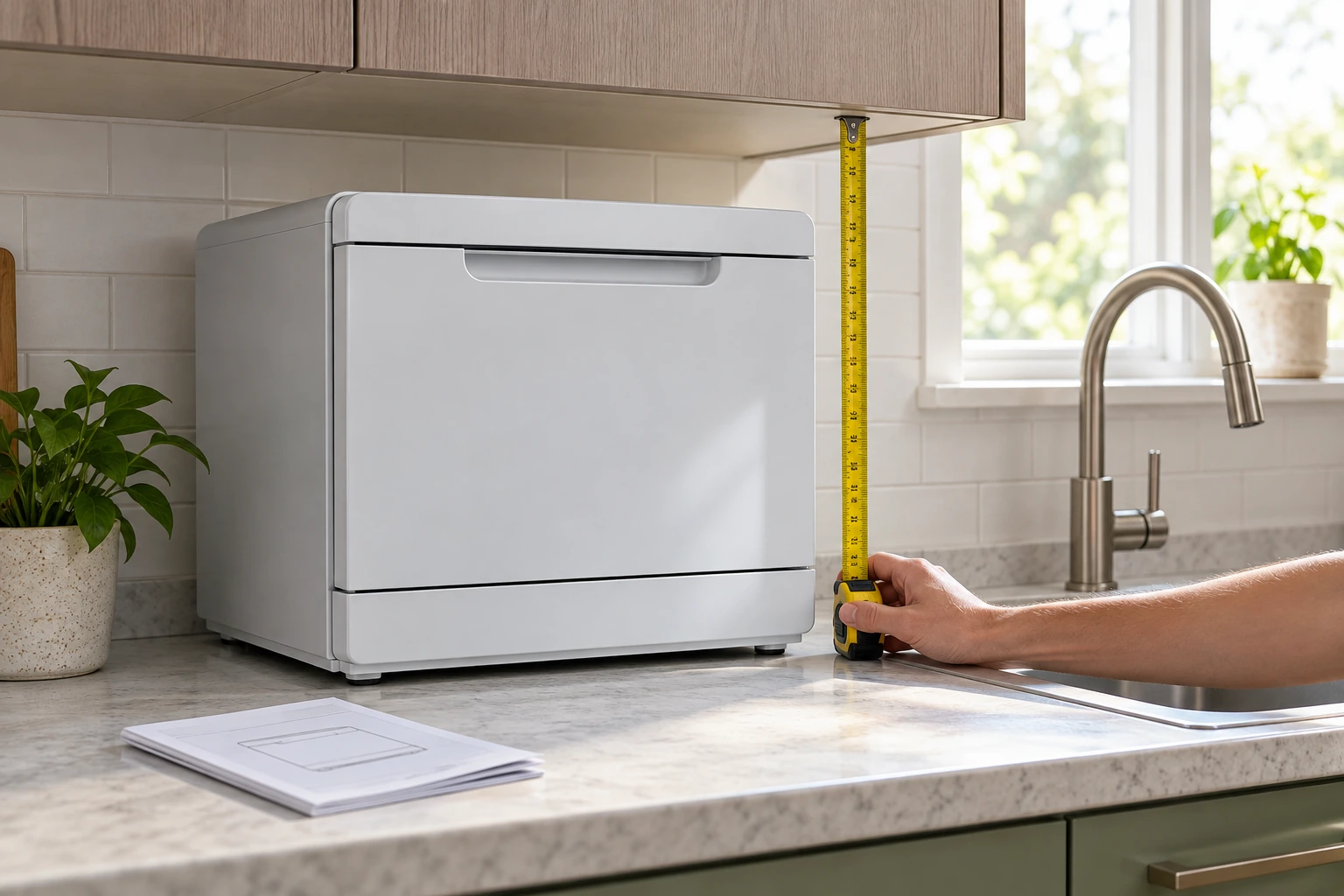
A compact dishwasher can fit on a counter and still fail the kitchen it was bought for. An upper cabinet may block its door, a sink may be too far away for the approved drain route, or the only outlet may be unsuitable. This guide explains how to solve countertop dishwasher placement problems before buying by measuring the whole operating space and following the selected model's actual manual. It is for choosing a workable location, not for repairing plumbing or rewiring a kitchen.
Start with the counter you intend to use, not the appliance photograph. Clear the proposed spot and measure its width, depth and height to any cabinet, shelf or fixture above. Then measure the route to the sink and the position of an appropriate outlet. Record each result with the unit. If another appliance, dish rack or food-preparation area already occupies the space, include the working room you will lose. A unit that technically fits its footprint may leave too little counter for daily kitchen tasks.
Two current product pages show different levels of information. The EUHOMY portable dishwasher listing states dimensions of 16.85 inches deep, 16.73 inches wide and 18.03 inches high, and describes both a built-in 5-liter tank option and a faucet water-supply option. The TFCFL countertop dishwasher listing emphasizes its touch screen and four programs but tells buyers to read the manual and permits measurement variation. The listing excerpt does not establish a complete connection and clearance plan. Ask for the current full manual and exact delivered model before assuming it fits.
Measure operating clearance, not only the box
Make a paper rectangle the size of the appliance's stated footprint and place it on the counter. Check the space in front, behind and above it. The machine needs enough room for its door to open fully, for a loaded rack to move as intended, and for hands to load dishes without hitting a cabinet edge. The outside height is only a starting point. The maker's manual may require additional ventilation or hose clearance. Follow that requirement even if the unit appears to slide under an upper cabinet.
For the EUHOMY example, the stated dimensions give you a first template. They do not tell you exactly how far its door projects when open or how much space its hoses need. Check those dimensions in the current manual or ask the seller for an installation diagram. For the TFCFL example, do not substitute the first model's measurements merely because both are described as countertop dishwashers. A similar product category does not mean the same body, door swing or connection positions.
Measure the height at several points beneath a cabinet. A counter can slope slightly or have a raised backsplash; an upper cabinet may have a lip or under-cabinet light lower than its main base. Measure from the actual resting surface to the lowest obstruction. Account for feet, a mat if the maker permits one, and any lid or top-fill opening the selected model requires. If the unit must be pulled forward each time to fill it, consider whether that repeated movement is practical and safe.
Do not place a machine where its door or loading area blocks a walkway. Sketch the door open and imagine someone passing while it is being loaded. A narrow galley kitchen can make the open door the decisive dimension. If the appliance must be stored elsewhere between uses, measure the storage shelf and the lifting route too. A dishwasher full of retained water or dishes may be awkward to move; follow its drain and handling instructions before shifting it. Select a permanent or approved temporary location that works in ordinary use.
Trace the intended water path
Identify how the chosen model is supplied with water. The EUHOMY listing describes a built-in tank mode and a faucet mode, but the exact filling and connection steps must come from the delivered manual. A tank can avoid a permanent faucet connection, yet you still need a safe place to fill it without spilling around electrical parts. Faucet mode requires compatible hardware and an approved connection. Do not assume that every faucet shape, pull-down spray head or adapter will fit. Ask the maker when the current connection is uncertain.
Plan the drain separately from the supply. Locate the sink, measure the practical hose route and check where the outlet must be secured according to the manual. A hose laid loosely across a counter can be pulled or dislodged. A drain that cannot reach its approved position is not solved by an improvised bowl on the counter. Follow the maker's specified route and secure the hose as directed. If the route crosses a walkway, hot surface or sharp cabinet edge, choose another location or qualified installation help.
Look at what is already happening at the sink. A dish rack may drip onto the counter for reasons unrelated to a dishwasher. The public guide on tracing water from a dish rack onto the counter addresses that separate source. For the dishwasher, establish its own supply and drain path before first use. Distinguishing the two avoids blaming the new appliance for an existing puddle or overlooking a newly loose hose.
Keep water away from electrical connections. Confirm the outlet and cord arrangement with the manufacturer's installation instructions and local electrical rules. Do not drape an extension cord across the sink, pinch a cord behind the unit, or modify a plug to reach a distant socket. If the only practical location lacks a suitable outlet, that is a real placement blocker. A qualified electrician can assess the kitchen; a product description cannot authorize a wiring workaround.
Compare capacity claims with actual dishes
Measure the plates, bowls and glasses you expect to wash. A small dishwasher may handle a daily set but not a large serving dish or tall pan. The interior rack layout, spray-arm clearance and permitted item materials govern the usable load. Do not infer capacity from outside width alone. Check whether a dinner plate stands without blocking the arm and whether cups can be angled as the manual requires. If you need to run multiple loads for one meal, include that routine in the decision.
The TFCFL listing specifically advises against stacking tableware and says concave surfaces should be tilted downwards; it also tells users to pre-soak difficult residue. Treat those instructions as a signal to inspect its actual rack layout and detergent directions, not as proof of universal cleaning performance. The listing mentions dishwashing powder and cautions against unsuitable detergents, but the current manual must determine what the delivered model accepts. Using the wrong product can damage a machine or leave residue. Do not extrapolate from a different dishwasher's detergent rules.
The EUHOMY page lists several wash modes and drying claims. Those are seller descriptions of the listed variant. A named program does not guarantee that every soil level, bottle or delicate item will be suitable. Check the manual's loading and temperature instructions before washing baby items, plastics, insulated objects or cookware. If an item has its own care directions, follow those too. Choose a machine whose normal load and approved cycles match your dishes rather than selecting on the count of program names.
Think about the counter after the cycle. Where will clean dishes go? A machine placed beside the sink may remove the space used for a drying rack or prep board. If you plan to unload directly into cabinets, make sure the open door does not block them. Draw the ordinary sequence: scrape, load, fill or connect, run, drain, unload and store. The location has to support the whole sequence. Solving only the machine's footprint can move the problem into the next task.
Resolve missing specification before ordering
Write down the unknowns for each model. For the EUHOMY example, confirm the exact current dimensions, required clearances, door projection, approved tank-fill method, faucet connector and drain arrangement. For the TFCFL example, request those same details rather than assuming that a touch screen and four programs imply a particular water setup. Ask for the model number and manual matching the unit that will ship. A generic manual for a neighboring model may show a different hose or body.
Compare the answers against your measured kitchen. Mark each requirement as confirmed, incompatible or still unknown. If a required dimension is missing, do not treat an approximate product photograph as a measurement. If a connection is unclear, do not order an adapter by guesswork. An unresolved unknown may make a different model or placement the better choice. The goal is a usable appliance, not merely a box that can be placed on a counter for a photograph.
Other kitchen devices illustrate why maker-specific attachment rules matter. The public guide on checking a pasta attachment against its maker's fit rules owns that separate accessory decision. A countertop dishwasher likewise needs its own manual and connection details. The analogy stops there: a pasta attachment's mechanical fit does not establish a dishwasher's water or electrical compatibility.
Check the kitchen's practical limits as well. In a rental or shared space, a faucet adapter or stored appliance may require permission. A counter with weak support, a damaged surface or a nearby heat source may be inappropriate. Do not assume a small appliance is light enough for every shelf or safe beside every cooktop. Confirm the appliance weight, counter support and maker's spacing directions. If the unit must cross a stair or narrow doorway to reach its spot, arrange safe handling before it arrives.
Trial the layout before first operation
After delivery, compare the exact model and included components with the order and manual. Set the unplugged machine in its intended location and open its door without attaching water or power. Confirm clearances and reach. Lay out the approved hose route without connecting it and see whether it reaches the sink safely. Do not run a cycle merely to discover that a hose will not stay in its required position. Stop at any mismatch and use the seller or maker's support path.
Only then follow the current manual for water supply, drain and electrical setup. Keep the manual nearby for the first cycle, observe the connections as directed and stop if you see leakage or unsafe cord placement. Do not leave an uncertain setup running unattended. If a first placement fails, preserve the before-state and determine the actual cause: clearance, water route, outlet, loading space or an incompatible part. Moving the machine to a second spot should resolve that cause, not repeat the same unknown setup.
The answer to how to solve countertop dishwasher placement problems before buying is to measure the full workflow: body and door clearance, sink and outlet routes, dish capacity and unloading space. The EUHOMY listing provides a useful dimensional starting point and describes two supply options; the TFCFL listing leaves important connection details to its manual. Neither can replace a check of the exact delivered model and your actual kitchen. A workable placement is one that follows the maker's instructions through an ordinary complete cycle.