Home & Living
Soapstone holder compatibility: distinguish the dimensions
Distinguish a holder-size statement from explicit marking-stock targets, retaining the actual geometry question and manufacturer-specific limits.
Read the dimension for the object it describes
Soapstone holder compatibility needs a supported relationship between the holder and the marking stock intended for it. A number printed beside a holder may describe that holder, while a different statement explicitly names the stock it accepts. Keep those two kinds of information separate. A familiar marking-material name does not supply the missing relationship, and a photograph of one body shape cannot provide a complete internal fit specification.
This guide concerns complete holders for marking soapstone. It provides no loading, adjustment, removal, filing or marking procedure. It does not approve a work surface, a heated process or a workplace application. Its purpose is to distinguish holder dimensions from an explicit recipient thickness statement, so that a supplier enquiry asks about the actual physical relationship rather than an unrelated number on the page.
Name the stock as well as the holder
Start with the marking stock you actually intend to use. Retain its product reference, shape and any stated dimensions exactly where those are available. If those details are incomplete, keep them incomplete in the enquiry. A description saying only marking material leaves several questions open. A holder that looks like a familiar writing instrument should not be treated as proof that an unidentified piece belongs inside it.
Identify the proposed holder with the same care. Keep the maker, model or product reference where the account provides one, without guessing a missing designation from a similar photograph. An enquiry can then name two actual objects. That is more useful than asking whether a product works with soapstone in general, especially when the available descriptions attach numbers to different parts of the proposed pairing.
Keep the round holder's size account in its own scope
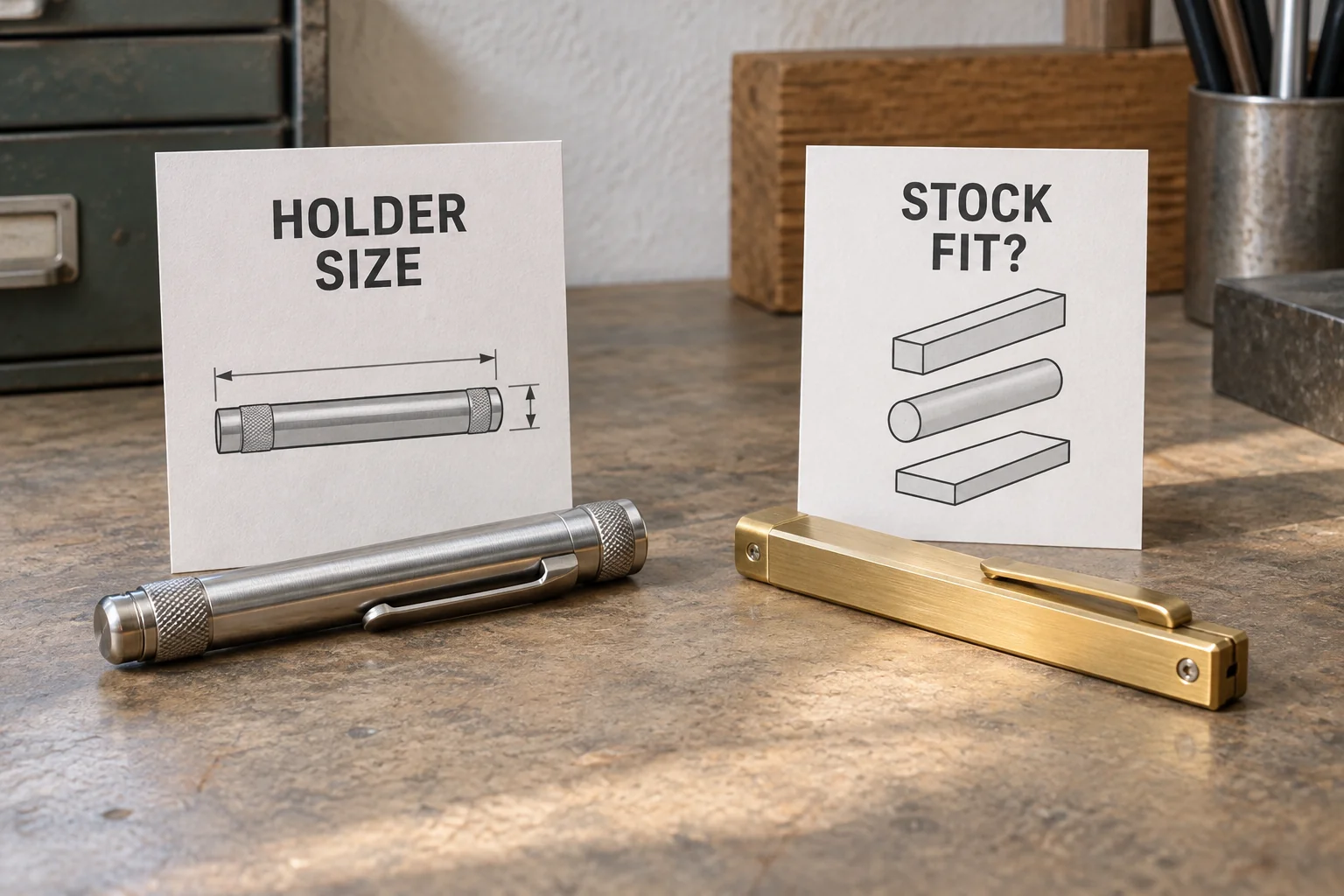
The Markal round holder listing identifies a round soapstone holder and writes its dimensions as 5"X1/4", also given as 5 In X 1/4 In. Its sole gallery shows a cylindrical holder with a pocket clip. This short account does not explicitly identify every compatible recipient stock or supply an internal opening drawing. Do not silently turn the holder's size wording into a universal refill-diameter statement.
The distinction is between what a description says and what you want to know. A dimension can help identify an offered item while leaving the fit question unanswered. If your purchase depends on the stock accepted by the holder, ask for that relationship explicitly. Do not complete a missing statement merely because one interpretation of the numbers would be convenient for the material already in your supplies.
Read the brass holder's named targets without expansion
The BH-10 brass holder listing explicitly names B&D marking soapstone and says its holders fit 1/32-inch thin and 1/16-inch medium marking soapstone. Its sole gallery shows flat holder bodies with pocket clips. Keep the universal wording bounded by those named targets. It establishes no cross-brand, round-stock or unlisted-width fit here, and supplies no loading or adjustment method.
An explicit target statement is useful because it says which relationship the offer describes. Preserve its qualifiers instead of reducing it to a reassuring adjective. If your stock is outside the named account, ask about that actual stock. A broad term in an offer does not replace the details surrounding it, and a familiar fraction alone does not identify every dimension of an object.
Keep the cross-section question open until it is answered
A fit enquiry may need information about more than one direction across the material. Ask which dimensions the applicable documentation requires for the holder and the exact stock. This guide does not provide a universal measurement checklist or infer tolerances. It keeps the geometric question visible so that a statement about one dimension is not mistaken for a complete description of the proposed fit.
Imagine a buyer with an unidentified piece of marking stock and an old package for a different supply. In this fictional example, the buyer initially writes the package reference into an enquiry, then realizes it may not identify the piece in hand. They retain that uncertainty and ask how to establish the actual stock's identity. The example supplies no measured result and no confirmation that the proposed holder accepts it.
Do not make the gallery an internal drawing
A product image can help distinguish a complete holder from loose marking stock. It cannot expose every internal surface or establish a clearance that has not been specified. Perspective, lighting and an unshown opening can leave essential details unseen. Retain the image for the visible identity it actually supports, without converting the apparent width of the body into a precise recipient specification.
The same limit applies when a pictured object appears to contain material. The picture alone may leave the complete supplied contents unresolved. Ask what the selected offer includes if that matters to the order. A compatibility answer and an inventory answer concern different questions. You can confirm one while leaving the other open, rather than treating a suggestive photograph as a complete account of both.
Ask which number belongs to which object
When sending an enquiry, quote the size wording accurately and ask what it describes. Is the supplier identifying the holder, the intended stock or a different feature? Keep that question attached to the exact offer. You do not need to rewrite a product specification yourself. An answer can clarify the meaning of the stated number while still leaving another dimension or variant question unresolved.
If a reply introduces a new dimension, retain its subject and unit with it. Avoid separating the number from the object it describes when passing the answer to another person. A note containing only a fraction can become misleading once the conversation is forgotten. A short phrase explaining which part the supplier meant preserves more useful information than a bare figure copied into a shopping list.
Keep material choice separate from holder fit
A holder relationship does not establish whether the marking material is suitable for a particular surface or process. Those questions require the actual material and application's own information. This article does not certify visibility, removability, heat behavior or a finished surface result. Obtain the relevant requirements before treating a successful accessory selection as approval to make a mark on useful work.
This boundary matters when several people use the same word for different marking supplies. Someone may be discussing a tool that retains a rigid piece, while another is thinking about material applied through a different tool. Explain which object the enquiry concerns. Shared vocabulary can start a useful conversation, but it does not establish interchangeable contents or a shared operating method.
Leave chalk-line methods with their actual system
The chalk line layout guide concerns a reel, powder, defined endpoints and a short practice mark. It owns the applicable setup and marking method for that system. It does not identify stock for a rigid soapstone holder. Read it for its separate layout task, without transferring its powder, opening, refill or handling directions to either holder selected here.
If the original request was for an accessory to an existing tool, make sure the search has stayed with that request. A different marking system may meet a different task, but choosing it is a new decision. It should not be presented as a confirmed replacement part for the original system. Keep any proposed change visible so the person who will use it can evaluate the actual equipment and work requirements.
Keep pencil-component guidance within its own recipient
The pencil eraser refill guide distinguishes a replacement component for named pencil families from a standalone eraser block. It supplies no dimensions or recipient statement for a marking-soapstone holder. Use its separate component enquiry when the item being replaced is an eraser. A shared pencil-like appearance does not transfer a part list, target family or fitting method from that article to these holders.
The question here is narrower than whether a small hand-held object can retain some kind of material. It concerns the exact stock and the physical account for the holder being considered. Keep the actual pairing in the enquiry even when someone offers an analogy to another tool. An analogy can explain why you are asking a question without becoming the evidence that answers it.
When the proposed holder changes
A supplier may answer by recommending a different item. Preserve the new reference and ask which part of the original question the recommendation resolves. A substitution can be useful without establishing that the first offer was suitable. Keep the earlier answer with the earlier item instead of allowing it to follow whichever product is currently in the basket.
If the replacement description still leaves the stock unidentified, the enquiry remains incomplete. You can acknowledge the helpful recommendation while asking for the missing connection. There is no need to claim a complete fit answer simply because the conversation has progressed. A well-defined remaining question lets the next reply address the actual gap rather than repeating a general statement about marking tools.
Keep quantity outside the physical relationship
A bundle can contain several copies of the same unsuitable holder. Resolve the supported stock relationship before treating the quantity as a reason to order. This article gives no pack-value or current price comparison. Quantity and fit can both matter to a supply decision while requiring different evidence. A count of holders does not establish the internal geometry of any one of them.
The number needed also belongs to the actual users and project. Do not invent a future demand to justify a larger package while the proposed pairing is unclear. You may decide to leave the order undecided until a supplier answers the physical question. That is a complete pre-purchase outcome, even though no accessory has yet been selected for use.
Retain the answer when the received reference differs
Compare a received item's actual identification with the exact product and stock relationship discussed in the enquiry. This guide supplies no inspection, loading or trial procedure. If the reference differs, keep the discrepancy visible and obtain clarification before treating the earlier answer as covering a newly received item. A delivery does not automatically close an unresolved compatibility question.
Keep any supplied instructions with the actual holder and its identified stock. If the stock later changes, the earlier answer remains evidence for the earlier pairing. It does not establish a broad rule for every replacement in the drawer. A new material reference can require a new enquiry without invalidating the useful answer already obtained for the original combination.
Keep checkout details with the chosen supply
If you consider a supply order through republeq.com and prefer crypto such as USDT, first keep the holder and marking-stock question attached to the actual selected offer. A payment preference cannot turn a holder dimension into a recipient specification or extend a named fit statement to an unidentified material. Check the payment methods presented for that particular order. A broad cryptocurrency reference does not establish which assets, networks or routes will be offered when you reach checkout. This guide supplies no receiving address or transfer procedure. Use the actual instructions for the method you choose, and leave the transaction undecided if a necessary detail remains unclear. Read the current delivery and return information for the same order rather than assuming that a preferred payment method creates a special arrangement. No arrival date, replacement outcome or refund result is promised here. If someone else is purchasing the holder for you, give them the exact item reference and any unresolved fit question alongside the payment decision. They can help complete the order without silently changing the equipment that the enquiry concerned. Should the supplier propose a substitute during checkout, retain its different identity and revisit the stock relationship before treating it as approved. An order confirmation identifies a transaction; it does not establish the internal dimensions of a holder or certify the material for your intended marking task. Keep the relevant product answer and the actual confirmation together, so a later question can be traced to the selection that was made rather than to a remembered description of another offer.
Keep the wording available to the next person
A brief note can preserve the actual enquiry and its limits when supplies change hands. Explain which pairing was discussed and which question remains open. Someone finding the items later should not have to infer a fit approval from the fact that they were stored together. The retained answer belongs with its original objects, even when another person organizes the drawer.
Preserve the meaning of the fit statement
Soapstone holder compatibility is established by the actual holder and supported marking-stock relationship, with every dimension kept attached to the object it describes. Preserve the named targets and leave an unidentified stock or missing internal specification unresolved. The useful result is a bounded fit answer or a precise remaining question, without a photograph-based diameter assumption, an expanded universal claim or an invented fitting procedure.