Office Supplies & Stationery
Pencil eraser refill compatibility: identify the pencil
Match an eraser refill enquiry to the actual pencil and supported family, distinguish standalone blocks and preserve unresolved model or source details.
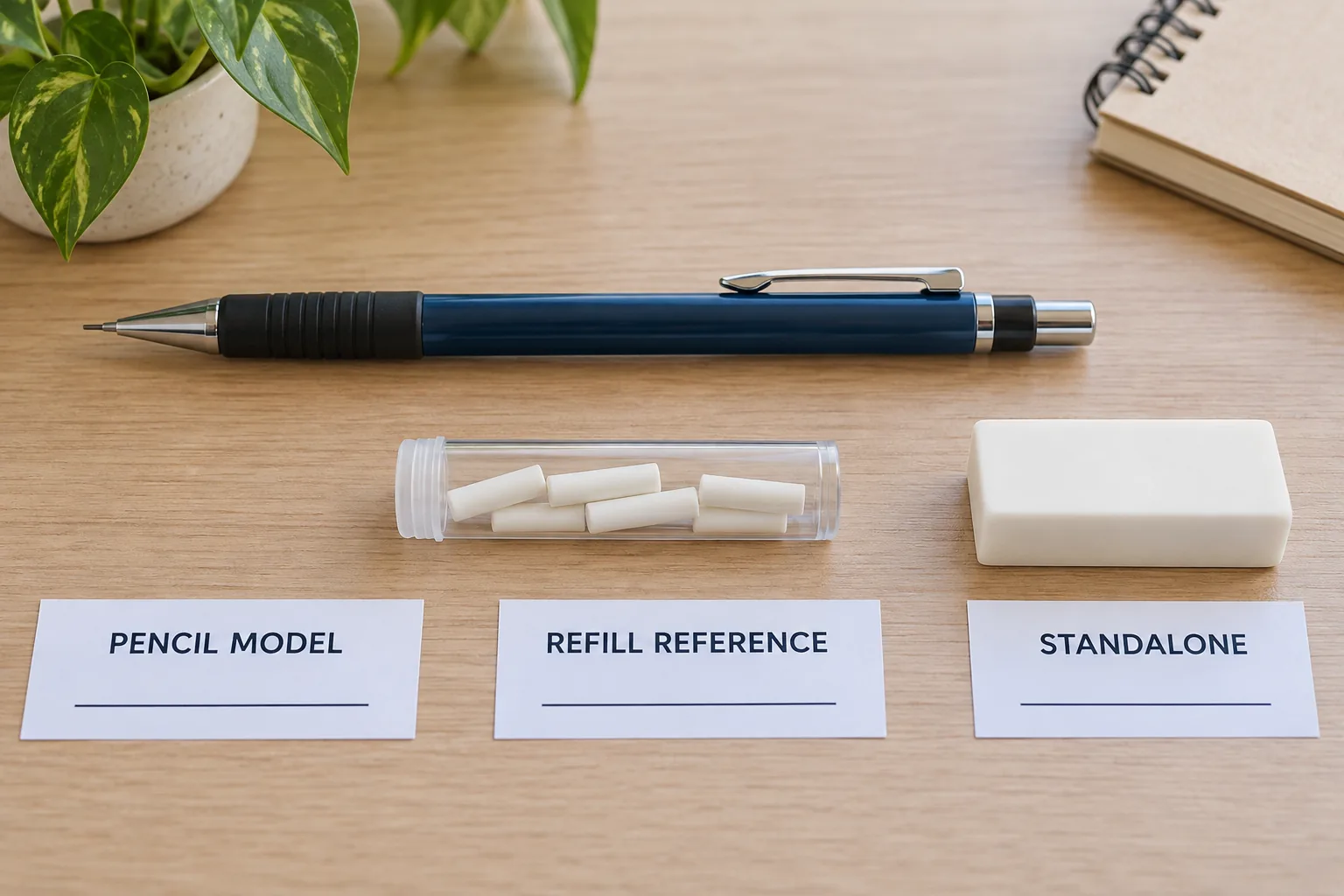
Identify the pencil before choosing its replacement eraser
Pencil eraser refill compatibility starts with the pencil that will receive the part. A product called an eraser may be a replacement component for particular pencils or a separate tool used on its own. Identify that role before comparing a familiar brand name, a package photograph or a quantity label. A standalone block can meet a separate erasing need while supplying no replacement for a pencil's own eraser holder.
An actual compatibility enquiry can end with a supported recipient relationship or a question that still needs an answer. Keep that outcome explicit, especially when a broad product name could describe more than one physical role. This guide helps frame a component enquiry. It supplies no installation procedure, universal diameter rule, erasing test or assurance that a product name covers every revision of a pencil.
Keep the actual pencil identity in the enquiry
Read the identification on the pencil and any original packaging or instructions you still have. Retain the maker and model or family designation exactly where it is available. A note saying only mechanical pencil leaves the intended recipient unidentified. A note naming a brand still leaves room for different pencil families and replacement parts.
If the identification is incomplete, make that the open question before buying a refill. A clear photograph of the actual markings can help explain which object you have when seeking clarification. The photograph should remain evidence of those visible markings, without becoming a measurement of an internal holder or proof of an undocumented component pairing.
Keep the original eraser or its package reference where available and appropriate under the pencil's own instructions. An existing part can provide another identifier to investigate. This guide gives no disassembly or extraction sequence. If finding the relevant information would require an uncertain mechanical action, obtain the applicable documentation rather than turning the identification enquiry into an experiment.
The listed pencil family is the relevant starting statement
For the listed pencil family, the Pentel refill eraser listing explicitly names Champ, Icy, Quicker Clicker, e-Sharp and Cometz pencils as its targets. The account describes mechanical-pencil refill erasers. Keep those names with this exact offer rather than expanding them to every Pentel product. Its description supplies no complete dimensional drawing, revision table or installation sequence. An exact model or variant question should retain that missing detail until the applicable information resolves it.
Read a compatibility sentence for the relationship it actually names. A pencil-family list connects a replacement component to those stated targets. It is different information from a general statement about pencil marks or school use. Keep the target names in your notes so that a supplier's later answer can be compared with the actual pencil you identified.
If the pencil in your hand has a different name, leave the relationship unconfirmed. A shared brand does not add that model to the list. Equally, a partially readable marking should not be completed from whichever listed family looks most familiar. Ask for an answer covering the actual object and the offered refill, with the remaining uncertainty made explicit.
Check whether a part or another complete tool is needed
Decide what the purchase is meant to restore. Replacing a component in an existing pencil is a fit question involving that pencil and the part. Obtaining a separate eraser is another purchase purpose. Write the purpose before choosing the product so that a general eraser search does not answer the wrong question.
A person may be content to use a separate eraser without replacing the pencil's own component. That is a choice about their working supplies, not a demonstration that the separate item fits the pencil. Keep the distinction clear if someone else asked you to buy a replacement part. They may need the pencil restored rather than another item to keep on the desk.
The reverse is also possible: a refill intended for a pencil should not be presented as a complete standalone tool merely because its name contains eraser. Use the actual description and applicable instructions to understand its role. A package quantity counts supplied components; it does not turn them into complete pencils or provide a holder for each one.
A standalone eraser block does not establish a component match
The Ling three-pack eraser listing first describes large pencil erasers for drawing and school use, and its gallery corroborates three separate blocks. The same account contains conflicting colour wording and unrelated cat-window-perch suction-cup text. Those passages supply no accepted colour, fit, material or performance claim here. The narrow supported role is a standalone eraser block. The account gives no relationship to a named Pentel pencil or its refill holder, so it cannot establish that component match.
Keep the supported identity separate from the unresolved listing details. An unrelated sentence should not be repurposed as an eraser feature, and a conflicting field should not be silently corrected into a delivery promise. Ask about the exact offer if one of those details affects a purchase. This guide does not certify the contents beyond the limited identity described above.
The physical role still matters even when the erasing task sounds similar. A complete block and a refill component can both be described for pencil work without being interchangeable objects. Do not transfer the recipient-pencil list from the refill offer to the block. That list belongs to the particular product relationship stated in its own source.
Keep package counts outside the fit decision
A large package may contain many copies of an unsuitable part. Resolve the actual component relationship before treating quantity as a reason to order. This article does not calculate pack value or the number of future corrections. A confirmed count and a confirmed fit answer different questions, and one should not be used as evidence for the other.
The eraser-pack budget guide owns the supplied-count and purchasing enquiry. Its BAZIC and Creative Mark examples preserve inconsistent quantity statements and the actual materials requirement before comparing a quote. That is separate from deciding whether a refill belongs in one identified pencil. No pack count or quoted total in that guide supplies a holder dimension or a target-model relationship for these offers.
If a supplier changes the proposed product while answering a quantity question, revisit the fit enquiry for the new item. A replacement offer has its own identity and supported targets. Keep the earlier answer with the earlier product rather than allowing an apparently similar package to inherit every compatibility statement made about it.
Ask a question tied to both objects
An enquiry can name the actual pencil on one side and the exact refill offer on the other. Include the markings or reference that identified each. Ask whether the proposed pairing is covered by the applicable replacement information, including any variant detail that remains unclear. This creates a question that an actual model-specific answer can resolve.
A reply repeating that the item is a pencil eraser would leave that relationship unanswered. A reply naming the pencil but not the offered part may also leave something to confirm. Preserve the useful information while identifying the missing connection. There is no need to discard an actual model reference because the response has not yet completed the compatibility enquiry.
If a supplier provides a replacement reference different from the one originally considered, keep that change visible. Check which product the answer actually names before ordering. A revised part number can be useful information without establishing that the original offer was suitable. Save the actual answer beside the pencil identity so that the reasoning can be revisited if the order changes.
Leave dimensions and physical fitting to actual documentation
A photograph of a short white component does not provide its complete dimensions or the tolerances of a pencil's holder. Keep any size information attached to the part it actually describes. A pencil's writing-lead label concerns another component and should not become an eraser-fit measurement simply because it is the most visible number on the barrel.
The mechanical-pencil refill and no-feed decision concerns the lead, its identity and the pencil's documented writing state. That diagnosis does not establish eraser compatibility. Here the component enquiry is about the eraser and its intended recipient. This article supplies no lead-loading, jam-clearing or control-testing procedure, and a successful writing action is not evidence for an unverified replacement eraser.
Use the instructions and replacement information for the exact pencil when a confirmed part is obtained. The present listing accounts do not provide a universal fitting method. An unresolved pairing should stay unresolved until the relevant documentation or supplier answer covers it. No trimming, modification or improvised component arrangement is prescribed here.
Separate compatibility from erasing performance
The eraser smearing guide owns small-area graphite correction, tool care and changed-paper limits. Its discussion distinguishes several eraser roles and methods, with separate source evidence for the actions it describes. That guidance does not establish that a particular refill fits your pencil. This compatibility enquiry makes no promise about removing a mark, protecting a drawing or avoiding a smear on the reader's paper.
A part identified for a pencil still has its own stated purpose and instructions. Conversely, a separate eraser that suits a particular drawing task does not thereby become the replacement component for that pencil. Keep the mechanical relationship and the intended erasing task distinct when asking for supplies, particularly if another person has specified what needs replacing.
If the original problem was a mark on paper rather than a missing or exhausted component, name that problem accurately. It may lead to a different enquiry from a refill purchase. This article does not diagnose the paper or the existing eraser. It keeps a compatibility decision from being treated as a complete answer to every issue associated with erasing.
Keep the answer with the received part
When an order arrives, compare its actual identification with the selected offer and the model-specific answer you saved. Follow the equipment's applicable instructions for any replacement. If the reference differs, preserve the difference and seek clarification before treating the earlier answer as approval for a newly received item.
A package photograph and an order description can provide useful records without proving the condition or identity of every later shipment. Keep the actual received reference where it is available. This guide supplies no delivery, replacement or refund promise. An unresolved order discrepancy should remain visible rather than becoming a reason to improvise a fit.
If the pencil changes, return to the recipient question. A refill confirmed for one identified object does not automatically become suitable for the next pencil because both came from the same drawer. Retaining the earlier answer with its original pairing protects its meaning while leaving a new model enquiry open.
Keep payment details with the actual supply order
If you intend to buy erasers through republeq.com using USDT or another crypto payment option, check the current checkout for the exact order before sending anything. A payment label in a listing does not establish which assets, networks or payment routes are available for your cart. Confirm the asset name and network shown by the active checkout, the full amount requested, any displayed fees and the destination details. Keep the order reference and the instructions you actually receive. Do not infer payment compatibility from an eraser's pencil-family statement, a familiar wallet name or an earlier purchase. Technical suitability and payment availability need their own checks. Review the current shipping information, cancellation conditions and return policy for the order, including any instructions that explain how a payment issue or refund request is handled. This article promises no asset acceptance, transfer completion, recovery service or refund outcome. If a payment instruction changes, or if an address or network is unclear, stop and seek clarification through the site's current support channel before authorizing a transfer. A quotation or order summary should remain attached to the exact eraser variant and quantity you intended to purchase; neither an advertised target name nor a picture establishes the delivered contents. Record the product question you still need answered separately from the payment question, so resolving one does not make the other appear settled. Recheck the current order details at the point of purchase rather than relying on a saved screenshot, a copied address or a description that may have changed since you first read it.
Keep the recipient and replacement together
Pencil eraser refill compatibility is an answer about an identified component and the pencil intended to receive it. Retain the offer's listed targets, obtain clarification for an unclear model or variant, and keep a standalone eraser's separate role visible. The useful outcome is a documented pairing or an honest open question, with no brand-wide fit assumption or invented mechanical specification.