Learning & Creative
Snow stair winter story: the moon lighthouse
An original winter fantasy follows a keeper from a village quay up a snow stair to the moon lighthouse and home again as the steps dissolve.
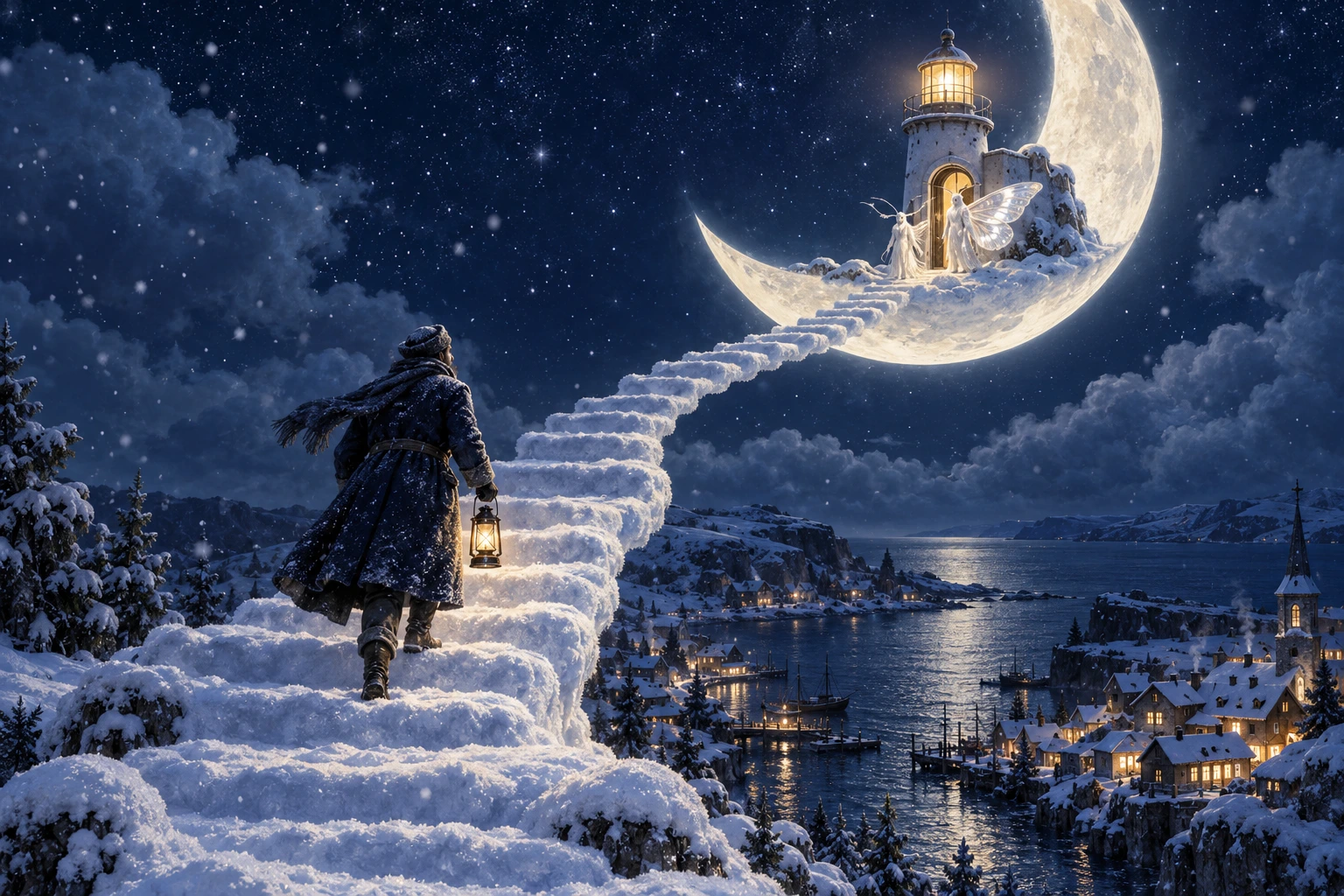
This Snow stair winter story is original fiction. Its village, keepers, moon lighthouse and impossible journey belong to an invented world. Real notebooks appear only in the separate catalog context after the tale; they make none of its events possible.
The first step above the quay
At dusk, Mara went down to the quay to bring in the empty lantern hooks. The winter boats had already been pulled above the tide. Their ropes lay stiff across the stones, and the little shop behind the harbour office had closed its blue shutters. Mara carried the hooks in a basket against her hip. She had almost reached the last post when snow began to fall upward from the water.
It rose in a narrow column beyond the quay, each flake turning slowly. Mara stopped. The snow gathered into a white ledge level with the stones, then another a little higher. More ledges formed above them, curving away over the harbour. She set down the basket. Through the opening between two steps she could still see the black water lifting against the wall. The steps had no supports, and their undersides disappeared into the snowfall.
High above the village, the moon had come out of a bank of cloud. There was a tower on its lower edge. Mara could distinguish its little gallery, the crooked roof and the window where a beacon ought to have shone. She had never noticed the tower before. Tonight its window was dark. The stair curved toward it, growing step by step while the snow continued to rise from the harbour.
A sound came down from above, too soft to be a bell. It was more like someone drawing a finger across the rim of an empty glass. Mara looked behind her. No one had opened a shutter. She took off her heavy basket strap and hung it on the last post, leaving the hooks inside. Then she placed one boot on the first white step. It held her in the peculiar, unquestioning way things sometimes do in a world where snow can climb.
The roofs below the snow
The first turn carried her above the harbour office. She looked down on a roof she had known all her life and saw the little square repair beside its chimney. Higher up, the village became a collection of warm windows with narrow dark spaces between them. Someone was carrying a candle across an upstairs room. The moving light vanished behind a curtain before Mara could decide whose house it was.
She climbed past the level of the church weathercock. Snow touched her coat, but the stair remained clear ahead of her. Its edges were rounded like the banks beside a road after a long night of falling weather. When she looked back, her boot prints were filling themselves. The village still lay below, close enough for her to recognize the curve of the main street. She could no longer hear the water against the quay.
At the next turn she found a mitten on the outer edge of a step. It was no larger than a walnut shell and had six narrow thumbs. Mara crouched beside it. A thread ran from its cuff into the air, where it disappeared among the rising flakes. She left the mitten where it lay and went on. A moment later the thread tightened, the mitten lifted, and something very small sneezed behind her.
The stair widened into a landing beside a cloud. From underneath, the cloud had looked grey. Here it resembled a white hillside whose slopes moved whenever Mara tried to study them. A round door stood in the moving whiteness, with no wall around it. The door opened a crack. One amber eye regarded her. “Tower?” a voice asked. Mara pointed upward. The eye blinked, and the door shut without another word.
Beyond the landing, the snow stair bent sharply toward the moon. The tower was much nearer now. Its stonework looked pale and porous, with small hollows along the mortar lines. A narrow garden lay around its base. Nothing grew there except tall silver stems, each bearing a closed flower shaped like a folded wing. Mara could see a figure standing among them, waiting beside the lighthouse door.
The keeper with folded wings
The last step brought her onto a path of fine white dust. She turned to look at the stair. It descended through the cloud and vanished behind the curve of the moon. The figure by the door bowed. It had the height of a person, a narrow coat the colour of old pearl and two enormous moth wings folded along its back. Its face was covered by a soft fringe that stirred when it spoke.
“You came before the lower steps began to go,” it said. Mara looked over her shoulder. Far below, a few flakes drifted away from the stair's bottom turn. “I saw your window,” she answered. The keeper glanced up at the tower. Its hands were long and dark, each finger ending in a tiny white tuft. It opened the door and stood aside. Mara followed it into a room smelling faintly of cold stone and apples.
There was no fire in the room. A table stood beneath a round window, and on the table lay a shallow bowl filled with darkness. The darkness had a smooth surface. A little wooden chair had been pushed back as though someone had risen from it in a hurry. The moth keeper took the bowl in both hands. “I put the light down for a moment,” it said. “Then I could not remember which side of the dark I had left it on.”
Mara leaned over the bowl. For an instant she saw the harbour reflected in it, though the round window faced the other way. There was her basket hanging from the post. There were the empty lantern hooks, their curves shining against the wicker. Then the reflection changed. She saw a green orchard under summer rain, a room with a red floor and a woman carrying a sleeping dog. Each picture passed before she could ask where it belonged.
“Does the light look like anything?” Mara asked. The keeper spread one wing. Its pale markings were worn nearly transparent in places. “It used to look like the way home,” it said. Mara waited for another picture. A railway platform appeared, empty except for a man holding a shoe. Then a kitchen doorway, then a boat pulled high on winter stones. She touched the rim of the bowl, and the boat remained.
A small light in the gallery
The keeper bent beside her. The picture showed the quay from the water. A single yellow point shone above the harbour office, where Mara kept the old winter lamp. She had left it burning before coming down to collect the hooks. In the bowl, the point grew brighter. The moth keeper reached toward it with two fingers and lifted a thread of yellow light out of the reflected harbour.
The thread curled in its hand like a living root. No water followed it, and no part of the village disappeared. The bowl became an ordinary empty bowl. Mara could see a hairline crack running across its bottom. The keeper wound the light gently around one finger, carried it to the foot of the tower stairs and looked back to see whether she was following. She left the bowl on the table.
Inside the tower, the stairs were smaller than they had looked from outside. Mara turned her shoulders at each bend. Tiny round windows admitted the blue light of the sky. Through one she saw a long procession of sleeping birds crossing beneath the moon, their wings moving while their heads remained tucked against their breasts. Through the next she saw only snow. The keeper climbed ahead, its folded wings brushing both walls.
At the top, a glass room enclosed a dark lens. The keeper opened a narrow door in its centre. There was no wick, lamp or mechanism inside, only a hollow shaped like a cupped hand. It laid the yellow thread in that hollow. Light spread through the lens, first along one curve, then another. The whole glass room brightened. Mara saw the keeper's shadow open behind it, wide as a second pair of wings.
The beacon turned its light across the sky. A cloud that had hidden the village drew away. Far below, the harbour appeared at the end of the snow stair. Mara could distinguish the post with her basket, though she could not possibly have seen so small a thing from such a height in any ordinary place. The keeper closed the lens door. “That will do for tonight,” it said, and the light passed over them again.
The way down
When they returned to the garden, the silver flowers had opened. Each held a little dark bead in its centre. The keeper walked with Mara to the first step. The stair had grown thinner at the edges, and the lowest turn was hidden by falling snow. “Will it still reach?” she asked. The keeper raised one wing toward the beacon. Its light rested on the steps, making a pale road through the dark.
Mara began the descent. The keeper remained above, beside the opened flowers. At the cloud landing, the round door stood open. A tiny coat hung inside, with a six-thumbed mitten drying from each sleeve. There was no amber eye to watch her now. She passed without knocking. Snow fell steadily through the spaces between the steps, and below her the church weathercock emerged from the white air.
She reached the harbour office roof just as the tower light swept across the village. The square repair beside the chimney shone for a moment. Someone downstairs laughed, and a chair scraped over a floor. The ordinary sounds seemed very near. Mara stepped onto the last turn. Behind her, the upper stair loosened into a long ribbon of flakes. They fell past her shoulders without touching the steps she had still to descend.
Her final step landed on the quay. Water struck the wall below her boots. The basket was hanging where she had left it, with the strap twisted around the post. Mara lifted it down. When she looked up, there was no stair at all. Snow drifted across the harbour in the usual direction. Above the cloud, the moon lighthouse sent a thin yellow beam over the roofs, then turned it toward the sea.
Mara carried the hooks back to the harbour office. Her winter lamp was still burning on its shelf. She stood beside the window until the beam crossed the water again. On the far edge of the moon, too small for anyone else in the village to notice, a moth keeper folded its wings beside a garden of silver flowers. Mara set the basket under the desk and closed the office door.
Actual notebook references outside the tale
The Roaring Spring four-subject notebook account describes a case of twelve notebooks. Its sole gallery shows assorted spiral notebook examples beside a case labelled twelve books per case. The Top Flight notebook account describes a fourteen-pack; its sole image shows one black notebook with TOP FLIGHT, three subjects and 108 sheets on its cover. A pictured example is not independently verified delivered stock. Neither notebook supplies Mara's invented journey.
The imaginary weather report guide develops invented bulletins and their consistent weather rule. The framed invented tale guide considers an outer gathering and the tale told within it. This Snow stair winter story instead presents one continuous fantasy journey. There is no broadcaster, storyteller frame, comparison of versions or instruction to reproduce its impossible events.
A possible transaction remains separate
A possible notebook purchase can be considered separately from this original winter story. A general payment-method reference does not establish which currencies, countries, accounts or transaction conditions a later checkout will support. If you investigate a notebook order and prefer USDT, read the actual options presented for that selected order before deciding whether to proceed. Keep the real product identity and the supplier's current information separate from this original story. Confirm how many complete notebooks the selected offer covers; a photograph and a package description answer different questions, and neither establishes what a later delivery will contain. Ask any unresolved quantity or variant question before authorising a purchase. A payment preference supplies no missing product evidence and promises no writing result, delivery date, discount or return outcome. Read the applicable delivery and return information for the actual transaction and retain its confirmation if an order is placed. This article provides no wallet setup, network selection, transfer instructions, exchange calculation or fee estimate. It does not claim that any transaction has occurred. If another person investigates an order, give them the exact offer and any supplier replies rather than the fictional keeper's journey. The snow stair, moth keeper and moon beacon have no retail identity or physical performance to demonstrate. You may read the story without purchasing either notebook. Leave an unanswered purchasing question open until appropriate current information addresses it. A transaction record documents a transaction; it cannot establish an invented event or turn a catalog photograph into a test of goods received. Consider any available payment option on the terms actually presented.