Sewing & Crafts
Imaginary weather report: an upward-rain morning
Write a fictional town bulletin where rain travels upward, letting a morning, a pause and an evening share one clearly declared imagined rule.
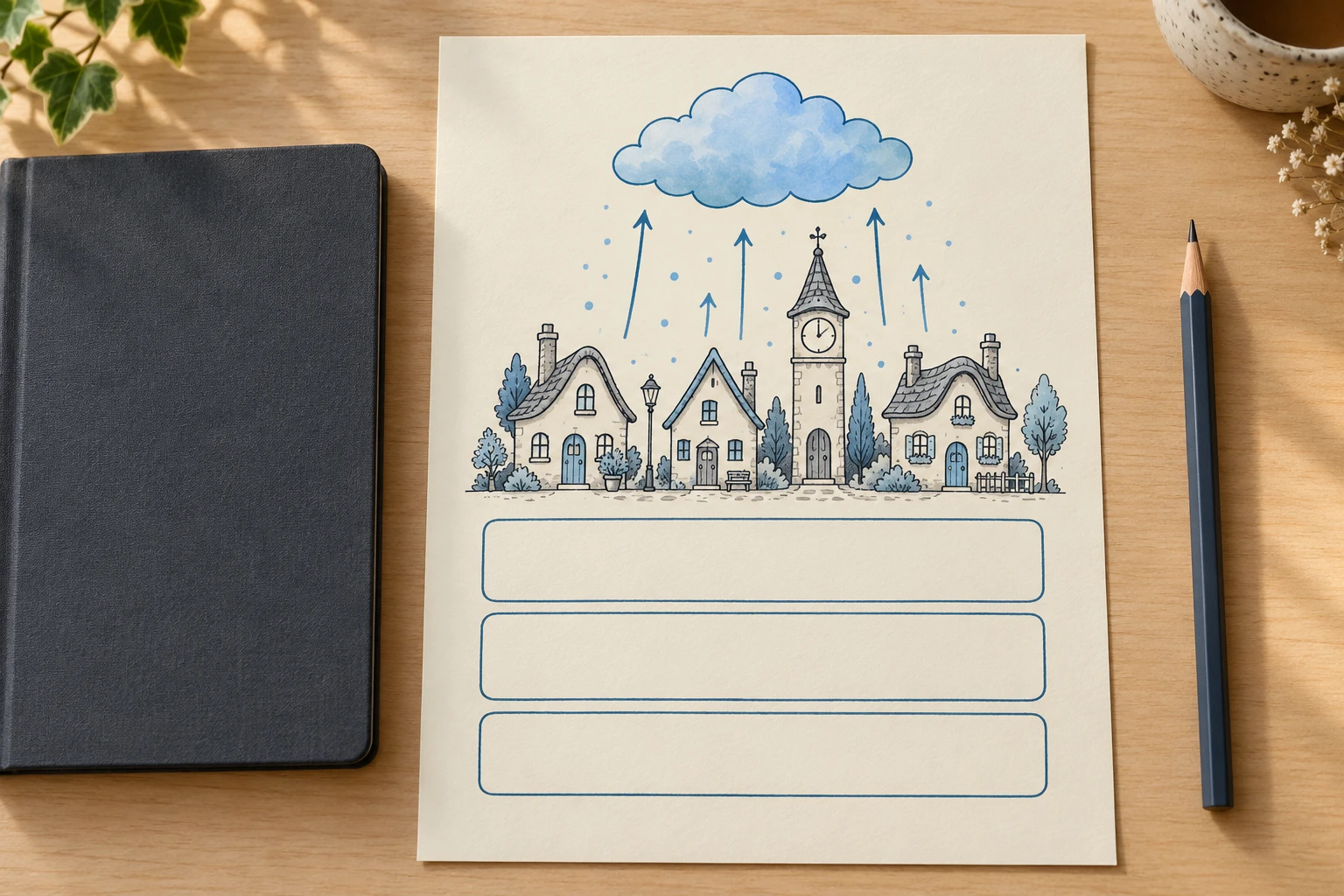
In Alderfold, rain travels upward whenever it appears. That is the invented rule for this Imaginary weather report, and the town belongs entirely to the page. A quiet morning, a pause at noon and an evening return can give you three short pieces to write without explaining how an impossible place works.
This is an optional creative invitation, with a complete original bulletin below. It supplies no actual forecast, weather observation, scientific demonstration or promise about writing ability. You can keep the example as something to read, invent another town or stop after one paragraph. No new supplies or public sharing are required.
Give the invented town one clear rule
Write the rule separately before beginning your report: whenever rain appears in Alderfold, it travels upward. This sentence belongs to the fiction. You are choosing a condition for the town you intend to describe, rather than offering a claim about rain in the world outside the story.
The wording leaves room for a moment without rain. It does not say that rain continues all day. That difference gives the three reports room to change while retaining the same imagined rule. You might prefer another impossible condition, but choose it openly before deciding whether a later sentence belongs in your version.
Name a small part of the town to return to. The example uses a square, a bookshop and a clock tower. Those are invented places, without a real location behind them. A few recognizable details let the weather bulletin sound as though someone has a particular place in mind, while leaving most of the town undescribed.
Read the complete morning bulletin
Fictional morning bulletin for Alderfold: “Upward rain has returned to the square. From the bookshop window, Mara can see bright drops lifting past the clock face. The tower keeper has left yesterday's notice in the window; its corner still curls toward the room. Below it, the square's empty chair keeps its place beside the blue door.”
“There is no announcement about when the rain will stop. Mara writes the morning report on the reverse of an old story draft, then draws a small square around the word returned. She likes knowing that the town had weather before this particular page began. The rest of that earlier day remains outside her report.”
This is authored fiction, including Mara, the tower keeper and the prior notice. Nobody is reported to have observed upward rain, conducted a writing session or found a real notice. The passage offers an imagined morning you can read as a small piece of prose. Its bookshop and chair give this version details without making them requirements for yours.
Let noon contain a genuine pause
Fictional noon bulletin for Alderfold: “The rain has paused. The tower's face is clear from the bookshop doorway, though Mara has not written a time beside the report. A folded blue cloth lies on the empty chair. Nobody in this bulletin has said who put it there. The square can keep that small unanswered question through the quiet part of the day.”
“Mara crosses out a sentence that would have explained the cloth. She would rather let the noon report leave something still in place. Her notice now names a pause, an open doorway and one object that was absent from the morning paragraph. It does not promise an evening answer.”
A pause does not contradict the declared direction rule. During this imagined noon passage, no rain is described as travelling in either direction. Keep that narrow reading with the words actually written. There is no need to invent an unseen weather mechanism, a measurement or a physical explanation to make the bulletin sound more complete.
Choose an evening that belongs to this page
Fictional evening bulletin for Alderfold: “Rain rises through the square again. Mara can see the cloth lifting at one corner on the chair, but she leaves it in her report without saying why it moves. In the bookshop, the tower keeper is reading yesterday's notice. The window now holds the three reports, each on its own small piece of paper.”
“The evening page ends with the blue door still open. Mara considers adding a visitor, then decides that the returning rain is enough of an arrival for this version. She puts the unused sentence beside the draft. Someone may enter the town on another page, but nobody has to arrive before this one can end.”
The selected evening retains upward rain and adds a particular stopping point. Its cloth movement is a fictional detail without an asserted cause. The bulletin does not establish that rain lifted it, that the tower keeper owns it or that Mara knows its history. You can enjoy an unanswered object while keeping the things the prose actually states distinct from possibilities it suggests.
Read the three moments as one chosen sequence
Put the morning, noon and evening passages together in that order. The morning introduces the square and a return of rain. Noon pauses it and adds the cloth. Evening brings rain back while leaving the cloth unexplained. This is the sequence chosen for this original example, rather than a template every imaginary town needs to follow.
Notice what stays available across the reports: the square, the bookshop and the chair. They give the reader points of return. You could keep only one of them in a shorter version. A report does not need a detailed street plan or a complete account of the town's residents to preserve one recurring place on the page.
Keep the rule beside the finished text for a final reading. Where the example actually describes rain moving, it moves upward. Where rain is absent, the direction condition has no event to describe. That check concerns the invented condition and the sentences in this particular selection; it is not a lesson about actual weather or evidence that a reader will respond in a particular way.
Try a different evening without hiding the change
Here is a separate proposed opening for another evening: “Rain falls past the clock face while Mara closes the blue door.” Read it beside the declared rule before deciding whether to keep it. The word falls supplies a direction that differs from the upward motion chosen for this town. An attractive sentence can still belong to another version.
You have several authorial choices. You could revise that opening to retain rising rain, choose a different weather event or deliberately begin a new town with a different rule. Name the change in your working notes rather than treating it as though nothing changed. The purpose is to keep the page you selected recognizable to yourself, without demanding that every possible sentence belong in it.
For this version, I keep the earlier evening with the open door and the unused visitor sentence. I like the choice to stop before somebody arrives. That is a preference about this piece of writing. It predicts no reader's feelings and supplies no result from an actual creative trial. Your own selection can leave a different detail open.
Leave room for your own report
If you want to write another bulletin, begin with a place name and one condition you are willing to keep for that version. Then give the first report something particular to notice. A closed bakery, a missing sign or a lantern at a window can be invented details. You do not need to explain a character's entire life before deciding which one you want on the page.
You may also choose an ordinary weather event inside a town with another impossible rule. Keep that decision explicit. The invitation is to make a small piece of fiction whose own stated condition remains readable, rather than to increase the number of strange events until the report becomes difficult to recognize. A single paragraph may be the whole piece you want.
If you share it, identify it as fiction and choose whether your separate rule note belongs with it. A willing reader might ask about a detail you had not intended to continue. You can keep that question for later without adding an answer immediately. Sharing a page does not oblige you to turn every suggested explanation into another scene.
Keep the neighboring creative pages distinct
The wind chime word-chain poem guide passes the last word of one authored line into the opening of the next. That literal spelling handoff belongs to its poem. This bulletin has no required boundary words, rhyme, acrostic or repeated final phrase; it retains one condition inside an invented town instead.
The non-dominant hand drawing guide offers a private choice about two imagined house sketches and an unfamiliar line a person might want to keep. This writing page does not compare hand choices or drawing accuracy. A small town illustration can remain optional, while the complete weather bulletin is made from words.
Read the actual paper offers in their own paragraph
The Strathmore 300 Series wired sketch-paper-pad offer describes twelve pads with 100 sheets per pad, wire binding and microperforation, with multiple sizes available. Its sole full gallery shows a yellow Strathmore 300 Series Sketch cover with a 100-sheet label and printed artwork. That does not independently count delivered pads, establish a measured selected size or supply the artwork as separate materials.
The Strathmore 400 Series Recycled sketch-pad offer also describes twelve pads with 100 sheets per pad and multiple sizes. Its two full galleries show green 400 Series Recycled Sketch covers and printed artwork. The description names 30 percent post-consumer fiber; that is an attributed disclosure, without an independent material test here. Neither the gallery nor this fictional bulletin establishes a delivered inventory or paper-performance result.
Keep a possible purchase separate from the fiction
If you separately consider buying supplies through republeq.com and prefer USDT or another cryptocurrency, identify the exact offer and selected variant before making that decision. An imaginary town's weather rule establishes nothing about the paper you would receive, and a complete fictional bulletin requires no order. Keep any product question that matters to your intended use beside the actual reference. If you proceed to checkout, inspect the payment choices presented for that order. This article does not confirm current availability of a token, network or payment service. Where cryptocurrency is offered, compare the named asset, network, requested amount, destination details and any stated payment window with the current transaction instructions. Do not infer a network from a familiar token name or copy a destination from an earlier order. Seek clarification through the responsible service if instructions are unclear before authorizing a transfer. Review the delivery, cancellation and return information applying to the selected order, retaining the terms with its product reference. A preferred payment method does not verify a material disclosure, selected paper format or delivered quantity. If another person is arranging a purchase, agree which exact item they are being asked to order and return proposed substitutions for consideration. If a transaction is completed, keep its acknowledgement and associated payment record. If order or payment status remains uncertain, reconcile that state before considering another payment. No present USDT eligibility, discount, dispatch date, refund amount or successful purchase is promised here. Mara's invented notice can remain on its fictional window while a real purchasing question stays open. Let each decision depend on the information that actually belongs to it.