Educational & Explainer Articles
Sleeping bag temperature labels: units, terms and fit
Read sleeping bag temperature labels with their units and rating terms. Keep Coleman’s 15°F claim separate from Kelty’s 20° wording and from fit or packing information.
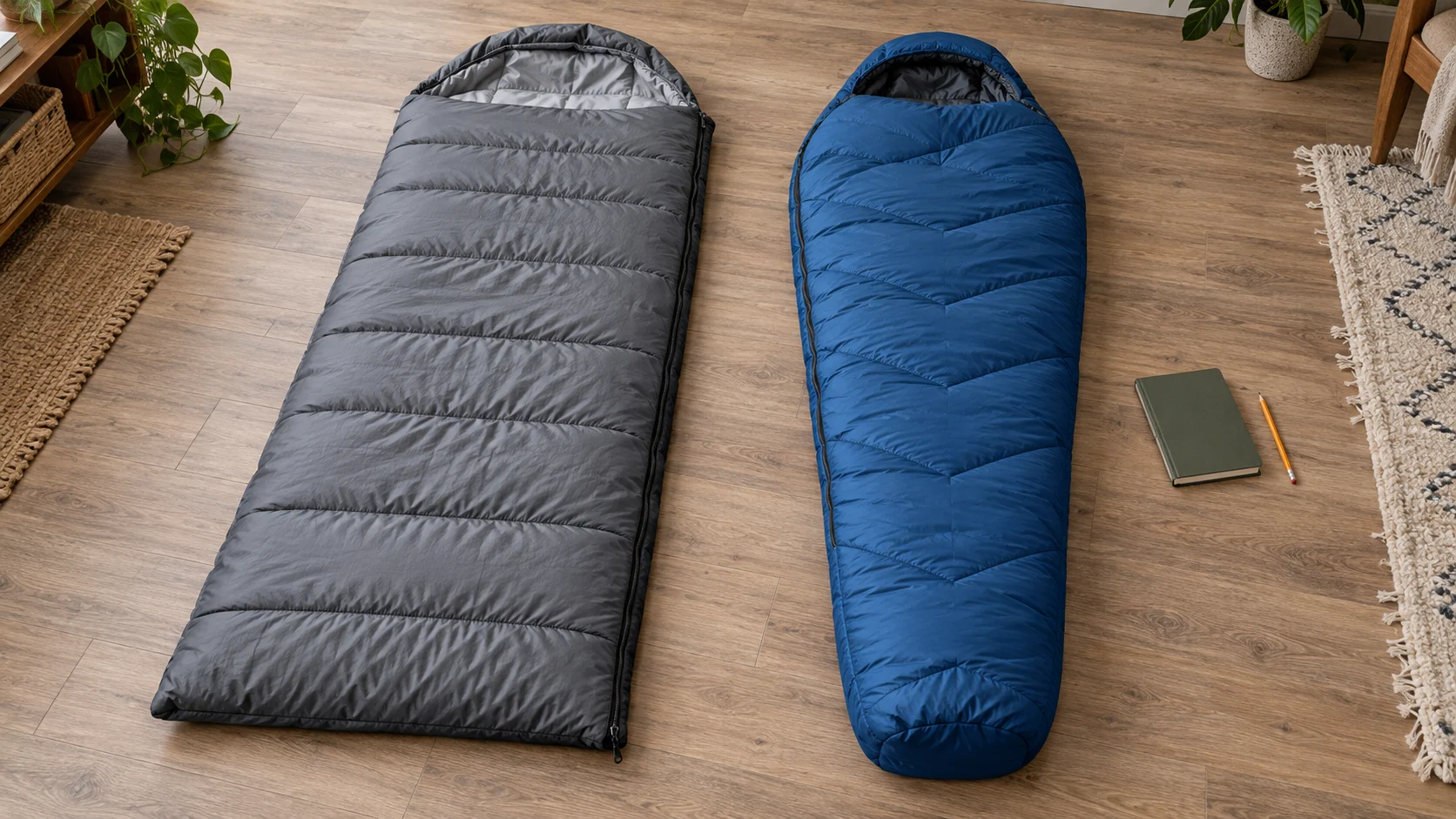
Sleeping bag temperature labels need more than a prominent number. Read the unit, the kind of rating being claimed and the information identifying the actual bag. A temperature claim, a season description, an insulation statement and a body-size limit describe different things. Use those distinctions to ask which missing detail would explain the offered bag.
The Coleman Arch Bay 15F and Kelty Cosmic 20° offers provide two concrete examples. Coleman’s description explicitly states 15°F. Kelty’s description uses 20° without naming a temperature unit in that account. Those statements should not become a five-degree comparison. The missing unit and rating terms need answers before the two figures can support a matched interpretation.
Read the complete Coleman temperature statement
The Coleman Arch Bay 15F Gray sleeping bag is described as a Big & Tall model rated for warmth to 15°F. The Fahrenheit unit is explicit. Its wording identifies a retail warmth claim; this description does not identify the figure as an ISO or EN comfort rating or give the full test conditions behind it.
Preserve the actual phrase when requesting more detail. Asking which rating method and category support the stated 15°F claim is more specific than asking whether the bag is warm. An answer about the fill material would address another feature. An answer about the method should identify what the number means for this actual model.
The description also gives SKU 15791801466 and UPC 076501177039. Keep those identifiers with an inquiry, particularly if a response discusses another Arch Bay product or a different temperature version. Similar names can leave the relationship unresolved. The information needs to identify the offered bag before it can explain that bag’s stated rating.
Keep the missing unit in the Kelty question
The Kelty Cosmic Blue sleeping bag is described as 20°, Regular and Unisex, with SKU 14673624077 and UPC 727880887513. The selected description does not name Fahrenheit or Celsius beside that figure. Keep the degree symbol as written instead of supplying a unit from memory or another Cosmic offer.
The same description says the bag is for spring and fall use. That seasonal statement does not complete the missing unit. Nor does Regular identify a rating category. Ask for the temperature unit and the applicable meaning of the 20° statement for this exact item before comparing it with Coleman’s explicitly Fahrenheit claim.
A reply that supplies only a temperature unit leaves the rating method unresolved. Keep those questions distinct. Establishing the unit makes the temperature statement more complete; it does not automatically establish whether the figure is a comfort rating, a limit rating or another manufacturer claim. Ask the reply to identify both the unit and what the value represents.
Temperature units and rating terms answer different questions
For temperature units and rating terms, begin with two separate entries: what scale the number uses and what the rating represents. A bare degree sign cannot settle the first entry. A Fahrenheit label settles that entry without supplying the second. Avoid treating a complete unit as proof that every other part of the rating is documented.
REI’s Expert Advice article How to Choose Sleeping Bags for Backpacking explains that ISO/EN comfort and limit ratings are different categories. Its account describes comfort in relation to an average cold sleeper and limit in relation to a warm sleeper. It also distinguishes standardized ratings from a brand’s estimate and says that a temperature rating does not guarantee warmth.
That terminology helps identify what to ask for. It does not establish that either selected retail offer has undergone a particular test. Neither selected description supplies a complete ISO/EN rating account here. Keep a reply about the exact bag separate from general guidance explaining how the terms are used.
Recognize a feature name that contains the word comfort
Coleman names a soft Comfort Cuff around the face. In this description, that is a feature name and a statement about the material at the opening. It is not identified as the bag’s thermal comfort rating. The shared ordinary word comfort does not make the feature label equivalent to a rating category.
The source also names a contoured top that leaves room for a pillow off the ground, a ZipPlow zipper designed to prevent snags and a Thermolock draft tube that helps limit heat loss through the zipper. Each statement identifies a design feature. None supplies a missing standardized rating table or a measured result for your own sleeping arrangement.
Read the stated purpose beside the named feature. The zipper account concerns snag prevention, while the draft-tube account concerns heat loss at the zipper. Those descriptions can help you identify features to investigate without adding the claims together into another temperature figure. There is no conversion from a list of feature names to an extra number of degrees.
Insulation wording is not another temperature number
Kelty’s description names trapezoidal baffles and says that lightweight 550 fill down provides warmth. The number 550 belongs to the insulation account. It is not a second temperature label, a body-length measurement or a rating that can be compared directly with Coleman’s 15°F statement.
The description also says the shell and liner use fully recycled fabric with a PFAS-free DWR finish. Preserve the scope of that wording: it names the shell and liner and their finish. It does not supply a water-exposure test, a drying procedure or a different thermal rating for the bag.
Coleman states that its shell, liner and Ecotherm fill are made from 100% post-consumer-recycled material. That is a material-content account. Kelty’s down-fill statement and its shell-and-liner statement describe their own components. These descriptions do not give a matched insulation test that would establish a temperature ranking between the two bags.
A season description leaves the actual condition open
Spring and fall name seasons rather than a specific overnight temperature. Keep Kelty’s wording attached to its offered use account. It does not provide the unit missing from 20°, identify a comfort or limit category, or describe the conditions at a particular place on a planned date.
A bag description and a proposed trip therefore answer different questions. The description identifies offered features and claims. A trip has its own actual location, timing and conditions. This article explains the labels and supplies no forecast, complete trip equipment prescription or promise that either bag will keep a particular person comfortable.
REI’s explanation also treats the sleeping bag, sleeping pad and clothing as parts of a sleep system and notes that actual comfort can vary with conditions. That general point does not supply a rating for the selected Coleman or Kelty. Keep the bag’s documented claim with the other information needed for the real arrangement.
Sleeping bag fit and packed size answer other questions
For sleeping bag fit and packed size, Coleman’s Big & Tall account says it fits campers up to six feet five inches tall. That is a body-fit claim, separate from its temperature statement. A stated height limit does not provide the full interior width, shoulder space or every person’s preferred sleeping room. Ask for the actual dimensions relevant to the intended user.
The same listing gives a catalog size of 3.7 lbs. Pounds describe mass in that entry; they are not the bag’s length or a packed-volume measurement. Keep the unusual field placement visible rather than turning the size label into dimensions it does not contain. A mass figure cannot establish whether the packed bag fits a particular compartment.
Kelty’s Regular and Unisex labels likewise do not provide a complete dimensional drawing in this description. Do not fill the missing length from Coleman’s Big & Tall claim. Each offered bag needs its own fit information, just as each temperature number needs its own unit and rating meaning.
Check the sleeping-space question on its own
The tent packed-size and sleeping-space guide separates a shelter’s stored package from the space used by bedding. Its actual Hengfa and NaNa tent descriptions illustrate why a stated occupant count does not establish the usable space for particular sleeping pieces.
That distinction matters when you plan where a sleeping bag will lie, but it supplies no temperature rating for either selected bag. Tent dimensions cannot complete an absent Fahrenheit or Celsius label. Equally, a sleeping bag’s warmth statement cannot establish that its shape and the other bedding fit inside a particular shelter.
Keep the equipment identities with the two questions. You may have a useful answer about the shelter’s dimensions while still needing the sleeping bag’s own measurements. You may also have a documented temperature statement while the actual layout remains undecided. One resolved question does not silently resolve the other.
Keep packing information distinct from warmth claims
The suitcase size-label guide uses actual Travelpro Maxlite 5 and it luggage offers to distinguish nominal size, overall dimensions, case measurements and expansion wording. Its packing questions provide a useful comparison here: identify which object a dimension or weight actually describes before assigning it space.
For a sleeping bag, a packed measurement would concern the bag in a stated stored form. An unfolded body-fit dimension would concern another form. Neither selected description provides a complete matched set of those measurements here. Ask for the actual figures you need rather than assuming a stated mass or Regular label supplies them.
Solving a carrying-space question still leaves the thermal question with its own evidence. A bag fitting into luggage does not change the meaning of its temperature claim. Record the packing issue in its own terms, then return to the evidence needed for the temperature question.
Read a reply for the question it resolves
Consider a fictional reply that says only “the bag is Regular and suitable for fall.” That repeats two kinds of product description but still leaves the temperature unit unidentified. Another fictional reply might identify a Fahrenheit figure without saying which rating category it represents. Those replies would provide different amounts of information, even if both sounded reassuring.
You can make the follow-up precise. Ask which unit accompanies the exact offered figure, which term describes the claimed temperature and which document identifies the model covered by that explanation. Keep the product identifiers in the question so that an answer about another size or temperature version does not quietly replace the item you were investigating.
If you receive a complete rating table, read its separate entries under their actual headings. Do not move a value from one category into another merely because it is the most prominent figure. This is a way to interpret the information you obtain, not a claim that a particular table or set of additional temperatures has already been supplied for either selected offer.
Ask for the missing unit and rating
Imagine a comparison note with Coleman’s 15°F statement on one side and Kelty’s 20° wording on the other. The immediate question is not which printed number looks more attractive. Kelty’s unit remains unidentified in the selected account, while the applicable rating category and method remain to be established for both.
A useful next reply identifies the exact offered bag, the temperature unit and the kind of rating or claim. Keep any test conditions with that reply. If the reply supplies only a materials description or a seasonal phrase, retain that useful information beside its own question while leaving the temperature interpretation unresolved.
Read sleeping bag temperature labels with the same care as fit and packing statements: retain the number, its unit and what it describes. Coleman’s explicit Fahrenheit wording and Kelty’s incomplete degree label offer different starting information. Neither should acquire a missing rating term, temperature unit or trip-specific result simply to make the comparison appear complete.
Conceptual sleeping bag temperature labels comparison with two whole generic empty bags, a notebook and pencil; no exact model, measured size, warmth test or thermal result is depicted.