Problem-Solving Articles
Tent packed size versus sleeping space: solve a bedding mismatch
Separate tent packed size from sleeping space, compare actual bedding outlines and work through a mismatch before replacing useful camping equipment.
A tent can fit neatly among the luggage and still leave you unsure where the bedding will go. The reverse can happen too: a promising sleeping arrangement may come in a package that is awkward for the journey. Comparing tent packed size versus sleeping space helps separate these problems before you buy extra equipment or start loading the car.
First decide which problem you actually have. Does the packed tent fail to fit the available cargo position? Do the sleeping pads appear too wide for the proposed layout? Or have you used a person-count label as though it described a mattress arrangement? List the people and equipment on the intended trip, then measure the cargo position or examine the sleeping layout that needs attention.
Tent packed dimensions and sleeping layout need separate plans
The tent packed dimensions and sleeping layout describe two different states of the equipment. Packed dimensions concern transport and storage. Unfolded dimensions describe a tent when open, but they do not automatically identify a clear rectangular sleeping floor. The fabric shape, entrances and other details of the particular tent still matter. Put the packed measurements beside your cargo sketch and the usable interior measurements beside your bedding sketch.
The Hengfa Trading two-person tent listing gives an unfolded size of 200 by 140 by 110 centimetres and a package size of 65 by 12 by 12 centimetres. It lists a package weight of 1,079 grams. Use the long narrow package dimensions to compare a cargo position. For sleeping, start with the unfolded figures and find out what usable interior space the tent actually provides.
The Na Na three-to-four-person pop-up tent listing gives an unfolded size of 2 by 2 by 1.3 metres and packaging dimensions of 67 by 67 by 12 centimetres. Both its item and packaging weights are listed as 1.38 kilograms. Compared with the Hengfa package, its listed longest side is only slightly longer, but a second side is much wider. Looking only at the longest measurement would miss that difference.
For a hypothetical cargo gap that is 70 centimetres long and 20 centimetres wide, the Hengfa package figures suggest a possible dimensional candidate before the gap's height, access and actual packed shape are checked. The Na Na package's 67-centimetre second side raises a different question. Turning a package may change its orientation, but a slim rectangular gap should not be assumed to accept it. Measure the available position in three dimensions and consider how the object will reach it.
Neither listing establishes how tightly you can compress the supplied package or whether its shape can be changed. Do not plan around squeezing a tent into an opening smaller than the documented package on the assumption that fabric is flexible. The frame and supplied components are part of what must travel. A package measurement also does not include a promise about extra bedding, a replacement bag or other items you intend to carry alongside it.
Tent person capacity and bedding width can tell different stories
The tent person capacity and bedding width belong on the sleeping plan together. A two-person label does not describe the exact pads or mattress you own. A group count also does not show how much room remains for movement, entrances or belongings. Compare the sleeping equipment's actual dimensions with a documented usable layout for the tent.
The Na Na description qualifies its three-to-four-person headline as two to three adults or three to four children in its specification section; the opening wording refers to four children. Keep that distinction. It is not a four-adult capacity statement. The Hengfa product name says two people, but its description does not supply a layout showing particular bedding sizes. Neither description is a test of your family's sleeping arrangement.
Make the bedding list concrete. Two narrow sleeping pads, two broad pads and one double mattress are different shapes even when the intended group has the same number of people. Use the dimensions of the equipment you will actually take. If a product gives a packed size and an inflated or unfolded size, use the latter for the sleeping plan and keep its packed size on the transport plan.
For illustration, suppose a separately confirmed rectangular usable sleeping area measures 200 by 140 centimetres. This is an arithmetic example, not a verified floor plan for either linked tent. Two hypothetical pads measuring 190 by 65 centimetres would occupy 130 centimetres of width side by side. Subtracting leaves 10 centimetres across that assumed rectangle and 10 along its length. That calculation describes the leftover dimensions only; it does not establish comfortable clearance or a suitable real tent arrangement.
Change the hypothetical pad width to 75 centimetres and the combined width becomes 150 centimetres. That exceeds the assumed 140-centimetre usable width. The person count has stayed at two, while the proposed equipment has changed the result. Before buying narrower pads, check whether the real tent's usable layout was ever established. Replacing bedding to solve a mismatch inferred from an external measurement could create an unnecessary purchase.
Check both directions before rotating bedding on a drawing. In the same hypothetical 200 by 140 centimetre rectangle, turning a 190-centimetre-long pad across the 140-centimetre dimension does not solve the width problem. Use the complete outlines of both pads and keep their dimensions attached to them. A sketch drawn without a consistent scale can make an impossible arrangement look plausible.
Separate measurement uncertainty from spare room. If a floor plan does not show whether a dimension describes the outside fabric or a clear interior area, a small arithmetic remainder cannot settle the fit. Confirm what the measurement refers to before treating a few leftover centimetres as useful space. This is particularly relevant when the proposed bedding nearly fills the assumed rectangle.
Check the complete outline, including access
A rectangular calculation is a useful first screen. A tent's usable arrangement may need more than adding pad widths. Work from the actual model's floor plan and the dimensions of your bedding, including any difference between its stated maximum width and shape. If those details are absent, keep the layout provisional. Do not turn an unfolded length, width and height into a fully documented interior drawing.
Place the entrance on the same sketch as the bedding. A plan that fills the whole outline without showing how occupants reach the door has left out part of the task. The Na Na description mentions two symmetrical doors and windows with shade cloth and mosquito netting. It does not give doorway dimensions or prove that every proposed pad arrangement leaves both routes usable. The Hengfa description supplies no comparable doorway layout.
Height needs its own interpretation. The Hengfa unfolded height is listed as 110 centimetres and the Na Na height as 1.3 metres. Those are not full-height walking-space promises. The descriptions do not supply a height profile across the floor, so a central height cannot establish headroom everywhere above a mattress or pad. Include the height of your sleeping equipment when deciding what information is still needed.
Belongings can also consume the remaining space. Decide which items actually need a position in the sleeping arrangement and which belong elsewhere under the applicable equipment and trip requirements. Do not automatically assign luggage or powered equipment to an unspecified part of the tent. Add each item that needs space so the sketch represents the arrangement you intend to use.
Keep the tent's package and use limits attached to the comparison
Before treating a dimensional candidate as a purchase choice, read the description for contradictions and restrictions. The Hengfa title uses “double layer,” while the specification says “single layer.” Its description gives a PU1000mm waterproof index and also explicitly says, “Cannot be on rainy days.” The water-related title and index do not cancel that notice. This guide does not recommend the tent for rain or settle the conflicting layer statements.
The Na Na description names a 170T coated polyester body, an Oxford fabric floor pad and a fibreglass frame. It includes waterproof and durability claims, but it does not provide a supported weather range or a test under your trip conditions. Its package list specifies one pop-up tent, eight metal stakes, four guy lines and one carry bag. Those are the listing’s stated contents, rather than instructions for using the components. Confirm that the current selected package has the equipment required for your intended trip.
An apparent space match still needs to be checked against the trip requirements. Keep weather suitability, complete components and the manufacturer's applicable requirements separate from the packing and bedding calculations. No setup sequence, anchoring method or weather-performance assurance follows from the figures compared here.
Plan the rest of a camping load without borrowing its space
The AA Products F1010A01 and BODEGA 55L camping-storage guide treats luggage, bedding and a car refrigerator as competing parts of the vehicle load. Its BODEGA discussion also separates total volume from the dimensions of the two compartments. For a trip carrying a tent and a powered cooler, give each its own documented cargo position; extra refrigerator litres cannot substitute for space for the packed tent. The guide's refrigerator power and ventilation requirements remain specific to that equipment.
The Angel Canada and BENTISM camping-loadout guide follows another part of the journey: moving equipment from the vehicle to its working position. It distinguishes a wheeled refrigerator with a tow handle from a larger unit without an established equivalent handling arrangement. A tent's listed package weight likewise answers only part of transport planning. Think about the other items travelling with it and the actual route you must carry them; neither refrigerator guide certifies the handling, weather suitability or layout of these tents.
Resolve the mismatch before replacing equipment
For a couple who already own two broad sleeping pads, begin with their unfolded dimensions and the tent's actual usable floor information. If the pads cannot be arranged appropriately, decide whether a different tent or different bedding better serves the trip. Do not buy new pads merely because a nominal two-person tent sounds like the smaller purchase. The actual arrangement, transport needs and equipment you already own should guide that choice.
For a household whose difficulty is loading the car, start with the packed tent and all other cargo. The Na Na listing's 67 by 67 centimetre package face may need a different position from the Hengfa listing's 65 by 12 centimetre dimensions, even though their longest measurements are close. Compare those shapes with the available cargo area before assuming the larger unfolded tent must be the harder one to transport in every vehicle.
When comparing tent packed size versus sleeping space, finish with two separate answers: where the complete packed equipment can travel, and how the intended sleeping arrangement fits an appropriately documented tent. If one answer remains uncertain, resolve that specific gap before replacing useful gear or committing the whole loadout to it.
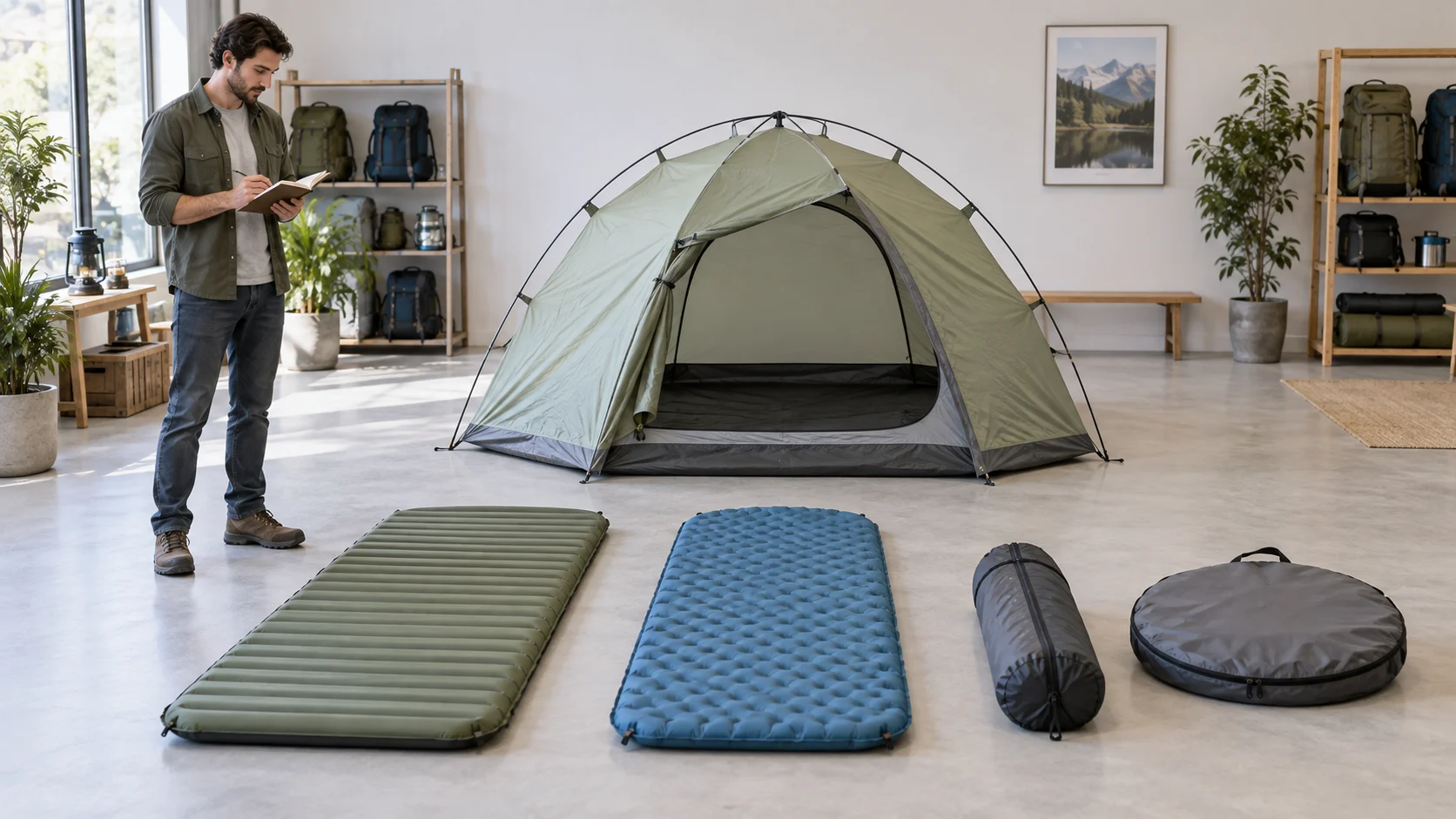
Conceptual scene for tent packed size versus sleeping space, with a complete generic tent, separate pads and two carry-bag shapes; no exact model or tested fit is depicted.