Furniture & Home Organization
Understanding sink caddy mounting styles: bases and faucet clamps
Understand freestanding caddy bases and faucet-clamped baskets, with separate questions for support eligibility, resting space and ordinary access.
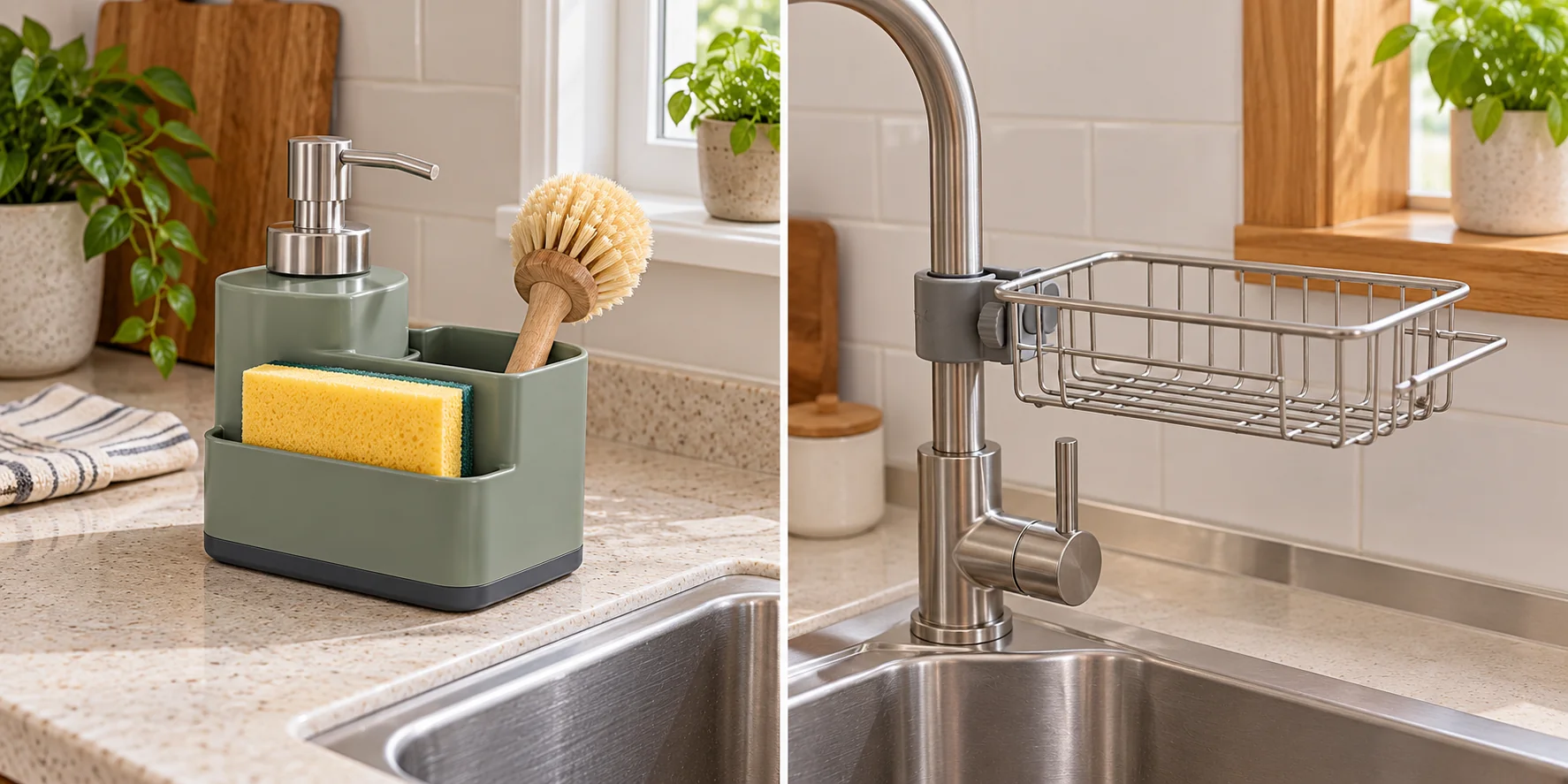
Sink caddy mounting styles describe what supports the organizer beside your basin. A freestanding unit rests on a surface. A faucet-mounted basket attaches to part of the faucet assembly. Both can put a sponge within reach, yet they ask different things of the space around the sink. Before comparing compartments or finishes, identify where the proposed unit would bear its weight and whether that location is available for the product's intended use.
Follow the support from the storage compartment to the place it touches your room. It gives a buyer a way to understand the two arrangements and recognize information still needed for a particular selection. It supplies no installation procedure, load rating or universal faucet-fit rule. Use the exact product's instructions to establish permitted mounting, loading and care. A picture can help identify an arrangement without proving it will work at your sink.
Read the support arrangement in the picture
The Unbranded sink caddy listing shows a combined pump dispenser and organizer resting on a base. Across its seven gallery images, the assembly has a front sponge area and a rear brush pocket; one image shows the tray removed. The native title uses Bathroom Accessories, while the gallery stages the unit in a kitchen. That context does not independently establish every intended location or supplied consumable. The photographed brush, sponge and scrubber need confirmation in the selected item's contents. Dimensions, material, cleaning and durability language remain seller representations, not measurements or tests performed for this guide.
The faucet organizer listing shows an open basket attached through a clamp around a faucet pipe, with a projecting rail. Its title includes “Soap Dispenser,” but the sole gallery image does not show a pump dispenser as part of that foreground basket. Background bottles and another staged storage area do not establish supplied contents. The listed pipe range and promotional material and corrosion claims need confirmation for the exact item; this guide does not authenticate them or certify a particular faucet as a suitable support.
What freestanding means
With a freestanding arrangement, start by locating the bottom of the whole assembly. Ask which portion must rest on the counter or other permitted surface. A compartment can project beyond that base, so the space occupied by the upper body may differ from the space touching the surface. Keep those two shapes separate when reading a dimension drawing. If the seller gives only an overall width, you still need enough information to understand the support underneath.
A freestanding label also leaves the surface question open. Your proposed spot may include a raised sink rim, a seam, a curved corner or a narrow strip behind the faucet. Note what is actually there. Compare it with the surface requirements in the product's instructions. Do not bridge a gap, balance a base on a lip or add an improvised support to make a photographed arrangement possible. If the location cannot meet the documented requirements, choose another permitted location or another design.
Consider what must happen around the stationary base. A hand may need to reach a dispenser head, lift a brush vertically or remove a sponge toward the front. Those movements occupy space beyond the resting footprint. You can describe the intended movements before purchasing: “I need to lift this item here” or “I need to reach the control from this side.” Then check the selected product's dimensions and access directions against your own sink area.
Moving a freestanding organizer for cleaning is another access question. Identify which part the instructions permit you to lift and whether contents or separate components need removal first. Leave room to carry out that process. A tidy front view can hide an awkward reach behind the faucet. Planning that reach does not establish that an unknown tray detaches or that any particular cleaning method is permitted.
What faucet-mounted means
In a faucet-mounted arrangement, the basket's visible resting position is only part of the picture. Find the connection between the basket and its clamp, then identify the exact faucet section that the product is intended to use. A nearby vertical shape in a photograph could be easy to recognize while the permitted mounting location remains undocumented. Resolve that location from instructions for the selected organizer and any applicable faucet guidance before treating it as an available support.
Separate the faucet's fixed and moving features in your own observation. Where are the handle, spout, hose or other controls during normal use? You do not need to loosen anything to notice that a proposed basket position overlaps a hand movement or an existing component. Record the overlap and obtain the relevant instructions. An organizer that appears to occupy otherwise unused air space can still obstruct something that moves through that space.
Diameter language answers only the question it actually specifies. A stated range does not, by itself, settle the permitted shape, mounting position, connection method or use limits for a real assembly. Check all requirements together. Do not tighten an unknown clamp experimentally, add padding or borrow a fastening method from a different product to close a documentation gap. If the organizer or faucet instructions leave the proposed arrangement unresolved, keep that location pending.
The basket also needs a usable position after the mounting question is settled. Think about the route from the stored object to your hand and then toward the washing area. A sponge may be easy to see while a taller object needs space above it. Describe the objects you intend to store without assuming that every object in a promotional scene is included, permitted or within a stated capacity.
Use two outlines for a placement check
For a preliminary layout, draw the proposed organizer's resting outline and a second outline for ordinary access around it. These are planning marks made from confirmed dimensions and your intended movements. They are not a mounting template or proof of strength. Label any dimension you still lack. Leaving a gap on the sketch is more useful than filling it with an estimate taken from the proportions of a photograph.
For the resting outline, include the entire selected assembly in its intended orientation. For access, mark where an item would leave its compartment and where a hand would approach a control. Check the sink from the side as well as from above. A plan view can show that a basket clears a handle horizontally while missing a height conflict. You can make these observations without attaching an organizer or placing a load on a proposed support.
Use the room in its ordinary condition. Include the objects that already belong there and the space someone needs to use the sink. If you clear everything away to make the outline fit, write down where those objects would go afterward. Otherwise, the sketch represents a temporary display arrangement. A useful planning result may be that the proposed position would displace something you still need beside the basin.
When several people share the sink, ask each person to describe the reach they expect to use. One may approach from the left, another from directly in front. Keep those observations specific to the household. They do not create a universal comfortable height or certify accessibility. If someone cannot comfortably use the proposed arrangement, retain that finding while comparing another permitted position.
A hypothetical comparison at one sink
Imagine a buyer, Nia, who wants a home for a sponge and a brush. This is a fictional planning example, not a test of either linked product. She sees an open counter patch beside the basin and a vertical faucet section in front of the backsplash. She draws both possible locations, then lists the evidence each would require. The counter position needs a suitable support area and working access. The faucet position needs documented mounting eligibility as well as working access.
Nia already knows the counter patch's shape because she can observe it. She has not yet confirmed the selected organizer's complete base dimensions or permitted surface. She records those questions beside that location. For the faucet position, she leaves the mounting location unresolved until she has matching instructions. The fact that she can draw a basket beside the faucet does not answer whether the assembly may support it.
Next, she traces how she would pick up the brush and put it back. Suppose one sketch brings her hand into the existing handle's operating area. She marks the conflict and considers another documented arrangement. She does not need to buy or install a unit to acknowledge the conflict on paper. Equally, a clear sketch gives her only a layout observation; she still needs the product-specific mounting and use information before proceeding.
Her comparison ends with separate findings for each location. One might have sufficient known space with a specification still pending. Another might have an obvious access conflict before its support eligibility is resolved. Keeping the findings separate lets her request the missing information without calling either product defective or declaring one support style universally better. She can also decide that neither proposed location suits her current sink arrangement.
Keep adjacent questions in their own guides
The dish rack water-on-counter guide follows a different decision: locating where rinse water first leaves its intended route and distinguishing tray, outlet, loading and placement questions. Choosing an organizer's support style does not diagnose a puddle or establish a drainage result. If water is the actual complaint, preserve that symptom as a separate investigation instead of treating a mounting-style change as a verified cure.
The conflicting soap dispenser listing guide uses a discrepancy sheet to identify the exact unit when page representations disagree. That identity task comes before relying on instructions for an uncertain variant. This article explains support arrangements after keeping those evidence limits visible; it does not resolve a title-image disagreement, supply a pump-repair procedure or establish that another dispenser's instructions apply.
Keep payment separate from placement
If a checkout on republeq.com presents USDT or another cryptocurrency as a payment option, review that actual checkout separately from the sink layout. A payment label cannot confirm the selected organizer's mounting location, included parts or suitability for your faucet. Before authorizing a transaction, read the current order details and the terms presented for the chosen method. This guide does not verify live payment availability, fees, exchange treatment, delivery timing, return rights or a particular transaction's protections. Keep any product question unresolved until the responsible seller provides the needed information. In Nia's hypothetical comparison, she could have a clear sketch and still be waiting for the exact organizer instructions. Reaching checkout would not close that gap. She would retain the selected-item description and the questions she still needs answered, then decide whether to wait or consider another documented option. That is a purchase decision she can make without treating the presence of a familiar currency name as evidence about physical fit. If she later proceeds, the displayed amount, selected method and order reference belong in her transaction record under the service's instructions. She should never provide wallet recovery phrases or private keys in a product enquiry. Any request to change or cancel an order needs the merchant's actual authorized process; an unanswered mounting question does not automatically pause fulfillment. This conditional example recommends no digital asset and promises no payment outcome. It keeps the choice of how to pay attached to the terms actually offered, while the choice of where an organizer can go remains attached to the exact product and sink. Leave the transaction pending if essential order or payment information is missing.
Bring the explanation back to your sink
Write down the support location you are considering and the access you need around it. For a freestanding unit, retain the selected assembly's base and overall dimensions alongside its permitted-surface instructions. For a faucet-mounted unit, retain the exact mounting requirements and the faucet information needed to evaluate them. Mark any observed conflict with normal sink use. Those notes give you a concrete basis for comparing a documented product with a real location.
Before use, match the delivered item and instructions to the selection you evaluated. If the parts, connection or dimensions differ, stop and resolve the difference through the seller's process. Follow the applicable assembly, loading and care directions once the arrangement is established. Keep your layout notes with those directions so a later change of sink accessories or stored items can be checked against the same support location and ordinary access needs.