Sewing & Crafts
Sharing unfinished color ideas without promising a gift
Sharing unfinished color ideas follows two fictional cousins as they clarify what a picture asks for, keep feedback specific and leave a making decision open.
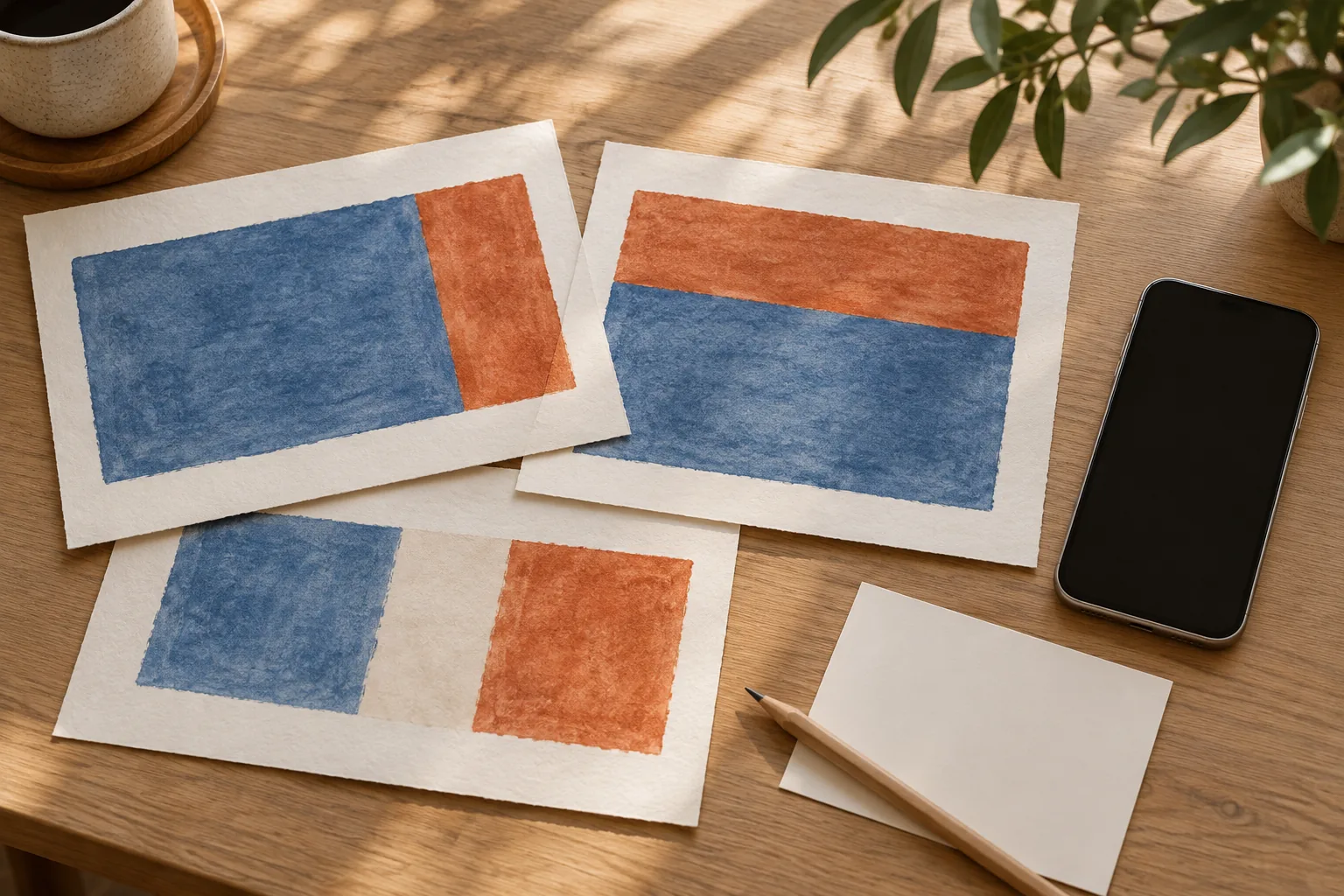
Sharing unfinished color ideas became awkward for Lio when his cousin replied, “That would be perfect for my birthday.” He had sent a drawing because he wanted to talk about two arrangements of color. He had not offered to make anything. Now the cheerful reply sat on his phone beside a thank-you for a gift he had never promised.
This is an original fictional conversation between two adults, Lio and his cousin Mina. The project consists of paper color concepts for a possible textile idea. No fabric is dyed, no garment is made and no result is reported for either retail product discussed later. The story concerns what the two people understand they are discussing, without a chemical recipe, application method or claim about a material's suitability.
A creative feedback request starts with a missing question
Lio's first message had been short: “Playing with these colors. What do you think?” He attached two original drawings of a long rectangle. One had a broad blue area beside a narrow rust-colored band. The other reversed their relative prominence. The drawings represented possible visual ideas, without a real scarf, selected fabric or dye formula behind them.
His creative feedback request did not actually say which question interested him. Mina knew he enjoyed making things and had mentioned her birthday during their previous conversation. She read the picture as a hint about a present. Lio had not intended that connection, but he could see why his open-ended message had left room for it.
He began typing that he might be able to do something. Then he stopped. He had no chosen material or making plan, and he did not want the project to become a birthday commitment. A vague possibility would make the misunderstanding more difficult to untangle later. Before answering Mina's preference about color, he needed to clarify the kind of conversation he was offering.
The clarification did not require deciding that Mina had been unreasonable. She had replied to what she thought she had received. Lio could explain what he meant without constructing an accusation about why she had expected a gift. The story gives both people an ordinary misunderstanding, with a chance to answer the actual question once it is stated.
An unfinished project promise is different from an idea
Lio wrote a second message: “I should have explained the pictures. I'm comparing two paper color ideas for myself, and I haven't decided whether to make anything. I wasn't offering a birthday present. If you feel like looking, which drawing makes the blue the part you notice first?”
That message separated an unfinished project promise from the invitation he actually wanted to make. It identified the pictures as paper ideas, left the making decision open and named one visual question. It also gave Mina room to decide whether she wanted to answer. Lio was asking for a response, rather than quietly appointing her as his project adviser.
Mina replied that she had misunderstood and was happy to look. She preferred the drawing with the wider blue area, adding that the narrow rust band made her notice the blue's edge. Her response was a preference about the invented drawings. It supplied no prediction of how dye would look on cloth or how another viewer would react.
Lio thanked her for that particular observation. He did not reply with another possible gift offer to soften the clarification. Their exchange could remain friendly without replacing one unchosen obligation with a smaller one. They had resolved the birthday assumption and begun the conversation he had originally hoped to have.
Keep the reply attached to the picture being discussed
The next day Lio made a third paper version with a pale gap between the two colors. He wanted to ask Mina whether the blue still interested her first. Instead of sending the new image alone, he wrote that it was a different version of yesterday's paper idea and repeated the question he wanted to discuss.
Mina said she liked the gap but now looked at the rust band first. That surprised Lio. He had intended the gap to give the blue more room, yet her response concerned another part of the page. He could ask what caught her eye without treating her answer as a failed attempt to agree with his intention.
She described the rust band as feeling more separate in this drawing. Lio kept that comment beside the third version. It did not overwrite her earlier response to the first two pictures. The paper had changed, and her preference had changed with it. Remembering only that Mina liked blue would lose the specific exchange he had asked for.
He decided to keep working from the earlier wide-blue drawing. Mina's preference did not have to become an instruction he must follow. He could value her observation and choose a different direction. Their conversation concerned his creative decision, with her response available as one person's reading of the page.
Asking for more feedback can be a separate invitation
Lio then wanted to discuss four further variations. Mina had time for one more picture, but not an evening of messages. She said so. He chose the version that interested him most and left the others for another occasion. The first invitation had not created an indefinite agreement to review every later drawing.
For that last picture, he asked whether the pale gap seemed like part of the arrangement or simply an empty space between two separate blocks. Mina answered that it felt like a deliberate pause to her. Lio enjoyed that reading. The phrase belonged to her response to this invented image, without becoming a universal description of pale gaps in design.
He could have asked for a quick favorite among all five versions instead. That would have been another task, requiring its own invitation. Choosing one question kept this exchange within the time Mina had offered. Lio did not have to make her refusal of a longer session sound like a lack of interest in him.
When Mina said she needed to leave the conversation, Lio let it end. He saved the selected drawing and the comments he wanted to revisit. The remaining questions could stay with him. A helpful response from another person did not make that person responsible for reaching his final creative answer.
Let a future gift remain a future conversation
A week later, Mina mentioned that she still liked the original blue-and-rust idea. Lio was tempted to treat that as renewed pressure about her birthday. Instead, he asked whether she was simply remembering the picture. She said she was. They could enjoy the earlier exchange without reopening a making promise neither had agreed on.
If Lio ever wanted to offer a gift, he could do so explicitly in a later conversation. That offer would need its own description and an actual answer from Mina. The earlier feedback would not establish that she wanted a particular finished object, a particular material or a present made under an untested plan.
Likewise, Mina could ask whether he would consider making something for her. Asking would leave him a choice. In this fictional story she does not make that request, and Lio makes no offer. The relationship does not need a completed object to justify the pleasure they found in discussing color.
He eventually put the paper project aside for a while. He told Mina because she had asked what he was working on, rather than sending an announcement that needed reassurance. She said she might like to see another idea if he returned to it. That was a possible future invitation, without a date or obligation attached.
Actual dye accounts do not turn drawings into results
The Unbranded Sandstone DyeMore offer is recorded as Beige and describes an eight-ounce container in a pack of three, with a King Combo QR code. Its gallery contains several color variants with seven-fluid-ounce bottle labels. Keep those differing statements with this actual offer. The page supplies no confirmed volume calculation or fabric result for Lio's paper colors.
The Rit Petal Pink twelve-pack offer names eight-ounce liquid dye in its title. Its gallery includes a Petal Pink bottle group among photographs of other All-Purpose and DyeMore color variants. Those alternatives do not all become the selected package. The short product description supplies no procedure for turning Lio's blue-and-rust drawings into a finished textile.
Neither selected account establishes a match to the fictional colors, a material choice or a completed project. The photographs are not Lio's trials. This story adopts no compatibility, safety, mixing, colorfastness or application claim from the offers. A making decision would need the actual product, material and complete applicable instructions, separately from the conversation about the paper drawings.
Keep neighboring creative decisions distinct
The wordless comic drawing session guide asks what a reader sees in an invented sequence and compares possible revisions. Here, the initial question is whether someone has been asked for feedback or offered a gift. Mina's response to a color drawing supplies no report about a comic page or its story.
The Crayola Air-Dry Clay gift guide redesigns an intended new gift around its role and the recipient's preference. Lio has offered no gift and selected no making material. Clarifying that absence comes before any discussion of changing an object to suit Mina. Its clay information supplies no dye method here.
Leave a clear question when the idea is unfinished
Lio kept a sentence he could use when he next wanted to share a drawing: “This is a paper idea, and I'm asking about this one visual choice.” He would still need to name the choice and ask whether the other person wanted to look. The sentence was a reminder of what had been missing, rather than a script guaranteed to prevent every misunderstanding.
He also kept the two questions separate in his own mind. Did he want to continue the project? Did he want someone else's response to a particular picture? He could answer yes to the second while leaving the first open. Enjoying a short conversation did not require committing to a finished object.
Mina's birthday came without a handmade textile from Lio. They met for lunch, and neither needed to explain an absent promised present. The conversation about blue and rust remained something they had enjoyed together. The story reports that fictional understanding, without turning it into advice about what every cousin should expect from a creative relative.
Sharing unfinished color ideas had become easier once Lio named what he was offering: a specific picture, a specific question and a choice about whether to respond. He could leave the project unfinished and still appreciate Mina's attention. She could enjoy the idea without becoming its recipient, adviser for every revision or owner of its eventual outcome.