Home Decor & Table Settings
A shared sideboard display that keeps both people in the room
Two fictional housemates make a shared display decision, try a mutually agreed alternative and keep each person’s objects and choices visible.
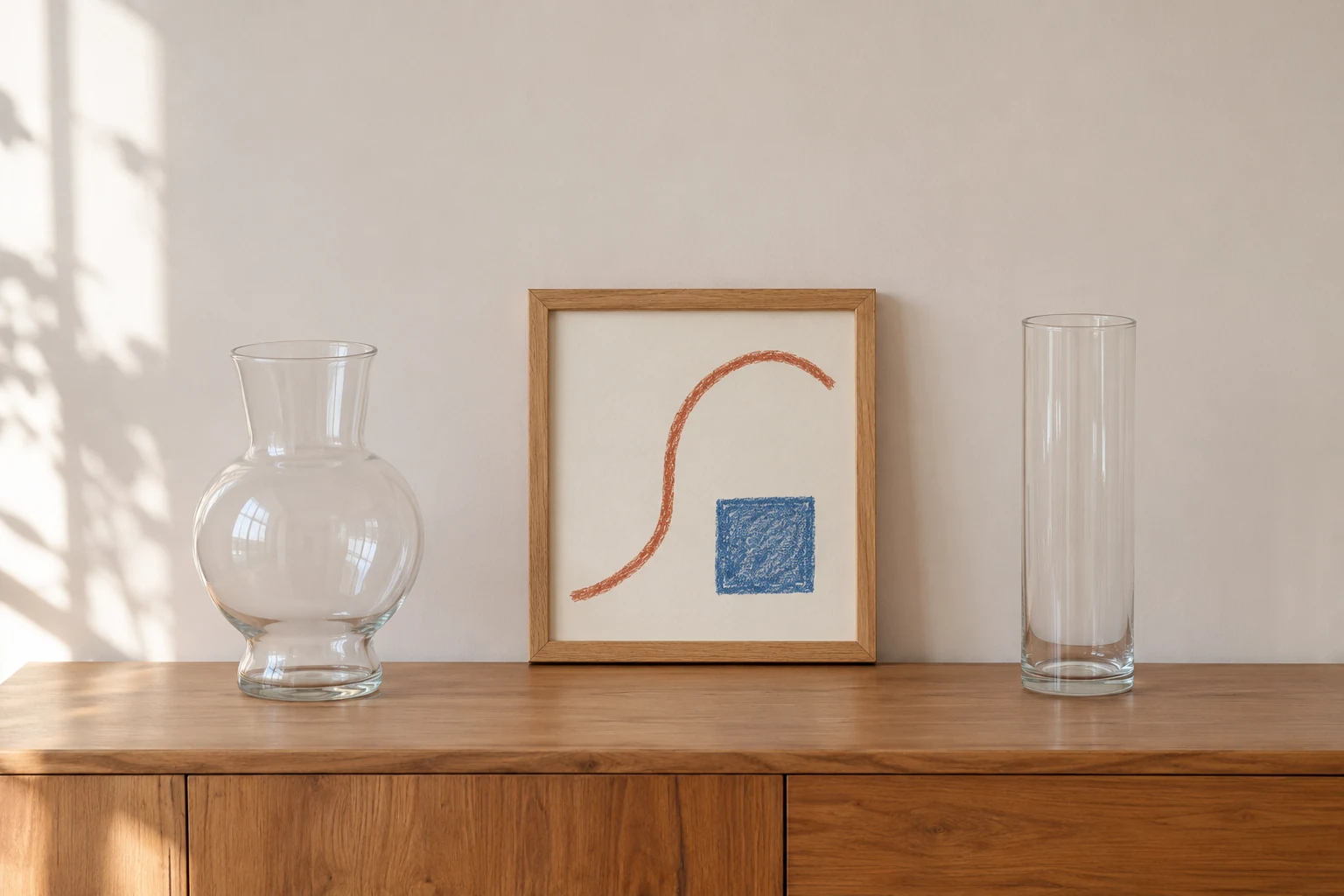
A shared sideboard display belongs to the people sharing the room. Before replacing a housemate’s object with something you prefer, talk about the change you want. The fictional story below follows Eli and Noor as they make room for empty clear vases while keeping Eli’s small framed drawing visible. Their choice concerns both people’s say in the room, rather than a rule about the right number of decorative objects.
Begin with the object already there
Eli’s drawing stands in a simple wooden frame on the sideboard. He made it one afternoon: a rust-coloured curved line above a small blue square. It is an invented drawing in an invented household, with no borrowed artist’s work or family provenance. Noor knows that Eli likes seeing it when he comes into the living room. She has never wanted to hang it elsewhere on his behalf.
Noor has two generic empty clear vases she would like to display. One has a rounded middle; the other has straight cylindrical sides. They are fictional belongings, not reported deliveries from either retail offer mentioned later. She imagines them on the sideboard because she likes their different outlines. Then she notices that her imagined version has quietly removed Eli’s frame from the surface altogether.
She could place the drawing somewhere else and ask afterward. Instead, she leaves it where it is and waits until Eli is in the room. “Could we try these here?” she asks, showing him both vases. She describes the actual proposed change, rather than asking whether he likes vases in general. Eli can respond to the place and the objects that would be affected.
Say what each person wants to keep
Eli says he wants the drawing to remain on the sideboard. He does not mind sharing the surface, but he does not want the frame tucked behind something that makes the blue square disappear. Noor explains that she wants both vase outlines to be visible. Neither request supplies a finished composition. Together, they establish what a possible arrangement would need to respect.
They avoid making one person defend the entire meaning of an object. Eli need not turn his drawing into an heirloom to justify keeping it visible. Noor need not claim that the vases will transform the room. Their personal objects can matter because each person wants them there. The conversation stays with this sideboard and these proposed changes, without ranking whose taste deserves more space.
Noor asks whether Eli would consider moving the frame slightly from its present position. He says yes, provided they choose the new place together. That answer concerns a small move on the same surface. It does not give her permission to remove the drawing later or put it in another room. They keep the extent of the answer attached to the change they are actually discussing.
Look at a complete first version
Their first imagined arrangement puts the rounded vase in the middle and the frame behind it. The cylinder stands to the right. From the doorway, Eli sees the vase’s rounded body across part of the rust line. Noor likes the rounded form at the centre, but she can also see that the drawing has become a background fragment. That version has not met Eli’s stated request.
They do not settle the disagreement by describing the drawing as clutter. Nor does Eli say that Noor’s idea has failed because the first position is unsuitable. He points to the particular conflict: “I want to see the whole drawing, including that lower corner.” Noor answers the observation. They have a specific version to change, rather than an argument about which one of them understands decorating.
In their next version, the rounded vase stands on the left. The frame sits in the middle, a little farther back, and the cylinder stands on the right. Neither vase crosses the drawing from their chosen ordinary view. The rust line and blue square remain visible. Noor can see the curved and straight vessel shapes separately. This is the complete alternative they decide to consider.
Let agreement include a real alternative
Eli proposes keeping only the rounded vase beside the drawing. That would also leave his work visible. Noor considers the whole suggestion before replying. She prefers the version with the cylinder because she wants the contrast between the two forms. She is not asking Eli to approve an object whose role she cannot explain; she is telling him which version she would choose and why.
They compare the two proposals without presenting either as a universal design principle. One has the rounded vase and frame. The other has rounded vase, frame and cylinder. Eli finds that he is comfortable with the second when the drawing stays unobscured. Noor agrees that she would not keep the cylinder in a position that hides the blue square. Their agreed arrangement now has actual content.
The scene gives them room to say no to a version. If Eli had still wanted the surface left as it was, Noor’s enthusiasm would not itself have resolved that difference. This story follows a case where both find a version they want to try. It does not promise that every shared household decision ends with every proposed object included.
Keep the trial attached to what was discussed
They decide to leave this version for the afternoon and talk again after dinner. That is an agreement within the fiction, not a recommended trial duration for every household. Eli will live with the frame in its new position; Noor will see whether she still wants both empty vessels there. Neither person treats a temporary arrangement as a permanent surrender of the other’s preferences.
Later, Noor notices a small bowl elsewhere in the room and imagines it between the cylinder and the frame. She does not add it immediately. Their earlier conversation concerned two vases and the drawing, not every object she might later want on the sideboard. She leaves the bowl where it is and remembers the idea for their next conversation. A new idea can remain a proposal.
Eli comes home before dinner and looks at the display from the doorway. The frame is where they chose to put it. He can still see both marks in the drawing. He notices the space between the frame and the straight-sided vase, but he does not fill it with another of his belongings. Noor’s choice remains part of the arrangement even when she is not standing beside it.
Talk again about the version that exists
After dinner, Noor asks whether Eli still wants to keep the arrangement. She does not ask a broader question about whether he has learned to appreciate her taste. Eli says the display works for him with the drawing visible. Noor says she would like to keep it too. They choose the version they actually tried, rather than quietly substituting a different one while discussing it.
She mentions the bowl. Eli thinks it would crowd the lower edge of the frame from where he usually sees it. Noor is not certain she wants it enough to change their present version. They leave the bowl out for now. Their agreement can remain modest: this arrangement stays, the possible addition has not been accepted, and either person can raise another change when they want to discuss it.
No household trial, real conversation or retail performance test is reported here. Eli and Noor are fictional people making a fictional shared-room choice. The useful invitation is to make your actual proposal visible and listen to the other person’s actual response. You can borrow that question without pretending that your belongings, room or relationship should produce the same arrangement.
There is another place Noor might have suggested for the drawing: a narrow shelf near Eli’s desk. Eli likes working there, but he does not want this drawing confined to his own corner. He wants it in the room they share. Noor hears that distinction and drops the shelf proposal. A surface that is technically available is not automatically an equivalent place for the person whose object would move.
Eli also asks whether Noor would rather keep the rounded vase on its own in her room. She says she brought the two vessels into the conversation because she wanted them in their shared living space. He accepts that answer without turning the separate room into the obvious solution. Their chosen version gives both people an ordinary place in the room, with the frame’s two marks and both vessel outlines still visible.
Keep the retail accounts beside the story
The Uxcell bubble-vase offer describes two clear vases. Six gallery frames show a complete vessel with a rounded middle and open upper chamber. The catalog attribution remains a listing statement, without a personally authenticated factory model.
The Unbranded cylinder-vase offer describes twelve clear pieces. Seven gallery frames include straight-sided vessels. Its opening dimensions are inconsistent across description and graphics; no fit or performance result is adopted here.
Neither offer supplies the fictional housemates’ belongings. The flowers, books and other styling objects pictured with retail vases are not established as included stock. A display story does not establish water holding, stability, glass quality or a care procedure. Follow the applicable directions for actual objects and resolve relevant product questions before deciding on a purchase.
The pair-or-blue-accent guide compares a repeated vase pair with one focal object. The empty-vase story follows one person’s ordinary-day preference. This story concerns two people retaining a say over their shared surface.
Leave both people in the finished scene
The sideboard ends the evening with the rounded vase left, Eli’s frame in the middle and the cylinder right. The drawing has not become the price of Noor’s new display. Her vases have not been pushed aside merely because Eli’s frame was there first. In this invented case, both people can point to something they wanted and recognise the version they chose together.
You may reach a different result at home: keep the existing display, select another surface or leave a proposed addition undecided. Begin with the people whose objects and choices are affected. Describe the actual change, give an alternative a fair look and keep later additions open for another conversation. The finished display can belong to both people without becoming a verdict about either person’s taste.
If you consider a republeq vase order using crypto or USDT, check the methods actually offered for the exact selected basket before authorizing payment. Keep the item identity, quantity and unanswered questions attached to that order. This story supplies no payment destination or network instruction and promises no delivery or refund outcome. Resolve an uncertain payment or order status before contemplating another transfer. A purchase confirmation would not document the fictional conversation or settle a housemate’s preference about the sideboard.
Conceptual shared sideboard scene; no exact retail set, actual housemates, completed household trial or vase performance is documented.