Writing & Documents
A self-answered question in Nella's original room monologue
A local prose exercise keeps Nella's question and her own spoken answer together, then compares a complete statement of the same thought.
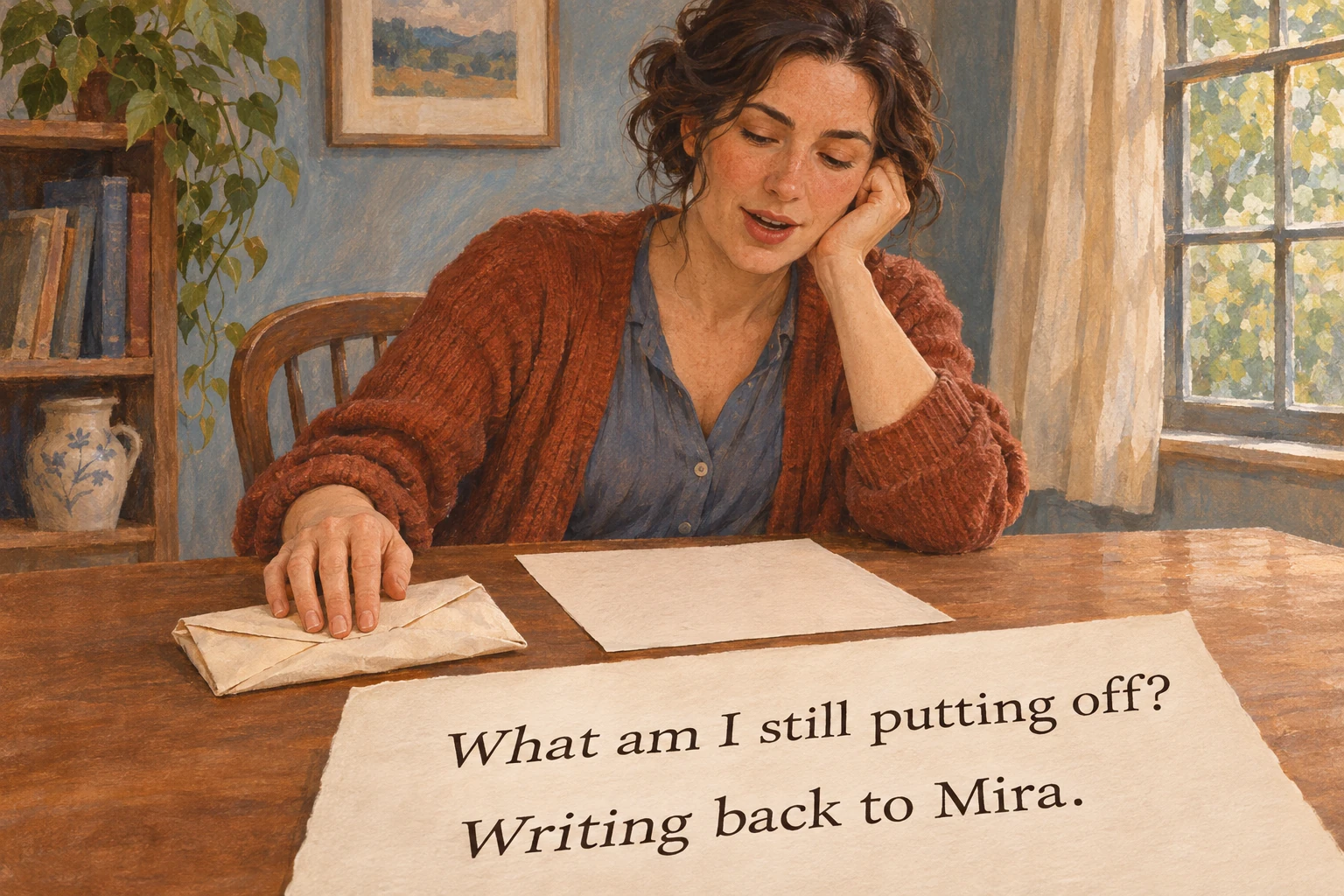
A self-answered question gives Nella two consecutive things to say in this original room monologue. She asks what she has been putting off, then supplies her own answer. This local writing exercise keeps the same voice for both parts and compares a complete statement of the same authored thought. The written answer is already on the page.
Give Nella a small situation she can speak about
Nella is alone in an invented room. An incoming letter from Mira lies on her table beside a blank sheet. Nella has read it and has yet to write back. Nella knows which letter she has left unanswered. The monologue will name that task.
The voice is spoken aloud. Nella can be heard only within the fiction, where the author supplies every word. Nella directs the words into the empty room. I want a short stretch of her own speech between two ordinary actions, beginning while she stands beside the table and ending before she starts a reply.
Her incoming letter has a soft fold through its middle. She has laid it open, with one edge resting over the blank sheet. When she moves the letter aside, the sheet becomes fully visible. Those positions are chosen details of this room. Neither paper is an identified retail item, and the monologue calls for no particular writing tool or purchase.
Let the same voice ask and answer
Nella drew the letter away from the blank sheet. She left her hand on its folded edge and looked toward the window. “What am I still putting off?” she said aloud. “Writing back to Mira.” She turned to the table again and laid the letter beside the sheet. The corner she had been holding rose slightly, and she pressed it down with the side of her hand.
Both quoted sentences belong to Nella in that paragraph. Her name and the surrounding action place her in the room, and the passage gives her the question and the answer. The second sentence introduces no new speaker. I have written the answer immediately after the question because I want those two parts to occupy this particular point in her short monologue.
Read the question as it actually appears. It begins with What and includes still putting off. The answer names writing back to Mira as the activity Nella has in mind. That connection is supplied by the printed words and the situation declared above. The exercise has already established that her letter remains unanswered, so the answer adds her own spoken naming of that task.
Keep the written answer with its own question
I retain the answer as the short phrase Writing back to Mira. Its subject comes from the question directly before it. A fuller answer could be written, but the selected paragraph already places the phrase beside the question it answers. There is no removed earlier line to restore. I am choosing the shape of a complete passage that contains both parts.
The word still appears in the question. It keeps Nella's current delay audible in the wording I have chosen. The answer does not repeat that word. It supplies the activity, while the question has already given the context in which she names it. If I were to add a new reason for the delay, that reason would need its own written sentence.
Mira's name occurs in the answer. The question alone leaves the activity unnamed, while the next quoted sentence makes it specific. I prefer keeping the name there in this version. The letter on the table provides the scene's declared background, but it does not speak the answer for Nella. Her actual quoted words supply that part of the monologue.
In the paired copy, the question mark follows off and the answer ends after Mira. The words she said aloud identify Nella between those quoted sentences. I keep that attribution with the question while letting her answer follow immediately. These are the exact punctuation and placement choices visible in this passage, with one speaker already present in the room.
Write a complete statement beside the paired form
The full alternative reads: Nella drew the letter away from the blank sheet. She left her hand on its folded edge and looked toward the window. “I am still putting off writing back to Mira,” she said aloud. She turned to the table again and laid the letter beside the sheet. The corner she had been holding rose slightly, and she pressed it down with the side of her hand.
This alternative keeps her spoken thought in one statement. It names the activity within that sentence, so the question-and-answer pair is absent from this copy. Nella remains alone and still says the words aloud. The letter has the same place beside the sheet afterward. The change I want to inspect is visible in the speech, with the surrounding actions held steady.
The word I now starts the quoted statement. In the paired form, What starts the question and Writing starts the answer. I can place the two passages next to each other and point to those actual openings.
Choose the paired form for this particular page
For my selected version, I keep Nella's question followed by her own answer. I want the activity to be named after she has spoken the question. The complete-statement alternative remains a possible version of the same small thought. I save it separately so its wording can be read in full, with the speech and surrounding gestures that belong to it.
Nella speaks the two quoted sentences as she looks toward the window. Her hand remains on the letter's fold until she turns back to the table. I keep that small gesture across the paired words. The same speaker carries the monologue while the action gives it a place inside the room.
The physical ending stays modest. Nella puts the incoming letter beside the blank sheet and flattens its corner. She has named her delayed reply, but she has not yet written it. An alternative ending in which she completes the letter would add another action and a later point in the scene. This selected paragraph can finish before that work begins.
Read the selected paragraph between an opening and a continuation
The room had become quiet after Nella carried her cup to the kitchen. She returned without it and stopped beside the table. The blank sheet was partly covered by Mira's letter. She had been moving other things around it all afternoon, leaving those two papers in place whenever she found something else to do.
Nella drew the letter away from the blank sheet. She left her hand on its folded edge and looked toward the window. “What am I still putting off?” she said aloud. “Writing back to Mira.” She turned to the table again and laid the letter beside the sheet. The corner she had been holding rose slightly, and she pressed it down with the side of her hand.
She pulled out the chair and sat. The sheet lay directly in front of her now, with Mira's letter to its left. Nella read the first line again. Outside, a door closed somewhere along the street. She stayed at the table and moved the incoming letter a little farther from the blank paper, leaving a clear space between their edges.
The opening gives her a return to the room and the papers already waiting there. The middle paragraph contains the spoken question and answer. The continuation puts her in the chair with the reply still unwritten. These are consecutive actions in the selected copy. The short monologue occupies one place among them, with both its question and answer available to read.
Read the actual ink-pad accounts within their evidence
The SP912K stamp-pad account names Rubber Stamp Creation. Its sole image shows an open red case and a dark pad surface. Native black-ink, chemistry, compatibility, largest-pad and dimension claims remain unverified here. No impression was tested, and no separate stamp is established as supplied.
The Handy Stamps ink-pad account has native brand Unbranded and description “1.” Its image shows one black pad beside a staged hand and dated egg. Those props supply no egg, stamp or food-use permission. Food-grade wording, maker identity, ink chemistry and dimensions remain unverified.
Keep neighboring speech revisions with their own tasks
The deleted-question repair removes another character’s question and rewrites a stranded reply as a complete volunteered statement. Nella’s question and answer are both deliberately present, and both belong to her own voiced monologue.
The direct and reported dialogue comparison preserves a two-person request and completed handover across quoted and narrated versions. Both Nella passages here remain spoken first-person realizations. Their choice concerns the paired question and answer or the complete statement.
Keep a possible order with its own transaction
A separate purchase on republeq.com begins with the actual offer and the order being considered. If a checkout presents cryptocurrency as an available payment choice, read that transaction's current information before choosing USDT or another displayed asset. The fictional manuscript above supplies no payment instructions and establishes no transaction. An expression of interest in a product can remain open while its actual details are being checked. Keep the selected offer reference and any questions with the order information so that a later answer can be understood in context. If someone else is helping with the purchase, tell them which decisions have actually been made before they act on your behalf. A remembered preference for one payment method cannot confirm that it appears in the checkout you are using. Read any presented conditions carefully and obtain clarification through the responsible service when an essential detail is unclear. This article provides no receiving address, transfer network, wallet procedure or promise about processing time. It attaches no discount, faster delivery or special refund arrangement to the mention of USDT. Preserve the actual records of any action you do take, including the order reference and the communications relevant to it. An acknowledgement needs to be read for what it actually confirms. A payment record, an order acceptance and a delivered item concern separate events. If the status of a transaction is uncertain, retain that uncertainty while seeking an account of the event before considering another payment. You can leave the purchase undecided while a necessary answer remains outstanding. A current checkout and its actual terms govern any eventual transaction, while Nella and her spoken room monologue remain part of an invented story.
Save the version with both parts intact
Keep the selected opening, paired paragraph and continuation together. In that copy, Nella returns from the kitchen, speaks her question, supplies the answer and sits before the blank page. Mira remains the absent letter writer. The incoming letter stays beside the sheet. The complete-statement version can remain a separately named alternative, preserving its different spoken sentence.
At the end of the chosen passage, Nella has a place to begin her reply. She has not written a greeting or promised when the letter will be finished. Her voiced question and answer have already happened. The page can stop with her seated at the table, the two sheets apart and the next words still hers to write.