Writing & Documents
Reply after a deleted question: a local scene repair
A complete original editing exercise repairs the reply left after an author removes its question, keeping the character’s plan and ordinary scene intact.
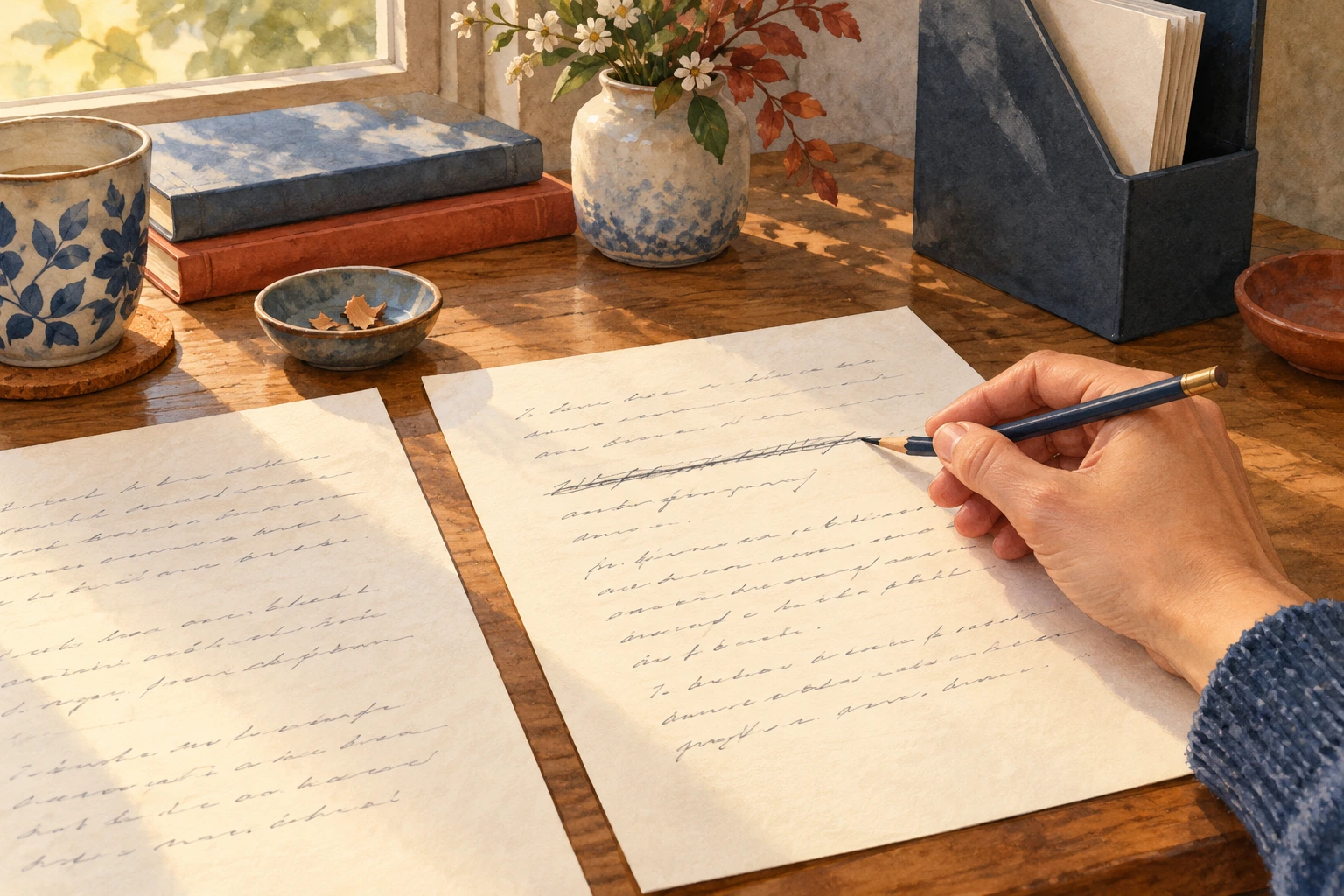
A reply after a deleted question can need a fresh sentence of its own. In this original editing exercise, an author removes “Are you staying until noon?” but leaves “Only until noon” in the next paragraph. The selected revision keeps the question out and makes the remaining line a volunteered statement. Mina, Ellis, the room and all their words are invented. This is a comparison of particular authored passages, without a rule that every short reply needs an explicit question or that every conversation must state its background.
Declare what the scene is meant to retain
Mina is visiting the room where Ellis is sorting drawings. She has already arranged her morning so that she will leave at noon. The author wants that existing plan to enter their conversation. Ellis does not ask her to stay longer, and Mina makes no new promise about another visit. Both characters remain in the room throughout the short exchange. A generic upright holder contains loose pages beside the window; it is not identified as either actual retail example discussed later.
The original draft gives Ellis a direct question about the duration of the visit. Mina answers it while moving a folded cloth away from the edge of the table. Later, the author decides to remove the question because they prefer Mina to bring up her own departure time. That is the chosen revision. The task is to finish it in the actual prose, rather than leave a working note saying that Mina now volunteers the information.
Keep the physical actions modest and fixed during this comparison. Ellis puts a drawing beside a folder. Mina moves the cloth, looks at the drawing and names a detail she remembers. Neither character leaves, gives away the drawing or begins a different task. Those actions let the revised line sit inside a complete exchange without turning the exercise into a question about a missing journey, a changed owner or who is holding an object.
Read the complete exchange before the deletion
Ellis put the drawing beside the folder instead of inside it. Mina stood at the other end of the table, with the folded cloth beneath one hand. “Are you staying until noon?” he asked. “Only until noon,” she said, moving the cloth away from the edge. He turned the drawing toward her. A narrow path ran behind the house in the picture. She leaned forward and said that she remembered the gate being wider.
Ellis looked from her to the drawn gate. He had made it from memory and had left the small latch out altogether. Mina said that she had never liked that latch, which was why she remembered it. He asked whether the path was in the right place. She followed it with her eyes to the edge of the page, then said she thought it was. He left the drawing beside the folder while they looked at it together.
In this complete version, the question supplies the subject of Mina’s short answer. “Only until noon” responds to Ellis asking how long she is staying. The surrounding actions do not have to supply that subject separately. This is something visible in these actual sentences. It does not establish a universal requirement that speakers repeat every part of a question in their replies.
Inspect the edited paragraph as it now stands
After deleting the question, the first paragraph reads: Ellis put the drawing beside the folder instead of inside it. Mina stood at the other end of the table, with the folded cloth beneath one hand. “Only until noon,” she said, moving the cloth away from the edge. He turned the drawing toward her. A narrow path ran behind the house in the picture. She leaned forward and said that she remembered the gate being wider.
The words are still available to read, but their former prompt is gone. Neither the folder nor the cloth states what lasts until noon. In another story, earlier context could make Mina’s meaning plain. This selected passage has no earlier discussion to borrow. The author wants her to introduce her departure time here, and the remaining line has not yet been rewritten to make that introduction explicit.
Do not restore an unwritten question in the commentary and call the scene finished. A note explaining that Ellis must have asked something would add a speaking event the edited paragraph no longer contains. The author has deliberately removed that event. Keep the current words visible while deciding whether to reverse the deletion or complete the chosen move toward a volunteered statement.
Write the restoration as a real alternative
The first repair is to restore the actual question: “Are you staying until noon?” he asked. “Only until noon,” she said, moving the cloth away from the edge. Put those sentences back between Mina standing at the table and Ellis turning the drawing. The resulting paragraph is the original exchange again. It gives the short reply its explicit prompt without changing what either character does with the drawing.
That restoration is available if the author changes their mind about who should introduce the subject. It does not need to be dismissed as bad dialogue merely because it is not the chosen version. Ellis can ask an ordinary question in a perfectly possible scene. For this draft, however, the author still wants Mina to volunteer the information, so restoring the question would undo the decision that began the revision.
Save this alternative in full. A note saying “put the question back” leaves the wording and placement undecided. The written pair above gives you something exact to compare with the selected replacement below. It also prevents the original question from quietly surviving in your account of the revised scene after you have decided to keep it out of the manuscript.
Give the remaining line its own stated subject
The selected replacement is: “I’m staying until noon,” she said, moving the cloth away from the edge. Mina now names the action whose limit she gives. She does not require Ellis to ask about it first. The line states the existing plan declared for this exercise; it does not introduce an agreement to remain for his benefit, an invitation or a promise about a later occasion.
This replacement also removes “only.” The earlier answer used that word while responding to the time Ellis named. The author could retain it in a fuller line, such as “I’m only staying until noon,” if that emphasis belonged to Mina’s voice here. For the selected version, keep the plainer sentence. Her next action is to look at the drawing, without an added explanation of why noon matters to her.
A different line, “I can stay until noon if you need me,” would change the exchange. It offers something in response to a possible need, rather than simply introducing her existing plan. That could belong in another authored scene. It is not a fuller way to say exactly the same thing in this one. Keep the selected statement attached to the intention you actually declared before comparing the drafts.
Keep the action around the replacement
Mina still moves the folded cloth away from the table edge. The movement does not become a substitute for naming the subject of her line. It remains an ordinary action accompanying the statement. Ellis still turns the drawing toward her afterward. The revision needs no additional nod of permission, no thank-you and no remark implying that he has requested her company until noon.
Likewise, keep her comment about the gate. It follows Ellis presenting the drawing, not a question about her departure. The scene can move from her volunteered plan into the picture they are looking at. Those are consecutive parts of this conversation. They do not need to be joined by a sentence claiming that the plan improved the visit or caused Ellis to remember something differently.
The second paragraph can remain unchanged. It concerns the latch, the path and the drawing’s place beside the folder. Nothing in it depends on Ellis having asked the removed question. That is a local finding from reading these exact paragraphs, rather than a guarantee that deleting an opening line never affects later prose. Another continuation would need to be inspected on its own terms.
Read the complete selected scene
Ellis put the drawing beside the folder instead of inside it. Mina stood at the other end of the table, with the folded cloth beneath one hand. “I’m staying until noon,” she said, moving the cloth away from the edge. He turned the drawing toward her. A narrow path ran behind the house in the picture. She leaned forward and said that she remembered the gate being wider.
Ellis looked from her to the drawn gate. He had made it from memory and had left the small latch out altogether. Mina said that she had never liked that latch, which was why she remembered it. He asked whether the path was in the right place. She followed it with her eyes to the edge of the page, then said she thought it was. He left the drawing beside the folder while they looked at it together.
The selected scene contains an actual new wording for the retained line, with the removed question absent. Its ordinary actions and second exchange remain available to read without the working notes. It ends while the two characters are looking at the drawing. Noon has not arrived and Mina has not departed. She has named her plan and returned to the drawing.
Actual magazine holders outside the exercise
The Unbranded 12068712 magazine-holder account identifies a black multi-compartment form. Its sole image shows one complete black mesh holder with integral partitions, shelves and a flat base. No printed model label or separate supplied goods are visible. The photograph does not authenticate material, scratch protection, dimensions or capacity. Its contents and the drawings in this exercise are not identified retail supplies.
The Unbranded ZF-004 magazine-rack account describes a brown five-tier folding rack. Its sole image shows one complete crossed-side rack with sloping tiers and staged magazines beside bedroom furniture. Those magazines, lamp, bedding and furniture are contextual objects. No printed model authentication, folding operation, height adjustment, load, material or stability result is established here. The account’s tabs and pads remain described integral parts.
Keep the neighboring prose decisions separate
The wallpaper story scene compares what different narrators notice and know within invented room passages. This exercise keeps one scene and viewpoint while repairing a retained reply after its question is cut. It does not add a room history or choose a new observer.
The written sign words mistaken for dialogue exercise removes an erroneous spoken event from an inscription. Mina’s line is genuinely spoken in every version here. The selected change makes its subject explicit without turning written words into speech or changing who says them.
Keep any purchase separate from the manuscript
If you plan to purchase an item on republeq.com, check the particular offer and current checkout before ordering. This guide does not establish that any cryptocurrency payment option is available. If USDT is offered for the intended order, verify the requested asset, network, amount, receiving destination and order reference with the responsible service before authorizing a transfer. Review the actual product identity, selected variant, quantity, delivery details, total charge and applicable terms. Use the confirmed order details when checking the payment instructions. Confirm any fee, conversion term or exchange rate from the current transaction information. Determine the applicable cancellation, return and refund process, including how a refund would be handled for the selected payment method. Keep the relevant instructions and transaction records, with dates and confirmed references. If essential instructions change, ask the responsible service to confirm the change against the exact order. An acknowledgement should identify the order and the agreed details; it does not replace checking whether the selected product is the one you intended to buy. If payment or order status remains uncertain, reconcile that status before considering another transfer. Do not treat an unresolved transaction as evidence that nothing happened. This article supplies no wallet address, transfer guarantee, recovery procedure or assessment of a counterparty. A product enquiry does not authorize a payment or resolve an uncertain order. If support provides an answer, retain the exact question and response so a later reviewer can understand what was confirmed. Decide whether to proceed only when the conditions of the particular transaction are clear, and retain the confirmed transaction information with the exact order.