Seed-Starting Equipment
seedling heat mat layout: footprint, control, and setup
Measure tray bases and bench space, then distinguish mat size, power rating, and controller contents before a seed-starting setup.
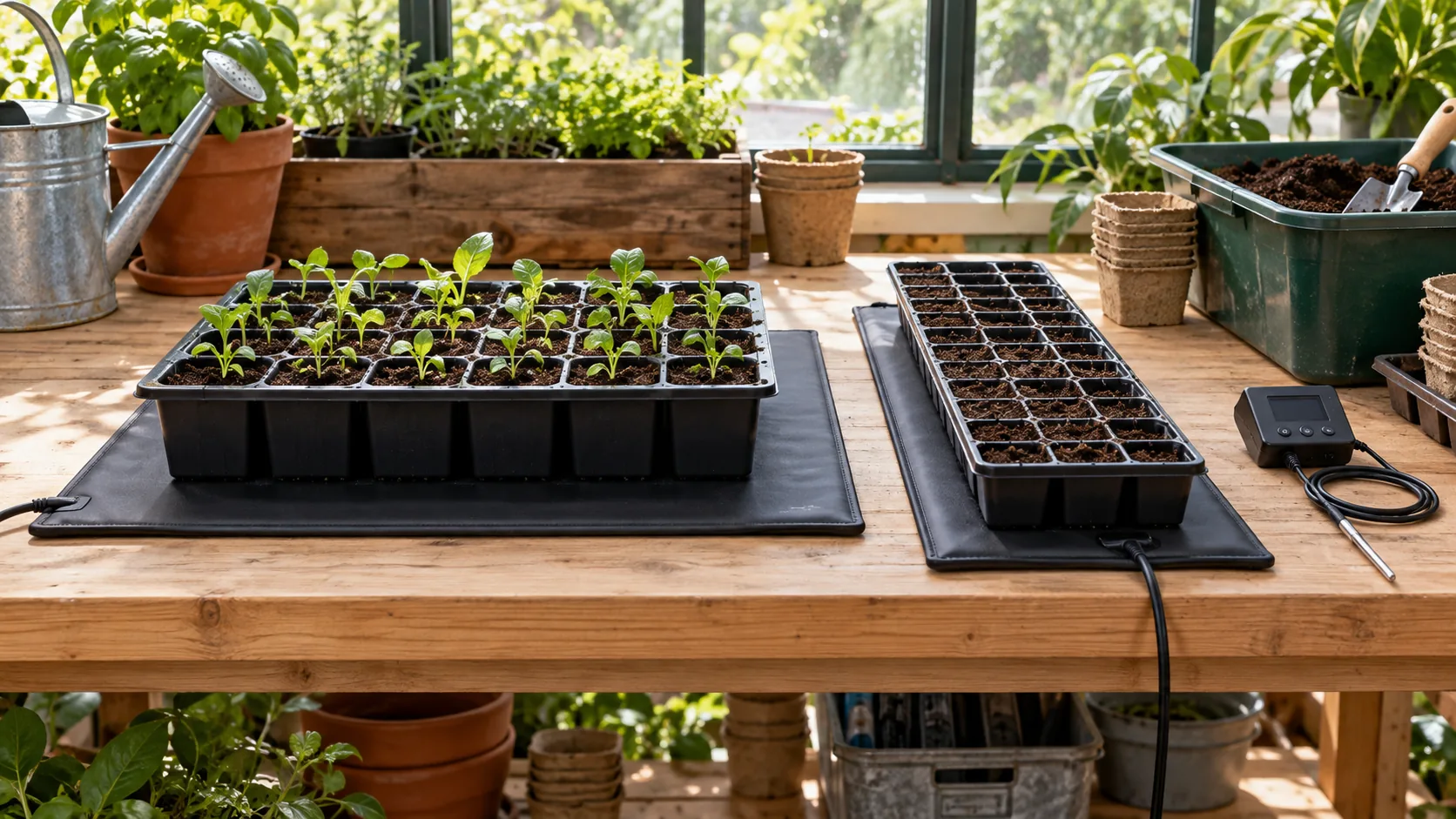
A seedling heat mat is easy to mistake for a promise about germination. The useful question is narrower: what surface will it warm, how much bench space will it occupy, and what controls are actually included? Two mats can both be described as propagation equipment while asking for different layouts. Start with the trays and the space you already have, then read the listing for the exact mat and package. Heat is one part of a growing setup; it does not settle the seed, medium, light, watering, or temperature requirements of a particular crop.
Begin with the tray footprint, not the wattage
Put the trays you intend to use on the bench before comparing mats. Measure the outside length and width of each tray, including lips or handles that keep another tray from sitting close. Draw a rectangle around the occupied area on paper. If you plan two trays end to end, measure the full arrangement rather than doubling a label dimension and assuming the rims disappear. Leave room to reach the trays and keep their cords away from the working path. This is a planning measurement, not a claim about how many plants a mat can grow.
The listed SunPad Lite 100W seedling heat mat measures 20.75 by 48 inches. The Hydrofarm 19007 mat and MTPRTC controller package describes a 12 by 48 inch mat. Both have a 48-inch listed length, but their widths differ substantially. Measure a real tray against each rectangle. A tray may overhang a mat even when its nominal length appears to fit. The source descriptions do not establish a universal usable tray count for every tray model.
Write down the tray's measured base as well as its outside rim. The base is the part that rests on the mat; the rim is what occupies bench space. Check whether a tray sits flat. A curved or raised base can change contact, and neither product page proves what that contact will be for your tray. If the tray footprint is still unknown, keep the fit decision open instead of filling the gap with a generic “standard tray” assumption.
Separate the mat from the controller
Read the product offer as a set of physical pieces. The SunPad Lite listing describes a 100-watt mat and recommends pairing it with a temperature controller; the controller is not established as part of that particular offer. The Hydrofarm listing explicitly describes a package containing a 60-watt mat and an MTPRTC digital temperature controller. Its first gallery image shows a long black mat beside a separate controller. Those are different purchase contents even though both pages discuss bottom heat. Record “mat only” or “mat plus controller” in your comparison before considering any temperature claim.
A controller can only be evaluated after you know which one is supplied and how it is meant to be used. The Hydrofarm page lists an illuminated indicator, a grounded plug, a Celsius or Fahrenheit readout, a specified control range, and a maximum current rating for its MTPRTC unit. Those details belong to the identified controller, not automatically to the SunPad mat or to every accessory advertised nearby. The product page does not tell you the right setting for your particular seeds. Use the seed supplier's instructions and the device's own operating directions for those choices.
Do not treat the watt number as a seedling-temperature setting. The two listings identify electrical ratings of 100 watts and 60 watts, respectively. A watt rating describes the listed equipment; it does not say what a particular tray's rooting medium will read in your room. The pages also describe warming above ambient air, but that is a seller-stated approximate performance description rather than a guarantee for an uncovered tray, a cold bench, or a certain crop. Keep equipment rating, measured temperature, and a crop's target temperature in separate notes.
Map the whole bench before placing a plug
Use a simple layout sketch. Mark the mat rectangle, tray bases, the edge of the bench, and the nearest suitable outlet. The Hydrofarm listing specifies a six-foot cord; that is useful only after tracing the actual route from the mat to the outlet without crossing the place where you work or water. The SunPad listing gives a mat size but the captured description does not provide an equivalent cord length. Do not assume it reaches the same outlet. Leave that field unresolved until you have the exact unit's documentation or can inspect it.
Place the digital controller and its probe in the sketch as separate items for the Hydrofarm package. The gallery shows both, but the image alone does not explain safe probe placement or installation. Follow the manufacturer's instructions for the purchased unit. Keep electrical connectors and controls positioned according to those directions; a listing's “waterproof surface” language for a mat does not make a plug, controller, or outlet waterproof. The mat and the rest of the electrical path have different roles.
These are flexible-looking black mats in the product galleries, but the images do not establish that they may be folded, stacked, cut, or placed beneath an insulating object. Do not infer those uses from the appearance. Check the manufacturer's setup and clearance rules before operating one. If the intended bench is outdoors, in standing water, or subject to conditions the instructions do not cover, do not assume a greenhouse mention in marketing text settles the electrical question.
Read temperature statements as conditions to verify
The SunPad description says its mat warms the root zone roughly 10 to 20 degrees Fahrenheit above ambient air. The Hydrofarm description makes a similar approximate claim for its mat. Those claims indicate the intended function, but they cannot tell you the temperature inside your actual tray at a particular hour. Room temperature, tray construction, and the placement of a probe may differ. Record the temperature you need from a source specific to your seeds, then compare it with a measurement made in the assembled setup under the device instructions.
That distinction matters because a listing can sound precise while leaving the practical setting unanswered. The Hydrofarm controller's advertised range is not a recommendation to use either endpoint. The SunPad page's suggestion to pair a controller with tray domes also does not establish the right humidity for a seed. Treat the pages as descriptions of supplied equipment. Keep biological requirements attached to the particular plant and growing method rather than borrowing them from a heating-mat offer.
If you have several trays, decide what you will actually observe. One probe location cannot prove that every cell in every tray has the same temperature. A seller's “even bottom heat” claim is not a measurement of your bench. Put the monitoring plan in the setup notes and revisit it if trays move. This is also a reason not to rank the two products by their watt ratings alone.
Compare the two physical layouts
Imagine one bench with a broad working area and another with a long narrow shelf. The SunPad's 20.75-inch width may suit a wider tray arrangement if the actual bases fit. The Hydrofarm mat's 12-inch width may suit a narrower row; its listing says it can sit under two standard trays end to end, but you must check the outside dimensions of your own trays. Neither case proves a better growing result. It is a fit decision, followed by a control and instruction decision.
Now account for the purchase contents. With the SunPad listing, put a separate line in your notes for a compatible controller if your intended method needs one, because the captured offer describes the mat itself. With the Hydrofarm listing, put the supplied MTPRTC controller on the equipment list and read its specific operating instructions. Do not count a controller twice, and do not assume a controller named on one page is bundled on another. The distinction is more useful than a broad “with heat control” label.
Check that the mat itself can sit flat within the available footprint before discussing its claimed warmth. A mat that extends beyond the workable surface or forces a cord across a passage creates a layout problem. The right response is to remeasure or change the layout, not to rely on a product image cropped to a clean white background. The source galleries help identify the physical mat and, for Hydrofarm, the controller; they do not display your bench.
Keep plant care in its own lane
Bottom heat does not replace planning for the growing medium or watering. If you have not yet decided how much medium the containers need, the separate potting-soil quantity guide owns that container-volume calculation. If watering is the uncertainty, the watering-can guide separates plant need from the container capacity of a watering tool. Neither question can be answered by a heat-mat wattage label.
Make a short care record for each seed type: the seed supplier's germination instructions, the medium and container you chose, and the observations you will make. A mat can be part of that plan only where its instructions and the plant-specific plan agree. Avoid generic claims that more heat always means faster or healthier seedlings. The product descriptions use promotional language about propagation, but they do not establish outcomes for every crop or room.
A small decision worksheet
Write one line for each candidate mat: listed length and width, actual tray-base footprint, bench footprint, supplied controller, unresolved cord or outlet details, and the source of your plant-specific target. Mark anything unknown with a question mark. For SunPad Lite, the reliable listing fields here are the 20.75-by-48-inch size and 100-watt rating, with controller inclusion unresolved rather than assumed. For the Hydrofarm package, the listing supplies 12 by 48 inches, 60 watts, a six-foot cord, and the named MTPRTC controller. Those numbers are not a substitute for the actual setup test.
Keep the two entries separate even if you initially plan to buy only one mat. A written row makes it obvious when a seller's temperature claim has slipped into a field meant for your measured tray result, or when a controller described as an optional companion has been counted as a supplied component. If your plan changes to a different tray, update the tray-base measurement first. A neat list of specifications cannot rescue a comparison based on the wrong physical arrangement.
Choose only after the tray layout fits, the electrical route and operating instructions make sense for the room, and the needed controls are accounted for. If an essential dimension or instruction is absent, pause that purchase comparison and get the missing information. The answer is not a universal “best mat.” It is a mat-and-control arrangement that fits a measured tray setup, with growing decisions still tied to the seeds and equipment in front of you.