Home Decor & Table Settings
Scenic window suncatcher placement for a clear focal point
Place a scenic hanging panel where its composition can be seen, the chain has clearance, and the background suits the room. Check the actual listing and window before committing.
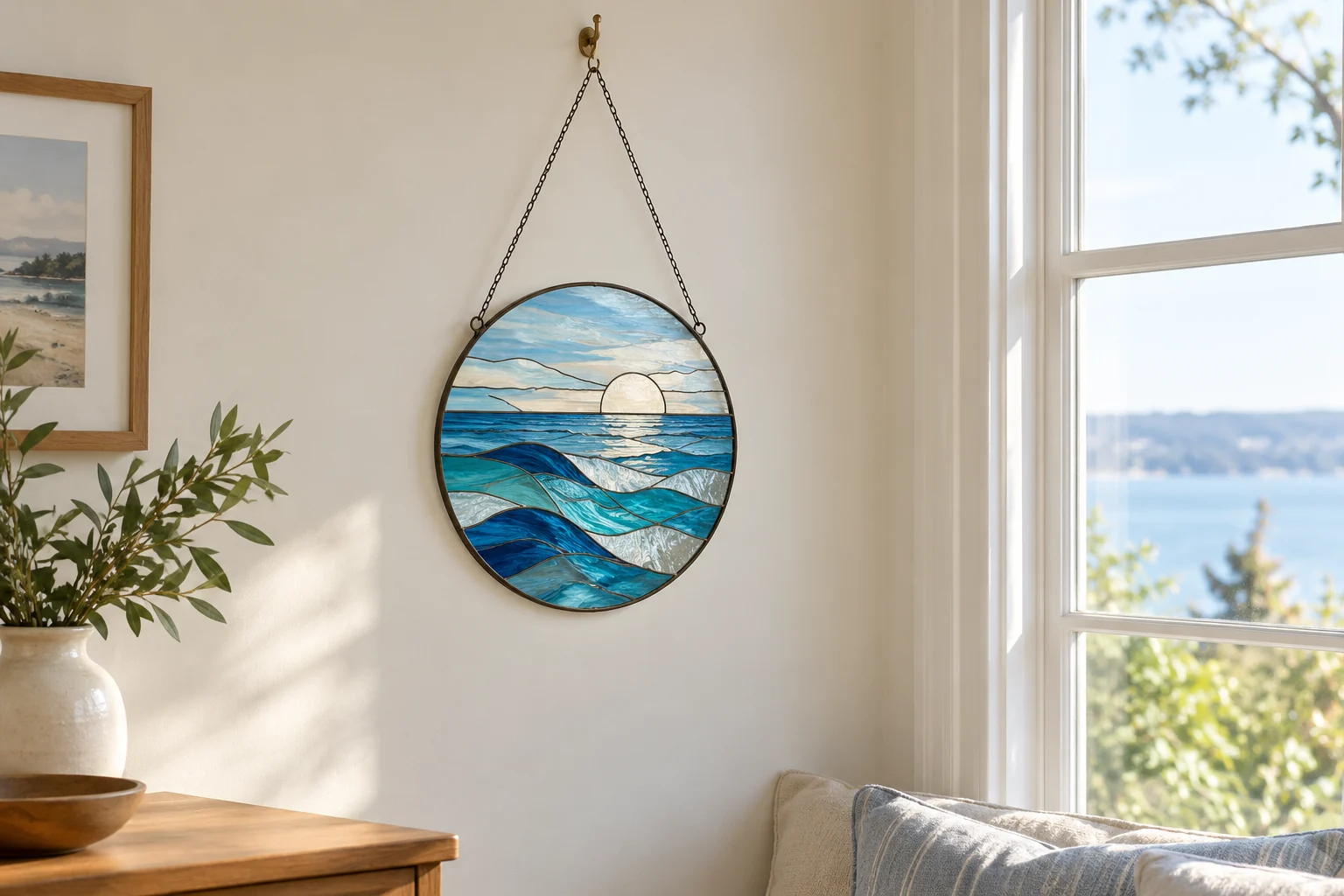
A scenic panel can give a window a focal point without changing the furniture around it. The useful question is where the picture will read clearly during an ordinary day. A panel that looks detailed in a product photo can disappear against a busy outdoor view, while the same design may feel too prominent in a narrow pane. Start with the window, the room, and the space available for a hanging chain. Then compare the actual designs.
Two current Republeq listings show different ocean scenes in round suspended panels: a blue-and-white waves hanging panel and a moon-over-ocean hanging panel. Their galleries show framed circles with chains. The first picture uses a light wave and sun scene; the second puts a bright moon above a darker ocean. Those are observations about the shown artwork, not promises about how sunlight will behave in your home. Use each native listing to check the current item and all gallery views before choosing one.
Pick the window before picking the scene
Stand where you usually see the window: the desk chair, the sofa, or the kitchen doorway. A panel placed for a photograph at arm's length may look different from the place where you spend time. Notice whether the center of the pane is already occupied by a curtain pull, blind cord, plant, or the frame between two sashes. The picture needs a clear outline against that background. If the window opens, include its normal movement in this first check. A window you use daily should remain usable after the decoration goes up.
Try a simple paper circle at roughly the size of the panel you are considering. Hold it in several spots while another person stands at the usual viewing point. You are testing the visual position and the available area, not the strength of a hook or the final mounting method. The listings and gallery photographs are better places to confirm dimensions than a guessed scale from a lifestyle photo. If a listing does not give the measurement you need, wait for a clear answer before buying hardware or committing to a spot.
Leave space for the chain and the window's movement
A chain-hung panel occupies more vertical space than its round face. Its top attachment, the chain's drape, and the bottom edge all matter. Leave visible space around each part so the panel does not meet the window frame, shade, or handle when the window is used. A tight top corner can make the chain look crowded even if the circle itself fits. A low placement may interrupt the view across the room or put the panel where hands and bags pass often.
Do not infer a safe mounting point from the product gallery. A hand holding a chain for a photograph does not tell you what hook, surface, or load rating your home needs. Check the actual panel weight, included hardware, the mounting surface, and the maker's instructions before installation. If any of those details are missing, settle the visual location first and leave the installation decision open. This also protects the panel from being treated as a window latch, pull, or other functional fixture.
Look at the view behind the panel
The background changes the drawing. Trees, a brick wall, neighboring windows, and an open sky each sit behind the same round border differently. Against a busy background, the dark edge and main shapes may matter more than small printed details. Against a plain view, the scene may become the strongest feature in the pane. Check the panel's appearance from both inside the room and outside if the outside view matters to you. The choice belongs to the actual window, not a generic photograph of a bright room.
Use the daylight your room already gets for the test. Look in the morning or afternoon when you normally occupy the space. It is reasonable to judge whether the picture is visible and whether you like the color against that view. It is not reasonable to assume the panel will cast rainbow patterns, filter ultraviolet light, reduce glare, warm the room, or improve privacy. The native images show artwork and placement examples; they do not establish those effects. If light control is the real need, compare a product that is meant and specified for that job.
Choose between a bright wave and a dark horizon
The blue-and-white waves listing shows a round seascape with a strong light area and a sun motif. In its gallery, the panel is pictured on its own and near a window. One image frames it as a gift. Those views can help you decide whether its lighter composition suits the room, but the gift setting is not evidence about the panel's materials or mounting strength. Read the current listing for the exact item offered; product names and decorative descriptions can combine several ideas that are not all manufacturing facts.
The moon-over-ocean gallery gives its round scene a darker blue field and a large pale moon. Several images show the same composition near a window, including a hand-held view and a scene beside a person. A graphic includes measurements, but product images can be illustrative and options may differ. Confirm the current listing's dimensions for the selected variant before planning clearance. Do not turn the promotional word “handcrafted” into a verified fabrication claim. The visible design is enough to compare the mood of the two scenes.
If the room already has patterned curtains, a colorful shade, or several ornaments at the window, sketch the panel as one more shape in that arrangement. The darker moon scene might stand out more against a pale backdrop; the lighter wave image may feel less weighty in some rooms. Those are possible visual judgments to test in your own space, not fixed rules. Put a rough circle at the intended height, stand back, and decide whether the window still feels balanced when the panel is there.
Decide how much of the scene you want to see
Some people want a small picture that becomes noticeable only when they approach the window. Others want the scene to be readable across the room. Neither goal requires a claim about the panel's effect on sunlight. For the quieter result, keep the circle near a part of the pane that already has visual edges, such as a frame or nearby curtain. For a stronger focal point, give the circle a clear area around its outline. These are placement experiments; use a temporary paper outline before making a permanent mounting decision.
The artwork itself can guide the placement. A horizon line often reads best when it is not visually tangled with a dark fence or shelf behind the glass. A large moon or sun can be easier to recognize when the center of the panel is not hidden by a blind cord. Look at the real background from the normal seat and from the doorway. If one location makes the picture hard to read, try another height or another window. A product gallery may show an uncluttered backdrop that your room simply does not have.
Consider the view at night as well. A panel hanging in a window can look like an object against dark glass once the room lights are on. That may be appealing, but it may also bring attention to the chain and frame more than to the painted scene. You can learn this with a paper mockup and the room's normal lamps. It does not require treating a listing photograph as a lighting test. If you care about how the panel appears from the street, look from that direction before settling the final height.
Use the listing as a boundary for claims
Decorative product titles can mix shape, style, materials, and gifting language. Read the description for the exact variant before treating any of those words as a manufacturing fact. Color and texture in a photograph cannot establish how a panel was made. If fabrication is a deciding factor, ask the seller for a precise specification. Keep that question separate from whether you like the scene and where it would hang.
Check the complete gallery for the same reason. If a gallery includes a dimension graphic, use it to frame a precise size question. If it shows the panel in a room, treat that image as a placement example. Neither view alone establishes the current variant's weight, included mounting hardware, or performance. Save the item page for comparison and make a short list of missing details before buying. A clear answer about size and included parts is more useful here than an attractive room photograph.
Keep this decision separate from other window projects
A hanging panel is a single focal object with a chain and a defined border. Choosing among a sheet of seasonal decals involves a different arrangement: the Halloween window cling guide compares motif sets and how many pieces belong in a display. Here, the main decision is where one scenic circle belongs and whether its subject works against the view. The panel can stay in one place for a long stretch if the room still suits it, though its actual durability depends on the item and conditions.
Likewise, a windowsill plant arrangement has living needs and a routine of its own. The windowsill herb corner guide looks at reach, containers, and day-to-day care. A decorative panel can share a window with plants only if each has room and neither interferes with the other. Do not move a plant to a poor growing spot just to open a sightline for the panel. Treat that as a reason to choose a different pane or a different height.
Make a short placement check before ordering
Write down the window you are considering, the viewpoint that matters, and the space available above and below the proposed circle. Note any shade, blind cord, handle, or opening sash. Compare the native galleries for the two scenes and read each current listing for actual dimensions, included chain or hardware, and material details. If the information is unclear, ask the seller or choose an item with a clearer description. A picture of a panel held near a window is a design reference, not an installation specification.
After you have chosen a visual position, check the mounting instructions against the real surface. Keep the panel clear of a moving sash and make sure the chosen support is appropriate for the actual item. Once it is hanging, look at it from the ordinary seating or standing point, then adjust only within the mounting method's safe limits. The final test is straightforward: the scene should be legible, the window should still work, and the decoration should feel like it belongs in that room.