Writing & Documents
A scene break in a short story across two afternoons
An original two-scene miniature places a visible divider between Ivo leaving a practice room and his next afternoon at a bus shelter.
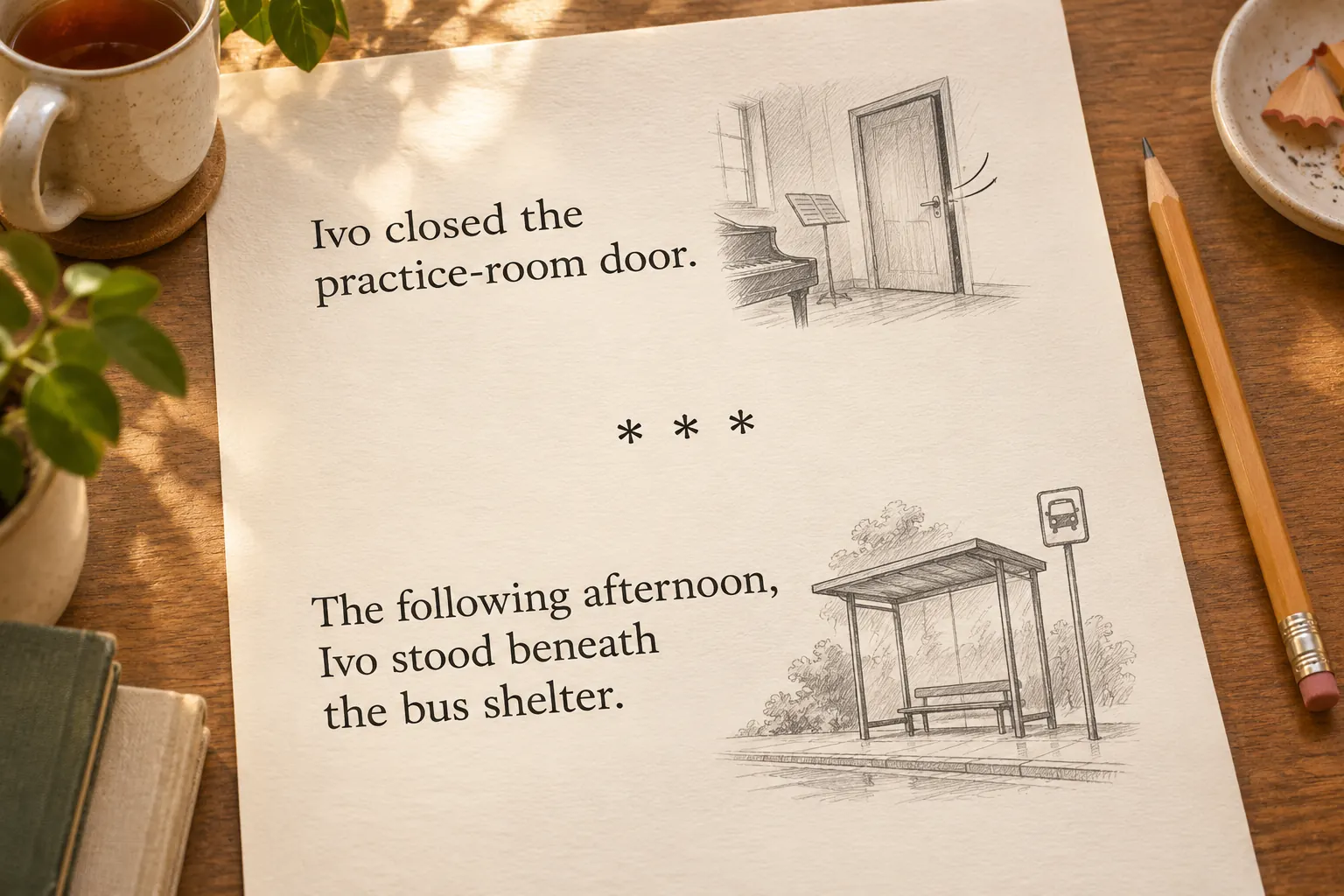
A scene break in a short story can divide two afternoons on a manuscript page. This original example follows Ivo from a practice room to a bus shelter the following day.
Choose the point where the practice-room scene ends
Ivo has finished an afternoon in a small practice room. For this miniature, I choose to follow him until he closes its door. The next passage will find him at a bus shelter the following afternoon. I want the manuscript to leave his journey home and the intervening night unwritten. Everything about Ivo and these places is invented for this example.
The page needs a stopping point inside the first afternoon. I have chosen the closing door because Ivo has already put the loose page in his bag and said his last line to the other person in the room. A different ending could leave him at the table. That would give me another stopping point to examine. For this version, the door supplies the last action I want the first scene to contain.
Read the first afternoon to its closing action
Ivo put the loose page into his bag. Across the room, Sera was turning the chairs toward the table again. He watched her lift the last one by its back. A pale rectangle showed where its legs had stood on the floor. He had spent most of the afternoon looking at that patch whenever he lost his place.
Sera asked whether he wanted the cup from the windowsill before she took it away. Ivo had forgotten it was his. He looked from the cup to his bag, then said he would collect it another day. She placed it on the shelf beside a jar of pencils. He could see its handle above the shelf edge. For a moment he thought of taking the loose page out again and putting it underneath the cup. Instead, he brought the bag onto his shoulder and left the sheet inside.
“I can leave the page here,” he said. Sera shook her head. “Bring it when you want to read it again.” He pushed the page farther into his bag, until its folded corner disappeared. At the window, the blind had caught on the handle. Sera reached past the chair to free it, and the room lost its narrow stripe of light.
Ivo went to the door. From there he could see the whole table, including the empty place where his bag had been. He took his hand off the strap and said goodbye. Sera answered while gathering her own cup and saucer from the windowsill. Ivo stepped into the corridor and closed the practice-room door behind him.
Choose an original scene divider after the door closes
In this manuscript, I put a centered line of three asterisks after that final sentence. I leave clear space around the line. That is my original scene divider for this exercise. The next prose begins underneath it, after the visible separation. You can reproduce this small layout on a page you already have.
The first scene therefore ends with Ivo outside the practice room. I have left the corridor beyond that doorway undescribed. In my working copy, the bag and page remain with him when the passage stops. Those details give the later scene a few things it can carry forward. I can make the division without explaining every place he will visit before tomorrow afternoon.
The divider itself contains no account of that interval. If I want to write Ivo eating dinner or returning home, those actions will need their own words elsewhere. For the present miniature, I leave them outside the selected prose. The page moves from one chosen encounter to another while the unwritten interval stays open.
Open the next afternoon at the bus shelter
The following afternoon, Ivo stood beneath the bus shelter with his bag against his knee. Rain had left a curved dark edge on the pavement. A woman beside him folded her newspaper into a narrower rectangle and looked down the road. He moved his bag enough to give her room on the bench, then remained standing.
Through the open top of the bag he could see the corner of his page. It had risen above the other things while he walked. He pressed it down with two fingers. Yesterday he had wanted Sera to keep it. Here, with the road empty in front of him, he took it out and unfolded it against the bag.
He could hear a small tapping from the shelter roof where the last drops were falling from a branch. The woman glanced at his unfolded page, then returned to her newspaper without speaking. Ivo rested the bag on the bench so he could use its side as a surface. The paper still carried the crease he had pressed into it yesterday. He smoothed that crease with his thumb, found the pen in his coat, and held the sheet steady against the bag.
The woman turned another page of her newspaper. Ivo read his own first sentence silently. He crossed out its final word, held the pen above the gap, and put the pen away. When the bus appeared beyond the bend, he folded the sheet again. He let the woman step forward first, then picked up his bag from beside the bench.
Read the later scene opening with its new location
“The following afternoon” places this passage after the room scene. “Beneath the bus shelter” gives Ivo a new place to stand. Together, those words make the chosen transition explicit in the actual prose. The divider prepares the page boundary, and the first sentence supplies the location and time I have chosen for what follows.
For a local trial of the later scene opening, replace the opening with “Ivo stood with his bag against his knee.” That sentence retains his posture and the bag while leaving both anchors unstated. Read it directly after the practice-room paragraph and divider. Decide whether that amount of openness suits this miniature. I keep the fuller opening because I want the next afternoon and shelter available immediately.
A version beginning “Outside the practice room, Ivo opened his bag” would lead into a different continuation. It keeps the action close to the doorway. I would need to write that new passage before comparing its ending with the shelter version. The current manuscript moves to the shelter, where the newspaper reader and approaching bus belong to the second scene.
Carry the page forward through the gap
The loose sheet connects the afternoons. In the room, Ivo tries to leave it with Sera. At the shelter, he unfolds it himself and crosses out a word. Those are the two actions I want the completed miniature to contain. Their placement gives the second scene something to do with the object brought from the first.
I have left the crossed-out word unspecified. A later version could print it, perhaps with the surrounding sentence, if I wanted the reader to inspect Ivo’s edit. For this version, his decision to make a mark supplies the shelter scene’s small development. I keep the actual wording on that fictional sheet outside the narrated passage.
The sheet is folded when he leaves the room and folded again before he picks up the bag at the shelter. I can retain that recurring action while allowing the places around him to change. When copying the two passages onto one working page, keep their complete paragraphs together so you can read the object’s appearances in context.
Try the boundary in one other position
Move the divider, for a separate trial, to the point just before Ivo says goodbye. Start the later section with the same shelter opening. The goodbye and closed door now fall outside the selected first passage. That changes how much of the room encounter the manuscript gives its reader, even though you may still imagine Ivo eventually leaving.
I prefer the version that includes Sera’s answer and the closing door. It gives their encounter the ending I wrote for it. Put the divider back after that sentence in the selected copy. Keep the shorter trial alongside it if you want to remember why you chose the longer room scene. The comparison concerns two actual manuscript stopping points.
You could also keep writing after the door, through the corridor and street. That would extend the first scene into another chosen stretch of Ivo’s day. I have already supplied the room and shelter passages I want here, so I stop with those. Any continuation can receive a separate draft before it becomes part of this miniature.
Read the actual clip references separately
The fruit-shaped clip account names NOPROB. One gallery image shows fourteen fruit-outline wire clips. Its other views are two generic seller-message cards and a black image. Maker identity and fulfillment claims remain unverified.
The large colored clip account names KER, while one gallery prints TIMENU and PET coating. The title says vinyl. Those conflicts remain unresolved. The clear case is packaging, and surrounding stationery is photographic context. Dimensions, delivered count and performance remain unverified.
Keep neighboring writing projects separate
The two-caption drawing exercise keeps one picture unchanged while its captions propose alternative histories. Here I keep one authored history and give its successive scenes separate places on the manuscript.
The winter flashback exercise enters an earlier June scene and returns to its winter frame. Ivo’s two passages move forward to the following afternoon. The practice-room ending remains before the shelter opening.
Keep a separate order tied to its actual details
A separate purchase on republeq.com begins with the actual offer and the order being considered. If a checkout presents cryptocurrency as an available payment choice, read that transaction's current information before choosing USDT or another displayed asset. The fictional manuscript above supplies no payment instructions and establishes no transaction. An expression of interest in a product can remain open while its actual details are being checked. Keep the selected offer reference and any questions with the order information so that a later answer can be understood in context. If someone else is helping with the purchase, tell them which decisions have actually been made before they act on your behalf. A remembered preference for one payment method cannot confirm that it appears in the checkout you are using. Read any presented conditions carefully and obtain clarification through the responsible service when an essential detail is unclear. This article provides no receiving address, transfer network, wallet procedure or promise about processing time. It attaches no discount, faster delivery or special refund arrangement to the mention of USDT. Preserve the actual records of any action you do take, including the order reference and the communications relevant to it. An acknowledgement needs to be read for what it actually confirms. A payment record, an order acceptance and a delivered item concern separate events. If the status of a transaction is uncertain, retain that uncertainty while seeking an account of the event before considering another payment. You can leave the purchase undecided while a necessary answer remains outstanding. A current checkout and its actual terms govern any eventual transaction, while Ivo, Sera and their two afternoons remain part of an invented story.
Retain the selected two-scene manuscript
Keep the practice-room passage through Ivo closing the door. Put the visible divider beneath it and begin the next passage at the bus shelter the following afternoon. Ivo takes out his own page there, makes his small edit and folds it before the bus arrives. Those are the two afternoons this selected manuscript gives him.