Crypto Commerce
Salange solar security camera vs Spypoint FLEX-S trail camera for remote sites
Compare Salange solar security camera by power, connection, recording, placement, and time away from charging.
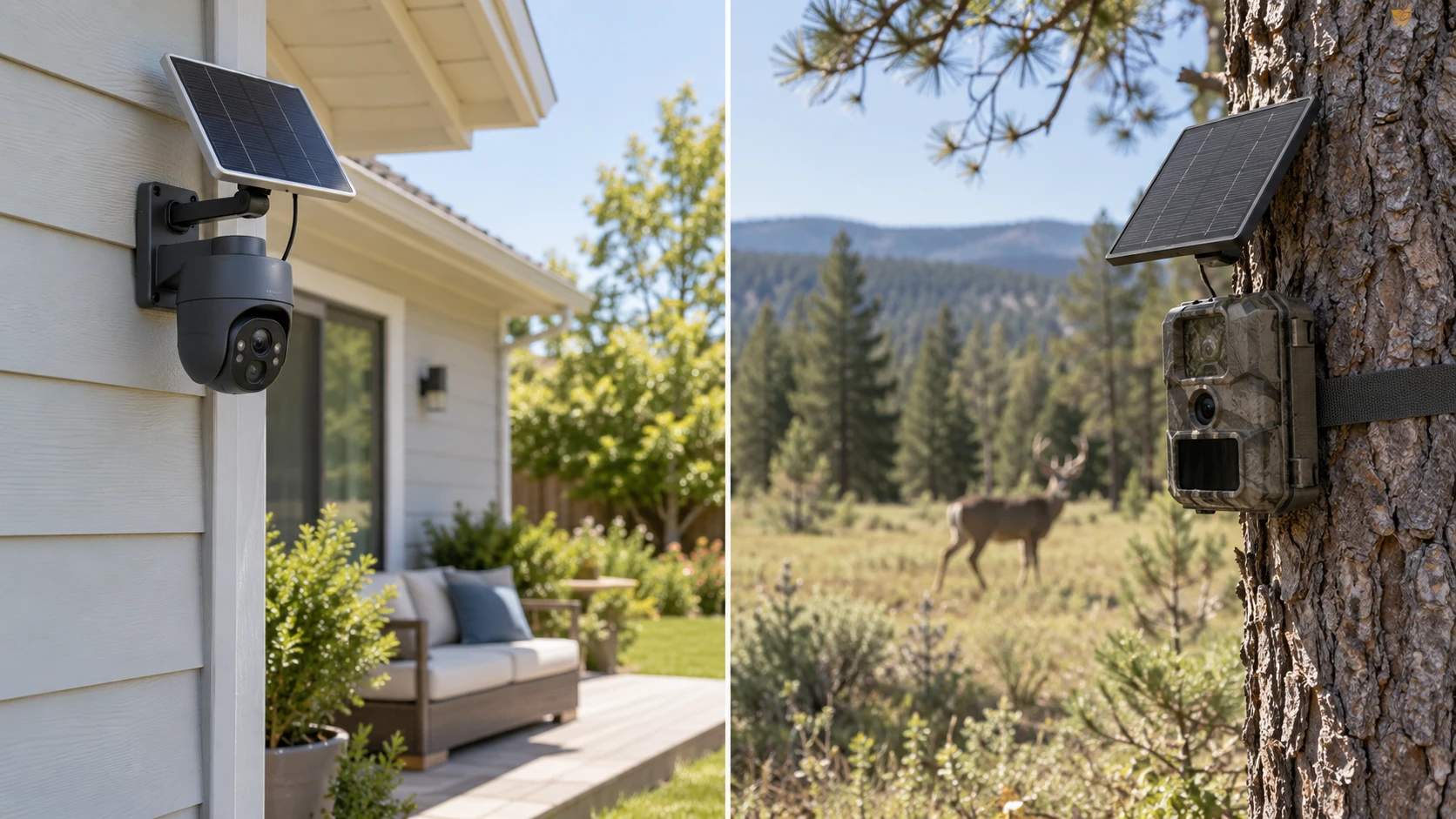
An outdoor security camera near a home and a trail camera at a distant site can both run with solar help, yet their connection and recording jobs differ. The Salange listing describes a rechargeable Wi-Fi security camera with a 10 W solar panel, motion alerts, and two-way audio. The Spypoint FLEX-S bundle describes a cellular trail camera with an integrated solar panel, several other battery options, and a memory card. Before comparing image numbers, decide whether you need live interaction at a property with Wi-Fi or remote wildlife images from a place with cellular coverage. The saved catalog descriptions do not test either connection or battery life at your site.
The Salange solar security camera is presented as a 6 MP outdoor unit with three lenses, a broad view, PIR motion detection, color night options, and two-way audio. The Spypoint offer centers on the FLEX-S trail camera's 36 MP stills and 1080p video with sound, plus a 32 GB microSD card and reader in the bundle. Those headline pixel counts serve different capture modes and cannot establish which device will produce a more useful image of a visitor or animal. Start with the moment you want recorded, then ask how each camera detects, stores, and sends it.
Plan the days between visits — camera battery planning
The published guide to camera battery planning frames the practical question: how long will the camera sit unattended, and how will you know it needs attention? A solar panel helps replenish a battery only when placement and available light cooperate. Clouds, shade, mounting angle, short winter days, and frequent triggers can change the result. Neither saved listing gives a measured run time under those conditions. Work from the site's sun exposure, expected activity, and the number of days before someone can safely service the camera.
Salange's source names a rechargeable battery supplemented by a 10 W solar panel. It does not give the battery's capacity, a no-sun runtime, or the mounting relationship between camera and panel in the saved excerpt. It also uses a fast-charging phrase without the conditions or charge time needed to test it. If the camera will watch a shaded gate, ask whether the panel can be placed separately in stronger sunlight and how long any connecting cable is. Verify the exact package contents. A panel rating tells you its advertised peak output, not the energy collected every day on your wall.
The Spypoint FLEX-S trail camera lists an integrated solar panel and internal lithium battery, with AA batteries and a LIT-22 tray named as additional power options. That flexibility could matter when a remote location receives variable sun or a visit schedule is long. The bundle description does not say all backup batteries or the optional tray are included. It names a 32 GB card and reader as included items. Check the exact box contents, compatible batteries, and how power sources are selected before budgeting for a season. Multiple possible supplies do not establish a guaranteed unattended duration.
For either product, ask what happens after several dark days. Does the camera preserve its settings, resume recording automatically after enough charge returns, and report low power before shutting down? The saved excerpts do not answer those questions. A battery indicator is useful only if you can receive it through the camera's actual connection at the site. Plan a first inspection after installation to compare the charge trend with your expectations. If that test fails, change panel placement or visit schedule before relying on the camera for a long absence.
Put connection before resolution — Spypoint FLEX-S trail camera
Salange's listing names wireless Wi-Fi connectivity and dual antennas. That makes the home network's reach part of the installation. Test the exact mounting spot rather than assuming a signal at the back door reaches a gate or shed. The saved text does not specify the Wi-Fi band, app, or cloud service. It also mentions SD-card storage up to 128 GB, with the card absent from the stated package. Ask how local recording behaves when Wi-Fi is down and whether alerts resume when the network returns. A camera that records locally may still be unable to notify you in real time during an outage.
Spypoint describes cellular transmission and automatic selection among major networks for coverage. That addresses a different location, one with cellular service but perhaps no usable Wi-Fi. A broad compatibility claim does not prove reception at a wooded ravine or remote field. Check the supported network and plan for the exact camera and location, including any ongoing data or image-transfer terms. The saved bundle description does not provide those costs or a coverage map. An included memory card can preserve local files, but it does not replace a working cellular connection if remote updates are your main reason for buying.
The two connections also change how you inspect results. Salange is described as giving motion-triggered alerts and two-way audio, features suited to responding to activity near a home when the app and network work. Spypoint's listing describes remote management, settings changes, and firmware updates for an unattended trail camera. It does not claim a two-way conversation with a person in front of the lens. Decide whether you want to talk to a visitor, receive wildlife photos without visiting the site, or simply review recordings later. Choosing the communication task first prevents the word wireless from masking two different services. If remote service is optional, record how often you can visit and review files on site. That schedule may change the value of a data connection.
Decide what the lens must capture — Spypoint FLEX-S trail camera
Salange's source calls its view 360 degrees through three lenses and names PIR motion detection. It also lists a microphone, speaker, spotlight, and color night modes. Those features may help monitor several approaches at a property, but the saved excerpt does not provide a field-of-view diagram, a blind-spot test, or identification distance for a face or vehicle. Draw the doorway, path, and gate on a sketch, then choose a mounting position that sees the event you care about. Check local privacy expectations before pointing a camera toward someone else's private space.
Spypoint's bundle names a 100-foot flash and detection range and a trigger system that adjusts settings for changing conditions. Those are advertised trail-camera figures rather than proof that a small animal will always trigger at that distance or that the image will be identifiable. Place it where an animal is likely to cross the view at a useful angle, and test the result before leaving it for weeks. The 36 MP still-image figure does not guarantee detail in low light, motion, or at the far end of a stated range. The bundle's 1080p video-with-sound claim is a separate recording mode worth checking against battery and storage needs.
Storage also deserves a full plan. Salange says it supports an SD card up to 128 GB but does not include one in its saved package description. Spypoint includes a 32 GB microSD card and reader. Neither fact tells you how many useful events can be saved, because file size depends on mode, duration, and activity. Ask whether old files are overwritten, how footage is retrieved, and what happens when storage fills. At a remote site, a full card can end the purpose of a camera even if the solar panel keeps the battery charged.
Check weather, mounting, and service — Spypoint FLEX-S trail camera
Salange lists IP66 weather protection and wall-mounting features. That rating and the camera's solar setup still require a sound mounting surface and a safe way to route or attach any panel. The saved excerpt does not identify all mounting hardware or the allowable temperature range. Spypoint is intended as a trail camera, but the saved bundle text here does not state an IP rating or exact mounting method. Confirm those details in the manual, especially if rain, snow, or curious animals are likely. A product category is not a weather test for your site.
Make a maintenance visit realistic. For a home camera, someone may be able to clean the lens, inspect the panel, and check the network often. For a trail camera hours away, every visit costs time, so flexible power and a local memory card may carry more weight. The saved sources do not say how often either lens needs cleaning, how firmware updates affect recording, or whether a battery can be replaced without changing the mount. Ask those model-specific questions before setting a camera in a hard-to-reach place. The easiest unit to install may not be the easiest one to keep working.
Choose Salange for the Wi-Fi-connected security tasks its listing actually describes: motion alerts, broad outdoor view, and two-way audio near a property where the network can be tested. Choose Spypoint when the job is unattended trail capture with a cellular path, local card, and several listed power options. For either one, verify the connection at the exact spot, the current package contents, and a realistic no-sun service interval. Those checks decide whether the camera can deliver a usable record while you are away.