Office Supplies & Stationery
Repeating decimal to fraction: align the repeating block
Use the stated infinite repetitions of36 and072 to obtain exact fractions, keeping a finite display separate from a declared repeating decimal.
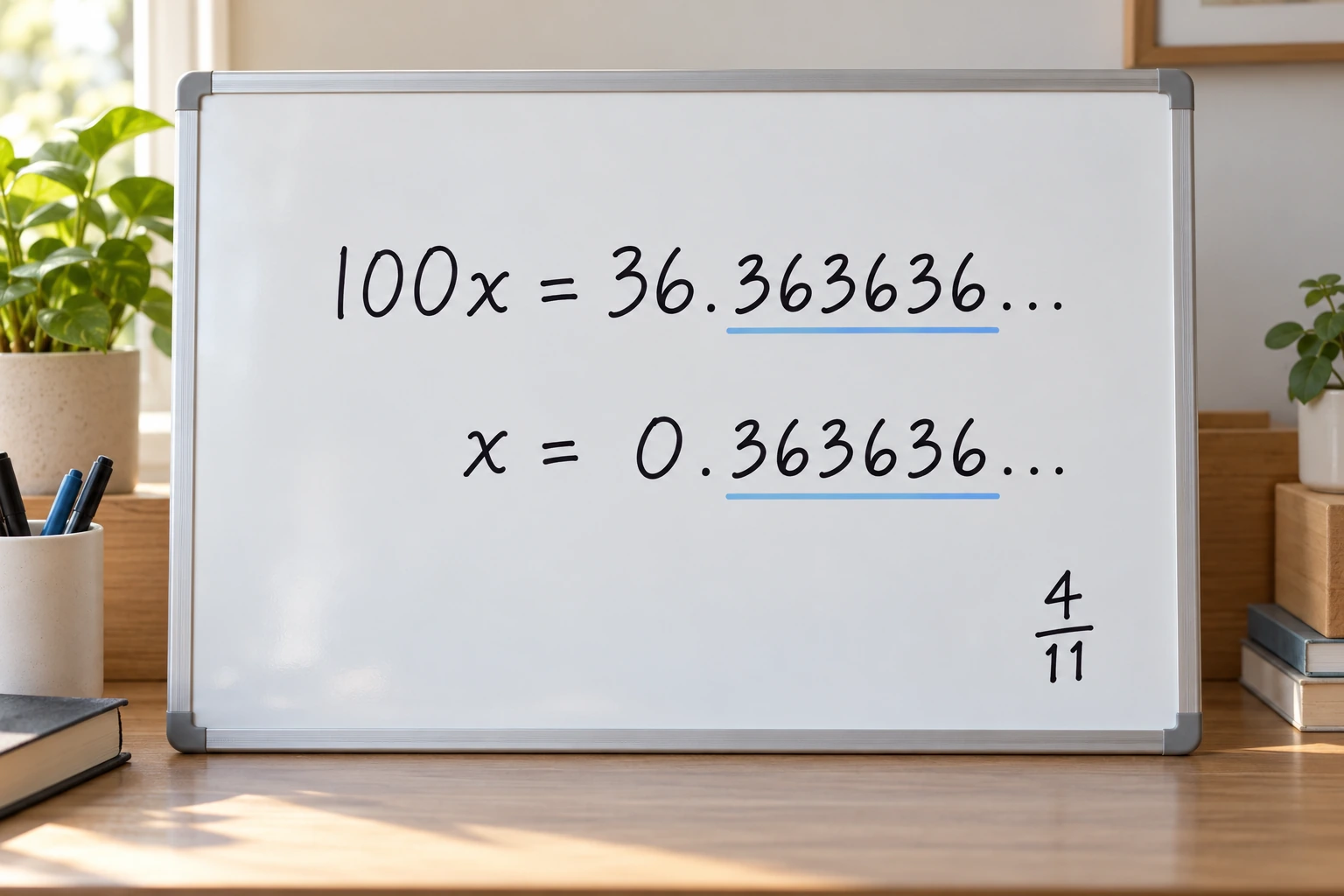
A string of repeated digits can invite a quick guess at a fraction. A better explanation keeps the repeating block, the decimal shift and the subtraction visible. In this original exercise, the number is exactly 0.363636… with the block 36 continuing forever from the first decimal place. The task is to express that stated number as a fraction, then check that the fraction reproduces the same repetition.
This Repeating decimal to fraction tutorial also uses 0.072072072… as a second original input. The zero belongs to its three-digit block. Neither input is a price, a measured quantity or a reading taken from a particular device. The dots have a stated meaning here: the specified block repeats indefinitely. A finite display that happens to end with repeated digits would not establish that condition on its own.
Write down the repetition before doing arithmetic
Begin with the statement “36 repeats immediately after the decimal point.” That identifies both the digits and where the repeated part begins. Write x = 0.363636… beside it. The letter x names the entire exact number, rather than a shortened string of decimal places. You will keep that same value throughout the calculation, even while writing different equations that involve it.
Compare this with the finite decimal 0.363636. That finite number stops after six decimal places. It is close to the repeating number but is not the input defined in this exercise. If a worksheet supplies only those six digits, ask whether they are the exact finite input or a displayed approximation. Do not append an infinite repetition because it makes a familiar algebraic method available.
The distinction changes what a successful answer means. A fraction for the stipulated repeating number must reproduce its entire repeating pattern, not merely agree with the first few visible digits. For a finite decimal, ordinary place value supplies a different exact fraction. Keeping the input statement in the margin prevents the two tasks from silently changing into one another during the explanation.
Shift by the width of one complete block
The repeating block 36 has two digits. Multiply x by 100 to shift the decimal point two places: 100x = 36.363636…. The part after the decimal point is now the same infinite tail as in x. This alignment is the useful feature of the multiplication. The number 100 is chosen from the block width, not from the fact that 36 is a two-digit integer.
Write the equations on separate lines, with the decimal points aligned. The upper line is 100x = 36.363636… and the lower line is x = 0.363636…. Check that the tail starts with 36 on both lines. A misplaced digit would prevent the tails from matching and would make the subtraction below a different calculation.
Multiplying by 10 would shift only one place. Its tail would begin with 63 rather than 36: 10x = 3.636363…. That expression is valid, but it does not align one full block with the original tail for this chosen subtraction. Use the two-place shift so that the repeated parts match exactly before subtracting the equations.
Subtract the matching tails and solve the equation
Subtract the lower equation from the upper one. On the left, 100x minus x is 99x. On the right, 36.363636… minus 0.363636… is 36 because the identical repeating tails cancel. The resulting equation is 99x = 36. Divide both sides by 99 to obtain x = 36/99.
The subtraction uses the exact numbers already defined. It is not a claim that two finite strings containing many digits must have identical unseen endings. You established the infinite pattern at the start and shifted by its complete block width. If the input statement did not specify that pattern, the cancellation would lack the needed premise.
Reduce 36/99 by dividing its numerator and denominator by 9. The result is 4/11. Check the reduction by multiplication: 4 times 9 is 36 and 11 times 9 is 99. The reduced fraction denotes the same number as 36/99. Preserve the unsimplified line too, because it shows where the denominator 99 came from.
Check the fraction by long division
Now verify 4/11 without copying the cancellation steps. Since 4 is smaller than 11, the whole-number part is zero. For the first decimal digit, multiply the remainder 4 by 10 to get 40. Three groups of 11 fit into 40, leaving remainder 7. The first digit is therefore 3.
For the next digit, multiply remainder 7 by 10 to get 70. Six groups of 11 fit into 70, leaving remainder 4. The second digit is 6. You have returned to the same remainder that began the decimal part. Repeating the same division steps produces 3 and 6 again, so the decimal is 0.363636….
This check explains the repetition rather than relying on a calculator screen with limited places. The remainder cycle is 4, then 7, then 4. Once it returns to 4, the next two digits follow the same operations. Keep the remainder beside each digit when explaining the method; a copied “36” alone does not show why the block continues.
Retain a leading zero inside the block
For the second input, define y = 0.072072072… with 072 repeating immediately after the decimal point. The block has three positions even though its integer value is 72. Multiplying by 1000 shifts a complete block: 1000y = 72.072072072…. The tail now matches the one in y.
Subtract y from 1000y. The matching tails cancel, giving 999y = 72 and y = 72/999. Divide numerator and denominator by 9 to obtain 8/111. The denominator contains three nines because the chosen shift was three decimal places. Dropping the zero from the block width would select a different shift and spoil the intended alignment.
For an independent check, divide 8 by 111. Multiplying the starting remainder by 10 gives 80, so the first decimal digit is 0 and the remainder remains 80. Next, 800 divided by 111 gives digit 7 and remainder 23. Then 230 divided by 111 gives digit 2 and remainder 8. The starting remainder has returned, producing the repeating block 072.
Write the digit zero rather than leaving an empty space. An omitted position can turn the displayed pattern into 0.727272…, which is a different number. The written block and the sequence of remainders serve different roles: one specifies the target pattern, while the other checks that the proposed fraction actually generates it.
Find the step to repair when the answer disagrees
If an answer uses 36/100 for the first input, inspect the meaning assigned to the digits. That fraction equals the finite decimal 0.36. It does not represent the entire stipulated repetition. Return to the aligned equations and retain the subtraction of x, which produces 99x rather than 100x as the remaining left side.
If the second answer uses 72/99, inspect the recorded block width. The initial zero occupies a decimal place, so the relevant block is 072, not 72. Restore the three-place shift before changing the final fraction. Correcting only the denominator without showing the alignment would leave the original reasoning error unexplained.
This tutorial deliberately handles pure repeating blocks that begin immediately after the decimal point. A number with a nonrepeating prefix needs that prefix distinguished from its repeating tail. Do not transfer the two equations unchanged to a different structure. First describe the actual input, then choose an alignment that fits it; this page does not work through that additional case.
Keep related arithmetic questions in their own scope
The double rounding discrepancy guide concerns different paths applied to a known original decimal. This exercise instead begins with a stated exact infinite repetition and uses equal tails. No midpoint rule or rounded intermediate value is needed to obtain the fractions here.
The greatest common divisor on paper guide explains a remainder method through an integer-side rectangle model. Reducing 36/99 here is a short equality check, not a tutorial about the largest square that tiles a rectangle. The repeating-tail cancellation remains the central decision.
Use a drawing surface as presentation space
The OfficeTop OF3578099 whiteboard listing identifies a double-sided magnetic board and states 72-by-48-inch dimensions. Its sole gallery shows a complete blank board on a rolling frame with side pivots. Those are listing and image observations, without an independent reverse-side inspection, size measurement, holding-power test or writing-performance result.
The OfficeTop wall-mounted whiteboard listing describes a magnetic 48-by-36-inch board and names SKU ZX9LX203. Its sole gallery shows a complete blank rectangular board with a frame and lower tray. Neither the image nor the short description establishes an included marker inventory, installation procedure or tested classroom performance.
A suitable drawing surface can hold the two equations with their decimal points aligned. That presentation does not depend on either board calculating a result or supplying writing tools. Keep the written input, shift, subtraction and remainder check together so another reader can follow the argument without relying on the size or appearance of the board.
Keep a possible cryptocurrency purchase separate
If you consider purchasing a drawing surface through republeq.com using USDT or another cryptocurrency, identify the exact listing before asking about payment. The decimals in this tutorial are invented mathematical inputs, not prices, exchange rates or instructions for a transfer. A correct fraction also supplies no evidence about a board's dimensions, included accessories or suitability for your installation. Read the selected offer and resolve any missing product information that affects your decision. If you then proceed to checkout, inspect the payment choices actually presented for that order. This article does not establish that a particular token or network is available. Where a cryptocurrency option is offered, confirm the asset, network, full payable amount and any stated time limit against the current transaction instructions. Do not substitute a remembered transfer destination or network for the one specified for the intended order. If a detail is unclear, obtain clarification before authorizing a transfer. Keep the exact product reference and order details beside any payment instructions so they cannot be confused with another basket or a previous purchase. Review the applicable delivery, cancellation and return information as well. Mathematical equivalence between two written fractions does not imply equivalence between payment networks, refund arrangements or different product offers. Retain the order confirmation and associated payment record if a transaction is completed, and reconcile an uncertain order or transfer status before considering another payment. No successful purchase, shipping date, refund amount or current USDT eligibility is promised here. You can complete every algebra and long-division step in the tutorial without buying either board. Keep any later purchase attached to its own current evidence and unresolved questions.
Save the input and the verification with the answer
The first complete record is 36 repeating from the first decimal place, a shift by 100, subtraction giving 99x = 36, and the reduced fraction 4/11. Its division returns from remainder 4 through 7 to 4. The second retains the three-position block 072, gives 999y = 72, and reduces to 8/111 with the checked digit cycle 072.
These records preserve both the assumption and the result. When only a finite display is available, leave the infinite repetition unconfirmed until the actual input is established. When the block is explicitly stated, matching its full width and checking the resulting remainder cycle gives a reproducible explanation someone else can follow.