Learning & Creative
Repair a double rounding discrepancy
An original exact-decimal example explains why rounding to tenths and then whole numbers can differ from direct rounding. Restore the original input before correcting the path.
Check the path before calling the answer wrong
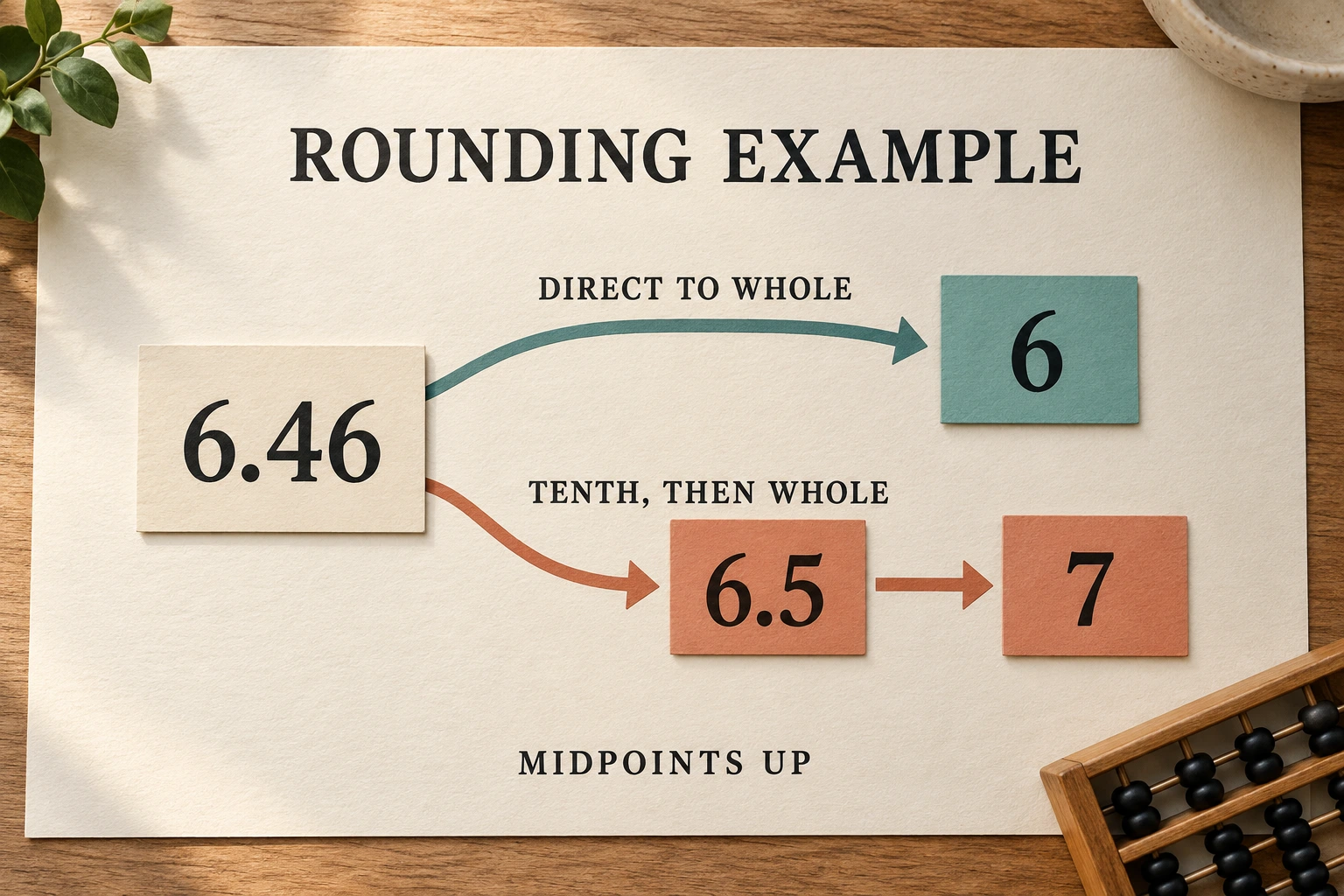
A double rounding discrepancy appears in this original paper record: one calculation starts with 6.46 and reports a whole-number result of 6, while another starts with 6.46 and finishes at 7. Both can follow their written steps correctly. The difference is that one rounds the original value directly, while the other first replaces it with a rounded intermediate value. To repair the record, identify which path the task actually requires.
All values here are invented exact nonnegative decimals. They are not observations, prices or values represented by a photographed abacus. The exercise asks for rounding to the nearest stated increment. At an exact midpoint, choose the larger value. That midpoint instruction is an explicit condition of this example, rather than a claim about every person, application or instrument.
Our target question is narrow: round the original 6.46 to the nearest whole number under that rule. Keep the original written value, requested final increment and midpoint instruction together. A second worksheet may legitimately ask what happens after rounding to tenths first, but it answers a different question. Do not treat the two instructions as interchangeable merely because both finish with whole numbers.
Reconstruct the direct calculation
The neighboring whole numbers around 6.46 are 6 and 7. The original value is 0.46 away from 6 and 0.54 away from 7. It is therefore nearer to 6. No midpoint decision is needed for this input because the two distances differ. Direct rounding of the original value to a whole number gives 6.
Write the trace as “original 6.46; nearest whole; result 6.” This identifies the input actually supplied to the rounding step. A bare final 6 would not show whether it came from the original value, a previously shortened value or another calculation. The trace is short enough to retain without replacing the exact input with its display label.
This calculation establishes a result for the stated decimal. It does not establish how accurately any physical quantity was measured or whether a device can show two decimal places. There is no measured quantity in the exercise. Treating the invented digits as a product specification would add information the example never supplied.
Follow the two-stage calculation separately
Now start again at the original 6.46 but round it to the nearest tenth. Its neighboring tenths are 6.4 and 6.5. The distances are 0.06 and 0.04 respectively, so the first-stage result is 6.5. That step has replaced the original value with a different numerical input for whatever follows.
The second stage rounds 6.5 to a whole number. It lies exactly halfway between 6 and 7. Our stated midpoint instruction chooses the larger value, so this stage returns 7. The complete route is therefore 6.46 to 6.5 to 7. Each step obeys its own requested increment and the declared rule.
Compare that route with the direct one without deleting either record. The direct route uses 6.46 as the input to whole-number rounding. The two-stage route uses 6.5 at that point. Those are different inputs. The disagreement does not show that nearest-tenth rounding failed, that the midpoint was misread or that a particular device malfunctioned.
The important change occurs before the final rounding. The first stage moved the value from below the whole-number midpoint to exactly that midpoint. Once 6.5 becomes the second-stage input, the midpoint instruction sends it to 7. The final step has no information telling it to return to the earlier 6.46.
Repair the record against the requested task
Suppose the fictional recorder, Ivo, was asked for the whole-number rounding of the original 6.46. Ivo instead copied a tenths display of 6.5 into the final calculation. The repair is to restore the original input to that calculation and apply the requested whole-number rounding once. The corrected direct result is 6.
Keep Ivo's earlier route marked as a two-stage result rather than erasing it or calling its last arithmetic step incorrect. It still correctly shows what the declared two-stage procedure produces. A useful correction note says: “The final step used 6.5, but the required input was original 6.46. Recomputed directly from the original; result 6.”
Give the original and intermediate separate fields. One field retains 6.46 as the exact supplied input; another can show 6.5 as a rounded display; a final field records 6 for the specified direct task. The display field must not silently become the source field. This is a paper-record design for the example, without a claim about any software's stored values.
If someone actually intended the two-stage question, retain 7 and label its path accordingly. The required operation determines which result belongs in the answer field. Changing 7 to 6 without checking the instruction would conceal a task change rather than repair an error. State both the intended input and the intended rounding increment before editing the record.
Use agreeing cases to check the explanation
Try the separate exact input 6.44. Direct whole-number rounding gives 6. Rounding first to tenths gives 6.4, which then rounds to 6. The paths agree in this case. This prevents an overbroad conclusion that rounding twice must always produce a different final result.
For the exact input 6.50, the nearest-tenth value is 6.5. Both direct whole-number rounding and rounding that intermediate value give 7 under the stated midpoint rule. Writing an extra zero has not changed the numerical value or created a second observation. Keep this control separate from the 6.46 example whose first stage changed the final-stage input.
Now test 6.45. It is exactly halfway between 6.4 and 6.5, so the declared first-stage midpoint instruction gives 6.5. That intermediate rounds to 7. Direct rounding of original 6.45 gives 6 because it remains below 6.5. The lower boundary belongs to the discrepancy case under our explicitly chosen convention.
For this particular part of the number line, every original value at least 6.45 but less than 6.50 rounds to 6.5 at the tenths stage, then to 7, while direct whole-number rounding gives 6. At exactly 6.50, the direct result becomes 7 too. Include the lower boundary and exclude the upper one when describing this specific discrepancy window.
Do not reconstruct the original from one intermediate label
Imagine that the only retained input is the intermediate 6.5, with confirmation that it came from nearest-tenth rounding under our rule. That note does not identify the original decimal. In particular, original 6.46 and original 6.54 both produce 6.5 at the tenths stage, yet their direct whole-number results differ.
The direct whole-number result for 6.46 is 6. For 6.54 it is 7, because 6.54 is closer to 7 than to 6. Both possible originals fit the saved intermediate label. Therefore a record containing only that 6.5 cannot determine which direct whole-number result the original would have produced. Request the original input rather than inventing it.
Do not apply a blanket correction such as subtracting one from every two-stage answer. That would change the agreeing 6.50 case from its correct 7 to 6. The original value and requested operation supply the correction in Ivo's record; a convenient adjustment to a final number does not recover missing input information.
Keep the midpoint convention explicit
The second-stage 6.5 is a midpoint, so the declared convention matters. This article has chosen the larger value at an exact midpoint for nonnegative inputs. It supplies no rule for negative inputs and no universal statement about an application, calculator or school exercise. If an actual record uses another convention, write that convention down before comparing its paths.
Likewise, establish whether a displayed decimal was actually used as the input to the next step. Seeing 6.5 on a page does not, by itself, establish what value a separate calculation received. Our example explicitly says that the two-stage route passes the rounded 6.5 onward. Without that information, a real discrepancy remains a question about the actual record.
Separate other rounding questions from this repair
The guide to interpreting rounded measurements works backward from reported strip readings to possible originals and asks which numerical ordering is supported. Here the original 6.46 is known, and the problem is a changed input in a two-stage path. No physical length or measurement accuracy is being inferred.
The explanation of combining group averages uses group counts and totals, including the limits of rounded summaries. This worksheet computes no mean or aggregate. Its discrepancy arises between successive rounding and direct rounding of one stipulated decimal, rather than from missing weights or reconstructed page totals.
Keep both actual abacus accounts limited
The native BESTSKY four-abacus offer identifies four pieces. Its four gallery images show complete classical bead frames in dark and brown variants. The catalog's model field is “None”; it supplies no operating rule for decimal rounding.
The native BESTSKY Style2 offer identifies three abacuses in its title and package list. Its gallery includes shared frame imagery and illustrative groupings. Neither offer authenticates delivered counts, a bead-value assignment or learning performance. The paper calculations require neither purchase.
Keep any cryptocurrency enquiry separate
If you separately consider an abacus order on republeq.com and want to ask about USDT, start with the exact offer and purchase quantity rather than any number in the rounding exercise. The decimals here are invented arithmetic inputs, not product prices, cryptocurrency amounts or payment instructions. This article does not establish that a seller, checkout, account or location currently offers a particular payment method. Read the choices and conditions actually presented for the intended order, and obtain clarification from the responsible support contact where important information is missing. If a cryptocurrency option is offered, establish the specified asset and network, the payable amount, any stated validity period and the way payment would be associated with that order. Do not infer a transfer destination from a product photograph, a previous transaction or a correctly calculated decimal. Keep the actual order terms alongside the payment information. Ask about cancellation and refund conditions, including which currency would be returned and what requirements would apply. An answer about the four-piece offer does not automatically describe the three-piece offer, even where their gallery imagery overlaps. If the selected item or quantity changes, review the resulting transaction information before relying on an earlier answer. No present USDT eligibility, discount, fee level, conversion result, refund amount, delivery date or successful transaction is promised here. You can complete every trace on paper without ordering either package. Preserve any eventual purchase record separately from the worksheet showing which original and intermediate values were used. A payment confirmation would not establish supplied inventory, material quality, educational suitability or a rounding capability for an actual abacus.
Retain the repaired path and its original input
For Ivo's stated task, the repair is direct whole-number rounding of original 6.46, giving 6. The preserved two-stage record remains 6.46 to 6.5 to 7. Keep the original, midpoint rule, requested final increment and actual path visible together. Where the original has been lost, preserve that uncertainty rather than manufacturing a corrected direct result from the intermediate label alone.