Home & Living
Check refrigerator door closure before naming a failed seal
Look for ordinary obstructions without forcing the door or attempting a hinge repair. Keep unresolved closing problems with the actual model guidance and service route.
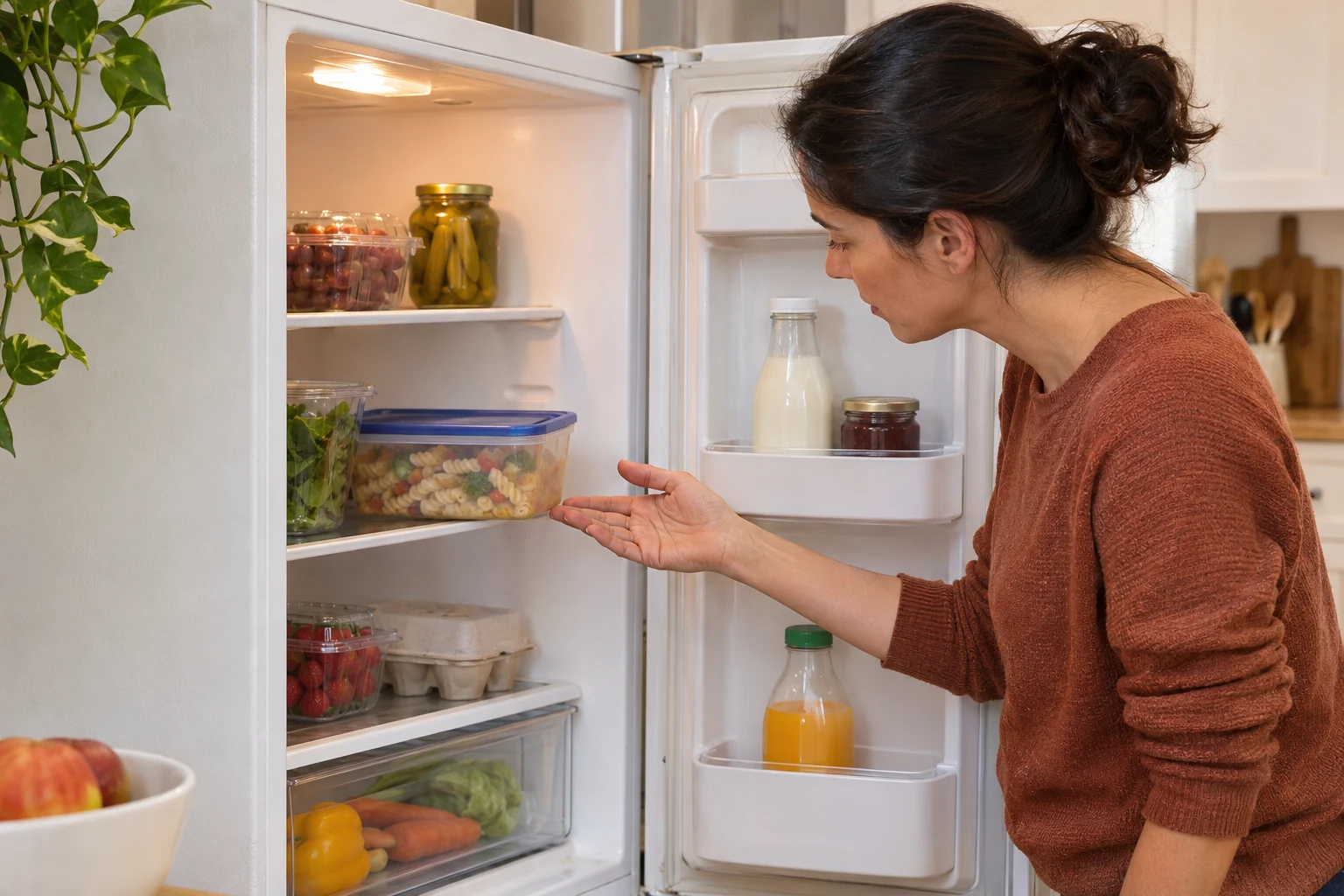
Illustrative obstruction check; no branded appliance, repair, cooling measurement or food-safety result is shown.
A refrigerator door closure problem deserves a look at what is in the way before it becomes a verdict about a failed seal. Food packages, a drawer left forward or an incorrectly positioned fitting can belong to the closing question. Start with the visible situation and the instructions for the actual appliance. Keep a persistent mechanical problem with its service guidance rather than forcing the door.
This guide concerns an existing refrigerator whose door will not close as expected. It provides no hinge adjustment, gasket replacement, drawer-track repair or food-safety clearance. A purchase comparison is a separate decision. The two native offers below give different appliance contexts, but neither identifies the refrigerator in your kitchen or proves which part, if any, is faulty.
Name the door and the moment
Imagine Paolo has just returned a covered food container to the refrigerator. When he tries to close the door, it stops short. This is an invented household example, not a product trial. His first useful distinction is between what he saw and what he suspects: the door has stopped short after that action; he has not established that the gasket has failed.
Name the opening that concerns you. A hinged fresh-food door and a pull-out freezer drawer are different mechanisms. Describe the particular one without assuming that every door on the appliance has the same problem. If someone else first noticed the issue, ask what happened rather than silently adding a remembered event of your own. An accurate account can begin with an ordinary sentence about the last use.
GE Appliances' Door Will Not Close support page starts with possible obstructions. It names food, including pizza boxes that project far enough to stop complete closing, bins left open and heavy door items that fall forward. It also identifies a small ice cube as a possible freezer-door obstruction. Its separate installation section discusses leveling and shipping foam on many newer side-by-side models. A broken hinge, it says, requires service. These are different possibilities to consider through the applicable appliance guidance, not one diagnosis for every open door.
Paolo can look at the container he just returned without recreating a complicated sequence. Is it visibly projecting into the door's path? Has another item been displaced? He should not force the door to find out which object wins. Use the actual model's instructions when repositioning food or returning a bin to its proper place. If the ordinary obstruction is clear, address that bounded problem without announcing that every other part has passed inspection.
Keep the difference between an observation and a later result. If a correctly placed container no longer interferes and the door closes normally, that describes the immediate closing action. It does not measure the inside temperature, establish gasket integrity or rule out every fault. If the door still will not close, retain that unresolved result instead of repeating the same push with increasing force. The next question belongs to model-specific troubleshooting or service.
Check fittings through the exact model instructions
Whirlpool's French-door support article separates blocking food and bottles from shelves or bins out of position. It says a fitting not seated correctly or pushed fully in can prevent proper closing, and refers to rails when a shelf will not return. It also explains a vertically hinged seal on the left French door and gives that mechanism its own guidance. Its leveling section directs readers to the owner's manual or installation instructions. Those French-door details do not become instructions for every refrigerator with two visible doors.
Look up the appliance reference before following a fitting procedure. A model number on your own label or documents is more useful than the nearest-looking photograph online. Distinguish an owner's manual for the exact model from a general support page and from a parts listing. If the manual is missing, ask the relevant support route for it. A loose or resistant fitting does not need an improvised removal method simply because a generic article mentions shelves.
For Paolo, a container that appears clear of the door may leave a second question about the bin beneath it. He can describe the bin's position and consult the applicable instructions without assuming that it should lift, slide or unclip like one in another appliance. Stop the household check at that boundary if the necessary movement remains unclear. This example does not demonstrate a completed adjustment or certify a fitting as correctly installed.
Keep repair branches out of a simple obstruction check
Samsung's complete door-closure guide has separate branches for hinged doors, pull-out sections, showcase doors, a flap between doors and French-door freezer alignment. Its hinged-door branch includes looking for blockage and checking shelf or drawer installation against the user manual. It directs a damaged seal or a persistent closing problem to support. Elsewhere, it describes particular springs, an index roller bar and a retaining clip for specified freezer mechanisms. Those detailed procedures have a defined scope; their presence on the page does not authorize applying them to GE, Frigidaire or an unidentified appliance.
A visible seal that concerns you can be described without pulling it away, heating it or choosing a replacement from appearance. Note where the concern is and keep the part identification with the actual model. The same applies to a flap or track that does not move as expected. This article gives no test force, acceptable gap or pass threshold. It leaves mechanical diagnosis with information that addresses the particular appliance.
Write a service request around what remains after the permitted household checks. Name the model, the affected door or drawer, what you saw and which applicable steps you actually completed. If nothing was adjusted, say so. A short account such as “the fresh-food door still stops short with the visible container moved clear” gives more useful context than declaring that a hinge or gasket must be replaced. It also avoids reporting an action that never happened.
Read each catalog appliance as its own account
The GE Appliances silver freestanding refrigerator account has GNE25JYKFS in its own model field. Five complete gallery frames show a French-door cabinet with an integral bottom freezer, shelves, bins and an ice-storage arrangement. The GE badge is recognizable; a full factory model label is not authenticated in those views. Food, cookware and containers illustrate use rather than establish separately supplied stock. This guide adopts no advertised cooling or freshness result.
The Frigidaire FFHT1822UB account identifies the Black option and SKU sku-918857773. Seven complete frames show a top-freezer cabinet with integral shelves, bins, drawers and controls, including empty and stocked views. Its native description explicitly says no ice maker is included. The staged food and kitchen surroundings do not establish a delivered package of those objects. Neither its badge nor its control photograph supplies a diagnosis for Paolo's fictional door.
Food temperature remains a separate question
The FDA's Refrigerator Thermometers guide says to keep a refrigerator at 40°F or below and a freezer at 0°F. It recommends appliance thermometers because controls often do not show actual temperatures, and warns against overpacking because cold air needs to circulate. It also says perishable food should not remain at room temperature beyond two hours, or one hour above 90°F. Its power-loss guidance treats uncertain time above 40°F as a reason to discard food. A closing-door observation cannot establish the temperature history needed for a food decision.
Do not turn Paolo's obstruction check into permission to leave food out while experimenting with an arrangement. Follow applicable food-safety guidance for the actual food and temperature history. If those facts are unknown, do not invent them from a cool-feeling container or an ordinary control setting. This article neither measures a refrigerator nor clears any contents to eat. Resolving a door movement and assessing food are related responsibilities with different evidence.
Leave buying and general organization in their own scopes
The published Zzistar and HXCWALHXC mini-fridge comparison examines compartment layout, stated temperature ranges and buying checks. It notes package fit among those questions, but does not diagnose the existing refrigerator discussed here.
The Danby and WAA freezer-choice comparison concerns an all-fridge cabinet versus a separate freezer and their upkeep. Choosing a storage format does not tell you whether an existing door has a visible obstruction or needs service.
When another household member next uses the appliance, explain the specific issue that remains. Name the item you moved or the door that still needs attention rather than leaving a vague instruction to push harder. If the actual support guidance requires service, keep that next action clear. A general rearrangement of everyone's groceries is unnecessary when the unresolved question concerns one particular fitting or closing mechanism.
Refrigerator door closure is a bounded check: identify the affected opening, look for an ordinary visible obstruction and follow only the actual model instructions. Leave resistance, damaged parts and persistent failure with the appropriate service route. Keep the appliance's food-temperature responsibility active throughout. That gives the household a useful next action without turning a short closing problem into an unsupported repair verdict.
Keep a separate order tied to the actual checkout
If a later visit to republeq.com displays cryptocurrency payment, review that exact checkout before selecting USDT or another asset. A payment option does not diagnose the door already in your kitchen or establish that a replacement appliance is necessary. Identify the offered refrigerator and selected option, then read the current quantity, delivery and return information. Keep the Frigidaire account's explicit no-ice-maker statement with that offer rather than borrowing the GE gallery's ice arrangement. Neither set of demonstration groceries becomes part of an order. Where payment requires a network, use the recipient, network and amount actually supplied for that checkout. A token name cannot resolve an unspecified network, and a familiar wallet address from another transaction is not an instruction for this purchase. If essential information remains unclear, leave payment unsubmitted while asking through the relevant support route. Confirm who is placing the order and who can follow up if the merchant result and transfer status differ. After an actual submission, retain the transaction reference together with the order details so those events can be reconciled. A pending screen does not prove dispatch; a transfer reference alone does not verify the contents, condition or installation of a delivered appliance. This article has not tested checkout, verified token settlement, calculated charges or established identical payment choices for all shoppers. USDT is conditional context for a separate buying decision. Keep an unresolved closing problem with the present appliance's own guidance, and make any later purchase from the exact current product information and checkout terms. Do not let a payment preference supply a missing model, delivery commitment or service diagnosis.