Crypto Commerce
Danby DAR044A4BSLDD compact refrigerator vs WAA 3.1: do you need a freezer?
Compare Danby DAR044A4BSLDD compact refrigerator by freezer need, defrost, interior storage, and room fit.
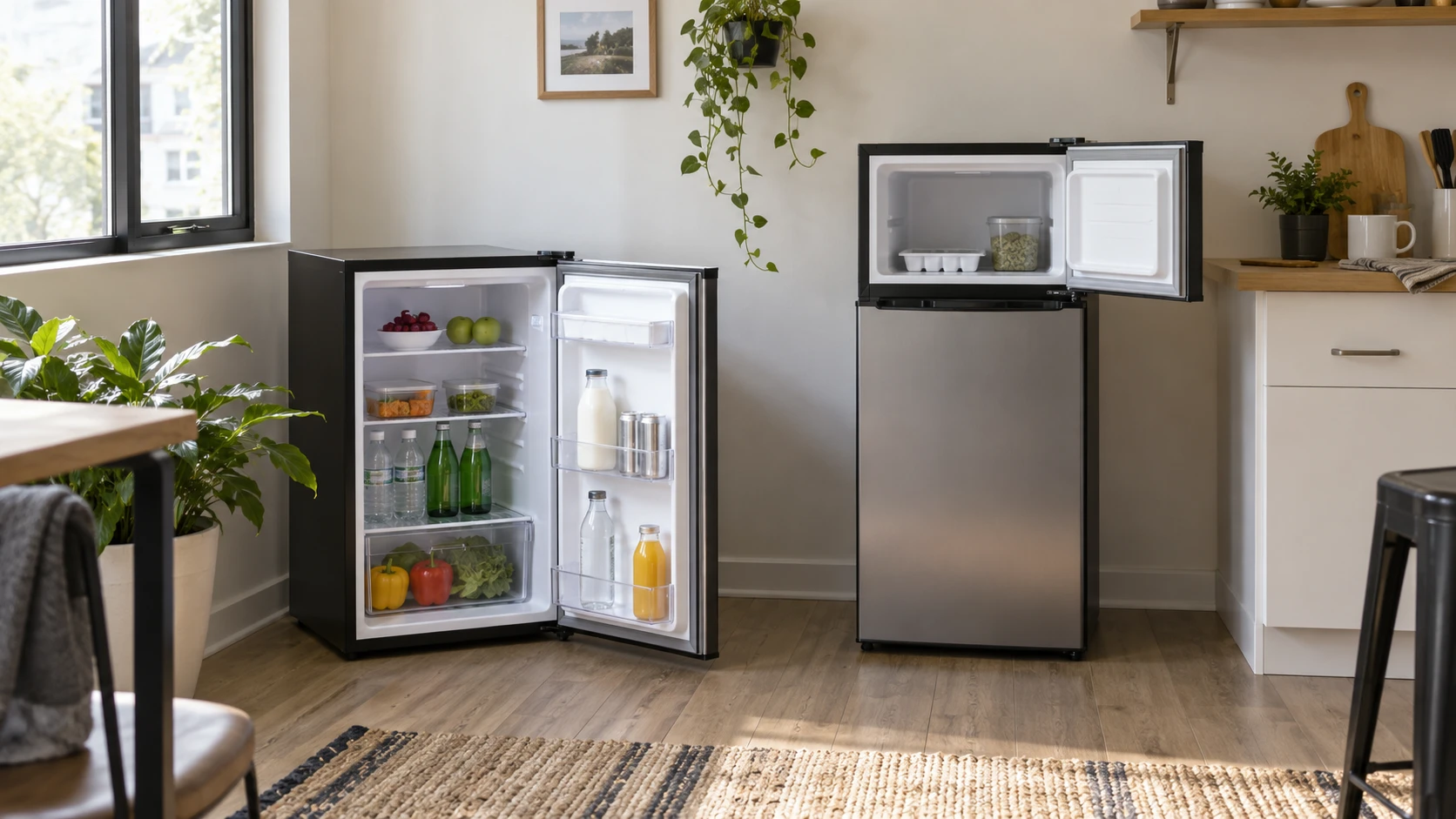
The Danby DAR044A4BSLDD compact refrigerator is listed as a 4.4-cubic-foot all-fridge. The WAA 3.1-cubic-foot mini fridge has separate refrigerator and freezer compartments behind two doors. That difference should guide the purchase before the finishes or control knobs do. If frozen food and ice already have a place elsewhere, Danby devotes its stated capacity to chilled storage. If this is the only appliance in the room, WAA's freezer may earn the space it takes from the refrigerator.
These saved descriptions do not include a matched capacity test or complete installation drawings for both units. Confirm the current model specifications before ordering. A compact refrigerator is often chosen for a dorm, office, bedroom, or secondary kitchen precisely because the space is tight. Door swing, usable shelf height, and defrost work can matter more than a small difference in the total volume printed in a listing.
Decide what must stay frozen — checking mini-fridge defrost requirements
Danby's listing calls the DAR044A4BSLDD an all-fridge, with no freezer compartment. That makes the interior available for drinks, produce, prepared food, and other refrigerated items. It will not cover a need to store frozen meals, ice, or food that must remain below freezing. If the room already has access to a main freezer, the all-fridge layout avoids dedicating part of a small cabinet to a feature that may rarely be used.
WAA's row describes a two-door unit with a separate freezer for frozen food and ice cream. The listing gives a 3.1-cubic-foot total capacity, but it does not split that figure into refrigerator and freezer volumes. Ask for the capacity of each compartment and the dimensions of the freezer shelf before assuming a particular frozen package will fit. Separate doors can help keep the freezer closed while someone reaches for a drink, though the saved row does not quantify any energy benefit from that arrangement.
Make a short inventory of the food the appliance is supposed to hold. Six cans and a few lunches call for a different layout than several produce containers and a carton of milk. A freezer used mainly for ice trays may be worth less than an extra refrigerator shelf, especially in a room with another freezer nearby. A household relying on the mini fridge for frozen meals should inspect the freezer's usable shape, not only the total cubic-foot rating.
The published guide on checking mini-fridge defrost requirements explains questions to ask before settling on a small refrigerator. It is a guide to the decision, not a specification sheet for either of these models. Use the exact manuals to confirm how each unit handles frost and where water goes during maintenance.
Budget time for frost and cleaning — WAA 3.1-cubic-foot two-door mini fridge
Danby's saved row states automatic defrost. That can simplify routine maintenance for someone using the fridge daily, although it does not remove the need to clean spills, door seals, and shelves. Ask whether any part of the unit still requires a manual procedure and follow the model's instructions. The row names a refrigerator-only cabinet, so its automatic-defrost claim should not be mistaken for a freezer feature.
The WAA 3.1-cubic-foot two-door mini fridge row says it does not have automatic defrost. That means the owner should investigate the manufacturer's manual-defrost instructions before deciding it belongs in a shared office or a student room. Ask how to recognize excessive frost, how to remove it safely, and where to place the food while the unit is off. Avoid scraping ice with a tool that could damage the cabinet. The listing does not provide a defrost interval; actual buildup depends on use and conditions.
Frost affects more than the chore calendar. It can crowd a small freezer and interfere with the way packages fit. If someone will be away for long periods, establish who is responsible for checking the unit and handling food when it needs cleaning. An appliance that seems convenient at purchase can become awkward if nobody has a safe place to hold its contents during maintenance.
Danby lists tempered-glass shelves, a vegetable crisper with a cover, and door shelving for a tall bottle. WAA lists removable glass shelves and interior lighting, but the saved row does not map out the shelf positions. In either cabinet, measure the tallest bottle and largest food container used regularly. A removable shelf can help one tall item fit at the cost of a second storage level. That tradeoff is easier to see with the actual interior than with a cubic-foot number.
Compare access, light, and controls — WAA 3.1-cubic-foot two-door mini fridge
Danby describes two full-width tempered-glass shelves plus a half-width shelf, an interior light, a mechanical thermostat, and CanStor beverage dispensing. The beverage feature may be handy when the unit is used mainly for cans, but check whether its door storage suits the drinks you buy. A carton or bottle may take different space. The crisper and cover could be useful for produce, while a room used only for drinks might value open shelf area more.
WAA describes an illuminated interior and a thermostat knob. Its saved row lists a refrigerator range of 32 to 50 degrees Fahrenheit and a freezer range of minus 1 to 3 degrees Fahrenheit. These are listed by Republeq control ranges, not measured temperatures in a loaded cabinet. Use an appliance thermometer and follow food-storage guidance for the items you keep. A number on a knob may be an adjustment position rather than a precise reading of what is happening in the middle of a crowded shelf.
Both units put a light inside the refrigerator according to their rows. That is useful in a dim dorm or office corner, but the light does not solve poor access if the door cannot open far enough to remove a shelf. Danby's reversible hinge may help when the fridge sits beside a wall or desk. The WAA row does not state that its doors are reversible. Check the actual hinge and the clearance for both WAA doors if that layout is important; do not assume a two-door unit can be changed to swing the other way.
The cabinets also have different finishes and visual roles. Danby describes a spotless-steel door that resembles stainless steel, an integrated handle, and a scratch-resistant worktop. WAA's listing describes a black unit. These may influence where either one looks at home, but they should follow the food and clearance checks. A worktop on a compact fridge is not automatically permission to place another appliance on it. Confirm load, ventilation, and heat-clearance instructions before stacking anything above the cabinet.
Measure the room before comparing total volume — WAA 3.1-cubic-foot two-door mini fridge
Neither saved row gives a complete exterior measurement set that can be compared here. Obtain the current manufacturer's dimension drawing for each exact SKU. Measure the opening and the delivery route, then add the clearances required around the appliance for airflow. Include the amount of space needed to swing the door and pull out shelves or bins. A refrigerator can physically enter a nook but be frustrating to use if a wall stops the door halfway.
WAA is described for dorm rooms, bedrooms, offices, RVs, and apartments. Those are suggested uses, not proof that any specific installation is safe or permitted. Check a dorm's appliance rules, an office's electrical policy, and an RV's power and ventilation requirements before buying. Danby's smooth-back design may make positioning easier in some spaces, but its row does not state a zero-clearance installation. Keep the required gap even when a cabinet looks as if it could sit flush against a wall.
Think about the doorway to the room as well as the finished position. A compact appliance may be moved between rooms more often than a kitchen refrigerator. The saved rows do not state weights, so confirm them if one person expects to handle delivery or seasonal storage. Move an unplugged appliance according to the manufacturer's transport guidance, especially after it has been tilted. Do not infer a safe restart time from another model's instructions.
Read the energy claims at their actual level of detail — WAA 3.1-cubic-foot two-door mini fridge
Danby is listed as ENERGY STAR certified and using R600a refrigerant. WAA describes an R600 compressor designed for low-noise, energy-efficient cooling and claims operation under 38 decibels. Those descriptions are not comparable annual electricity figures. The WAA row supplies no matched energy-cost estimate or test condition for its noise number, and the Danby row supplies no corresponding sound measurement. Request the current energy information for the exact models if the appliance will run all year.
Placement and use also affect the owner's experience. A refrigerator beside a bed makes compressor sounds more noticeable than one in a kitchen, while frequent door openings change how hard the unit works. Neither saved listing provides a controlled comparison of sound in the same room. If noise is central to the choice, look for an independent measurement or a retailer policy that allows a practical evaluation after installation.
Danby is the clearer fit for someone who wants a larger stated chilled-only cabinet with automatic defrost and reversible-door flexibility. WAA is the candidate when a separate freezer is necessary and the owner can accommodate manual defrost. Before paying, verify exterior and compartment dimensions, hinge clearance, current energy information, and the maintenance instructions for the exact item being shipped. Those details will determine whether the mini fridge works in its intended room long after the first grocery trip.