Furniture & Home Organization
Record player stand dimensions: read tabletop and storage claims
Separate a stand’s outside frame, tabletop and record-storage claims; compare stated dimensions with your room and equipment.
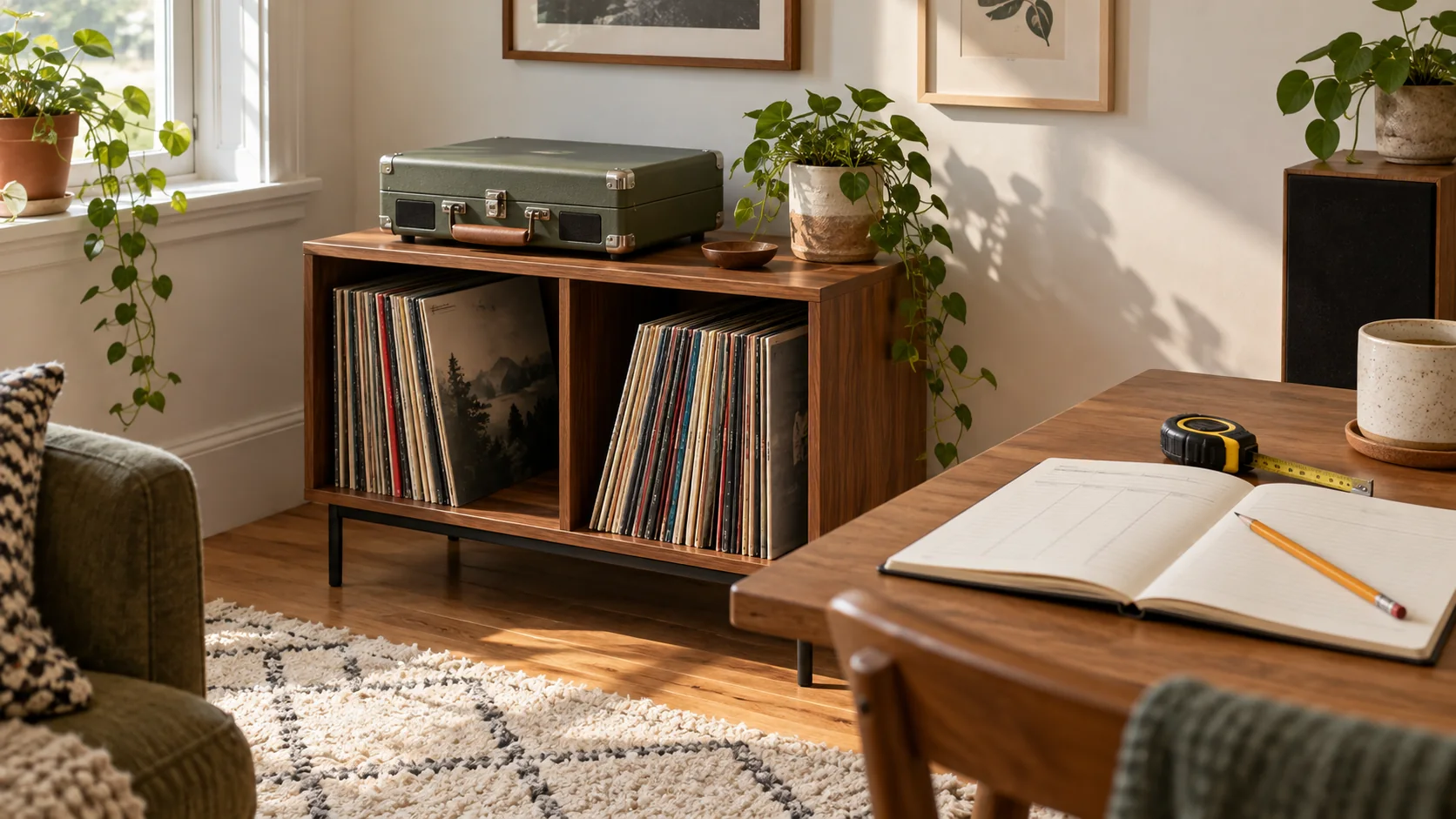
A stand for a turntable can look like one piece of furniture in a photograph while its listing describes several different things: the tabletop, the space for records, the unit's outside size, and sometimes a package containing more than one stand. Record player stand dimensions help only when those fields are kept separate. Begin with the equipment and records you actually intend to place, then read each product claim against the corresponding measurement. The two listings here illustrate why a storage count and a furniture footprint cannot answer each other's questions.
Separate the top, storage and outside frame
Draw three boxes on a simple worksheet. Label them tabletop, record-storage area, and outside frame. A turntable or other object would occupy the first; record sleeves would occupy the second; the third must fit the room. Each box needs its own confirmed measurements. A page may give a full outside size while leaving the useful open space under the top unspecified. Another page may advertise album capacity without showing how your own sleeves or dividers will occupy each section.
Use the actual device's manual and measured body size for its placement requirements. A product photograph of a portable player on a stand cannot establish the clearance, ventilation, cable routing, or surface requirements for a different device. Record where the player's lid or controls need access if that matters to your setup, using its own instructions. Then keep the stand's measurements on a separate line. This avoids treating a stand's tabletop label as proof that every player can be operated there.
Write down the specific furniture job before comparing products. One reader may need a single top surface beside a small record collection. Another may be arranging two stations in separate rooms. The package count and floor-space needs belong on separate worksheet lines. If you do not yet know where the second stand would go, a two-piece offer does not solve that uncertainty. The worksheet should reveal the missing location before an attractive gallery arrangement turns into an assumed plan.
Read the two-tier set as a package and a unit
The LELELINKY two-tier stand listing describes a set of two white stands with wood-texture finish. It names a tabletop, a three-compartment record holder, four adjustable feet, and an advertised storage figure of up to 100 albums. The first gallery image shows two open white units with records and a portable player. The image helps identify the offer's form. Measure the units and your record group separately.
Keep the two stands in the package distinct from the features of one stand. The captured description gives a set count but does not establish complete outside measurements for either unit or clearly tell the reader how the “up to 100 albums” figure is divided between them. Put those items in an unanswered-field column. If your plan uses one unit near the player and another elsewhere, each location needs its own footprint check. If you need only one location, ask whether a two-unit offer makes sense for that actual use.
The page also states a 75-pound load capacity and includes assembly-time language. Check the stated load and assembly details against the current instructions, your actual equipment and placement. Obtain the current instructions and any applicable loading guidance for the exact selected offer before placing equipment. An assembly-time claim does not give a step-by-step procedure. Keep the product's physical facts separate from the practical question of where the assembled stand will sit.
Read the five-tier stand's measurements carefully
The Fuliko five-tier stand listing describes a top for a record player and several record-storage sections. Its captured text gives a measurement string of 31.9 inches by 11.8 inches deep by 30.7 inches. It explicitly labels 11.8 inches as depth but does not label the other two axes in that sentence. The first gallery image shows records in different compartments and a player on top. Keep the unlabeled axes open until an axis-labeled source confirms them.
The Fuliko page advertises storage for 300-plus albums. Count your own sleeves, dividers, and other items against confirmed usable storage space. Its image shows one way to arrange records across the sections, while the page's text names a two-shelf area, a multitier area, and an open divided area. Record those as features of this specific stand. They do not supply the exact usable width or height of each compartment in the captured description.
Ask for an axis-labeled outside diagram and the usable dimensions of the sections you would fill. The gallery can show that the frame has several openings; perspective cannot turn those openings into verified numbers. If a turntable will sit on top, compare its own measurements and instructions with the stand's confirmed top area. Do not infer that the pictured player is included or that your device has the same footprint. Keep current selected variant and product identity attached to every number you write down.
Keep album capacity apart from usable space
The two advertised album counts come from listings with different package and storage descriptions. One offer contains two stands; the other shows one tiered unit. Neither number measures your sleeves, record thicknesses, dividers, or the amount of space you want to leave for handling records. Write the advertised figures in a source-claim column, then count the albums you intend to store in each actual location. Avoid turning the larger advertised figure into an automatic ranking.
A hypothetical collection of sixty records could be divided between frequently played albums and a separate archive. Use that division as a worksheet example; test actual capacity from confirmed opening dimensions. Decide which records need to be near the player. If the storage area is difficult to reach, a theoretical maximum has little use for that group. List actual sections and their confirmed inside measurements when available. A stand with a lower advertised count could still suit a particular room better if its verified shape matches the intended placement.
Also ask what “album” means in a product claim when the detail determines an order. A single sleeve, a gatefold, and a boxed set occupy different space, and the pages here do not specify a uniform test collection. You can measure a sample of your own records and compare it with confirmed internal dimensions, leaving clearance and handling needs visible. Use a specialist source for record-care and archival choices; this worksheet addresses furniture space. Use a relevant specialist source for any conservation decision.
Translate listing dimensions into a room sketch
Measure the proposed wall run and floor depth in the actual room. Mark nearby door movement, chairs, cables, and any equipment that must remain accessible. A stand's outside frame is the part to draw on the floor plan. The tabletop and storage sections need separate notes. For the Fuliko measurement string, only its stated depth is labeled clearly in the captured sentence; seek confirmation for the other axes before committing a scaled outline. The LELELINKY description needs complete outside dimensions for each stand before either footprint can be placed accurately.
Draw a provisional shape for each candidate only as far as the evidence allows. You might write “depth stated; other axes pending” beside the five-tier stand and “two units; outside size pending” beside the set. The labels keep the provisional drawing honest. If the stand is planned near a chair or doorway, include the space someone uses to approach it and select a record. The wall measurement alone cannot show whether the furniture remains easy to use once the room is occupied.
Check the top as its own measurement problem. A stand may fit the wall yet provide a top that is too small or inconvenient for the particular player. Compare the exact player's dimensions and operating access with an actual stated tabletop size or confirmed manufacturer drawing. The name “record player stand” does not identify every compatible device. The gallery player is a visual example. Its body and lid are not interchangeable with the device the reader already owns.
Keep neighboring decisions in their own guides
The public guide on cataloging a personal vinyl collection helps a reader record album artwork, credits, and a useful shelf location. The catalog guide owns the notebook decision. Here, the question is what a stand listing actually measures and which physical fields remain unknown. A note saying where an album belongs can inform your storage plan, but it does not establish a stand's compartment size or a guaranteed capacity for that collection.
The public guide on coffee-table layout and drawer access demonstrates how to keep furniture body dimensions separate from storage access. For a record-player stand, apply the same distinction to its own body and storage openings. Use your room dimensions and the exact stand under consideration. If a storage section needs clearance to remove a sleeve, record that question beside its own opening instead of borrowing a number from unrelated furniture.
Make a specification sheet you can actually use
Give each product a row with its exact URL and current variant. Add columns for package count, outside width, depth and height, tabletop area, storage opening dimensions, advertised album count, and the number of records you plan to keep nearby. Place “not stated” in a cell when the captured page leaves it open. Do not fill the cell from a photograph. If a seller provides a later diagram, date the new evidence and update only the fields it establishes.
For the two-tier set, the visible facts include two units, a named three-compartment holder, and the advertised count, while complete outside measurements remain pending in the captured account. For the five-tier stand, keep the 31.9-by-11.8-deep-by-30.7-inch string intact until the unlabeled axes are confirmed. Record the 300-plus claim as stated and seek usable section dimensions. These notes keep the comparison useful even if one listing provides more detail than the other.
Before checkout, revisit the current offer and obtain the exact information your layout needs. Verify the chosen product, dimensions, assembly and loading instructions, and any equipment placement requirements from their proper sources. Your room sketch can then answer a specific question: where would the complete stand go, and how would a person use its top and record sections? If a decisive measurement is unavailable, leave that choice open. Keep that unresolved question on the sheet for the next inquiry.
Decide what the record player stand dimensions establish
A listing may establish a package count or an outside depth while leaving a compartment opening unresolved. Treat each field as its own piece of evidence. The LELELINKY offer's two-unit wording cannot stand in for a measured floor plan; the Fuliko album-count claim cannot stand in for a confirmed usable opening. Bring the actual player, room and record collection into the comparison through their own measurements. The resulting decision may be a suitable stand, a different location, or a request for a missing diagram.
Keep the final sheet with the exact product identities and the source date. If your collection grows or the equipment changes, revisit the affected tabletop and storage fields instead of assuming the earlier layout still works. The point is a stand that can be assessed in a real room, with records a person can reach and a player placed according to its own instructions. Confirm the dimensions and intended use before relying on an advertised storage count.